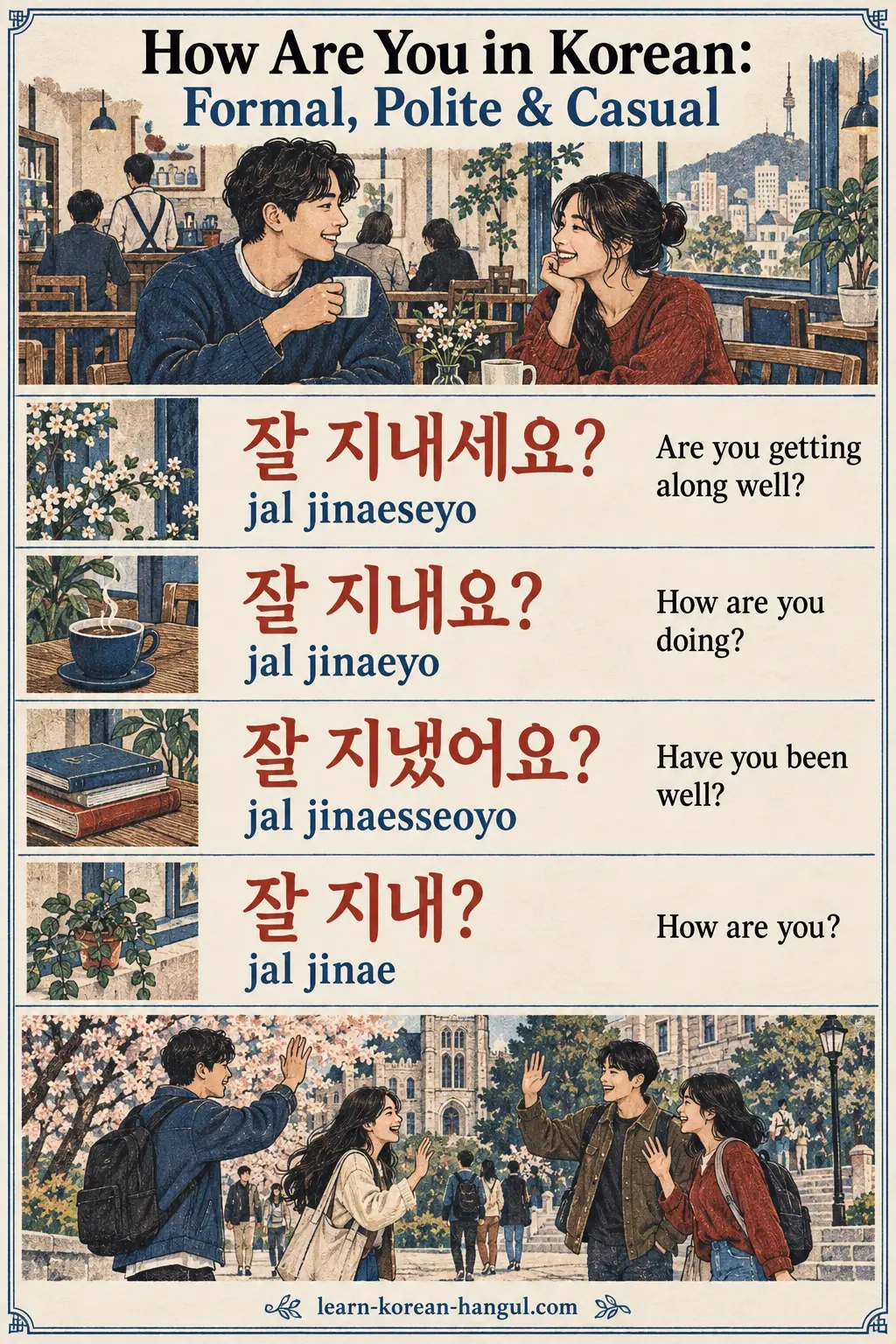
잘 지내세요?
잘 지내세요?
What you'll learn
- Ask how are you with 잘 지내세요?, 잘 지냈어요? or 잘 지내? according to the listener.
- Choose the present or past question depending on how long it has been.
- Reply naturally with 네, 잘 지내요 and ask back with ...는요?
- Pronounce 잘 지냈어요 as [잘 지내써요].
Before you start: learn hello in Korean first, because how are you almost always follows 안녕하세요. Time: about 12 minutes. Audio plays only when you press a button.
How Do You Say How Are You in Korean?
The standard way to say how are you in Korean is 잘 지내세요?, built from 잘 (well) and 지내다 (to get along, to spend one's days) with the respectful polite ending -세요. Korean asks about how your days are going rather than how you feel right now.
| Form | Romanization | Meaning | When |
|---|---|---|---|
| 잘 지내세요? | jal jinaeseyo | Are you getting along well? | Someone you respect and know |
| 잘 지내요? | jal jinaeyo | How are you doing? | A peer you speak politely with |
| 잘 지냈어요? | jal jinaesseoyo | Have you been well? | After days, weeks or years apart |
| 잘 지내? | jal jinae | How are you? | A close friend or younger person |
Time matters as much as politeness. If you saw the person yesterday, the question is unnecessary; if you have not seen them for a month, the past-tense 잘 지냈어요? fits best. The next section shows each form in a sentence.
What Are the Polite and Casual Ways to Say How Are You?
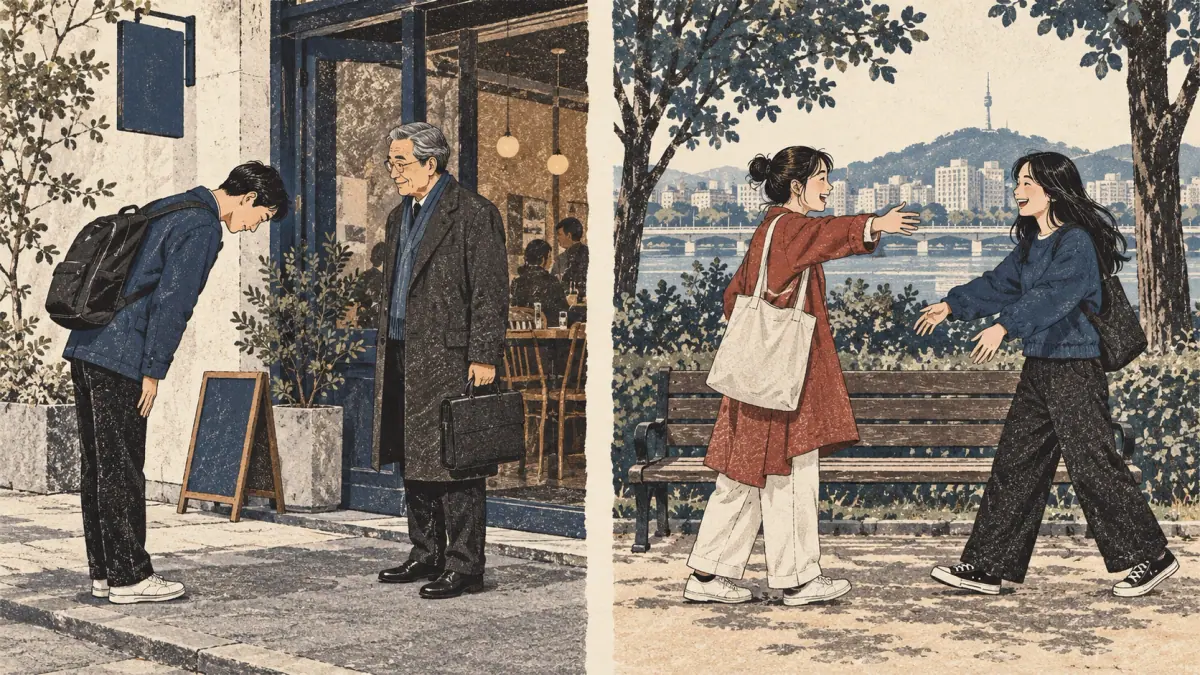
How are you follows the Korean speech levels, the endings that change with the listener, described in the guide to Korean speech levels. The verb 지내다 stays the same; only the ending moves.
Polite: 잘 지내세요? (jal jinaeseyo)
Polite · 해요체잘 지내세요? contains the honorific -시- inside -세요, so it respects the listener. Use it with a former teacher, a friend's parent, an older neighbour or a client you know. The formal written version, 잘 지내십니까?, appears in speeches and formal letters.
선생님, 요즘 잘 지내세요?
seonsaengnim, yojeum jal jinaeseyo?
Teacher, how are you these days?
Adding 요즘 (these days) makes the question sound natural and less abrupt.
Polite: 잘 지내요? (jal jinaeyo)
Polite · 해요체잘 지내요? drops the honorific -시- but keeps the polite -요. It suits a peer you speak politely with, such as a coworker of the same rank or a language-exchange partner. With anyone older or senior, add the -시- and say 잘 지내세요?
민지 씨, 잘 지내요?
minji ssi, jal jinaeyo?
Minji, how are you doing?
Polite: 잘 지냈어요? (jal jinaesseoyo)
Polite · 해요체잘 지냈어요? uses the past tense -었-, so it asks "have you been well (since we last met)?" Koreans use it more than any other form when friends, classmates or colleagues meet again. To an elder, add -시- and say 잘 지내셨어요? (jal jinaesyeosseoyo).
오랜만이에요. 잘 지냈어요?
oraenmanieyo. jal jinaesseoyo?
Long time no see. Have you been well?
The pairing with 오랜만이에요 (it's been a long time) is so common that it works as a set phrase; see long time no see in Korean.
Casual: 잘 지내? (jal jinae)
Casual · 반말잘 지내? is the casual form, for close friends, siblings and people clearly younger than you. The past-tense casual 잘 지냈어? is just as common after a break.
야, 진짜 오랜만이다. 잘 지냈어?
ya, jinjja oraenmanida. jal jinaesseo?
Hey, it's been ages. How have you been?
The four forms all ask the same thing; the next step is saying them with a natural rhythm.
How Do You Pronounce 잘 지내세요?
잘 지내세요? is pronounced as written, [잘 지내세요], jal jinaeseyo, with a short pause after 잘 and a gentle rise on the last syllable because it is a question.
- 잘 (jal): a soft j, "ah", and a light l with the tongue tip touching the ridge behind the teeth.
- 지 (ji): a soft "jee".
- 내 (nae): "neh"; the standard rules still list ㅐ and ㅔ as two vowels, but most Seoul speakers today pronounce them the same.
- 세 (se): "seh".
- 요 (yo): short, with a slight rise for the question.
Sound Changes to Listen For
Two spellings on this page change in speech, and intonation adds a third point:
- 잘 지냈어요 is [잘 지내써요]. The final ㅆ of 냈 moves to the empty first slot of 어, so you hear "ji-nae-sseo-yo" with a tense ss. This is liaison with a tense final, covered in liaison of tense and aspirated finals.
- 어떻게 is [어떠케]. In the longer question 어떻게 지내세요?, the ㅎ of 떻 merges with the ㄱ of 게 to make ㅋ. This is aspiration, explained in Korean aspiration rules.
- Intonation carries the question. 잘 지내세요 with a falling end is a wish ("take care"); with a rising end, it is a question.
Pronouncing the question is half of the exchange. The other half is knowing how to answer.
How Do You Reply to How Are You in Korean?

Reply with a short positive answer and then ask back. Korean small talk does not expect a detailed report.
- Answer: 네, 잘 지내요 (yes, I'm well) or, to the past question, 네, 잘 지냈어요.
- Add warmth (optional): 덕분에요 (thanks to you), a polite formula that credits the other person.
- Ask back: put ...는요? or ...은요? after their name or title: 선생님은요? (and you, teacher?), 민지 씨는요? (and you, Minji?).
네, 덕분에 잘 지냈어요. 선생님은요?
ne, deokbune jal jinaesseoyo. seonsaengnimeunyo?
Yes, I've been well, thanks to you. And you, teacher?
The full set of replies, including honest ones for bad days, is on the page for I'm fine in Korean. With question and answer in place, the next question is when to ask at all.
When Should You Ask 잘 지내세요, and When Should You Not?

Ask 잘 지내세요? or 잘 지냈어요? when you meet someone you already know after some time apart. Do not ask it of strangers or of people you saw yesterday, because the question assumes shared history.
Situations Where It Fits
- Meeting a former teacher. 선생님, 잘 지내셨어요? shows respect and warmth.
- Calling a friend after months. 잘 지냈어? opens the call naturally.
- An email to a client you know. Start with 그동안 잘 지내셨어요? (have you been well all this time?).
- Seeing a colleague after a holiday. 휴가 잘 다녀왔어요? (did you have a good holiday?) or 잘 지냈어요?
Situations to Avoid
- A first meeting. Say 안녕하세요 and 처음 뵙겠습니다 or 반갑습니다; asking how a stranger has been sounds odd.
- A coworker you saw this morning. A nod is enough.
- Shop staff. 안녕하세요 alone is normal; asking how they are is unusual.
- Elders with 잘 지내? or 잘 지내요? Add the honorific: 잘 지내세요?
These rules become clearer in the following short conversations.
What Does How Are You Sound Like in a Real Conversation?

A how-are-you exchange in Korean is quick: question, short answer, ask back, then a real topic. Listen for the ask-back pattern.
Meeting a Former Teacher
Student
선생님, 안녕하세요. 잘 지내셨어요?
seonsaengnim, annyeonghaseyo. jal jinaesyeosseoyo?
Hello, teacher. Have you been well?
Teacher
어, 오랜만이네. 나는 잘 지냈지. 너는?
eo, oraenmanine. naneun jal jinaetji. neoneun?
Oh, long time no see. I've been well. And you?
Student
저도 잘 지냈어요.
jeodo jal jinaesseoyo
I've been well too.
What to notice: the teacher answers in casual speech, which is normal from an older person to a former student.
Friends Meeting after a Trip
Seo-Yeon
왔어? 여행 어땠어?
wasseo? yeohaeng eottaesseo?
You're back? How was the trip?
Tae-Ho
완전 좋았어. 너는 잘 지냈어?
wanjeon joasseo. neoneun jal jinaesseo?
It was great. Have you been okay?
Seo-Yeon
응, 그냥 똑같지 뭐.
eung, geunyang ttokgatji mwo
Yeah, same as always.
What to notice: 그냥 똑같지 뭐 (same as ever) is a typical casual answer. The habit of keeping answers short comes from the culture around the question.
What Should You Know about the Culture behind How Are You?

Korean how are you is a relationship question, not a greeting formula. In English, "How are you?" can be said to a cashier; in Korean, the equivalent is said mainly to people you know.
- 안녕하세요 already covers it. At a first or daily meeting, 안녕하세요 is the whole greeting. Its literal meaning, "are you at peace?", already asks after the person.
- Past tense after a gap. Koreans think in terms of the time since the last meeting, which is why 잘 지냈어요? is so common.
- Food as care. 밥 먹었어요? (have you eaten?) often replaces how are you between friends and family.
- Modest answers. 덕분에요 (thanks to you) credits the other person, even if they did nothing, as a polite formula.
An expert insight: learners who translate "How are you?" directly into every greeting sound like a phrasebook. Saving the question for people you have not seen in a while makes your Korean sound more natural at once. The mistakes below come from ignoring that rule.
What Mistakes Do Learners Make with How Are You in Korean?
Most how-are-you errors come from treating it as part of every greeting, as in English.
| Mistake | Why it is a problem | Fix |
|---|---|---|
| Asking 어떻게 지내세요? to someone you just met | It presumes history and sounds odd | Say 안녕하세요, 반갑습니다 |
| Saying 잘 지내? to an older person | Casual ending | Say 잘 지내세요? or 잘 지내셨어요? |
| Answering with 괜찮아요 | Sounds like something is wrong | Say 잘 지내요 or 잘 지냈어요 |
| Using the present tense after months apart | Less natural than the past | Say 잘 지냈어요? |
| Forgetting to ask back | Feels one-sided | Add ...는요? |
Learners often assume 어떻게 지내세요? is the best translation of "How are you?" because it contains "how". Actually, 어떻게 지내세요? invites a real update and is heavier than 잘 지내세요?, which is the lighter, more common check-in.
Is It the Same as How Are You Doing?
Yes, in Korean "how are you" and "how are you doing" are both 잘 지내세요? or 잘 지내요?; Korean does not separate them. The answers below cover the other searches folded into this page.
- How are you formal in Korean: 잘 지내셨어요? in speech, 잘 지내십니까? in formal writing.
- How are you casual in Korean: 잘 지내? or 잘 지냈어?
- How do you do in Korean: the English formula for a first meeting matches 처음 뵙겠습니다 (it's my first time seeing you), not a question about health.
- How r u in Korean: in texts, friends write 잘 지내? or 뭐 해? (what are you up to?).
- What's up in Korean: 뭐 해? and 요즘 어때?, covered in what's up in Korean.
Before moving on, practise the choice of form aloud.
Practice: Say It Aloud
Play the slow clip of 잘 지내세요? and repeat it three times, then the 잘 지냈어요? clip. Then pick the best question or reply. Answers follow.
- You meet your old landlady after a year.
- Your best friend calls after a week abroad.
- A coworker asks you 잘 지냈어요? after the holidays. Reply and ask back.
- How is 지냈어요 pronounced, and why?
Answers
- 잘 지내셨어요? (respect plus past tense).
- 잘 지냈어?
- 네, 잘 지냈어요. ○○ 씨는요? (put their name before 씨는요).
- [지내써요], because the final ㅆ links to the next vowel.
The phrase flashcards include the question and reply forms with audio.
Related Phrases to Learn Next
How are you is the middle of a greeting; the next phrases complete it.
- I'm fine in Korean: honest and polite answers, from 잘 지내요 to 그냥 그래요.
- Long time no see in Korean: 오랜만이에요, the usual opener before 잘 지냈어요?
- Hello in Korean: the greeting that comes first.
This guide belongs to the Korean greetings collection. What this page does not cover: asking about health after illness, condolences, and the full honorific system, which lives in the speech levels guide. Ask the past-tense question after time apart, keep the answer short, and you can say how are you in Korean like a local.
Frequently Asked Questions
How do you answer how are you in Korean?
Answer briefly and positively. Say 네, 잘 지내요 (yes, I'm doing well) or, after time apart, 네, 잘 지냈어요. Add 덕분에요 (thanks to you) for warmth, then ask back with ...는요? as in 선생님은요? (and you, teacher?). Long health reports are unusual unless the person is a close friend.
Does 잘 지내세요 also mean take care?
Yes. Said as a statement at the end of a meeting, letter or email, 잘 지내세요 means stay well or take care, especially when you will not see the person for a while. The words are the same as the question; only the falling intonation and the context show that it is a farewell wish.
What is the difference between 잘 지내요 and 괜찮아요?
잘 지내요 means I'm getting along well and answers how have you been. 괜찮아요 means I'm okay or it's fine and answers are you okay, often after a small accident or bad news. If someone asks 잘 지냈어요?, answering 괜찮아요 suggests something is wrong, so use 잘 지냈어요 instead.
Is 어떻게 지내세요 a natural way to ask how are you?
It is correct and means how are you getting on, but it is a bigger question than 잘 지내세요. It invites a real update, so it fits someone you know who has been through a change, such as a new job. For a quick check-in, 잘 지내세요? or 잘 지냈어요? sounds lighter.
Why do Koreans ask if you have eaten?
밥 먹었어요? (have you eaten?) is a friendly check-in that works much like how are you between people who know each other. It shows care rather than an invitation to eat. Answer 네, 먹었어요 (yes, I ate) or 아직이요 (not yet); no one expects a menu.