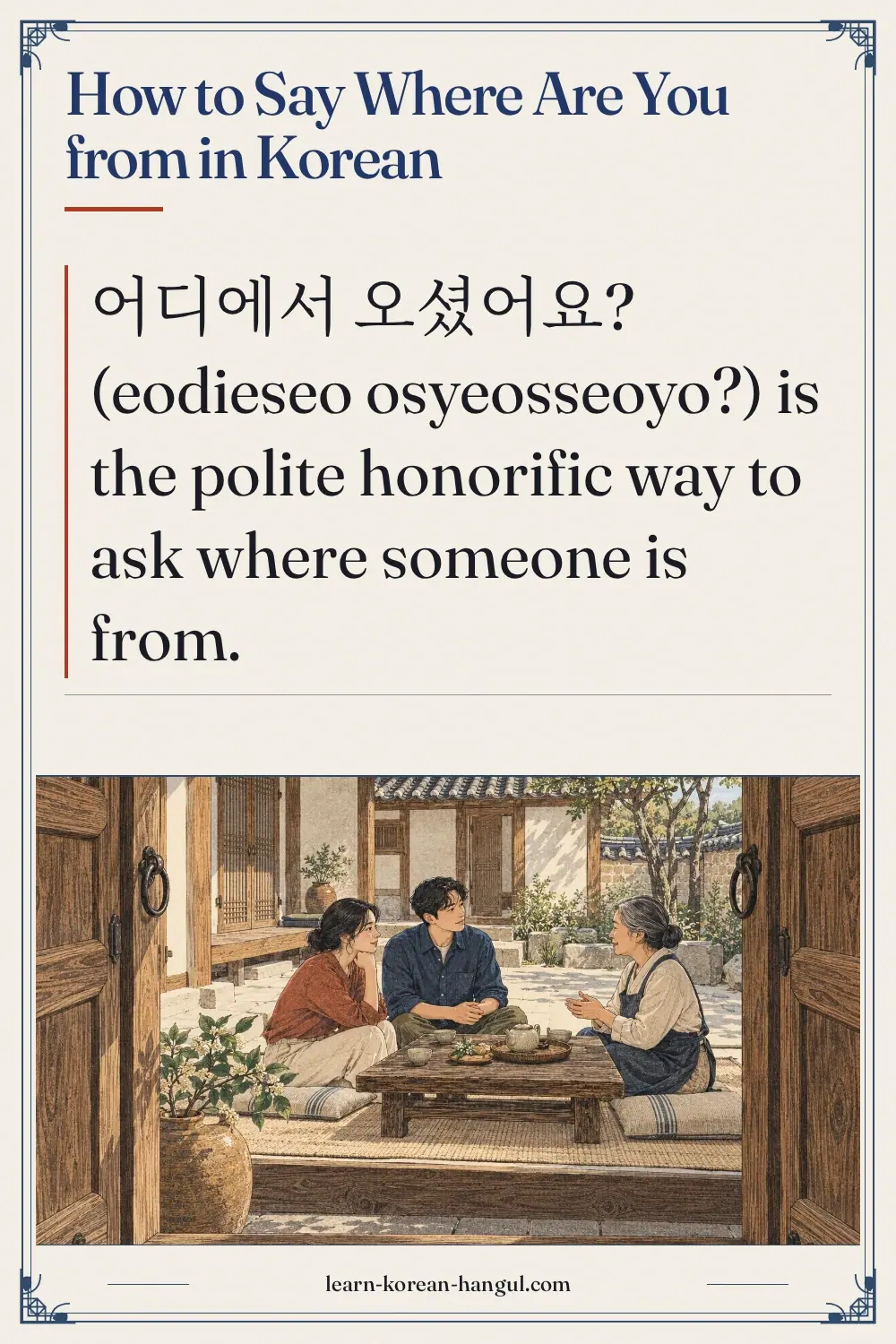
어디에서 오셨어요?
어디에서 오셨어요?
What you'll learn
- Say 어디에서 오셨어요? aloud as [어디에서 오셔써요], and 미국에서 왔어요 as [미구게서 와써요].
- Choose between 어디에서 오셨어요?, 어느 나라 사람이에요? and 어디서 왔어? for a colleague, a stranger and a friend.
- Answer with 저는 + country + 에서 왔어요, with no honorific on yourself.
- Avoid the present-tense mistake 어디 와요?, which asks where you are coming to.
Before you start: you need to read Hangul; romanization is shown as an aid and can be hidden. Time: about 10 minutes. Audio plays only when you press a button.
How Do You Say Where Are You from in Korean?
The most natural way to ask where someone comes from in Korean is 어디에서 오셨어요?. It joins 어디에서 (from where) with 오셨어요 (came, honorific). Four forms cover the question and its answer.
| Form | Romanization | Register | Say it to |
|---|---|---|---|
| 어디에서 오셨어요? | eodieseo osyeosseoyo | Polite (해요체, honorific) | Colleagues, guests, elders, new acquaintances |
| 어느 나라 사람이에요? | eoneu nara saramieyo | Polite (해요체) | Foreigners, travellers; asks nationality |
| 어디서 왔어? | eodiseo wasseo | Casual (반말) | Close friends, younger people |
| 저는 미국에서 왔어요 | jeoneun migugeseo wasseoyo | Polite (해요체), answer | Your reply when someone asks |
The table lists the choices. The next section shows each one in a sentence.
What Are the Formal, Polite and Casual Ways to Say Where Are You From?
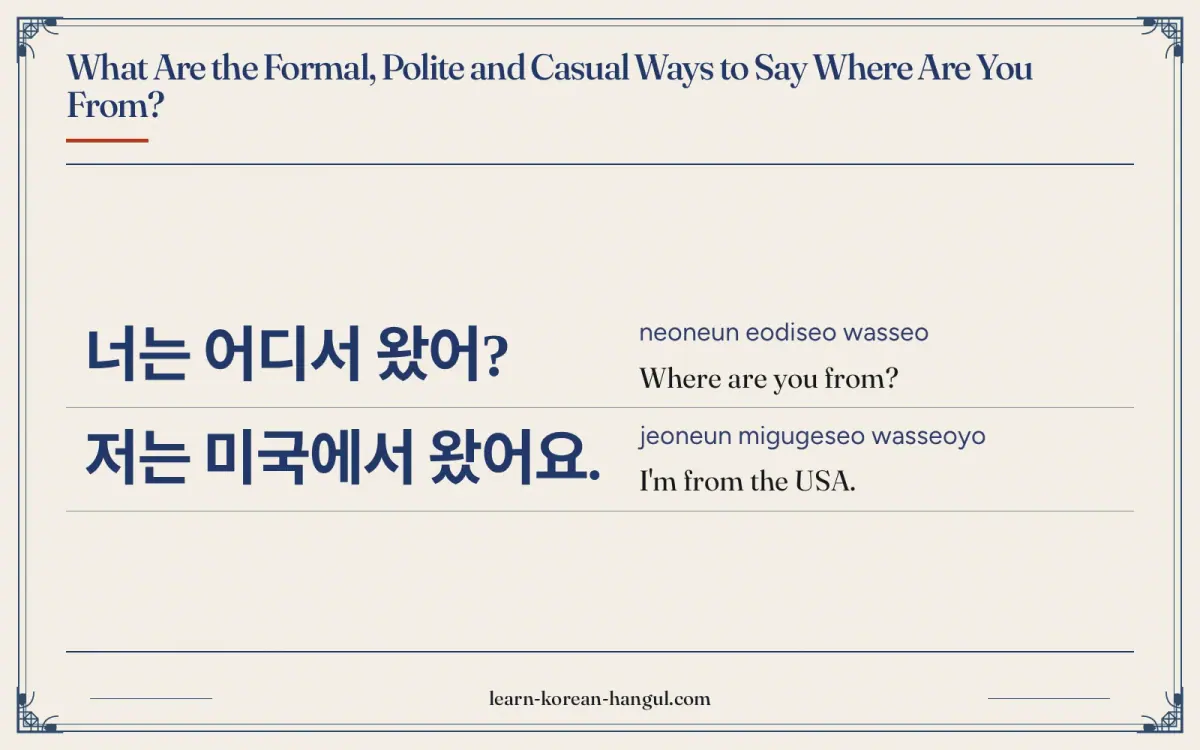
Korean changes the sentence ending to match the listener's age, status and closeness. These endings are called speech levels, and the guide to Korean speech levels explains them in full. This question adds the honorific -시- when you ask about someone else.
Polite: 어디에서 오셨어요? (eodieseo osyeosseoyo)
Polite · 해요체어디에서 오셨어요? has the honorific -시- inside 오셨어요, which raises the listener, plus the past tense. The past tense matters, because Korean treats origin as something that has already happened. It is the right form for a new colleague, a guest or a stranger.
안녕하세요. 어디에서 오셨어요?
annyeonghaseyo. eodieseo osyeosseoyo
Hello. Where are you from?
Polite: 어느 나라 사람이에요? (eoneu nara saramieyo)
Polite · 해요체어느 나라 사람이에요? asks "Which country's person are you?" It targets nationality, and Koreans use it mostly with foreigners. Between Koreans, a more natural question is about the hometown. It is polite but not honorific.
어느 나라 사람이에요? 한국어를 잘하시네요.
eoneu nara saramieyo? hangugeoreul jalhasineyo
Which country are you from? You speak Korean well.
Casual: 어디서 왔어? (eodiseo wasseo)
Casual · 반말어디서 왔어? uses 어디서, the everyday contraction of 어디에서, and the casual past 왔어. It is 반말 (casual speech) for close friends and younger people. At a hostel or a language exchange, travellers of the same age often use it after agreeing to speak casually.
너는 어디서 왔어?
neoneun eodiseo wasseo
Where are you from?
Answer: 저는 미국에서 왔어요 (jeoneun migugeseo wasseoyo)
Polite · 해요체The answer uses 저는 (I, humble), a place, the particle 에서 (from) and 왔어요 (came). It does not use the honorific -시- for yourself. For the sentence "I am American", say 저는 미국 사람이에요. A short table of countries follows the example.
저는 미국에서 왔어요.
jeoneun migugeseo wasseoyo
I'm from the USA.
| Country | Romanization | Say |
|---|---|---|
| 미국 | miguk | USA |
| 영국 | yeongguk | UK |
| 캐나다 | kaenada | Canada |
| 호주 | hoju | Australia |
| 인도 | indo | India |
| 독일 | dogil | Germany |
| 브라질 | beurajil | Brazil |
Four lines cover the question and answer. Saying the main question cleanly comes next.
How Do You Pronounce 어디에서 오셨어요?
어디에서 오셨어요? is pronounced [어디에서 오셔써요], eodieseo osyeosseoyo, in eight syllables. The sounds to watch are the glide in 셔 and the tense ㅆ in 셨어요, which links to the next vowel.
- 어 (eo): an open "uh".
- 디 (di): "dee".
- 에 (e): "eh".
- 서 (seo): "suh".
- 오 (o): a rounded "oh".
- 셨 (syeot): "shyuht", with the final ㅆ carried to the next syllable.
- 어 (eo): "uh"; with the linked ㅆ it sounds like [써].
- 요 (yo): "yoh"; the question word already marks the question, so the end usually falls or rises and then falls.
Sound Changes to Listen For
Two points from the National Institute of Korean Language Standard Pronunciation (표준 발음법) matter here, plus a note on romanization.
- Liaison in 미국에서. The ㄱ of 국 moves onto 에, so 미국에서 is [미구게서]. See liaison (resyllabification).
- Linking the ㅆ in 왔어요. The final ㅆ in 왔 links to 어, giving [와써요], and 오셨어요 becomes [오셔써요]. ㅆ is already a tense letter, so nothing new happens to it; compare true Korean tensification, where a plain letter becomes tense.
- Romanization follows spelling. Revised Romanization writes migugeseo wasseoyo, which already shows the link, so the romanized form is a reliable guide here.
With the sound set, the next question is who should be asked with which form.
When Should You Use 어디에서 오셨어요?, and When Should You Not?
Ask 어디에서 오셨어요? whenever you want to be polite. Ask 어느 나라 사람이에요? only when you want to know nationality, and 어디서 왔어? only among friends.
Situations Where It Fits
- A new colleague or classmate. 어디에서 오셨어요? is friendly and polite.
- A traveller at a hostel. After agreeing to speak casually, 어디서 왔어? is fine.
- A foreign guest at an event. 어디에서 오셨어요? is warm and respectful.
- A language exchange partner. 저는 ...에서 왔어요 is the answer to practise first.
Situations to Avoid
- Using 어디 와요? The present tense reads as where are you coming to; origin needs the past 왔어요.
- Using 오셨어요 about yourself. The honorific -시- is for the listener only.
- Asking Koreans 어느 나라 사람이에요? Between Koreans, ask about hometown: 고향이 어디예요?.
These choices are easier to feel in real exchanges, so here are three.
What Does Where Are You from Sound Like in a Real Conversation?
A Korean origin exchange is short. The asker uses the honorific, and the answer names a place and sometimes a reason for being in Korea.
A New Colleague
Sora
어디에서 오셨어요?
eodieseo osyeosseoyo
Where are you from?
Anna
저는 캐나다에서 왔어요.
jeoneun kaenadaeseo wasseoyo
I'm from Canada.
What to notice: Anna uses 왔어요 for herself, with no honorific.
Friends at a Hostel
Min
너는 어디서 왔어?
neoneun eodiseo wasseo
Where are you from?
Jack
나는 호주에서 왔어.
naneun hojueseo wasseo
I'm from Australia.
What to notice: both speakers use casual forms and 나는 instead of 저는.
A Conversation with a Stranger
Daeho
어느 나라 사람이에요?
eoneu nara saramieyo
Which country are you from?
Maria
저는 브라질 사람이에요. 서울에서 일해요.
jeoneun beurajil saramieyo. seoureseo ilhaeyo
I'm Brazilian. I work in Seoul.
What to notice: Maria answers with her nationality and adds where she works. This leads to the culture around origin questions.
What Should You Know about the Culture behind Where Are You From?
In Korea, questions about where someone is from are common and usually friendly. They often lead to talk about hometowns, food and travel.
- Hometown for Koreans. Between Koreans, 고향이 어디예요? (where is your hometown?) asks the region, such as 부산 or 대구.
- Nationality for foreigners. 어느 나라 사람이에요? is the question Koreans ask foreigners.
- Curiosity is friendly. Questions about origin are a way to start talking and do not imply anything.
- Follow-ups. After the answer, Koreans often ask 한국에 온 지 얼마나 됐어요? (how long have you been in Korea?).
An expert tip: 어디에서 오셨어요? can mean both where are you from and where did you just come from. The context decides, so someone arriving at a door may answer with the street they just left. This page covers everyday origin questions. Immigration forms, nationality law and regional dialect differences are not covered here.
What Mistakes Do Learners Make with Where Are You from in Korean?
Most mistakes with this question come from tense, the honorific and the particle.
| Mistake | Why it is a problem | Fix |
|---|---|---|
| Saying 어디 와요? | Present tense asks where you are coming to | Use 어디에서 오셨어요? |
| Saying 오셨어요 about yourself | The honorific raises the listener only | Say 왔어요 |
| Using 에 instead of 에서 in the answer | 에서 marks the starting point | Say 미국에서 왔어요 |
| Saying 저는 미국이에요 | That means I am America | Say 저는 미국 사람이에요 |
| Pronouncing 미국에서 as [미국에서] | The ㄱ moves to the next syllable | Say [미구게서] |
Learners often mix up 에 and 에서, because both can translate English at or in. For origin, 에서 (from) is right, while 에 marks a destination or the place where something exists.
Is It the Same as Where Do You Come from or Hometown?
Partly. The short answers below cover the other ways people search for this phrase.
- Where are you from formal in Korean: 어디에서 오셨어요? or the very formal 어디에서 오셨습니까?.
- Where do you come from in Korean: the same question, 어디에서 오셨어요?
- Where is your hometown in Korean: 고향이 어디예요? (gohyangi eodiyeyo).
- I'm from in Korean: 저는 ...에서 왔어요, with your place before 에서.
- I am American or I'm American in Korean: 저는 미국 사람이에요 or 저는 미국인이에요.
Reading the forms is one thing; producing them on cue is another, so practise now.
Practice: Say It Aloud
Play the slow clip of 어디에서 오셨어요?, repeat it three times, then answer it with your own country. Then choose a form for each situation. Answers follow.
- A new colleague joins your team.
- A traveller your age at a hostel.
- You are from Canada. How do you answer?
- Why is 왔어요 in the past tense?
Answers
- 어디에서 오셨어요?
- 어디서 왔어?
- 저는 캐나다에서 왔어요.
- Because the arrival has already happened.
The phrase flashcards drill all four lines with audio.
Related Phrases to Learn Next
Asking where someone is from sits with the other first-meeting phrases.
- Introduce yourself in Korean: the full set of self-introduction phrases.
- What's your name in Korean: the usual first question.
- Where do you live in Korean: the usual next question.
- Nice to meet you in Korean: 만나서 반갑습니다, for closing the introduction.
This guide belongs to the introducing yourself collection. What this page does not cover: dialect differences and formal nationality terms. Pick 어디에서 오셨어요? when in doubt, and you can ask where are you from in Korean to almost anyone.
Frequently Asked Questions
What is the difference between 어디에서 오셨어요? and 어느 나라 사람이에요?
Both ask about origin. 어디에서 오셨어요? asks where someone came from and is honorific. 어느 나라 사람이에요? asks nationality and is mostly aimed at foreigners. Between Koreans, the usual question is about hometown. The first is more polite and more general.
Is 어디에서 오셨어요? formal or casual?
It is polite and honorific, in the 해요체 style with -시-. It is not stiff, but it shows respect to the listener. With close friends use 어디서 왔어?, and for very formal settings use 어디에서 오셨습니까?. Answer it without the honorific, as in 저는 미국에서 왔어요.
Can I use 어디에서 오셨어요? with friends, elders and strangers?
Yes with elders and strangers, where it is the best choice. With close friends it sounds formal, so use 어디서 왔어?. It also works with foreign guests. The honorific shows respect, so it is safe whenever you are unsure. Between Koreans, it may be heard as a question about hometown.
How do you answer 어디에서 오셨어요?
Answer with 저는 plus the place plus 에서 왔어요, such as 저는 미국에서 왔어요. Do not use the honorific 오셨어요 for yourself. For nationality, say 저는 미국 사람이에요. Add your city if you like, as in 저는 시애틀에서 왔어요.
What is the most common mistake with where are you from in Korean?
The most common mistake is using the present tense, 어디 와요?, which asks where you are coming to. Use the past tense 왔어요 for origin. The second mistake is using 에 instead of 에서 in the answer; 에서 marks the starting point.