이름이 뭐예요?
이름이 뭐예요?
What you'll learn
- Say 이름이 뭐예요? aloud as [이르미 뭐예요], with the liaison in 이름이.
- Choose between 이름이 뭐예요?, 성함이 어떻게 되세요?, 이름이 뭐야? and 이름이 뭐니? for an elder, a peer, a friend and a child.
- Understand why 성함 is used for others and 이름 for yourself.
- Reply with your own name using 제 이름은 ... 예요 or 저는 ... 예요.
Before you start: you need to read Hangul; romanization is shown as an aid and can be hidden. Time: about 11 minutes. Audio plays only when you press a button.
How Do You Say What's Your Name in Korean?
The simplest way to ask someone's name in Korean is 이름이 뭐예요?, which means "What is your name?" The word 이름 means name and 뭐 means what. Four question forms and one answer cover all situations.
| Form | Romanization | Register | Say it to |
|---|---|---|---|
| 이름이 뭐예요? | ireumi mwoyeyo | Polite (해요체) | Peers, classmates, neighbours, people you meet |
| 성함이 어떻게 되세요? | seonghami eotteoke doeseyo | Respectful (해요체, honorific) | Elders, customers, clients, patients |
| 이름이 뭐야? | ireumi mwoya | Casual (반말) | Close friends, siblings, peers who agree to speak casually |
| 이름이 뭐니? | ireumi mwoni | Casual (반말), to children | Children and young students |
| 제 이름은 민수예요 | je ireumeun minsuyeyo | Polite (해요체), answer | Your reply when someone asks |
The table lists the choices. The next section shows each one in a sentence.
What Are the Formal, Polite and Casual Ways to Say What's Your Name?
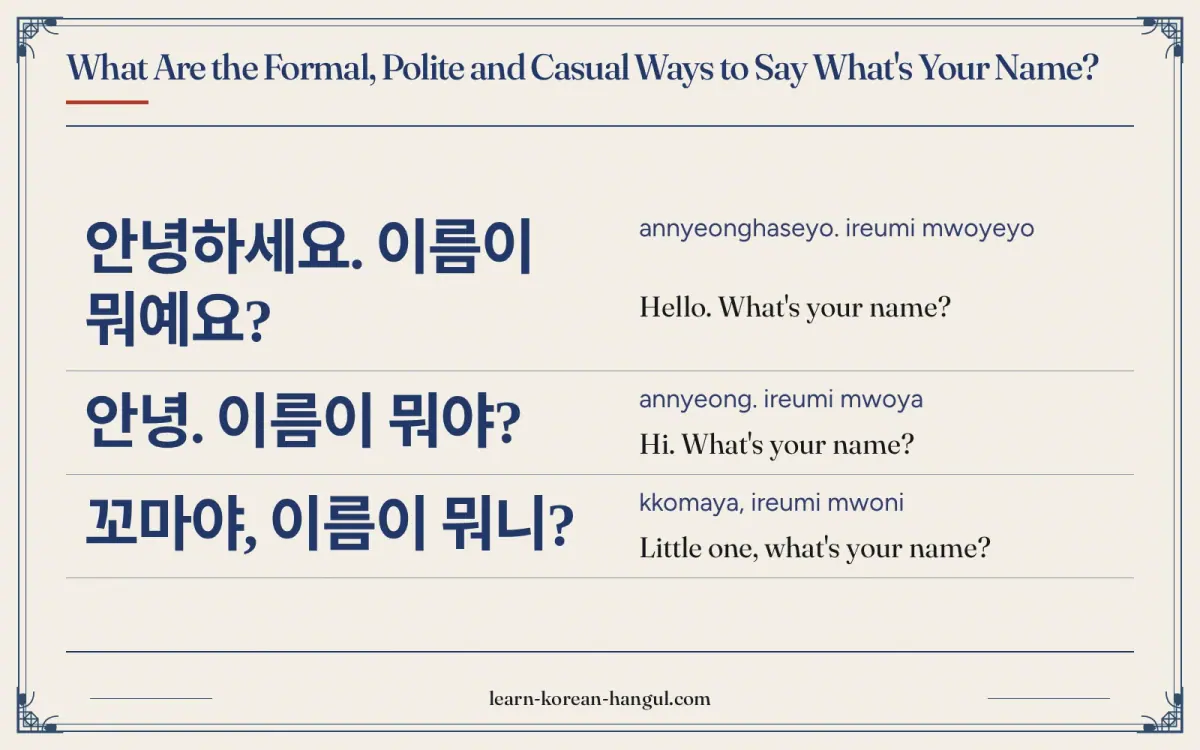
Korean changes the sentence ending to match the listener's age, status and closeness. These endings are called speech levels, and the guide to Korean speech levels explains them in full. For names, the noun itself also changes: 이름 becomes 성함 for respected people.
Polite: 이름이 뭐예요? (ireumi mwoyeyo)
Polite · 해요체이름이 뭐예요? is the standard question in the 해요체 style. It fits people your own age, classmates, neighbours, teammates and anyone you meet in a relaxed setting. Koreans often add a greeting first.
안녕하세요. 이름이 뭐예요?
annyeonghaseyo. ireumi mwoyeyo
Hello. What's your name?
Respectful: 성함이 어떻게 되세요? (seonghami eotteoke doeseyo)
Formal · 합쇼체성함 is the honorific word for someone's name, and 어떻게 되세요 literally asks "How does it become?" Together they form a very polite question. Bank tellers, receptionists and hotel staff ask it. Use 성함 only for the other person, never for your own name.
실례지만 성함이 어떻게 되세요?
sillyejiman seonghami eotteoke doeseyo
Excuse me, may I ask your name?
Casual: 이름이 뭐야? (ireumi mwoya)
Casual · 반말이름이 뭐야? drops the polite -요. It is 반말 (casual speech) for close friends, peers who have agreed to speak casually and people clearly younger than you. With a stranger of your age, start with the polite form and switch only when both agree.
안녕. 이름이 뭐야?
annyeong. ireumi mwoya
Hi. What's your name?
Casual to Children: 이름이 뭐니? (ireumi mwoni)
Casual · 반말이름이 뭐니? uses the question ending -니, which adults use with children. It sounds kind and a little parental. Teachers, parents and neighbours say it to small children, and adults do not use it with each other.
꼬마야, 이름이 뭐니?
kkomaya, ireumi mwoni
Little one, what's your name?
Reply: 제 이름은 민수예요 (je ireumeun minsuyeyo)
Polite · 해요체The reply uses 제 (my, humble) and 이름은 (the name as the topic), then your name and 예요 or 이에요. Use 예요 after a name ending in a vowel (민수예요) and 이에요 after a name ending in a consonant (민준이에요). Learn the full pattern in my name is in Korean.
제 이름은 민수예요. 만나서 반갑습니다.
je ireumeun minsuyeyo. mannaseo bangapseumnida
My name is Minsu. Nice to meet you.
Five lines cover almost every introduction. Saying the main question cleanly comes next.
How Do You Pronounce 이름이 뭐예요?
이름이 뭐예요? is pronounced [이르미 뭐예요], ireumi mwoyeyo, in six syllables. The key sound change is liaison: the ㅁ of 름 moves onto the next syllable, so 이름이 sounds like three smooth syllables, not a hard break.
- 이 (i): a short "ee".
- 름 (reum): a light r like a quick tap of the tongue, then "eum".
- 이 (i): "ee"; the final ㅁ of 름 joins it, giving [미].
- 뭐 (mwo): round the lips for "mw", then relax to "uh".
- 예 (ye): "yeh".
- 요 (yo): "yoh"; the question word already marks the question, so the end usually falls or rises and then falls.
Sound Changes to Listen For
Four points matter here; the first two are rules of the National Institute of Korean Language Standard Pronunciation (표준 발음법).
- Liaison in 이름이. A final consonant before a vowel moves to the next syllable, so 이름이 is [이르미]. See liaison (resyllabification).
- Aspiration in 어떻게. ㅎ and ㄱ merge into ㅋ, so 어떻게 is [어떠케]. In the same question, 성함이 is [성하미], because the ㅁ of 함 links to 이.
- Question pitch. 뭐 already marks the question, so 이름이 뭐예요? usually ends with a fall or a rise-fall. Only yes/no questions, which have no question word, rely on a final rise.
- Romanization is only an aid. Revised Romanization writes ireumi mwoyeyo, which happens to match the linked sound, but it does not show the pitch.
With the sound set, the next question is who should be asked with which form.
When Should You Use 이름이 뭐예요?, and When Should You Not?
Use 이름이 뭐예요? with people on your level and 성함이 어떻게 되세요? with people above you or in service settings.
Situations Where It Fits
- A new classmate or neighbour. 이름이 뭐예요? is friendly and polite.
- A bank, hospital or hotel desk. 성함이 어떻게 되세요? is the standard.
- A friend of a friend at a party. Start with 이름이 뭐예요?, then switch if you both relax.
- A child at a school event. 이름이 뭐니? is gentle and natural.
Situations to Avoid
- Asking an elder 이름이 뭐예요? It is polite but not respectful enough; use 성함.
- Using 당신 for you. 당신 sounds cold or confrontational in a question; leave the pronoun out.
- Asking before greeting. Jumping straight to 이름이 뭐예요? feels abrupt; say 안녕하세요 first.
These choices are easier to feel in real exchanges, so here are three.
What Does What's Your Name Sound Like in a Real Conversation?
A Korean name exchange starts with a greeting, then the question, then the reply and a polite closing.
New Classmates
Minsu
안녕하세요. 이름이 뭐예요?
annyeonghaseyo. ireumi mwoyeyo
Hello. What's your name?
Yuna
저는 유나예요. 이름이 뭐예요?
jeoneun yunayeyo. ireumi mwoyeyo
I'm Yuna. What's your name?
Minsu
저는 민수예요. 만나서 반가워요.
jeoneun minsuyeyo. mannaseo bangawoyo
I'm Minsu. Nice to meet you.
What to notice: both students use the polite form and swap the question back, which is normal.
At a Bank Desk
Teller
성함이 어떻게 되세요?
seonghami eotteoke doeseyo
May I ask your name?
Customer
김수진입니다.
gim sujinimnida
I'm Kim Sujin.
What to notice: the customer answers with the family name first, 김, then the given name, 수진, as is standard in Korea.
Meeting a Child
Teacher
안녕, 이름이 뭐니?
annyeong, ireumi mwoni
Hi, what's your name?
Child
서준이에요.
seojunieyo
I'm Seojun.
What to notice: the teacher uses the child form, and the child answers politely. This leads to the culture around names.
What Should You Know about the Culture behind What's Your Name?
In Korea, names are handled with care. The right form of the question shows your respect before the person has said a word.
- Family name first. Korean names put the family name first, so 김수진 is Kim (family) Sujin (given). Most family names have one syllable.
- Titles instead of names. Koreans often call elders and seniors by title, such as 선생님 (teacher) or 사장님 (boss), not by name.
- Names and age. Age often matters for the speech level, so people may ask 몇 살이에요? soon after the name, as in how old are you in Korean.
- Honorific suffixes. After learning a name, add -씨 (ssi) for equals, as in 민수 씨, or the title for seniors.
An expert tip: 성함 is a word for other people's names. Saying 제 성함은 민수예요 about yourself sounds odd, as if you were honouring your own name. Use 제 이름은 for yourself. This page covers everyday questions. Formal ceremonial names, hanja name meanings and the dozens of Korean name suffixes are not covered here.
What Mistakes Do Learners Make with What's Your Name in Korean?
Most mistakes with this question come from the honorific, the pronoun and the order.
| Mistake | Why it is a problem | Fix |
|---|---|---|
| Asking an elder 이름이 뭐예요? | Polite but not respectful enough | Use 성함이 어떻게 되세요? |
| Saying 당신 이름이 뭐예요? | 당신 sounds cold or like a quarrel | Leave out the pronoun |
| Saying 제 성함은 about yourself | 성함 is for other people | Say 제 이름은 |
| Confusing 이름이 뭐예요? with 누구세요? | 누구세요? asks who someone is, at a door | Use 이름이 뭐예요? for names |
| Pronouncing 이름이 as [이름이] | The ㅁ should move to the next syllable | Say [이르미] |
Learners often think the polite -요 form is always enough. For elders and customers, 성함이 어떻게 되세요? is the safer choice, because it uses the honorific noun that Koreans expect.
Is It the Same as What Is Your Name or Ask Name?
Yes. English has several spellings for the same question. The short answers below cover the other ways people search for this phrase.
- What is your name in Korean: 이름이 뭐예요?, the same question.
- Whats your name or what's ur name in Korean: 이름이 뭐예요?; Korean does not have a text spelling like ur.
- What is your name formal in Korean: 성함이 어떻게 되세요? or the very formal 이름이 무엇입니까? (ireumi mueosimnikka).
- What is your name informal in Korean: 이름이 뭐야? with friends.
- Ask name in Korean: 이름 물어봐도 돼요? (ireum mureobwado dwaeyo) means "May I ask your name?"
Reading the forms is one thing; producing them on cue is another, so practise now.
Practice: Say It Aloud
Play the slow clip of 이름이 뭐예요?, repeat it three times, then try 성함이 어떻게 되세요? and 이름이 뭐야?. Then choose a form for each situation. Answers follow.
- You meet a new classmate your age.
- A customer in their seventies comes to your desk.
- A close friend introduces you to a friend.
- Why is 이름이 pronounced [이르미]?
Answers
- 이름이 뭐예요?
- 성함이 어떻게 되세요?
- 이름이 뭐야?
- The final ㅁ of 름 moves onto the next vowel (liaison).
The phrase flashcards drill all five lines with audio.
Related Phrases to Learn Next
Asking a name sits with the other first-meeting phrases.
- Introduce yourself in Korean: the full set of self-introduction phrases.
- My name is in Korean: how to answer.
- Nice to meet you in Korean: 만나서 반갑습니다, the phrase that follows.
- Where are you from in Korean: the usual next question.
This guide belongs to the introducing yourself collection. What this page does not cover: hanja name meanings and formal name suffixes. Pick 이름이 뭐예요? for peers and 성함이 어떻게 되세요? for elders, and you can ask what's your name in Korean to anyone.
Frequently Asked Questions
What is the difference between 이름이 뭐예요? and 성함이 어떻게 되세요?
Both ask for a name. 이름이 뭐예요? is polite and fits peers and classmates. 성함이 어떻게 되세요? is respectful and uses the honorific noun 성함, so it fits elders, customers and service settings. The first sounds friendly, and the second shows formal respect.
Is 이름이 뭐예요? formal or casual?
It is polite, in the 해요체 style. It is neither stiff formal speech nor casual speech, so it works with most adults of similar age. For elders use 성함이 어떻게 되세요?, and for close friends use 이름이 뭐야?. With children, adults often say 이름이 뭐니?.
Can I use 이름이 뭐예요? with friends, elders and strangers?
Yes with strangers of your age and with peers. With close friends it sounds a little formal, so use 이름이 뭐야?. With elders, use 성함이 어떻게 되세요?. If you are unsure of someone's age or status, the respectful form is almost never wrong.
How do you pronounce 이름이 뭐예요?
It is pronounced [이르미 뭐예요]. The ㅁ in 름 moves onto the next syllable, so the first word sounds like i-reu-mi. Round your lips for 뭐 and raise your voice slightly at the end, because it is a question. Revised Romanization writes ireumi mwoyeyo.
What is the most common mistake with what's your name in Korean?
The most common mistake is asking an elder 이름이 뭐예요? without the respectful 성함. The second is adding 당신 (you), which sounds cold. Leave out the pronoun and begin with a greeting such as 안녕하세요. Then ask the name and give yours in return.