어디에 사세요?
어디에 사세요?
What you'll learn
- Say 어디에 사세요? aloud as [어디에 사세요], and 서울에 살아요 as [서우레 사라요].
- Choose between 어디에 사세요?, 어디에 살아요? and 어디 살아? for an elder, a peer and a friend.
- Answer with 저는 + place + 에 살아요, the pattern textbooks teach first.
- Avoid asking for a full address, which Koreans treat as personal.
Before you start: you need to read Hangul; romanization is shown as an aid and can be hidden. Time: about 9 minutes. Audio plays only when you press a button.
How Do You Say Where Do You Live in Korean?
The most natural way to ask where someone lives in Korean is 어디에 사세요?. It joins 어디에 (where) with 사세요 (live, honorific). Four forms cover the question and its answer.
| Form | Romanization | Register | Say it to |
|---|---|---|---|
| 어디에 사세요? | eodie saseyo | Polite (해요체, honorific) | Neighbours, colleagues, elders, new acquaintances |
| 어디에 살아요? | eodie sarayo | Polite (해요체) | Peers, classmates, people of similar age |
| 어디 살아? | eodi sara | Casual (반말) | Close friends, younger people |
| 저는 서울에 살아요 | jeoneun seoure sarayo | Polite (해요체), answer | Your reply when someone asks |
The table lists the choices. The next section shows each one in a sentence.
What Are the Formal, Polite and Casual Ways to Say Where Do You Live?
Korean changes the sentence ending to match the listener's age, status and closeness. These endings are called speech levels, and the guide to Korean speech levels explains them in full. This question adds the honorific -시- when you ask about someone else.
Polite: 어디에 사세요? (eodie saseyo)
Polite · 해요체어디에 사세요? has the honorific -세요, which raises the listener. It is the standard question for a new neighbour, a colleague or an elder. The verb 살다 (to live) becomes 사세요 because the ㄹ drops before -세요.
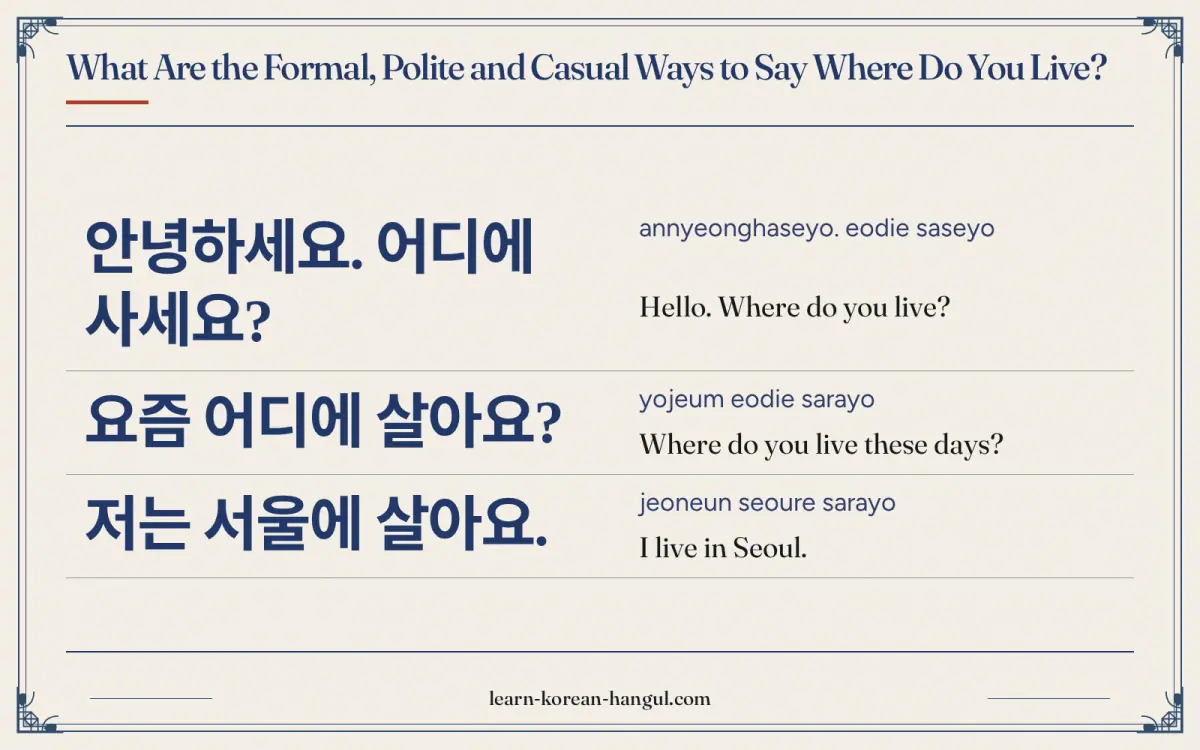
안녕하세요. 어디에 사세요?
annyeonghaseyo. eodie saseyo
Hello. Where do you live?
Polite: 어디에 살아요? (eodie sarayo)
Polite · 해요체어디에 살아요? uses the plain polite style without the honorific. It fits peers, classmates and people of similar age whom you address politely. With someone clearly older, choose the honorific form.
요즘 어디에 살아요?
yojeum eodie sarayo
Where do you live these days?
Casual: 어디 살아? (eodi sara)
Casual · 반말어디 살아? drops both the polite ending and the particle 에, which is common in casual speech. It is 반말 (casual speech) for close friends and younger people. Friends often follow it with 가까워? (is it close?).
너 어디 살아? 우리 집이랑 가까워?
neo eodi sara? uri jibirang gakkawo
Where do you live? Is it close to my place?
Answer: 저는 서울에 살아요 (jeoneun seoure sarayo)
Polite · 해요체The answer uses 저는 (I, humble), a place, the particle 에 and 살아요 (live). Use 에, the particle for the place where you exist or live. 서울에서 살아요 is also correct, but 에 is the pattern textbooks teach first. Do not use the honorific 사세요 for yourself. You can also name a neighbourhood, such as 강남에 살아요.
저는 서울에 살아요.
jeoneun seoure sarayo
I live in Seoul.
Four lines cover the question and answer. Saying the main question cleanly comes next.
How Do You Pronounce 어디에 사세요?
어디에 사세요? is pronounced [어디에 사세요], eodie saseyo, in six syllables, with no sound change. The answer 서울에 살아요 does change: it is [서우레 사라요], because each final consonant moves onto the next vowel.
- 어 (eo): an open "uh".
- 디 (di): "dee".
- 에 (e): "eh".
- 사 (sa): "sah".
- 세 (se): "seh".
- 요 (yo): "yoh"; the question word already marks the question, so the end usually falls or rises and then falls.
Sound Changes to Listen For
One rule from the National Institute of Korean Language Standard Pronunciation (표준 발음법) matters here, plus two notes.
- Liaison in 서울에 and 살아요. The ㄹ of 울 moves onto 에, so 서울에 is [서우레]. The ㄹ of 살 moves onto 아, so 살아요 is [사라요]. See liaison (resyllabification).
- Question pitch. 어디 already marks the question, so 어디 사세요? usually ends with a fall or a rise-fall. A yes/no question such as 서울에 사세요? ("Do you live in Seoul?") is the one that rises at the end.
- Romanization follows spelling. Revised Romanization writes seoure sarayo, which shows the link, so the romanized form is a reliable guide for this answer.
With the sound set, the next question is who should be asked with which form.
When Should You Use 어디에 사세요?, and When Should You Not?
Ask 어디에 사세요? whenever you want to be polite. Ask 어디에 살아요? among peers, and 어디 살아? only with close friends.
Situations Where It Fits
- A new neighbour. 어디에 사세요? is warm and polite.
- A colleague on the commute. 어디에 사세요? often leads to a chat about the subway line.
- A classmate of your age. 어디에 살아요? is relaxed and friendly.
- A close friend. 어디 살아? is quick and natural.
Situations to Avoid
- Using 에서 with 있다. 서울에서 살아요 is acceptable, but 서울에서 있어요 is wrong; say 서울에 있어요 (I am in Seoul).
- Using 사세요 about yourself. The honorific is for the listener only.
- Asking a full address on first meeting. Asking the neighbourhood is enough.
These choices are easier to feel in real exchanges, so here are three.
What Does Where Do You Live Sound Like in a Real Conversation?
A Korean residence exchange is short. The asker uses the honorific, and the answer names a city or a neighbourhood.
A New Neighbour
Daeho
안녕하세요. 어디에 사세요?
annyeonghaseyo. eodie saseyo
Hello. Where do you live?
Sora
저는 3층에 살아요.
jeoneun samcheunge sarayo
I live on the third floor.
What to notice: Sora answers with a floor, which is a natural answer in an apartment building.
Colleagues on the Commute
Jun
어디에 사세요?
eodie saseyo
Where do you live?
Sumi
수원에 살아요. 지하철로 한 시간 걸려요.
suwone sarayo. jihacheollo han sigan geollyeoyo
I live in Suwon. It takes an hour by subway.
What to notice: Sumi adds the travel time with 걸려요, a common detail.
Friends
Min
너 어디 살아?
neo eodi sara
Where do you live?
Yuna
신촌에 살아. 학교 근처야.
sinchone sara. hakgyo geuncheoya
I live in Sinchon. It's near the school.
What to notice: both friends use casual forms. This leads to the culture around residence questions.
What Should You Know about the Culture behind Where Do You Live?
In Korea, a person's neighbourhood often says something about commute and life, so residence questions are common small talk. A full address is private.
- Neighbourhood, not address. People name a district or a station, such as 강남 or 신촌, not a street number.
- Apartments. Many Koreans live in apartment complexes, called 아파트 (apateu), so floor and building are natural details.
- Commute talk. Colleagues often ask about commute time, 얼마나 걸려요? (how long does it take?).
- Small talk, not an invitation. Asking where someone lives is friendly interest, and it does not mean you want to visit.
An expert tip: 에 and 에서 are the core pair here. 에 marks the place where something exists or where you live (서울에 살아요), while 에서 marks where an action happens (서울에서 일해요, I work in Seoul). 살다 accepts both, because living can be seen as a state or an activity. This page covers everyday residence questions. Rental terms, addresses and housing vocabulary are not covered here.
What Mistakes Do Learners Make with Where Do You Live in Korean?
Most mistakes with this question come from the particle, the honorific and privacy.
| Mistake | Why it is a problem | Fix |
|---|---|---|
| Saying 서울에서 있어요 | 있다 (to be somewhere) takes only 에; 살다 accepts both | Say 서울에 있어요 |
| Saying 사세요 about yourself | The honorific raises the listener only | Say 살아요 |
| Asking an elder 어디 살아? | Casual ending | Use 어디에 사세요? |
| Pronouncing 살아요 with a separate ㄹ | The ㄹ moves to the next syllable | Say [사라요] |
| Asking for a full address at once | It is personal | Ask for the neighbourhood |
Learners often think 에서 is the only word for in. Korean splits it: 에 for existence and living, 에서 for action. 살다 sits between the two, so 서울에서 살아요 is also correct, but 에 is the pattern to learn first.
Is It the Same as Where Do You Stay or Reside?
Partly. The short answers below cover the other ways people search for this phrase.
- Where do you stay in Korean: for a trip, 어디에서 묵어요? (eodieseo mugeoyo) asks where you are staying, such as a hotel. For where you live, use 어디에 사세요?.
- I live in in Korean: the pattern is 저는 + place + 에 살아요.
- I live in Seoul in Korean: 저는 서울에 살아요.
- Where do you reside in Korean: the very formal 어디에 거주하세요? (eodie geojuhaseyo), used in writing and official talk.
Reading the forms is one thing; producing them on cue is another, so practise now.
Practice: Say It Aloud
Play the slow clip of 어디에 사세요?, repeat it three times, then answer it with your own city. Then choose a form for each situation. Answers follow.
- A new neighbour moves in next door.
- A close friend asks where you moved.
- You live in Busan. How do you answer?
- Why does 서울에 sound like [서우레]?
Answers
- 어디에 사세요?
- 어디 살아?
- 저는 부산에 살아요.
- The ㄹ of 울 moves onto the vowel 에 (liaison).
The phrase flashcards drill all four lines with audio.
Related Phrases to Learn Next
Asking where someone lives sits with the other first-meeting phrases.
- Introduce yourself in Korean: the full set of self-introduction phrases.
- Where are you from in Korean: the question about origin.
- What do you do in Korean: the question about work.
- How old are you in Korean: another common get-to-know-you question.
This guide belongs to the introducing yourself collection. What this page does not cover: addresses, rental terms and housing vocabulary. Pick 어디에 사세요? when in doubt, and you can ask where do you live in Korean to almost anyone.
Frequently Asked Questions
What is the difference between 어디에 사세요? and 어디에 살아요?
Both ask where someone lives. 어디에 사세요? has the honorific -세요 and fits neighbours, colleagues and elders. 어디에 살아요? is plain polite and fits peers and classmates. The first shows more respect, so choose it when you are unsure.
Is 어디에 사세요? formal or casual?
It is polite and honorific, in the 해요체 style with -세요. It is not stiff, but it shows respect to the listener. For close friends use 어디 살아?, and for very formal settings use 어디에 사십니까?. Answer it with 저는 서울에 살아요, without the honorific.
Can I use 어디에 사세요? with friends, elders and strangers?
Yes with strangers and elders, where it is the best choice. With close friends it sounds formal, so use 어디 살아?. With classmates of your age, 어디에 살아요? is relaxed. The honorific is safe whenever you are unsure.
How do you answer 어디에 사세요?
Answer with 저는 plus the place plus 에 살아요, such as 저는 서울에 살아요. Use 에, the textbook pattern (에서 also works with 살다), and do not use the honorific 사세요 for yourself. You can name a neighbourhood, such as 강남에 살아요, or a floor, such as 3층에 살아요.
What is the most common mistake with where do you live in Korean?
The most common mistake is using the honorific 사세요 about yourself; say 살아요 for your own home. The second is the particle. 서울에 살아요 is the pattern to learn first. 서울에서 살아요 is also correct with 살다, but with 있다 only 에 works, as in 서울에 있어요.