How Do You Say How Old Are You in Korean?
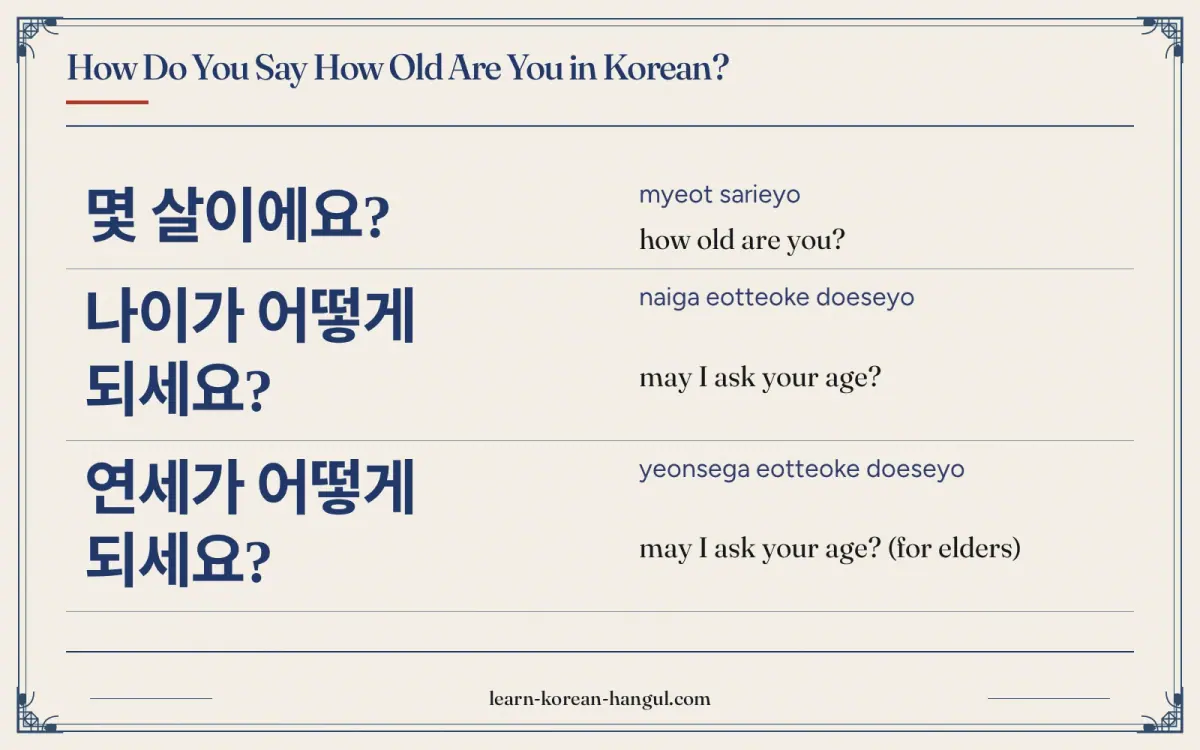
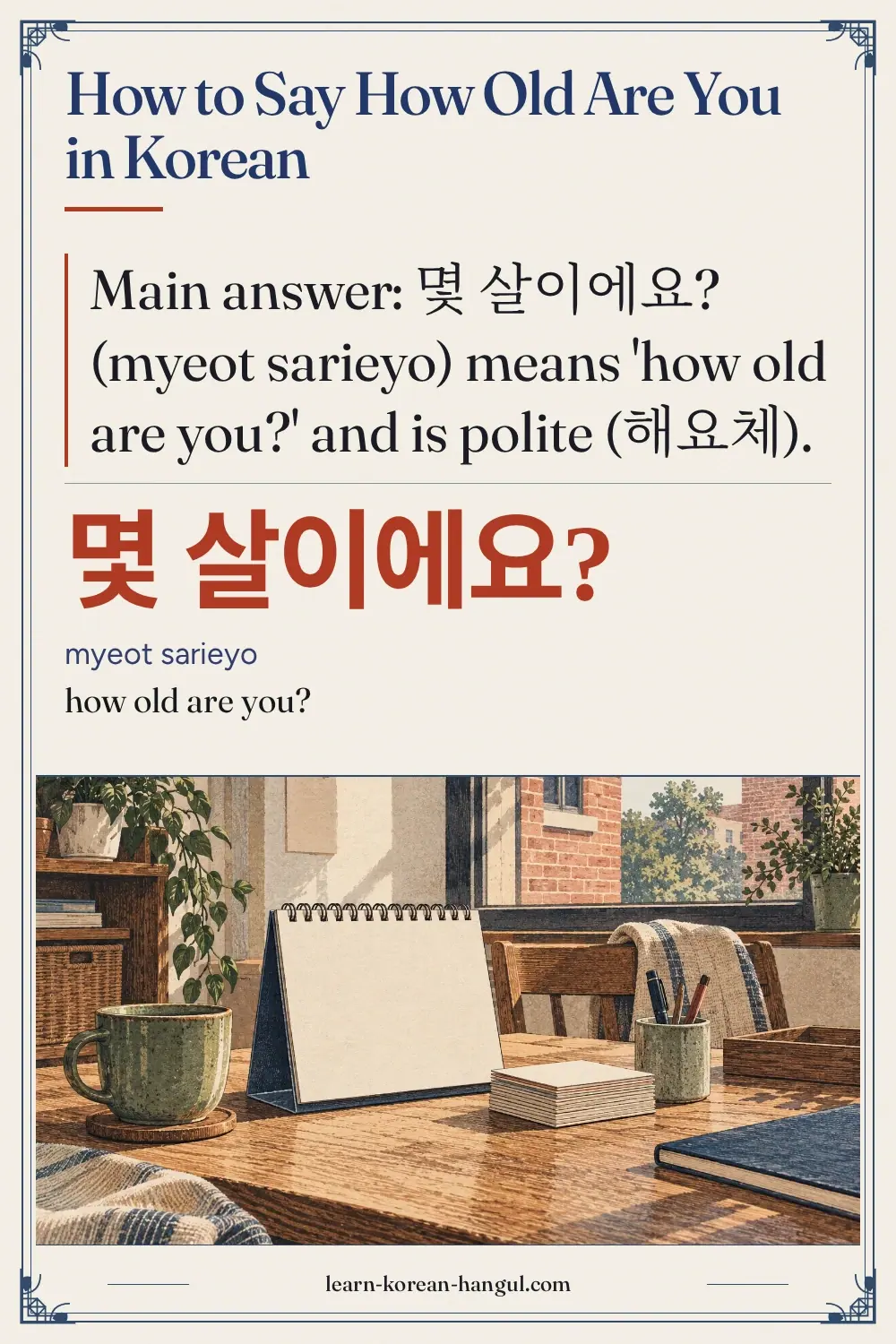
The standard polite way to say how old are you in Korean is 몇 살이에요? (myeot sarieyo). The phrase has three parts: 몇 (myeot, "how many"), 살 (sal, the counter for years of age) and 이에요 (ieyo, "is"). The question word 몇 already marks the question, so the end usually falls or rises and then falls.
Five forms cover most situations.
| Korean | Revised Romanization | Meaning | Register |
|---|---|---|---|
| 몇 살이에요? | myeot sarieyo | how old are you? | polite (해요체) |
| 나이가 어떻게 되세요? | naiga eotteoke doeseyo | may I ask your age? | polite, respectful |
| 연세가 어떻게 되세요? | yeonsega eotteoke doeseyo | may I ask your age? (for elders) | polite, highly respectful |
| 몇 살이야? | myeot sariya | how old are you? | casual (반말) |
| 저는 스무 살이에요 | jeoneun seumu sarieyo | I am twenty | polite answer |
Revised Romanization (the South Korean government standard of 2000) is a reading aid only. The Hangul is the real spelling. The next section sorts the forms by listener.
What Are the Formal, Polite and Casual Ways to Say How Old Are You?
Four forms ask the question and one answers it. Korean speech levels decide which question fits: polite forms end in 요 or 세요, and the casual form drops that ending. The strictly formal version is 몇 살입니까? (myeot sarimnikka), which you will hear in forms and announcements.
Polite: 몇 살이에요? (myeot sarieyo)
몇 살이에요? means "how old are you?" and is the clearest form for people of your own age or younger. It suits a new classmate, a coworker of similar age or a student in a language exchange.
Example: 저는 스물다섯 살이에요. 몇 살이에요? (jeoneun seumuldaseot sarieyo. myeot sarieyo?) "I am twenty-five. How old are you?"
Respectful: 나이가 어떻게 되세요? (naiga eotteoke doeseyo)
나이가 어떻게 되세요? means "may I ask your age?" and literally asks "how does your age come out?" The verb 되세요 carries the honorific marker -(으)시-, which raises the listener. Use it with a stranger, a client or an adult you do not know well, and start with 실례지만 (sillyejiman, "excuse me, but").
Example: 실례지만, 나이가 어떻게 되세요? (sillyejiman, naiga eotteoke doeseyo?) "Excuse me, may I ask your age?"
For a clearly older person, swap 나이 for the honorific noun 연세 (yeonse): 연세가 어떻게 되세요?
Casual: 몇 살이야? (myeot sariya)
몇 살이야? means "how old are you?" and drops the polite ending, so it fits a close friend, a sibling or a child. Never use it with a stranger or an elder, because the missing 요 sounds blunt.
Example: 너 몇 살이야? (neo myeot sariya?) "How old are you?"
Polite Answer: 저는 스무 살이에요 (jeoneun seumu sarieyo)
저는 스무 살이에요 means "I am twenty." Native Korean numbers go before 살, and 스물 (seumul, "twenty") changes to 스무 (seumu) in front of it. The page on how to say age in Korean covers the full pattern, including the formal counter 세.
Example: 저는 스무 살이에요. (jeoneun seumu sarieyo.) "I am twenty."
Choosing a Form by Listener
The table gives one clear choice per listener.
| Listener | Best choice | Why |
|---|---|---|
| New classmate or coworker your age | 몇 살이에요? | clear and polite |
| Stranger, client, adult you just met | 나이가 어떻게 되세요? | respectful |
| Grandparent age or a senior | 연세가 어떻게 되세요? | honorific noun |
| Close friend, sibling, child | 몇 살이야? | casual |
| Form or announcement | 몇 살입니까? | strictly formal |
Once the form is chosen, the next step is how it sounds.
How Do You Pronounce 몇 살이에요?
몇 살이에요? is pronounced [멷 싸리에요], roughly "myeot ssa-ri-e-yo," with five syllables in two word groups. Play the slow clip, then the normal clip, and repeat each one aloud.
| Word | Spelled | Spoken | Revised Romanization |
|---|---|---|---|
| 몇 | 몇 | [멷] | myeot |
| 살이에요 | 살-이-에-요 | [사리에요] | sarieyo |
What Sound Changes Happen in 몇 살이에요?
Three sound details matter. They follow the Standard Pronunciation Rules (표준 발음법) of the National Institute of Korean Language (국립국어원).
- 몇 ends in ㅊ, but a final consonant is sounded as one of seven sounds. Here ㅊ is read as [ㄷ], so 몇 sounds like [멷].
- 몇 살 becomes [멷 쌀]. After the stop sound [ㄷ], the consonant ㅅ turns tense. The page on Korean tensification explains this change.
- 살이에요 becomes [사리에요]. The final ㄹ of 살 moves to the next syllable because 이 begins with a silent ㅇ, so you hear "sa-ri."
Together these give [멷 싸리에요]. Say the sounds in order, and the phrase flows. The next question is when to use it.
When Should You Use 몇 살이에요?, and When Should You Not?
Use 몇 살이에요? with people your own age or younger, and use 나이가 어떻게 되세요? with anyone else. Koreans often ask age early in a friendship, because age decides who speaks politely to whom. Use native Korean numbers before 살.
Situations Where 몇 살이에요? Fits
- A language exchange or classroom. Ask a peer after you share names.
- A new coworker of similar age. Ask after a few minutes of small talk.
- A child or teenager. Switch to 몇 살이야? (myeot sariya) for a child.
Situations to Avoid with 몇 살이에요?
- A senior or a client. Use 연세가 어떻게 되세요? instead, and only if you have a reason to ask.
- A formal business meeting. Skip the question unless the setting calls for it.
- A first message to a stranger. Greet first, then ask later in the conversation.
The dialogues below show the question in the right order.
Example Conversations with How Old Are You
Read each dialogue, play the clip, and say one role aloud.
Dialogue 1: Two new classmates
- A: 저는 스물다섯 살이에요. 몇 살이에요? (jeoneun seumuldaseot sarieyo. myeot sarieyo?) "I am twenty-five. How old are you?"
- B: 저는 서른 살이에요. (jeoneun seoreun sarieyo.) "I am thirty."
- A: 아, 저보다 나이가 많으시네요. (a, jeoboda naiga maneusineyo.) "Oh, you are older than me."
저는 스물다섯 살이에요. 몇 살이에요? 저는 서른 살이에요. 아, 저보다 나이가 많으시네요.
Dialogue 2: Asking a senior
- A: 실례지만, 연세가 어떻게 되세요? (sillyejiman, yeonsega eotteoke doeseyo?) "Excuse me, may I ask your age?"
- B: 올해 예순이에요. (olhae yesunieyo.) "I am sixty this year."
- A: 정말 젊어 보이세요. (jeongmal jeolmeo boiseyo.) "You look very young."
실례지만, 연세가 어떻게 되세요? 올해 예순이에요. 정말 젊어 보이세요.
Dialogue 3: Talking to a child
- A: 너 몇 살이야? (neo myeot sariya?) "How old are you?"
- B: 열 살이야. (yeol sariya.) "I am ten."
- A: 와, 많이 컸네. (wa, mani keonne.) "Wow, you have grown a lot."
너 몇 살이야? 열 살이야. 와, 많이 컸네.
In Dialogue 1, the reply 저보다 나이가 많으시네요 shows why age matters: A learns that B is older and adds the honorific -(으)시- at once. A cultural idea sits behind this question.
Why Koreans Ask about Age: the Culture behind It
In Korean, age tells both speakers how to talk, so the question is practical and not rude. Verb endings, titles and even how drinks are poured and received change with age, and speakers need that fact early. Two new friends often ask 몇 살이에요? in the first conversation, and the answer decides who calls the other 형, 누나, 오빠 or 언니 (hyeong, nuna, oppa, eonni), the older-sibling words used for older friends.
Many Koreans also ask 몇 년생이에요? (myeot nyeonsaengieyo, "what year were you born?"), because people born in the same year treat each other as the same age (동갑, donggap), so the year settles the question at once. Since June 2023, Korean law uses the international way of counting age (만 나이) for official matters. In daily talk, some people still use the traditional Korean count, so ask 만으로 몇 살이에요? (maneuro myeot sarieyo, "how old in international age?") when it matters. With the custom clear, the common mistakes are easy to spot.
What Mistakes Do Learners Make with How Old Are You in Korean?
The most common mistake is using Chinese-based numbers before 살. Five mistakes appear again and again:
- Saying 이십 살. Fix: use native numbers with 살, so say 스무 살 for twenty. Sino-Korean numbers go with 세, as in 이십 세.
- Saying 스물 살. Fix: 스물 shortens to 스무 before 살, so say 스무 살.
- Using 몇 살이에요? with a senior. Fix: say 연세가 어떻게 되세요? for an elder.
- Missing the tense sound. Saying "myeot sal" with a soft s sounds foreign. Fix: say [멷 쌀].
- Treating the question as rude and skipping it. Fix: ask kindly, after greeting, and do not apologise for it.
These slips come from carrying English habits into Korean. A few related searches ask the same thing in other words, so they are answered next.
Is It the Same as How Old Are You Formal, Casual or What Is Your Age?
Not exactly, because Korean has a form for each listener. Six searches lead to this page, so each gets a short answer.
- How old are you formal in Korean: 나이가 어떻게 되세요? or 연세가 어떻게 되세요? for respect, and 몇 살입니까? for forms and announcements.
- How old are you casual in Korean: 몇 살이야? (myeot sariya), for friends and children.
- What is your age in Korean: 나이가 어떻게 되세요? is the closest match.
- Asking age in Korean and ask age in Korean: Start with 몇 살이에요? and switch by listener.
- My age in Korean: Say 저는 ○○ 살이에요 (jeoneun ○○ sarieyo), with a native number in the blank.
After the answers, the next pages continue the conversation.
Related Phrases to Learn Next
Three pages help you keep the conversation going:
- What's your name in Korean: the question that usually comes before age.
- Where are you from in Korean: the next question in a first meeting.
- How to say age in Korean: the numbers and counters for your answer.
The complete list sits in the introduce yourself in Korean cluster.
Practice: Say It Aloud
Spend five minutes on this routine.
- Play the slow clip of 몇 살이에요? and repeat it three times, with the prominence on 몇 and a falling or rise-fall end.
- Say it again with the tense sound: [멷 쌀], not "myeot sal."
- Answer aloud with your own age: 저는 ○○ 살이에요.
- Hide the Romanization with the toggle and read the five forms from Hangul only.
- Drill the cluster with the phrase flashcards.
When the question comes out with a gentle rise, you can ask how old are you in Korean in a way that fits every listener.
Frequently Asked Questions
The answers below add details about how to say how old are you in Korean beyond the sections above.
How do you say how old are you in Korean?
The standard polite question is 몇 살이에요? (myeot sarieyo). For a stranger or an adult you respect, say 나이가 어떻게 되세요? (naiga eotteoke doeseyo). For an elder, use 연세가 어떻게 되세요?. With a close friend or a child, 몇 살이야? (myeot sariya) is natural. Answer with a native number plus 살.
How do you pronounce 몇 살이에요?
Say it as [멷 싸리에요], roughly myeot ssa-ri-e-yo. The final ㅊ of 몇 is read as [ㄷ], the ㅅ of 살 becomes tense after it, and the final ㄹ of 살 moves to the next syllable. The Revised Romanization is myeot sarieyo. Play the slow clip first, then repeat it at normal speed.
What is the difference between 몇 살이에요? and 나이가 어떻게 되세요?
몇 살이에요? is a direct, short question and suits peers and younger people. 나이가 어떻게 되세요? asks "may I ask your age?" with the honorific ending 세요, so it sounds softer and more respectful. Use it with strangers, clients and adults you have just met.
Is 몇 살이에요? formal or casual?
몇 살이에요? is polite, in the 해요체 style, between formal and casual. The strictly formal version is 몇 살입니까? (myeot sarimnikka), used in forms and announcements. The casual version, 몇 살이야?, is only for close friends, siblings and children. Add or drop 요 to move between polite and casual.
Can I use 몇 살이에요? with friends, elders and strangers?
It works with peers, younger people and most adults of similar age. With strangers and clients, 나이가 어떻게 되세요? is safer. With an elder, use 연세가 어떻게 되세요? and ask only if you have a reason. With close friends and children, 몇 살이야? is natural.
What is the most common mistake with how old are you in Korean?
Learners answer with Chinese-based numbers, saying 이십 살, when native Korean numbers belong before 살, so the answer is 스무 살. Another slip is 스물 살; 스물 shortens to 스무 before 살. A third is using 몇 살이에요? with a senior instead of 연세가 어떻게 되세요?.