약국이 어디예요?
약국이 어디예요?
What you'll learn
- Ask for a pharmacy, then ask for medicine once you are inside.
- Name two common kinds of medicine: 소화제 (for digestion) and 감기약 (for a cold).
- Say 약국이 as [약꾸기], with the tense sound and the link behind it.
- Tell a pharmacy (약국) from a hospital (병원) so you are sent to the right place.
Before you start: if you feel unwell, you may also want to say I have a headache in Korean. Time: about 15 minutes. Audio plays only when you press a button.
How Do You Say Where Is the Pharmacy in Korean?
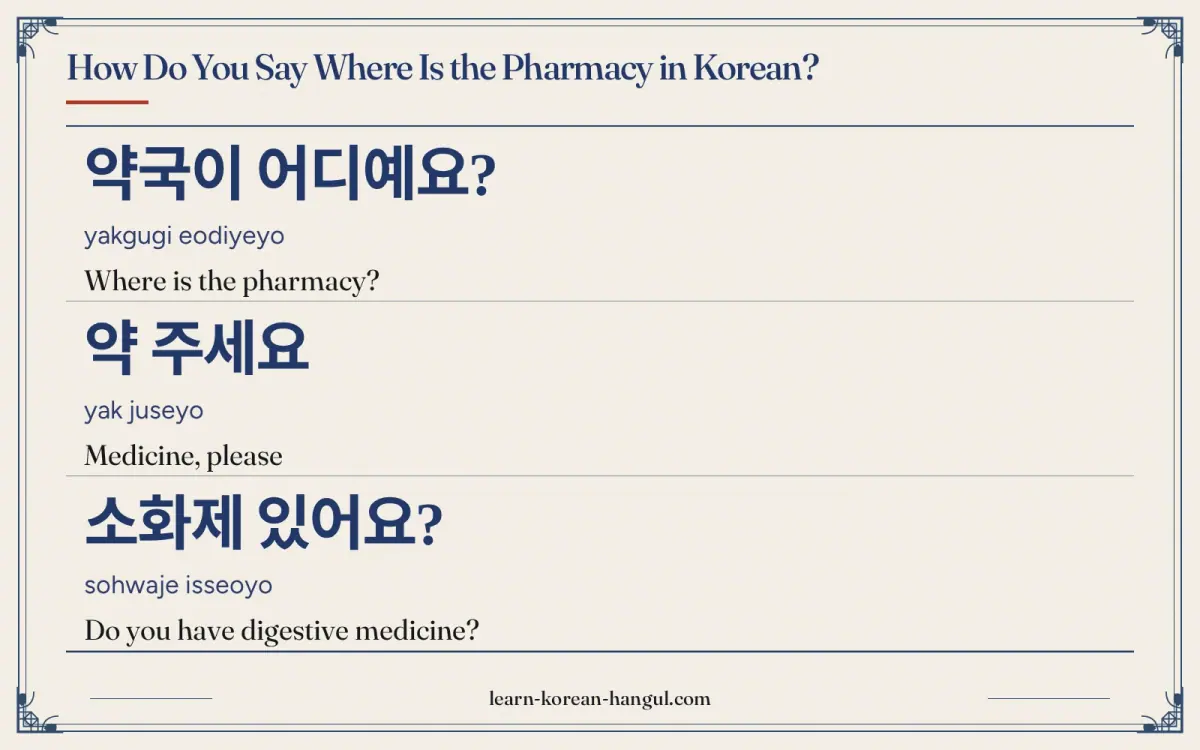
The standard question is 약국이 어디예요?, and three partners help you once you arrive. Learn them as a set: one finds the shop, and the others get you what you need.
| Situation | Korean | Revised Romanization | Meaning |
|---|---|---|---|
| Find the pharmacy | 약국이 어디예요? | yakgugi eodiyeyo | Where is the pharmacy? |
| Ask for medicine | 약 주세요 | yak juseyo | Medicine, please |
| Ask for a stomach remedy | 소화제 있어요? | sohwaje isseoyo | Do you have digestive medicine? |
| Ask for a cold remedy | 감기약 주세요 | gamgiyak juseyo | Cold medicine, please |
The word 약국 (藥局) joins 약, "medicine", and 국, "office", so it means a place that gives out medicine. The particle 이 marks 약국 as the subject, 어디 means "where", and 예요 is the polite "is". The next section shows each form in a sentence.
What Are the Polite Ways to Say Where Is the Pharmacy?
All the forms below are polite or formal, because you almost always ask strangers or staff. Korean marks the listener with speech levels, the sentence endings explained in the guide to Korean speech levels. The ending -요 makes a sentence polite, and -ㅂ니까 makes a question formal.
Polite: 약국이 어디예요? (yakgugi eodiyeyo)
Polite · 해요체This is the default. Use it with hotel clerks, cafe staff, taxi drivers and passers-by. It asks only for the place, so the answer is a direction.
저기요, 약국이 어디예요?
jeogiyo, yakgugi eodiyeyo?
Excuse me, where is the pharmacy?
Polite: 약 주세요 (yak juseyo)
Polite · 해요체주세요 is the polite request "please give me". Say 약 주세요 once you are at the counter, and add the problem if you can. It is short but friendly.
안녕하세요. 약 주세요.
annyeonghaseyo. yak juseyo
Hello. Medicine, please.
Polite: 소화제 있어요? (sohwaje isseoyo)
Polite · 해요체소화제 is a medicine for digestion, and 있어요 asks "do you have it?". Put the name of any product before 있어요 to check whether a shop sells it. A yes or no question like this usually rises at the end.
소화제 있어요?
sohwaje isseoyo?
Do you have digestive medicine?
Polite: 감기약 주세요 (gamgiyak juseyo)
Polite · 해요체감기 is a cold, and 약 is medicine, so 감기약 is cold medicine. The same pattern works with other names, such as 진통제 (jintongje, painkiller).
감기약 주세요.
gamgiyak juseyo
Cold medicine, please.
Formal: 약국이 어디입니까? (yakgugi eodiimnikka)
Formal · 합쇼체The formal question ending -ㅂ니까 suits a hotel front desk or an official setting. It is correct, but stiff on the street.
실례합니다. 약국이 어디입니까?
sillyehamnida. yakgugi eodiimnikka?
Excuse me. Where is the pharmacy? (formal)
Casual: 약국 어디야? (yakguk eodiya)
Casual · 반말With close friends and family, drop -요 and say 어디야. Never use it with strangers, staff or elders.
야, 약국 어디야?
ya, yakguk eodiya?
Hey, where's the pharmacy?
Asking is only half the exchange, so the next section covers what you will hear back.
What Will People Answer When You Ask?
Most answers are short and point to a place, so learn six replies. People often point or nod as they speak.
| Korean | Revised Romanization | Meaning |
|---|---|---|
| 저쪽에 있어요 | jeojjoge isseoyo | It's over there |
| 병원 옆에 있어요 | byeongwon yeope isseoyo | It's next to the hospital |
| 편의점 맞은편에 있어요 | pyeonuijeom majeunpyeone isseoyo | It's opposite the convenience store |
| 2층에 있어요 | icheunge isseoyo | It's on the second floor |
| 지금 문 닫았어요 | jigeum mun dadasseoyo | It's closed now |
| 내일 아침에 열어요 | naeil achime yeoreoyo | It opens tomorrow morning |
The last two replies are worth learning, because pharmacies close in the evening and some open late. Knowing the answers prepares you for the sounds in the question itself.
How Do You Pronounce 약국이 어디예요?
약국이 어디예요? is pronounced [약꾸기 어디예요], yak-kku-gi eo-di-ye-yo, in seven syllables with a tense sound in the second one.
- 약 (yak): "yahk", with the final ㄱ held short and unreleased.
- 꾸 (kku): the ㄱ of 국 becomes a tense sound, said with a tight throat and no puff of air.
- 기 (gi): the final ㄱ of 국 moves here and joins 이.
- 어 (eo): the open vowel ㅓ is unrounded, like the "u" in "bus".
- 디 (di): a soft d, like "dee".
- 예요 (yeyo): "yeh-yo", said lightly; many speakers say [에요] in everyday speech.
Sound Changes to Listen For
Four points make the question and its partners sound natural:
- Tensing in 약국. A ㄱ after a ㄱ batchim is said tense, so 약국 alone sounds like [약꾹]. The National Institute of Korean Language (국립국어원) Standard Pronunciation rules (표준 발음법) set this in Article 23. See Korean tensification.
- Liaison (연음). When a syllable ends in a consonant and the next one starts with the silent ㅇ, the consonant moves across. In 약국이 the final ㄱ moves onto 이, giving [약꾸기]. See the liaison rules.
- 약사 is [약싸]. The ㅅ after the final ㄱ is said tense. Add 님 for respect: 약사님.
- 약 주세요 is often [약쭈세요]. In running speech the ㅈ after a final ㄱ is often tense as well, though careful speakers may keep it plain.
Once the sounds are clear, the next step is knowing which place and which words fit.
When Should You Use 약국이 어디예요?, and When Should You Not?
Use 약국이 어디예요? for ordinary needs, such as a cold, a stomach upset or a bandage. Use a different question when the situation is serious.
Situations Where It Fits
- A mild illness. A cold, a headache or an upset stomach can often be handled with advice from a pharmacist.
- Everyday supplies. Plasters, bandages and simple remedies are sold at a 약국.
- At a hotel. The front desk usually knows the nearest pharmacy and its opening times.
Situations to Avoid
- A serious emergency. Use I need a doctor in Korean or call for help, not a pharmacy question.
- Looking for a clinic. If you need an examination or a prescription, ask for a 병원 or a 의원 instead.
- Using the casual form with staff. 약국 어디야? is for friends only.
Real exchanges show how the questions chain together.
What Does Asking for a Pharmacy Sound Like in a Real Conversation?
Three short exchanges cover the usual cases: finding the shop, asking for a cold remedy and asking for a stomach remedy. Listen for the opening phrase and the answer.
Asking a Passer-By
Traveller
저기요, 약국이 어디예요?
jeogiyo, yakgugi eodiyeyo?
Excuse me, where is the pharmacy?
Passer-By
저 건물 1층에 있어요.
jeo geonmul ilcheunge isseoyo
It's on the first floor of that building.
Traveller
감사합니다.
gamsahamnida
Thank you.
What to notice: the answer names a building and a floor. 저 means "that over there", so the passer-by is pointing.
Asking for Cold Medicine
Customer
안녕하세요. 감기약 주세요.
annyeonghaseyo. gamgiyak juseyo
Hello. Cold medicine, please.
Pharmacist
어디가 아프세요?
eodiga apeuseyo?
Where does it hurt?
Customer
목이 아파요.
mogi apayo
My throat hurts.
Pharmacist
하루에 세 번 먹으세요.
harue se beon meogeuseyo
Take it three times a day.
What to notice: the pharmacist asks a wh-question, so it ends with a falling or rise-fall tone, not a sharp rise. 목 (mok) is the throat or neck, and 목이 sounds like [모기]. The instruction ends in the polite request -으세요.
Asking for a Stomach Remedy
Customer
소화제 있어요?
sohwaje isseoyo?
Do you have digestive medicine?
Pharmacist
네, 있어요.
ne, isseoyo
Yes, we do.
Customer
얼마예요?
eolmayeyo?
How much is it?
Pharmacist
사천 원이에요.
sacheon wonieyo
It's 4,000 won.
What to notice: 얼마예요 asks for a price, and prices use Sino-Korean numbers with 원. A few local habits also make buying medicine easier.
What Should You Know about the Culture behind Buying Medicine?
Pharmacies are everywhere in Korean towns, and a few habits help visitors.
- The sign. Pharmacies usually show the word 약국 and a green cross sign.
- Over the counter and prescription. Many everyday remedies for colds, digestion and pain are sold by the pharmacist, while stronger medicine needs a doctor's prescription, a 처방전 (cheobangjeon).
- Pharmacist advice. Pharmacists often ask about your symptoms before they choose a medicine, so be ready to say where it hurts.
- Convenience stores. A few basic medicines are also sold in convenience stores, but the range is small.
- Drugstores are not pharmacies. Shops called 드럭스토어 (deureokseutoeo) sell cosmetics and health goods, and the medicine counter is in a 약국.
An expert insight: tell the pharmacist about any allergy with 알레르기 있어요 (allereugi isseoyo). It takes five seconds and helps them choose safely. The next section lists the mistakes that cause the most confusion.
What Mistakes Do Learners Make with Where Is the Pharmacy in Korean?
Most mistakes come from picking the wrong place or the wrong request.
| Mistake | Why it is a problem | Fix |
|---|---|---|
| Asking for a 병원 | A hospital or clinic is not a pharmacy | Say 약국 |
| Saying 약이 있어요 | It states a fact, not a request | Say 약 주세요 |
| Reading 약국 as [약국] | The ㄱ should be tense | Say [약꾹] |
| Saying 약국 어디야 to staff | It is casual and abrupt | Say 약국이 어디예요 |
| Forgetting the name of the problem | The pharmacist cannot guess | Add 감기약, 소화제 or the body part |
Learners often assume 약 only means a pill. In fact 약 covers all medicine, including syrup, cream and patches, and 약 can also mean "about" before a number in formal writing, so context decides. Several other English queries fold into this page.
Is It the Same as Pharmacy, Medicine or Drugstore?
Mostly yes. Each English word maps onto a Korean word you can use in a question.
- Pharmacy in Korean: 약국. See the word page on pharmacy in Korean.
- Medicine in Korean: 약. See the word page on medicine in Korean. 먹는 약 means medicine you swallow.
- Drugstore in Korean: 드럭스토어 is the loanword for a health-and-beauty shop, while 약국 is the place with a pharmacist.
- Where is the pharmacy in Korean: 약국이 어디예요? is the exact question.
Now practise the question until it feels automatic.
Practice: Say It Aloud
Play the slow clip of 약국이 어디예요? three times and repeat it. Then choose a form for each situation. Answers follow.
- You are on the street and need a pharmacy.
- You are at the counter and have a cold.
- You want to know if a shop sells a stomach remedy.
- You are at a hotel front desk and want the formal form.
Answers: 1. 약국이 어디예요? 2. 감기약 주세요. 3. 소화제 있어요? 4. 약국이 어디입니까?
Use the phrase flashcards to drill the question with audio.
Related Phrases to Learn Next
- I have a headache in Korean: 머리가 아파요 to describe the problem.
- I need a doctor in Korean: the next step when a pharmacy is not enough.
This guide belongs to the Korean medical phrases collection. What this page does not cover: medicine names, dosage instructions and the full list of body parts, which deserve their own lessons. Master the question and the three requests above, and you can say where is the pharmacy in Korean in any town.
Frequently Asked Questions
How do you say where is the pharmacy in Korean?
Say 약국이 어디예요? (yakgugi eodiyeyo). The word 약국 means pharmacy, 어디 means "where", and 예요 is the polite "is". The ending -요 makes the sentence suitable for staff and strangers. Once you arrive, ask for medicine with 약 주세요 or for a specific kind with 감기약 주세요.
How do you pronounce 약국이 어디예요?
It sounds like yak-kku-gi eo-di-ye-yo, with seven syllables. The ㄱ of 국 is tense, and the final ㄱ moves onto 이, so you hear 꾸기 and not 국이. Keep the ㅓ vowel in 어디 relaxed and unrounded, and say the last syllable lightly.
What is the difference between 약국이 어디예요? and 약 주세요?
Both are polite, but they do different jobs. 약국이 어디예요? asks where the pharmacy is, so you use it on the street. 약 주세요 asks the pharmacist for medicine, so you use it at the counter. Add the problem, such as 감기약 for a cold, to get the right product.
Can I use 약국이 어디예요? with friends, elders and strangers?
Yes for strangers and elders, because the ending -요 is polite. With a close friend you can drop it and say 약국 어디야?. At a hotel desk or an official counter, the formal 약국이 어디입니까? is also fine. Avoid the casual form with staff and with anyone you do not know well.
What is the most common mistake with where is the pharmacy in Korean?
Asking for a 병원, which is a hospital or clinic, when you need a 약국. Staff will send you to a doctor, not a medicine counter. Use 약국 for medicine, and use 병원 only when you need an examination. The second most common mistake is saying 약이 있어요 when you mean to request medicine.