잘못 거셨어요
잘못 거셨어요
What you'll learn
- Say wrong number as the person who answers (잘못 거셨어요) and as the caller (잘못 걸었어요).
- Apologise politely and formally with 죄송합니다.
- See why 걸다 becomes 거세요 and 거셨어요.
- Pronounce 잘못 as [잘몯].
Before you start: you only need to read Hangul. Learn hello on the phone in Korean first, since most calls open with 여보세요. Time: about 10 minutes. Audio plays only when you press a button.
How Do You Say Wrong Number in Korean?
Korean does not use a fixed noun phrase for "wrong number". It describes the action: someone dialed wrongly. The word 잘못 (jalmot) means "wrongly" or "by mistake", and 걸다 (geolda) here means "to make a call". So 잘못 걸다 is "to call wrongly".
| Who speaks | Best form | Romanization | Why |
|---|---|---|---|
| The person who answers | 잘못 거셨어요 | jalmot geosyeosseoyo | Polite, honorific to the caller |
| The caller, politely | 전화 잘못 걸었어요 | jeonhwa jalmot georeosseoyo | Polite, about yourself |
| The caller, formally | 죄송합니다. 잘못 걸었습니다. | joesonghamnida. jalmot georeotseumnida | Formal apology |
| The person who answers, softly | 전화 잘못 거신 것 같아요 | jeonhwa jalmot geosin geot gatayo | "I think you dialed wrong" |
| A friend, casual | 전화 잘못 걸었어 | jeonhwa jalmot georeosseo | Casual |
Note the role: the honorific -시- goes on the other person (거셨어요), and it never goes on yourself (걸었어요). The next section sorts the forms.
What Are the Formal, Polite and Casual Ways to Say Wrong Number?
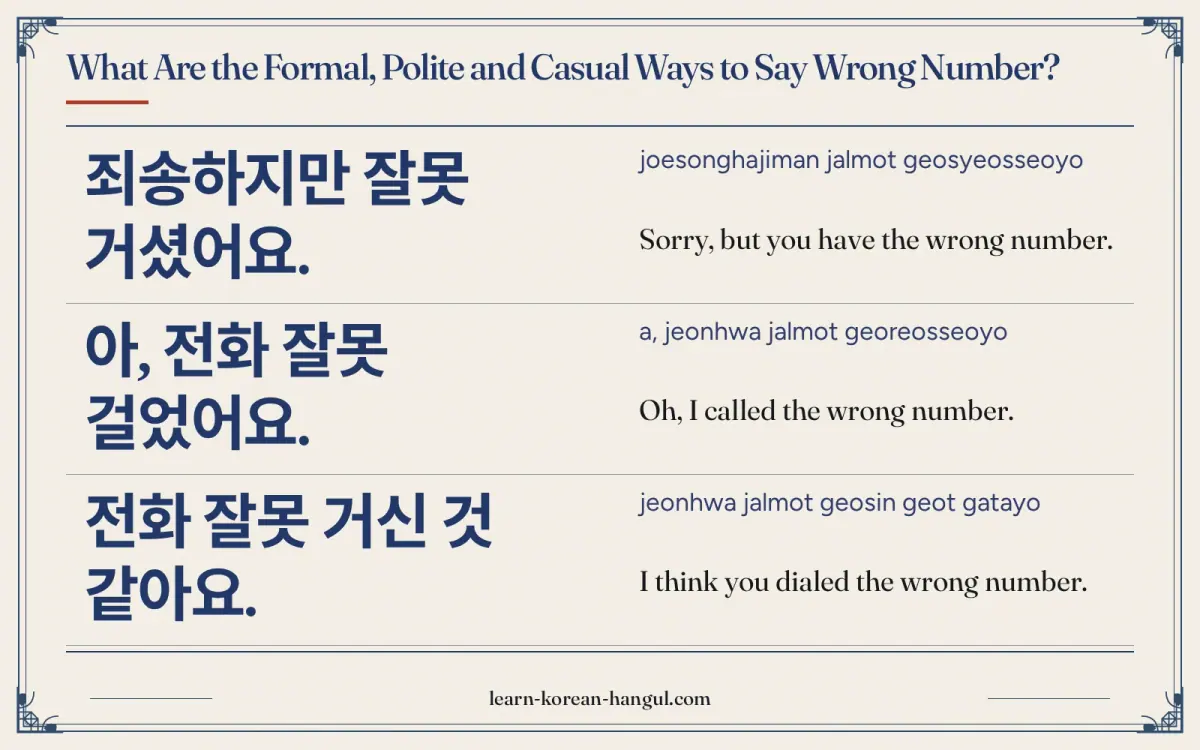
The forms follow the Korean speech levels, the endings that change with the listener. The guide to Korean speech levels explains each level. A call between strangers is usually polite, so most forms below use the polite or formal level.
Polite: 잘못 거셨어요 (jalmot geosyeosseoyo)
Polite · 해요체This is the standard reply when you answer a wrong call. The honorific -시- shows respect for the caller, and -었- puts the verb in the past, because the call has already been made. Adding 죄송하지만 (joesonghajiman, I'm sorry, but) makes it softer.
죄송하지만 잘못 거셨어요.
joesonghajiman jalmot geosyeosseoyo
Sorry, but you have the wrong number.
Polite: 전화 잘못 걸었어요 (jeonhwa jalmot georeosseoyo)
Polite · 해요체When you are the caller, you speak about yourself, so you use no honorific: 걸었어요. 전화 (jeonhwa) means "phone call", so the sentence says "I called wrongly". It is often said with a short apology.
아, 전화 잘못 걸었어요.
a, jeonhwa jalmot georeosseoyo
Oh, I called the wrong number.
Formal: 죄송합니다. 잘못 걸었습니다. (joesonghamnida. jalmot georeotseumnida)
Formal · 합쇼체The formal endings -ㅂ니다 and -습니다 are used by a caller to a business, an official or an older stranger. 죄송합니다 (joesonghamnida) is the formal "I'm sorry". It is pronounced [죄송함니다]. The caller often says it before hanging up, as in 죄송합니다, 잘못 걸었습니다. See sorry in Korean for the full set of apologies.
죄송합니다. 잘못 걸었습니다.
joesonghamnida. jalmot georeotseumnida
I'm sorry. I dialed the wrong number.
Polite: 전화 잘못 거신 것 같아요 (jeonhwa jalmot geosin geot gatayo)
Polite · 해요체If you are not sure the caller made a mistake, soften it with 것 같아요 (geot gatayo, "I think" or "it seems"). The form 거신 is the honorific modifier of 걸다. This is gentler than 잘못 거셨어요 and avoids blaming the caller.
전화 잘못 거신 것 같아요.
jeonhwa jalmot geosin geot gatayo
I think you dialed the wrong number.
Casual: 전화 잘못 걸었어 (jeonhwa jalmot georeosseo)
Casual · 반말With a friend or family member, drop the honorific and the polite ending. A caller says 어, 미안. 전화 잘못 걸었어 (oh, sorry, I called wrong). Do not use this with a stranger.
Before the sounds, one grammar point explains the forms.
How Does 걸다 Change?
걸다 (geolda) is an ㄹ-irregular verb. The final ㄹ of the stem drops before certain sounds, such as ㅅ, ㄴ and ㅂ. That is why the honorific of 걸다 is 거세요 (geoseyo) and not 걸세요, and the past honorific is 거셨어요.
- 걸다 → 걸어요 (georeoyo): calls
- 걸다 → 거세요 (geoseyo): the honorific, drops ㄹ before ㅅ
- 걸다 → 거셨어요 (geosyeosseoyo): the past honorific
- 걸다 → 겁니다 (geomnida): the formal present, drops ㄹ before ㅂ
The ㄹ stays before vowels without ㅅ, so you see 걸었어요 and 걸었습니다. The same pattern works for 만들다 (to make: 만드세요) and 알다 (to know: 아세요). Now the sounds.
How Do You Pronounce 잘못 거셨어요?
잘못 거셨어요 is pronounced [잘몯꺼셔써요], jal-mot geo-syeo-sseo-yo, in six syllables. Three sound changes help it flow.
- 잘 (jal): "jal", with a light l.
- 못 (mot) → [몯]: the final ㅅ is said as [ㄷ] and the tongue stops at the teeth.
- 거 (geo) → [꺼]: the ㄱ after a ㄷ sound is usually tense in this phrase.
- 셨 (syeot) → [셔써]: the ㅆ moves to the next syllable, so you hear 셔 and 써.
- 요 (yo): "yo".
The ㅓ in 거 and 셔 is unrounded: keep your lips relaxed, like "uh", not "oh".
Sound Changes to Listen For
These notes follow the National Institute of Korean Language standard pronunciation rules (표준 발음법):
- 잘못 is [잘몯]. At the end of a syllable, ㅅ is said as [ㄷ] (Article 9). Revised Romanization writes jalmot.
- A tense sound follows. In 잘못 걸었어요, the ㄱ after the [ㄷ] sound is usually said as tense [ㄲ], giving [잘몯꺼러써요]. RR does not write the tensing: jalmot georeosseoyo. See Korean tensification.
- 걸었어요 is [거러써요]. The final ㄹ and ㅆ both link to the next vowel (Article 13).
- 죄송합니다 is [죄송함니다]. The ㅂ before ㄴ becomes ㅁ (Article 18). See Korean nasalization.
- 걸었습니다 is [거럳씀니다]. The ㅆ is said as [ㄷ] before ㅅ, the ㅅ is tense, and the ㅂ is nasal. RR writes georeotseumnida.
With the sounds clear, here is when each form fits.
When Should You Use 잘못 거셨어요, and When Should You Not?
Use 잘못 거셨어요 when you answer a call that is clearly for someone else. Do not use it with a friend, and do not use it when you only suspect a mistake.
Situations Where It Fits
- A call from an unknown number. The caller asks for someone who does not live there, so you reply 잘못 거셨어요.
- A call to a shop. The caller wanted a different business, and you reply politely, then say 안녕히 계세요 (goodbye).
- A call you made by accident. You say 전화 잘못 걸었어요 and a quick apology.
Situations to Avoid
- A friend. Say 잘못 걸었네? or 번호 잘못 눌렀어? (did you press the wrong number?).
- A caller who may be right. Check first with 거기 어디예요? (where is this?) or use 것 같아요.
- A sharp tone. A cold 잘못 거셨어요 can sound like hanging up on someone. Keep your tone soft.
Two conversations show how it sounds.
What Does Wrong Number Sound Like in a Real Conversation?
A wrong-number call is short. The caller checks the name, the answerer says it is wrong, and both say goodbye.
A Wrong Number
Caller
여보세요? 거기 김민수 씨 댁이죠?
yeoboseyo? geogi Gim Minsu ssi daegijyo
Hello? Is this Mr. Kim Minsu's home?
Answerer
아니요, 잘못 거셨어요.
aniyo, jalmot geosyeosseoyo
No, you have the wrong number.
Caller
아, 죄송합니다. 잘못 걸었습니다.
a, joesonghamnida. jalmot georeotseumnida
Oh, I'm sorry. I dialed the wrong number.
Answerer
괜찮아요. 안녕히 계세요.
gwaenchanayo. annyeonghi gyeseyo
That's fine. Goodbye.
What to notice: the caller checks with -이죠? (isn't it?), a tag question that rises at the end. The answerer replies with a short, kind 괜찮아요 after the apology.
A Friend Dials Wrong
Doyun
어, 미안. 전화 잘못 걸었어.
eo, mian. jeonhwa jalmot georeosseo
Oh, sorry. I called the wrong number.
Seoyun
괜찮아. 누구한테 걸려고 했어?
gwaenchana. nuguhante geollyeogo haesseo
It's fine. Who were you trying to call?
Doyun
우리 형. 번호가 비슷해서.
uri hyeong. beonhoga biseutaeseo
My older brother. The numbers are similar.
Seoyun
아, 그렇구나.
a, geureokuna
Ah, I see.
What to notice: friends use the casual style. 누구한테 걸려고 했어? is a wh-question, so the pitch does not climb sharply at the end. 비슷해서 is pronounced [비스태서], and the Revised Romanization shows the aspirated sound: biseutaeseo.
What Should You Know about the Culture behind Wrong Number?
Wrong-number calls are usually short and polite. The caller apologises first, often with 죄송합니다, and the answerer replies with 괜찮아요 or 아니에요 and ends the call kindly. A brisk, friendly tone matters more than the exact words.
- Check before you dial. People often ask 거기 김민수 씨 댁 맞죠? (is this Mr. Kim Minsu's home?) to confirm, and the answer is 네, 맞아요 or 아니요, 아니에요.
- A recorded message. If you dial a number that does not exist, a recorded voice may say 없는 번호입니다 (eomneun beonhoimnida, pronounced [엄는 번호임니다]), "this number does not exist".
- Say the number slowly. If you want to check a number, see Korean phone numbers and what's your phone number in Korean.
If the caller asks who you are, the other side of the conversation is covered in who is this in Korean.
What Mistakes Do Learners Make with Wrong Number in Korean?
Most mistakes come from translating word by word or from the honorific.
| Mistake | Why it is a problem | Fix |
|---|---|---|
| 틀린 번호예요 | Understood, but not the set phrase | Say 잘못 거셨어요 |
| 잘못 거세요 | The present tense; the call is already made | Say 잘못 거셨어요 |
| 잘못 걸세요 | 걸다 drops ㄹ before ㅅ | Say 거세요 or 거셨어요 |
| 잘못 거셨어요 about yourself | The honorific is for others | Say 잘못 걸었어요 |
| [잘못 거셨어요] with a final ㅅ | The final ㅅ is said as [ㄷ] | Say [잘몯꺼셔써요] |
The honorific rule matters most. In Korean, you add -시- to show respect for the other person's actions, not your own. So the answerer says 거셨어요 about the caller, and the caller says 걸었어요 about themselves.
Is It the Same as Dialed Wrong or Wrong Number Korean?
Mostly. The searches folded into this page each have a short answer.
- Wrong number Korean: the same: 잘못 거셨어요 when you answer, 잘못 걸었어요 when you call.
- Dialed wrong in Korean: 잘못 걸었어요 (I called the wrong number), or 번호를 잘못 눌렀어요 (beonhoreul jalmot nulleosseoyo, I pressed the wrong number).
- A wrong number (noun): 잘못 걸린 전화 (jalmot geollin jeonhwa), "a call that came by mistake".
- Is this the wrong number? 번호 잘못 눌렀나요? (did I press the wrong number?).
- Wrong (adjective): 틀리다 for a wrong answer, 잘못되다 for something that went wrong.
Now say them aloud.
Practice: Say It Aloud
Play the slow clip of 잘못 거셨어요 three times, with [잘몯] and a tense [꺼]. Then choose a phrase. Answers follow.
- You answer a call for someone else, politely.
- You called the wrong number and apologise formally.
- You tell a friend that you dialed wrong.
- You softly say "I think you dialed the wrong number".
Answers
- 잘못 거셨어요.
- 죄송합니다. 잘못 걸었습니다.
- 전화 잘못 걸었어.
- 전화 잘못 거신 것 같아요.
The phrase flashcards drill these lines with audio.
Related Phrases to Learn Next
A wrong number usually involves an apology and a greeting.
- Sorry in Korean: 죄송합니다 and 미안해요 for the apology.
- Hello on the phone in Korean: 여보세요 for the start of a call.
- Who is this in Korean: 누구세요? for the other side.
- What's your phone number in Korean: how to ask for and give a number.
This guide belongs to the Korean phone phrases collection. What this page does not cover: customer-service scripts, voicemail and reading long numbers aloud. Use 거셨어요 for the caller, 걸었어요 for yourself, and you can say wrong number in Korean with confidence.
Frequently Asked Questions
How do you say wrong number in Korean?
If you answer the phone, say 잘못 거셨어요 (jalmot geosyeosseoyo), 'you have the wrong number'. If you are the caller, say 죄송합니다, 전화 잘못 걸었어요 (joesonghamnida, jeonhwa jalmot georeosseoyo), 'sorry, I called the wrong number'. The verb is 잘못 걸다, 'to dial wrongly'. There is no separate noun phrase you must say.
How do you pronounce 잘못 거셨어요?
It is pronounced [잘몯꺼셔써요], jal-mot geo-syeo-sseo-yo, in six syllables. The final ㅅ of 못 is said as [ㄷ] and the next ㄱ is usually tense, giving [꺼]. The ㅆ at the end of 셨 moves to the next syllable. The ㅓ in 거 and 셔 is unrounded: keep your lips relaxed. Revised Romanization writes jalmot geosyeosseoyo.
What is the difference between 잘못 거셨어요 and 전화 잘못 걸었어요?
The first is said to the caller, and it uses the honorific -시- to show respect for them: 'you dialed wrongly'. The second is said by the caller about themselves, with no honorific: 'I dialed wrongly'. The two are two sides of one conversation, so learn both.
Is 잘못 거셨어요 formal or casual?
It is polite. The ending -어요 suits most calls, and the honorific -시- adds respect. The formal version is 잘못 거셨습니다 (jalmot geosyeotseumnida), and the casual one, to a friend, is 잘못 걸었네 or 전화 잘못 걸었어. A caller who apologises formally says 잘못 걸었습니다.
Can I use 잘못 거셨어요 with friends, elders and strangers?
With a stranger, yes: it is the standard polite sentence. With an elder, it is respectful as it is. With a friend, the honorific sounds stiff, so say 잘못 걸었어 (you called wrong) or 번호 잘못 눌렀어? (did you press the wrong number?). A formal workplace may prefer 잘못 거셨습니다.
What is the most common mistake with wrong number in Korean?
Learners translate 'wrong number' word by word as 틀린 번호. Listeners will understand, but Koreans say 잘못 걸다, 'to call wrongly'. 틀리다 describes wrong answers, not wrong actions. A second mistake is using the present tense, 잘못 거세요, when the call has already been made. Use the past, 거셨어요.