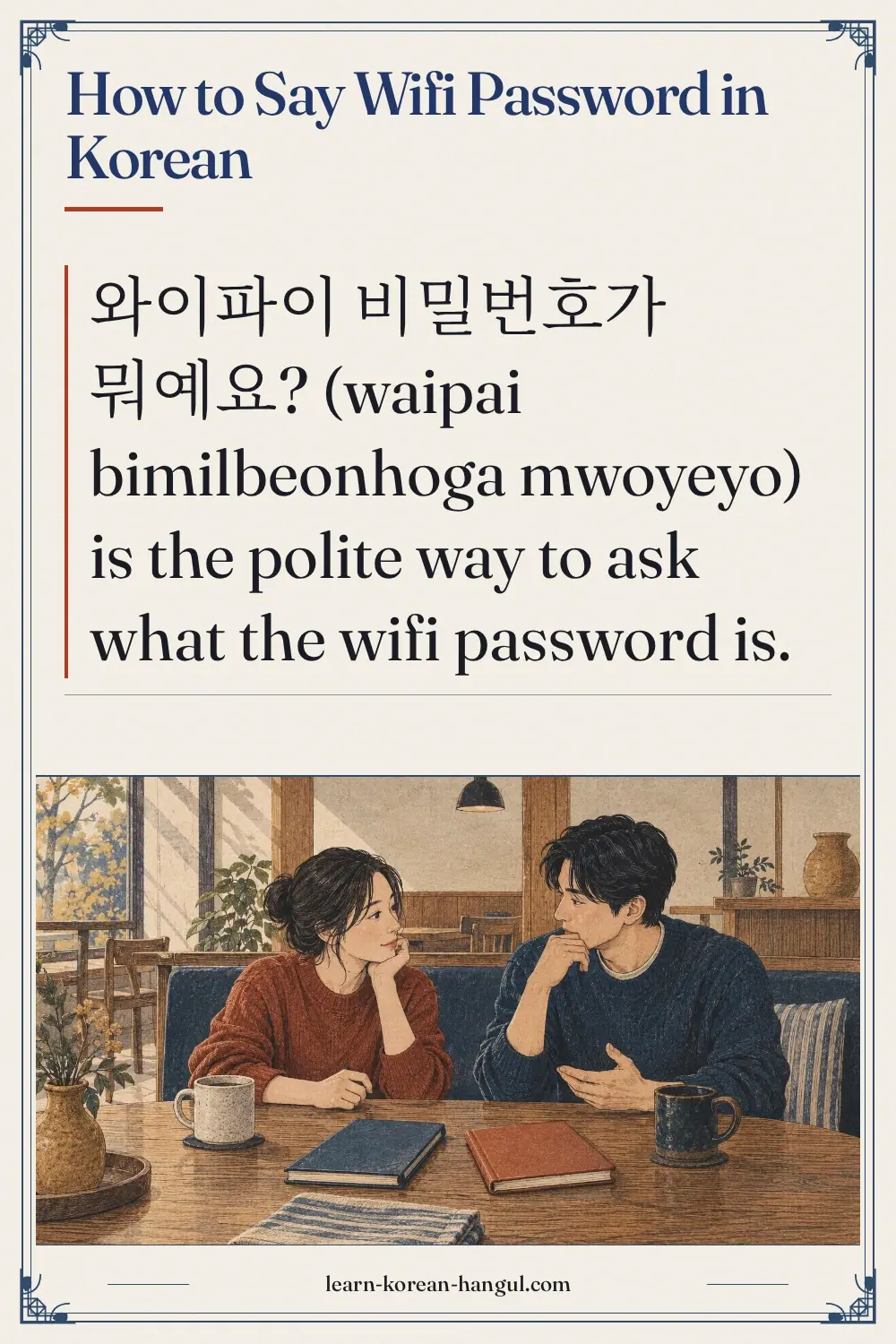
와이파이 비밀번호가 뭐예요?
와이파이 비밀번호가 뭐예요?
What you'll learn
- Ask for the wifi password with 와이파이 비밀번호가 뭐예요?, and ask whether wifi works with 와이파이 되나요?.
- Choose between the polite, casual and formal forms.
- Say 와이파이 as four syllables and 비밀번호 clearly.
- Avoid the common mistake of using 암호 for a password.
Before you start: you only need to read Hangul. If you are travelling, pair this page with check in in Korean. Time: about 10 minutes. Audio plays only when you press a button.
How Do You Say Wifi Password in Korean?
The standard way to ask is 와이파이 비밀번호가 뭐예요?. Read it in three parts. 와이파이 is "wifi", a loanword. 비밀번호 means "password" and is made of 비밀 (bimil, secret) and 번호 (beonho, number). 뭐예요 means "what is it?". The particle 가 marks 비밀번호 as the thing you are asking about, so the whole sentence is "what is the wifi password?".
| Situation | Best form | Romanization | Why |
|---|---|---|---|
| Asking staff or a stranger | 와이파이 비밀번호가 뭐예요? | waipai bimilbeonhoga mwoyeyo | Polite, clear |
| Checking that wifi exists | 와이파이 되나요? | waipai doenayo | Polite yes/no question |
| Asking someone to tell you | 비밀번호 알려 주세요 | bimilbeonho allyeo juseyo | Polite request |
| Asking a friend | 와이파이 비번 뭐야? | waipai bibeon mwoya | Casual |
| Formal speech or writing | 와이파이 비밀번호가 무엇입니까? | waipai bimilbeonhoga mueosimnikka | Formal |
Korean usually drops "the" and "I", so you do not need extra words. The next section sorts the forms by listener.
What Are the Polite Ways to Say Wifi Password?
Korean has speech levels: endings that change with the listener. The guide to Korean speech levels explains each level. For wifi, you can ask in three polite ways, and each does a different job.
Polite: 와이파이 비밀번호가 뭐예요? (waipai bimilbeonhoga mwoyeyo)
Polite · 해요체This is the form to learn first. It suits café staff, hotel desks, shop owners and anyone you do not know. It asks directly for the password, so use it when you already know the place offers wifi.
저기요, 와이파이 비밀번호가 뭐예요?
jeogiyo, waipai bimilbeonhoga mwoyeyo
Excuse me, what's the wifi password?
Because 뭐예요 asks "what", the question is a wh-question. Its pitch does not end in a sharp rise. Put the weight on 비밀번호 and let the end settle or dip slightly. A strong final rise can make it sound like a yes/no question.
Polite: 와이파이 되나요? (waipai doenayo)
Polite · 해요체The verb 되다 (doeda) means "to work" or "to be possible". So 와이파이 되나요? asks "does the wifi work here?" or "is wifi available?". It is a yes/no question, so the voice rises at the end. The ending -나요 is a soft, polite question form that sounds gentle and a little curious. Use it when you are not sure there is wifi at all.
여기 와이파이 되나요?
yeogi waipai doenayo
Does the wifi work here?
Polite: 비밀번호 알려 주세요 (bimilbeonho allyeo juseyo)
Polite · 해요체알려 주세요 means "please let me know" or "please tell me". It is a request, not a question, so it ends with a falling tone. It comes from the verb 알리다 (allida, to let someone know), plus 주세요 (please do it for me). Adding 좀 (jom, a little) makes it softer, and a short apology like 죄송하지만 (joesonghajiman, I'm sorry, but) makes it very polite.
죄송하지만 비밀번호 좀 알려 주세요.
joesonghajiman bimilbeonho jom allyeo juseyo
Sorry, but please tell me the password.
Casual: 와이파이 비번 뭐야? (waipai bibeon mwoya)
Casual · 반말With friends, family and people your age, drop the polite ending. 비번 (bibeon) is the everyday short form of 비밀번호, and 뭐야 is the casual form of 뭐예요. A casual request is 나 와이파이 비번 좀 알려 줘. Do not use these with staff, elders or strangers.
나 와이파이 비번 좀 알려 줘.
na waipai bibeon jom allyeo jwo
Tell me the wifi password, please.
Formal: 와이파이 비밀번호가 무엇입니까? (waipai bimilbeonhoga mueosimnikka)
Formal · 합쇼체무엇 (mueot) is the full word for "what", and -입니까 is the formal question ending. You will see this on a notice, hear it in an announcement or use it in a very formal setting. It is rare in a shop or café, where 뭐예요 is better. It is pronounced [무어심니까].
Now let us look at how the sounds work.
How Do You Pronounce 와이파이 비밀번호가 뭐예요?
Say it in twelve syllables with even rhythm: wa-i-pa-i bi-mil-beon-ho-ga mwo-ye-yo. Most of the sentence is spoken as written, so it is a good first phrase to read aloud.
- 와 (wa): a quick "w" into "ah", like "wa" in "water".
- 이 (i): "ee", a separate syllable.
- 파 (pa): a strong, breathy p, with a puff of air. The ㅍ is an aspirated consonant.
- 이 (i): "ee" again.
That makes 와이파이 four syllables. English speakers often say "wee-fee", with two syllables, and that sounds unclear. Count four beats: wa-i-pa-i.
Sound Changes to Listen For
These notes follow the National Institute of Korean Language standard pronunciation rules (표준 발음법):
- 비밀번호 has no change. Say [비밀번호] clearly: the ㄹ in 밀 and the ㅂ in 번 stay separate. The ㅎ in 호 is gentle between vowels, so 비밀번호가 flows into 가.
- 뭐예요 is [뭐예요]. The first part is a glide from "w" to "uh". In everyday speech many people say [뭐에요], and both are fine to hear.
- 알려 is spelled with two ㄹ. Say a long "l": [알려]. Hold the tongue on the ridge behind your teeth for a moment. See Korean liaison for the wider pattern.
- 무엇입니까 is [무어심니까]. The final ㅅ of 엇 moves to the next syllable (Article 13), and the ㅂ in 입 becomes ㅁ before ㄴ (Article 18). See Korean nasalization. Revised Romanization shows the nasal change: mueosimnikka.
With the sounds clear, the next question is when to use each form.
When Should You Use 와이파이 비밀번호가 뭐예요?, and When Should You Not?
Use 와이파이 비밀번호가 뭐예요? when you are a guest or customer and the place probably offers wifi. Do not use the casual 비번 뭐야 with anyone you do not know well.
Situations Where It Fits
- At a café. Order first, then ask 와이파이 비밀번호가 뭐예요?. Staff are used to this question.
- At a hotel desk. After check-in, ask 와이파이 비밀번호가 뭐예요? or 와이파이 되나요?.
- At a friend's home. Ask the host 와이파이 비밀번호 좀 알려 주세요 if the host is older, or 와이파이 비번 뭐야? if the host is a close friend.
Situations to Avoid
- Texting a work superior. Do not send 비번 뭐야?; write 비밀번호 알려 주실 수 있으세요? (bimilbeonho allyeo jusil su isseuseyo, could you tell me the password?).
- Asking for a bank or phone password. Never ask anyone for these. The phrase is only for public or shared wifi.
- Using 암호. This is the topic of the mistakes section below.
Two short conversations show how it sounds.
What Does Wifi Password Sound Like in a Real Conversation?
Real conversations are short. The customer asks, the staff member answers with a place or a number, and the customer says thanks.
In a Café
Customer
저기요, 여기 와이파이 되나요?
jeogiyo, yeogi waipai doenayo
Excuse me, does the wifi work here?
Staff
네, 돼요. 비밀번호는 영수증에 있어요.
ne, dwaeyo. bimilbeonhoneun yeongsujeunge isseoyo
Yes, it does. The password is on the receipt.
Customer
감사합니다.
gamsahamnida
Thank you.
What to notice: the customer asks about the wifi first, and the staff answer in the same polite level. The staff member says 비밀번호는, with 는, because the password is now the topic of the answer. In the second line, 돼요 is the polite form of 되다.
At the Hotel Desk
Guest
실례합니다. 와이파이 비밀번호가 뭐예요?
sillyehamnida. waipai bimilbeonhoga mwoyeyo
Excuse me. What's the wifi password?
Staff
안내 카드에 있어요. 한번 보세요.
annae kadeue isseoyo. hanbeon boseyo
It's on the information card. Please take a look.
Guest
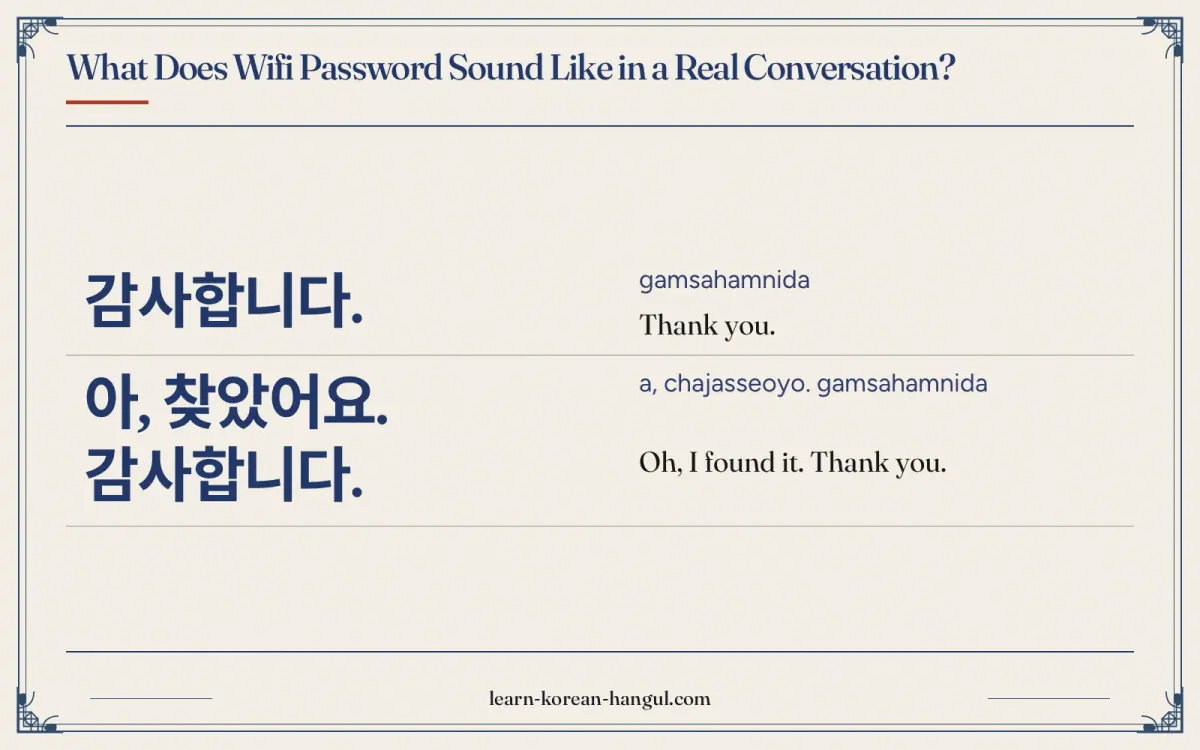
아, 찾았어요. 감사합니다.
a, chajasseoyo. gamsahamnida
Oh, I found it. Thank you.
What to notice: 실례합니다 is a formal way to get attention, a little more formal than 저기요. The staff member answers with a place, 안내 카드에, and a polite invitation, 보세요. The guest closes with 찾았어요 (I found it), pronounced [차자써요].
What Should You Know about the Culture behind Wifi Password?
Many cafés, hotels and public places in Korea offer wifi, and visitors ask for it all the time, so the question is neither rude nor unusual. The password is often posted on a sign or card, or printed on a receipt, so look around before you ask. Practice differs from place to place, and some places want you to order first.
- Ask after you order. In a café, the polite order is to buy something and then ask. It shows respect for the place.
- Numbers are read aloud. When staff say the password, they often read digits in Sino-Korean numbers, such as 일이삼사 (il-i-sam-sa). Listen for them and repeat them back.
- A small thank-you goes far. End with 감사합니다 or 고맙습니다.
Do not worry if the staff answer in English. Show that you tried, and say 감사합니다 anyway.
What Mistakes Do Learners Make with Wifi Password in Korean?
Most mistakes come from a wrong word choice or the wrong pronunciation of the English loanword.
| Mistake | Why it is a problem | Fix |
|---|---|---|
| 와이파이 암호가 뭐예요? | 암호 means a code or cipher, so it sounds like a secret code | Say 와이파이 비밀번호가 뭐예요? |
| Saying "wee-fee" | Korean listeners may not catch it | Say 와이파이 in four syllables |
| 비번 뭐야? to staff | Casual speech to a stranger sounds rude | Say 비밀번호가 뭐예요? |
| A sharp rising tone on 뭐예요 | It can sound like a yes/no question | Let the pitch settle at the end |
The word 암호 is the one most guides miss. Banks, spies and puzzle games use 암호. For a Wi-Fi, phone lock, email or account password, Koreans say 비밀번호, so you should too. A related word you will see on screens is 패스워드 (paseuwodeu, a loanword for password). It is understood, but 비밀번호 is the standard word.
Is It the Same as Wifi?
Mostly the phrase covers the single-word searches folded into this page. Each also has a dedicated guide.
- Wifi in Korean: 와이파이. The full guide is wifi in Korean.
- Internet in Korean: 인터넷 (inteonet), pronounced [인터넫] at the end of a phrase. See internet in Korean for more.
- Password in Korean: 비밀번호. The word guide is password in Korean.
- Wifi name in Korean: 와이파이 이름 (waipai ireum). Ask 와이파이 이름이 뭐예요?.
- Is there wifi? 와이파이 있어요? asks whether the place has it, and 와이파이 되나요? asks whether it works.
The phone page covers the other side of a typical exchange, so see what's your phone number in Korean when you need to share your number back.
Practice: Say It Aloud
Play the slow clip of 와이파이 비밀번호가 뭐예요? three times. Then read each line aloud, keeping four beats on 와이파이. Choose the phrase for each case. Answers follow.
- You ask a barista you have not met.
- You are not sure the café has wifi.
- You ask a friend at their home.
- You want the staff member to tell you the password politely.
Answers
- 와이파이 비밀번호가 뭐예요?
- 와이파이 되나요?
- 와이파이 비번 뭐야?
- 비밀번호 알려 주세요.
The phrase flashcards drill these lines with audio.
Related Phrases to Learn Next
A wifi question often comes at the start of a stay.
- Check in in Korean: the first conversation at a hotel desk.
- Do you have a room in Korean: how to ask for a room.
- What's your phone number in Korean: the other thing people exchange.
This guide belongs to the Korean hotel phrases collection. What this page does not cover: network settings, tech terms on a router, or reading the password aloud letter by letter. Ask politely, use 비밀번호, say 와이파이 in four beats, and you can say wifi password in Korean with confidence.
Frequently Asked Questions
How do you say wifi password in Korean?
Say 와이파이 비밀번호가 뭐예요? (waipai bimilbeonhoga mwoyeyo) in polite speech. It means 'what's the wifi password?'. To a friend, say 와이파이 비번 뭐야? (waipai bibeon mwoya). In a formal setting, say 와이파이 비밀번호가 무엇입니까?. The noun phrase on its own is 와이파이 비밀번호 (waipai bimilbeonho).
How do you pronounce 와이파이 비밀번호가 뭐예요?
Say it as written, in twelve syllables: wa-i-pa-i bi-mil-beon-ho-ga mwo-ye-yo. 와이파이 has four syllables and the ㅍ is a strong, breathy p. 비밀번호 has no sound change. 뭐예요 is [뭐예요], and in quick speech it often sounds like [뭐에요]. The question is a wh-question, so it does not end in a sharp rise.
What is the difference between 와이파이 비밀번호가 뭐예요? and 와이파이 되나요?
와이파이 비밀번호가 뭐예요? asks for the password itself. 와이파이 되나요? asks whether the wifi works or is offered at all. Ask 되나요 first if you are not sure there is wifi, then ask for the password. Both are polite and suit staff, strangers and elders.
Can I use 와이파이 비밀번호가 뭐예요? with friends, elders and strangers?
Yes for strangers, staff and most elders, because the 요 ending is polite. With close friends the casual 와이파이 비번 뭐야? sounds more natural. With a very senior person or in writing, 와이파이 비밀번호가 무엇입니까? is the formal choice. Adding 저기요 (excuse me) or 좀 (a little) makes any version softer.
What is the most common mistake with wifi password in Korean?
Learners use 암호 (amho) for a wifi password. 암호 means a code or cipher, such as a secret code in a story or a bank's security code. For a login, phone or wifi password, the everyday word is 비밀번호. A second common mistake is saying 'wee-fee' instead of 와이파이.
How do I ask for the name of the wifi network in Korean?
Say 와이파이 이름이 뭐예요? (waipai ireumi mwoyeyo), which means 'what's the wifi name?'. Staff often point to a sign or a card. Then ask 비밀번호는요? (bimilbeonhoneunyo), 'and the password?'.