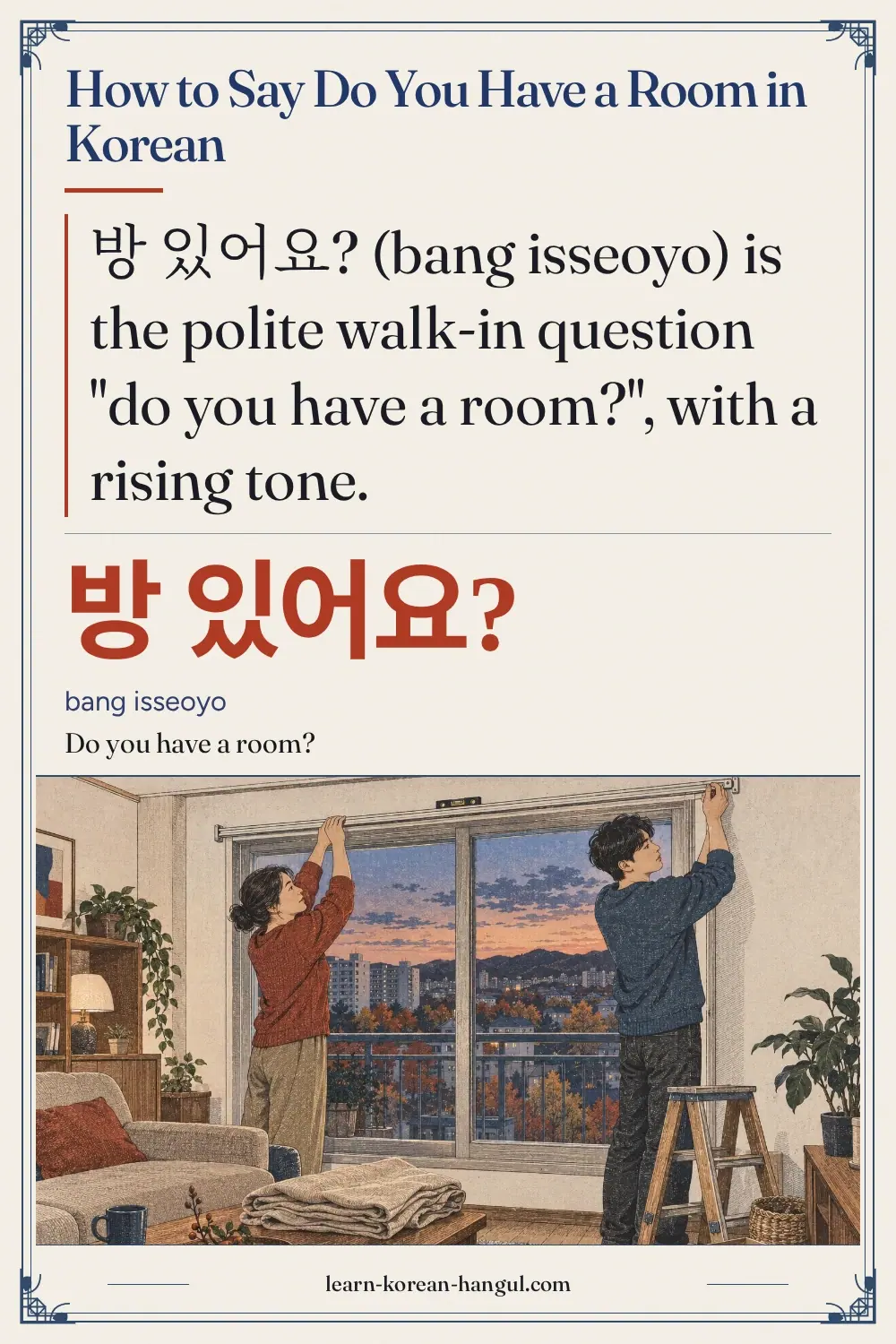
방 있어요?
방 있어요?
What you'll learn
- Ask for a room with 방 있어요? and 빈방 있어요?
- Ask for a single room with 1인실 있어요? and ask the price with 하룻밤에 얼마예요?
- Count nights with 박 and Sino-Korean numbers.
- Pronounce 있어요 as [이써요] and 하룻밤 as [하루빰].
Before you start: the endings below follow the levels explained in Korean speech levels. Once you have a room, check in in Korean is the next step. Time: about 12 minutes. Audio plays only when you press a button.
How Do You Say Do You Have a Room in Korean?
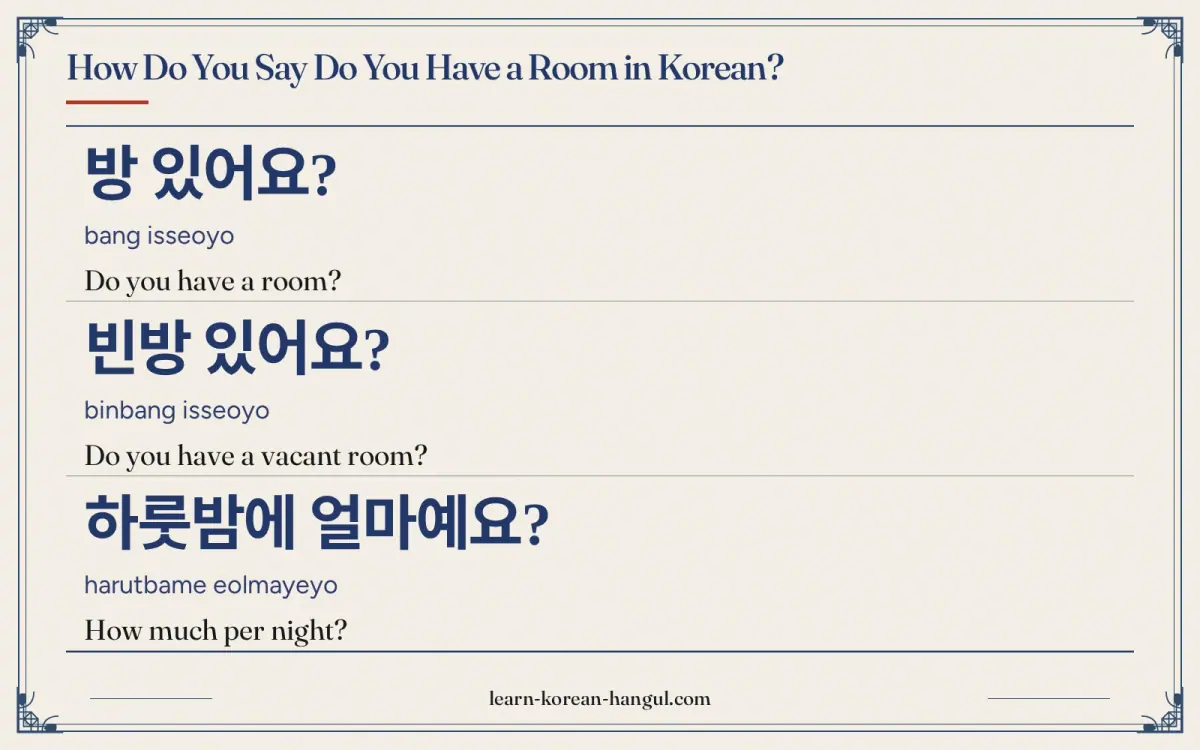
The standard way to say do you have a room in Korean is 방 있어요?, from 방 (room) and 있어요 (there is). The question has no subject or particle, which is normal in spoken Korean. The table shows the main choices.
| Situation | Korean | Romanization | Meaning |
|---|---|---|---|
| Standard walk-in question | 방 있어요? | bang isseoyo | Do you have a room? |
| Asking for a vacancy | 빈방 있어요? | binbang isseoyo | Do you have a vacant room? |
| Asking the price | 하룻밤에 얼마예요? | harutbame eolmayeyo | How much per night? |
| One person | 1인실 있어요? | irinsil isseoyo | Do you have a single room? |
| More formal | 방 있습니까? | bang itseumnikka | Do you have a room? |
Revised Romanization (the South Korean government standard of 2000) is a reading aid here. Learn the Hangul first. A sign saying 만실 (mansil) means the hotel is full.
What Are the Polite Ways to Say Do You Have a Room?
Do you have a room has four useful questions, and all of them are polite. They differ in what they ask, so you will often use two or three in a row.
Polite: 방 있어요? (bang isseoyo)
Polite · 해요체방 있어요? is the opening question. It is a yes or no question, so the pitch rises on the last syllable. Add 오늘 밤 ("tonight") to say when you need the room.
오늘 밤 방 있어요?
oneul bam bang isseoyo
Do you have a room tonight?
For a more formal tone, a clerk or a business traveller may ask 방 있습니까?, which is also correct but less common at a walk-in desk.
Polite: 빈방 있어요? (binbang isseoyo)
Polite · 해요체빈방 combines 빈 (empty) and 방 (room), so 빈방 있어요? asks for a vacant room. It is the closest everyday phrase to "vacancy". Add the room type you prefer, such as 온돌방 (a floor room with a heated floor).
빈방 있어요? 온돌방이면 좋아요.
binbang isseoyo? ondolbangimyeon joayo
Do you have a vacant room? A heated-floor room would be nice.
Polite: 하룻밤에 얼마예요? (harutbame eolmayeyo)
Polite · 해요체하룻밤에 얼마예요? asks "how much for one night?". 하룻밤 means one night, and 에 here means "per". Because the question word is 얼마, the pitch usually falls or rise-falls instead of rising sharply. Ask about breakfast at the same time: 조식 포함이에요? ("is breakfast included?").
하룻밤에 얼마예요? 조식 포함이에요?
harutbame eolmayeyo? josik pohamieyo
How much per night? Is breakfast included?
Polite: 1인실 있어요? (irinsil isseoyo)
Polite · 해요체1인실 means a room for one person (인 is the counter for people, 실 means room). 2인실 is a room for two. The number is read in Sino-Korean, so 1인실 is said [이린실].
1인실 있어요? 이 박 묵을 거예요.
irinsil isseoyo? i bak mugeul geoyeyo
Do you have a single room? I will stay two nights.
With staff at a hotel, you will always use the polite or formal forms, so there is no casual version to learn here. Four questions cover most requests. Next, the sounds, because tense consonants and a number change are involved.
How Do You Pronounce 방 있어요?
방 있어요? is pronounced [방 이써요], bang i-sseo-yo, in four syllables. The question mark in writing matches a rising pitch in speech.
- 방 (bang): a short "bang", ending in the nasal "ng".
- 있 (is) → 이 (i): the final ㅆ moves forward.
- 어 (eo) → 써 (sseo): the moved ㅆ joins the vowel and sounds tense.
- 요 (yo): a short "yo", with the pitch rising for a question.
Sound Changes to Listen For
Three features shape this phrase and its relatives:
- Liaison. The final ㅆ of 있 moves onto the next vowel, so 있어요 is [이써요]. The rule is covered in Korean liaison.
- Tensification and sai-siot. In 하룻밤, the sai-siot ㅅ makes the ㅂ that follows tense, so it is [하루빰]. The standard also allows [하룯빰], with the ㅅ said as [ㄷ]. With 에, it becomes [하루빠메]. Revised Romanization does not show tensing caused by a neighbouring sound, so it writes harutbam. See Korean tensification and the page on sai-siot.
- Sino-Korean numbers. 1인실 is read 일인실 and sounds like [이린실], because the ㄹ of 일 moves onto 인.
Say [이써요] with a tense ㅆ, and raise your pitch at the end. Knowing how to ask is only half the job, because you also need to understand the answer.
What Will the Clerk Say, and How Do You Count Nights?
The clerk's replies are short, and nights are counted with the counter 박. Hearing these phrases once will help you follow the conversation.
| Clerk says | Korean | Meaning |
|---|---|---|
| Yes, we do | 네, 있어요 | Yes, there is one |
| Sorry, we are full | 죄송합니다. 만실이에요 | Sorry, we are full |
| How many people? | 몇 분이세요? | How many people are you? |
| How many nights? | 몇 박이세요? | How many nights? |
Answer with a Sino-Korean number plus 박: 1박 (il bak), 2박 (i bak), 3박 (sam bak). A stay of two nights and three days is 2박 3일 (i bak sam il). Do not count nights with 개 (things) or with native numbers. People are counted with 명, so 두 명이에요 means "two people".
When Should You Use 방 있어요?, and When Should You Not?
Use 방 있어요? when you arrive without a booking, and skip it when you already have one. The question has a specific job.
Situations Where It Fits
- A walk-in at a hotel, guesthouse or motel. 방 있어요? at the front desk.
- Calling ahead on the day. 오늘 밤 방 있어요? on the phone.
- Changing rooms. 빈방 있어요? to ask for another room.
Situations to Avoid
- You already have a booking. Say your name and 예약했어요 (yeyakaesseoyo, "I reserved") instead.
- Asking a friend about their home. The question is a service request, so use another phrase.
Three short dialogues show how the exchange sounds.
What Does Do You Have a Room Sound Like in a Real Conversation?
A room request usually takes three exchanges: availability, people or nights, and price. Listen for the rising tone on yes or no questions and the falling tone on questions with 얼마.
A Walk-in at the Front Desk
Guest
안녕하세요. 방 있어요?
annyeonghaseyo. bang isseoyo
Hello. Do you have a room?
Clerk
네, 있어요. 몇 분이세요?
ne, isseoyo. myeot buniseyo
Yes, we do. How many people?
Guest
두 명이에요.
du myeongieyo
Two people.
What to notice: the clerk asks 몇 분이세요? with the honorific counter 분, while the guest answers with the plain counter 명.
Asking for a Single Room
Guest
1인실 있어요?
irinsil isseoyo
Do you have a single room?
Clerk
네. 며칠 계세요?
ne. myeochil gyeseyo
Yes. How many days will you stay?
Guest
이 박이요.
i bagiyo
Two nights.
What to notice: the guest answers with a number and 박, and the ending 이요 turns the answer into a polite fragment.
Asking the Price
Guest
하룻밤에 얼마예요?
harutbame eolmayeyo
How much per night?
Clerk
칠만 원이에요. 조식 포함이에요.
chilman wonieyo. josik pohamieyo
It's 70,000 won. Breakfast is included.
Guest
좋아요. 그 방으로 할게요.
joayo. geu bangeuro halgeyo
Good. I'll take that room.
What to notice: the guest accepts with 할게요, which is pronounced [할께요], a promise to do something.
What Should You Know about the Culture behind Do You Have a Room?
Lodging in Korea comes in several types, and the room type matters as much as the price. The details below are typical, not universal.
- Floor rooms and bed rooms. An 온돌방 (ondolbang) has a heated floor and bedding on the floor. A 침대방 (chimdaebang) has a bed. Ask for the one you prefer.
- Many kinds of lodging. Hotels, guesthouses, hanok stays and motels all exist. A 모텔 (motel) is often a simple, budget room and is not the same as a Western roadside motel.
- Walk-ins and apps. Many places take walk-ins, but online booking apps are common, so a phone call or the app may be faster.
- Counters ask about people. A clerk will often ask 몇 분이세요? before quoting a price, because the price can depend on the number of guests.
An expert insight: the word on a hotel sign is often 객실 (gaeksil, "guest room"), while 방 is what you say aloud. The mistakes below are the ones that make the exchange slow.
What Mistakes Do Learners Make with Do You Have a Room in Korean?
Most mistakes involve counting, tone and the sounds of 있어요.
| Mistake | Why it is a problem | Fix |
|---|---|---|
| Counting nights with 개 or 하나, 둘 | Korean counts nights with 박 | Say 1박, 2박, 3박 |
| Flat tone on 방 있어요 | Sounds like "there is a room" | Raise the last syllable |
| Saying 있어요 as [잇어요] | Misses the liaison and the tense ㅆ | Say [이써요] |
| Saying 하룻밤 as [하룻밤] | Misses the tense ㅂ | Say [하루빰] |
| Answering 몇 분이세요? with 두 분이에요 | 분 is the honorific counter, not for yourself | Say 두 명이에요 |
Learners often assume 하룻밤 is two words, but it is one word, spelled with the sai-siot ㅅ, and spacing it as 하루 밤 is an error.
Is It the Same as Room, Single Room, Double Room and Vacancy in Korean?
Not exactly. Each search points to a nearby word, and the short answers below separate them. The page on room in Korean covers the word 방 in depth.
- Room in Korean: 방 (bang) for any room, and 객실 (gaeksil) for a hotel guest room.
- Single room in Korean: 1인실 (irinsil), or 싱글룸 in some listings.
- Double room in Korean: 2인실 (iinsil), a room for two people. Some listings use 더블룸 for a double bed.
- Vacancy in Korean: 빈방 (binbang) for an empty room, and 만실 (mansil) when there is no vacancy.
Now practise the question with your own voice.
Practice: Say It Aloud
Play the slow clip and repeat 방 있어요? three times, raising the last syllable. Then choose the right phrase. Answers follow.
- You arrive without a booking and need a room tonight.
- You travel alone and want one person's room.
- You want to know the price for one night.
- How do you say "three nights"?
Answers
- 오늘 밤 방 있어요?
- 1인실 있어요?
- 하룻밤에 얼마예요?
- 3박 (sam bak)
The phrase flashcards drill these questions with audio.
Related Phrases to Learn Next
Do you have a room connects to the phrases for arriving and paying.
- Check in in Korean: what to say when you reach the desk with a booking.
- How much is it in Korean: the general price question.
- Wifi password in Korean: the first question many guests ask in the room.
This guide belongs to the Korean hotel phrases collection. What this page does not cover: booking online and complaints about a room. Rise on the last syllable, count the nights with 박, and you can ask do you have a room in Korean at any front desk.
Frequently Asked Questions
How do you say do you have a room in Korean?
Say 방 있어요? (bang isseoyo) with a rising tone at a hotel, guesthouse or motel. To be more specific, say 빈방 있어요? ("do you have a vacant room?") or 1인실 있어요? ("do you have a single room?"). Add 오늘 밤 ("tonight") to say when you need it.
How do you pronounce 방 있어요?
Say bang i-sseo-yo, written [방 이써요]. The ㅆ in 있 moves onto the next syllable, so 있어요 sounds like 이써요. Raise your pitch on the last syllable to make it a question. For the price question, 하룻밤에 is said [하루빠메] with a tense ㅂ.
What is the difference between 방 있어요? and 하룻밤에 얼마예요?
방 있어요? asks whether a room is available, and 하룻밤에 얼마예요? asks the price for one night. Ask them in that order. The first is a yes or no question that rises, while the second has the question word 얼마 and usually falls or rise-falls.
Can I use 방 있어요? with friends, elders and strangers?
Yes, with strangers it is the normal polite question at a front desk. With elders and formal staff, you can also say 방 있습니까?, which is more formal. With friends, you would not ask this question, because the context is a business.
How do you say how many nights in Korean?
Say 몇 박이세요? (myeot bagiseyo) when a clerk asks you, and answer with 1박, 2박 or 3박, read as il bak, i bak and sam bak. Nights use the counter 박 with Sino-Korean numbers. A trip of two nights and three days is 2박 3일.
What is the most common mistake with do you have a room in Korean?
Counting nights with 개 or native numbers, when Korean uses 박 with Sino-Korean numbers. Another mistake is a flat tone on 방 있어요, which makes it a statement. A third is saying 하룻밤 as [하룻밤] with a sounded ㅅ, instead of [하루빰].