체크인하고 싶어요
체크인하고 싶어요
What you'll learn
- Say 체크인하고 싶어요, 예약했어요 and 여권 여기 있어요 at the front desk.
- Understand the staff question 성함이 어떻게 되세요?
- Pronounce 체크인하고 싶어요 as [체크인하고 시퍼요] and 예약했어요 as [예야캐써요].
- Avoid the common mistake of using 성함 for your own name.
Before you start: if you have not booked a room, see do you have a room in Korean first. Time: about 12 minutes. Audio plays only when you press a button.
How Do You Say Check in in Korean?
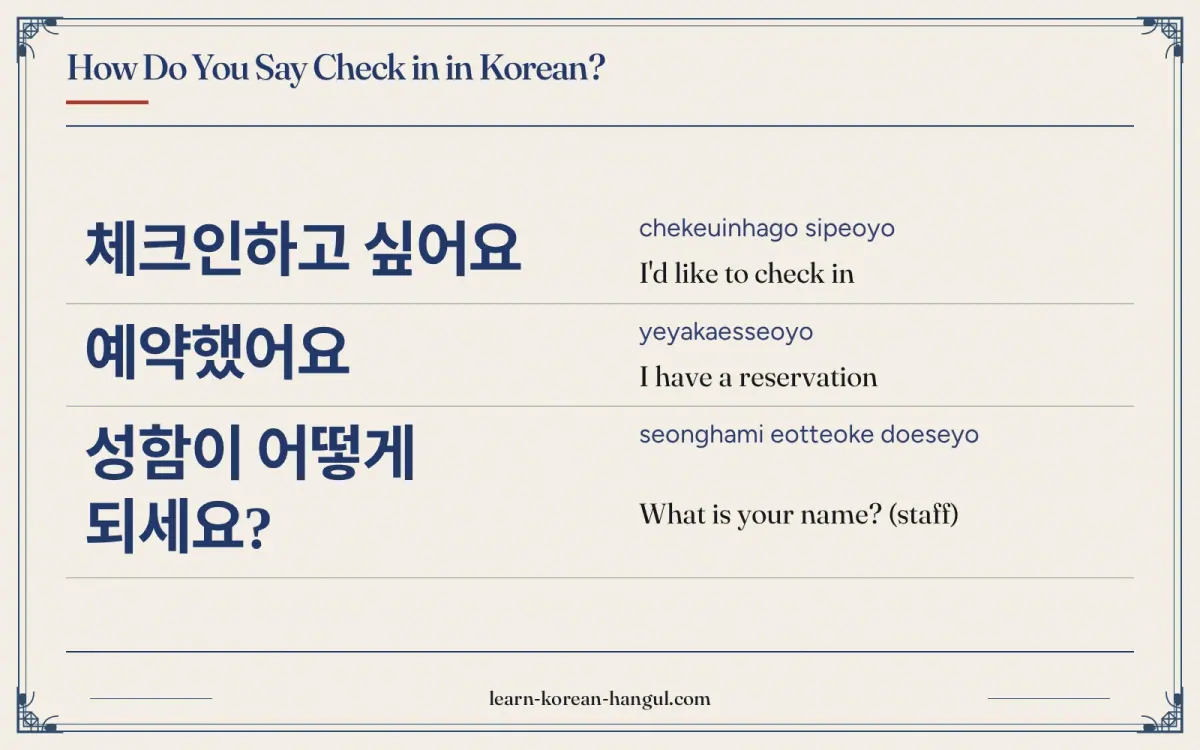
The standard way to check in in Korean is 체크인하고 싶어요. The loanword 체크인 (chekeuin) comes from English "check-in" and has three syllables. The ending -고 싶어요 means "I want to", so the sentence says "I want to check in". It sounds softer than a plain statement, which suits a request at a desk.
| Korean | Romanization | Meaning | Where you hear it |
|---|---|---|---|
| 체크인하고 싶어요 | chekeuinhago sipeoyo | I'd like to check in | Starting the check-in |
| 예약했어요 | yeyakaesseoyo | I have a reservation | Giving booking details |
| 성함이 어떻게 되세요? | seonghami eotteoke doeseyo | What is your name? (staff) | Staff to guest |
| 여권 여기 있어요 | yeogwon yeogi isseoyo | Here is my passport | Handing over ID |
Revised Romanization (the South Korean government standard of 2000) is only a reading aid here. Learn the Hangul first. The next section shows how each line fits a moment at the desk.
What Are the Polite Ways to Say Check In?
Hotel Korean is polite from start to finish. Guests and staff both use the 요 or 습니다 style, as explained in Korean speech levels. The lines below follow the order of a normal check-in.
Polite: 체크인하고 싶어요 (chekeuinhago sipeoyo)
Polite · 해요체체크인하고 싶어요 opens the conversation. Say it after a greeting. The verb 체크인하다 means "to check in", and -고 싶어요 expresses a wish. You can also say just 체크인할게요 ("I'll check in"), but the wish form sounds gentler.
안녕하세요. 체크인하고 싶어요.
annyeonghaseyo. chekeuinhago sipeoyo
Hello. I'd like to check in.
Polite: 예약했어요 (yeyakaesseoyo)
Polite · 해요체예약했어요 is the past form of 예약하다 (to reserve), and Koreans use it to say "I have booked". Follow it with the name on the booking. The phrase 이름으로 means "under the name".
김민수 이름으로 예약했어요.
gim minsu ireumeuro yeyakaesseoyo
I booked under the name Kim Min-su.
Staff: 성함이 어떻게 되세요? (seonghami eotteoke doeseyo)
Polite · 해요체성함이 어떻게 되세요? is what staff ask you. 성함 is the honorific word for someone's name, and 되세요 is the honorific of "to become". You will hear it, but you do not say it about yourself. It is a wh-question, so the pitch does not rise sharply at the end.
성함이 어떻게 되세요?
seonghami eotteoke doeseyo
May I have your name?
Polite: 여권 여기 있어요 (yeogwon yeogi isseoyo)
Polite · 해요체여권 여기 있어요 is what you say as you hand over your passport. Foreign guests usually need to show one. 있어요 means "it is here", so the sentence works as a plain, polite handover.
네, 여권 여기 있어요.
ne, yeogwon yeogi isseoyo
Yes, here is my passport.
Four lines cover most check-ins: the wish, the reservation, the staff question and the passport. The next section shows how to pronounce them.
How Do You Pronounce 체크인하고 싶어요?
체크인하고 싶어요 is pronounced [체크인하고 시퍼요], in eight syllables. The spelling and the sound differ in the last two words, so go slowly.
- 체 (che): an aspirated ch and the vowel ㅔ.
- 크 (keu): an aspirated k and the flat ㅡ vowel, with the lips spread.
- 인 (in): a clear i and n.
- 하 (ha) and 고 (go): plain and light.
- 싶 (si): a soft s followed by i. The final ㅍ moves on to the next syllable.
- 어 (peo): the ㅍ links to 어 and is spoken as an aspirated p, so you hear [퍼].
- 요 (yo): a short, light ending.
Sound Changes to Listen For
- Linking ㅍ. The final ㅍ of 싶 moves to the vowel of 어, so 싶어요 sounds like [시퍼요]. This is always so, not a casual habit.
- Aspirated ㅋ. In 예약했어요, the ㄱ of 약 and the ㅎ of 했 merge into one aspirated ㅋ, and the verb is spoken [예야캐써요]. Revised Romanization shows this in verbs and writes yeyakaesseoyo.
- Linking ㅁ. In 성함이, the ㅁ links to the vowel of 이, so it sounds like [성하미].
- Tense ㄱ in 여권. The word 여권 is spoken [여꿘], with a tense ㄱ in the second syllable.
Learners often say 체크인 as "check-in" with one beat. Korean spreads it over three syllables, 체-크-인, with a short ㅡ after the k. Once the sound is right, the next question is when each line fits.
When Should You Use 체크인하고 싶어요, and When Should You Not?
Use 체크인하고 싶어요 when you reach the desk, and 예약했어요 when you have a booking. Say 여권 여기 있어요 when the staff ask for ID. The order is the same in a hotel, a guesthouse or a resort. If you arrive early, you can ask 일찍 체크인할 수 있어요? (iljjik chekeuinhal su isseoyo), pronounced [일찍 체크인할쑤 이써요]. It is a yes-or-no question, so it ends with a rise.
Situations Where It Fits
- A hotel front desk. Greet the staff, say 체크인하고 싶어요, then give your name.
- A guesthouse or hanok. The same lines work. Small places may ask you to wait while they prepare the room.
- An early arrival. Ask 일찍 체크인할 수 있어요? and be ready to leave your luggage.
Situations to Avoid
- 제 성함은 ... 입니다. 성함 honours the owner of the name, so it is not used for yourself. Say 이름.
- Casual forms with staff. 체크인할래 is for a friend, not a front desk.
- Giving a booking name without 예약했어요. The staff may not know you have a booking.
Three short scenes show the lines in context.
What Does Check in Sound Like in a Real Conversation?
Check-in usually has three beats: the wish, the name and the passport. Listen for the staff question.
At the Front Desk
Guest
안녕하세요. 체크인하고 싶어요.
annyeonghaseyo. chekeuinhago sipeoyo
Hello. I'd like to check in.
Staff
네, 성함이 어떻게 되세요?
ne, seonghami eotteoke doeseyo
Yes, may I have your name?
Guest
김민수예요. 예약했어요.
gim minsuyeyo. yeyakaesseoyo
I am Kim Min-su. I have a reservation.
What to notice: The guest gives the name with 김민수예요 and does not use 성함 for it. 예요 after a vowel is the standard form, with [에요] as the common spoken variant.
Showing a Passport
Staff
여권 좀 보여 주세요.
yeogwon jom boyeo juseyo
Please show me your passport.
Guest
네, 여권 여기 있어요.
ne, yeogwon yeogi isseoyo
Yes, here is my passport.
What to notice: 보여 주세요 is a polite request with the verb 보이다 (to show). The staff use the same 주세요 pattern as in call me in Korean.
Arriving Early
Guest
일찍 체크인할 수 있어요?
iljjik chekeuinhal su isseoyo
Can I check in early?
Staff
방을 준비 중이에요. 잠시만 기다려 주세요.
bangeul junbi jungieyo. jamsiman gidaryeo juseyo
We are preparing the room. Please wait a moment.
What to notice: The guest's question rises at the end because it is a yes-or-no question. The staff reply with 기다려 주세요, a polite request to wait.
What Should You Know about the Culture behind Check In?
Check-in follows a few habits. These are general, and each hotel sets its own rules.
- Passport or ID. Hotels ask for a passport or an ID card at check-in. Keep your passport ready, not packed.
- Honorific name. 성함 is the honorific word for someone's name, used by staff to guests. Guests use 이름 for themselves.
- Afternoon check-in. Many hotels open check-in in the afternoon, and the exact time differs by hotel. Check your booking.
- Key cards. Rooms usually open with a key card, called 카드키 (kadeuki). Staff will hand it over after the form.
An expert tip: say the name of the booking, not just 예약했어요. 김민수 이름으로 예약했어요 gives the desk what it needs in one sentence. For the single word, see reservation in korean. When you leave, the matching phrase is in check out in Korean.
What Mistakes Do Learners Make with Check in in Korean?
Most errors at the desk come from the honorific name word or from the sound of the loanword.
| Mistake | Why it is a problem | Fix |
|---|---|---|
| Calling your own name 성함 | 성함 is honorific and only for others | Say 이름 |
| Saying 체크인 in one beat | Korean spreads it over three syllables | Say 체-크-인 |
| Using casual 체크인할래 with staff | It sounds like speech to a friend | Say 체크인하고 싶어요 |
| Saying 예약했어요 as [예약했어요] | The ㄱ and ㅎ merge into ㅋ | Say [예야캐써요] |
| Saying 싶어요 as "sip-eo-yo" | The ㅍ moves to the next vowel | Say [시퍼요] |
Learners often think the loanword 체크인 is the whole job. The verb ending, the name and the passport complete the sentence.
Is It the Same as Hotel Check in or I Have a Reservation?
Mostly yes. The searches below point to the same few lines.
- Hotel check in in Korean: 체크인하고 싶어요, the same line as above.
- Reservation in Korean: 예약 (yeyak), pronounced [예약].
- I have a reservation in Korean: 예약했어요, or 예약이 있어요 (yeyagi isseoyo), pronounced [예야기 이써요].
Practice: Say It Aloud
Play the slow clip and repeat 체크인하고 싶어요 three times. Then choose the best line for each scene. Answers follow.
- You reach the desk and want to start.
- The clerk asks 성함이 어떻게 되세요?
- The clerk asks to see your passport.
- How is 싶어요 pronounced?
Answers
- 체크인하고 싶어요.
- 김민수예요. (or give your own name with 이에요 / 예요.)
- 네, 여권 여기 있어요.
- [시퍼요]: the ㅍ links to the vowel of 어.
The phrase flashcards drill these lines with audio.
Related Phrases to Learn Next
Checking in connects to other hotel phrases.
- check out in Korean: what to say when you leave.
- wifi password in Korean: the first thing many guests ask after check-in.
- do you have a room in Korean: when you have no booking.
This guide belongs to the korean hotel phrases collection. What this page does not cover: payment, deposits and room upgrades. Learn the wish, the booking and the passport line, and you can check in in Korean at any hotel.
Frequently Asked Questions
How do you say check in in Korean?
Say 체크인하고 싶어요 (chekeuinhago sipeoyo) for "I'd like to check in". If you have a booking, add 예약했어요 and your name. Staff will ask 성함이 어떻게 되세요? and may ask for your passport. These lines are polite and fit every hotel, guesthouse and resort.
How do you pronounce 체크인하고 싶어요?
Say che-keu-in-ha-go si-peo-yo. The ㅡ in 크 is flat, with the lips unrounded. The final ㅍ of 싶 links to the next vowel, so 싶어요 sounds like [시퍼요]. Revised Romanization writes chekeuinhago sipeoyo. Play the slow clip and repeat it a few times.
What is the difference between 체크인하고 싶어요 and 예약했어요?
체크인하고 싶어요 says what you want to do: check in. 예약했어요 gives a fact: you have a booking. Use both together. Say the wish first, and then the booking and your name. If you have no booking, use only the first line and ask about a room.
Can I use 체크인하고 싶어요 with friends, elders and strangers?
Yes with strangers and staff. The line is polite and also fits elders. With close friends you would not use it, because friends do not check each other in. For the casual wish, drop the 요 and say 체크인하고 싶어. Hotel staff expect the polite form.
Why do staff say 성함 and I say 이름?
성함 is the honorific word for someone else's name, so staff use it for guests. For your own name, use 이름, as in 제 이름은 김민수예요. Using 성함 for yourself is the most common mistake at the desk, and staff will understand you anyway.
What is the most common mistake with check in in Korean?
Calling your own name 성함. The word honours the owner of the name, so staff use it for you, and you use 이름 for yourself. A second mistake is saying 체크인 as one beat. Spread it over three syllables, 체-크-인, and say 싶어요 as [시퍼요].