What Are the Most Useful Korean Hotel Phrases to Learn First?
Learn five Korean hotel phrases first: 체크인하고 싶어요 (chekeuinhago sipeoyo, I would like to check in), 체크아웃할게요 (chekeuautalgeyo, I will check out), 방 있어요? (bang isseoyo, do you have a room?), 방 청소해 주세요 (bang cheongsohae juseyo, please clean my room) and 와이파이 비밀번호가 뭐예요? (waipai bimilbeonhoga mwoyeyo, what is the wifi password?). Together they cover a normal stay from arrival to departure.
| Order | Job | Korean | Revised Romanization | Page |
|---|---|---|---|---|
| 1 | Arrive | 체크인하고 싶어요 | chekeuinhago sipeoyo | Check in in Korean |
| 2 | Leave | 체크아웃할게요 | chekeuautalgeyo | Check out in Korean |
| 3 | Find a room | 방 있어요? | bang isseoyo | Do you have a room in Korean |
| 4 | Ask for cleaning | 방 청소해 주세요 | bang cheongsohae juseyo | Please clean my room in Korean |
| 5 | Get online | 와이파이 비밀번호가 뭐예요? | waipai bimilbeonhoga mwoyeyo | Wifi password in Korean |
Revised Romanization (the South Korean government standard of 2000) is shown only as a reading aid. Learn the Hangul first. The next section puts the arrival lines in order.
What Is the Check-in Script in Korean?
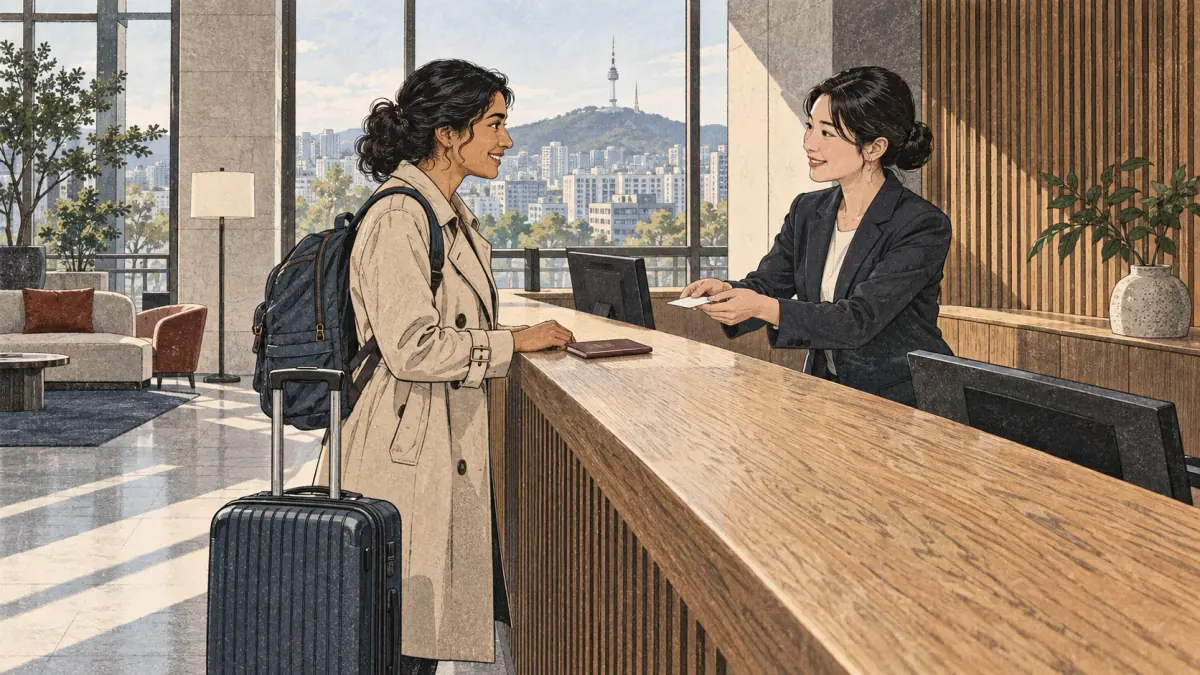
At check-in, say hello, say you have a reservation, give your name and hand over your passport. The whole exchange takes four short sentences, and the front desk leads most of it.
| Step | You say | Meaning | Staff may say |
|---|---|---|---|
| 1 | 안녕하세요. | Hello. | 어서 오세요. (Welcome.) |
| 2 | 예약했어요. | I have a reservation. | 성함이 어떻게 되세요? (What is your name?) |
| 3 | 이름은 지민이에요. | My name is Jimin. | 여권 보여 주세요. (Please show your passport.) |
| 4 | 여권 여기 있어요. | Here is my passport. | 몇 박이세요? (How many nights?) |
Say 예약했어요 as [예야캐써요], because the ㄱ and ㅎ merge into a k sound. Use 이름 (ireum) for your own name, because 성함 (seongham) is the honorific word reserved for other people. Check-out time varies by hotel, so ask 몇 시까지 체크아웃이에요? (myeot sikkaji chekeuausieyo, until what time is check-out?). The same pattern works for requests inside your room.
How Do You Ask for Things in Your Room?
Say the thing you want, then 주세요 (juseyo, please give me). For a problem, say the thing, then 이/가 안 돼요 (does not work). These two patterns cover most requests.
| Need | Korean | Meaning |
|---|---|---|
| Extra towels | 수건 더 주세요 | More towels, please |
| Water | 물 주세요 | Water, please |
| Cleaning | 방 청소해 주세요 | Please clean my room |
| Broken air conditioner | 에어컨이 안 돼요 | The air conditioner does not work |
| Storing bags | 짐을 맡길 수 있어요? | Can I leave my luggage? |
The word 더 (deo) means "more", so 수건 더 주세요 asks for extra towels. The ending -ㄹ 수 있어요 means "can", so 짐을 맡길 수 있어요? asks for permission. These patterns need the right level of politeness, which the next section sorts out.
How Do You Choose between Formal, Polite and Casual Korean Hotel Phrases?
Use the polite -요 style with hotel staff. Staff often answer in the formal -ㅂ니다 style, which is standard in service jobs, but you do not need to copy it. Korean marks the listener with three speech styles, explained in the guide to Korean speech levels.
| Situation | Style | Example |
|---|---|---|
| You ask staff for something | Polite (해요체) | 수건 더 주세요 |
| Staff speak to you | Formal (합쇼체) | 도와드리겠습니다 (I will help you) |
| You travel with a friend | Casual (반말) | 와이파이 비밀번호 뭐야? |
Speak politely to the desk and the staff will take care of the rest. If you want only the words, not the phrases, see the Korean hotel vocabulary list or the single-word page hotel in Korean. Now the full list of guides follows.
All Korean Hotel Phrases Guides
The list below has all 5 guides, each with its lead phrase and a short audio clip. The Korean phrases hub holds the other situation clusters, and Korean greetings cover the first words to say at any desk.
Start Here
Check in in Korean
The key phrase is 체크인하고 싶어요 (chekeuinhago sipeoyo), which means "I would like to check in."
Check out in Korean
The key phrase is 체크아웃할게요 (chekeuautalgeyo), which means "I'll check out."
Do You Have a Room in Korean
The key phrase is 방 있어요? (bang isseoyo), which means "do you have a room?" It is the quick walk-in question. (how much per night?) and 1인실 있어요? (do you have a single room?).
More Phrases
The remaining 2 guides are listed below.
Please Clean My Room in Korean
The key phrase is 방 청소해 주세요 (bang cheongsohae juseyo), which means "please clean my room."
Wifi Password in Korean
The key phrase is 와이파이 비밀번호가 뭐예요? (waipai bimilbeonhoga mwoyeyo), which means "what is the wifi password?"
How Do You Practise Korean Hotel Phrases?
Practise Korean hotel phrases in three steps: listen, repeat, then act it out. Play the clip on a guide once, say the phrase aloud twice, then run through the check-in script with a friend playing the desk. The phrase flashcards drill this cluster with audio, and each guide ends with a short practice set with answers.
Start with 예약했어요, because it opens the check-in and is the phrase you will use first. Then add 수건 더 주세요 and 와이파이 비밀번호가 뭐예요? Role-playing both sides trains you to recognise staff questions as well as say your own lines. After this cluster, continue with Korean greetings, because every desk visit starts with a hello.
Common Mistakes with Korean Hotel Phrases
Most mistakes come from borrowed English words, honorific words used for yourself and commands that sound too blunt.
| Mistake | Why it is a problem | Fix |
|---|---|---|
| Giving your own name as 성함 | 성함 is honorific and only for others | Say 이름은 ...예요 |
| Saying 나가요 for check out | It only means "I am going out" | Say 체크아웃할게요 |
| Counting nights with 밤, as in 이틀 밤 | Hotels count stays with the Sino-Korean 박 | Say 2박 (two nights) or 3박 (three nights) |
| Using the clipped 비번 with staff | 비번 is casual slang for 비밀번호 | Say 비밀번호 in full |
| Saying 치워 to housekeeping | It is a casual command | Say 방 청소해 주세요 |
Learners often assume English hotel words are used the same way in Korean. Actually, 체크인 and 체크아웃 are borrowed words that take 하다 (to do), so the verb forms are 체크인해요 and 체크아웃해요, and the polite request is built on those. Use these Korean hotel phrases as a reference, and return to a guide whenever a situation at the desk is unfamiliar.
Frequently Asked Questions
How do I check in at a Korean hotel?
Greet the desk with 안녕하세요, then say 예약했어요 (I have a reservation) and give your name: 이름은 지민이에요. Hand over your passport with 여권 여기 있어요 (here is my passport). Staff will usually ask 성함이 어떻게 되세요? (what is your name?) and how many nights you are staying.
How do I ask for the Wi-Fi in Korean?
Ask 와이파이 비밀번호가 뭐예요? (waipai bimilbeonhoga mwoyeyo, what is the wifi password?). To check whether wifi exists, say 와이파이 되나요? (does wifi work?). Many hotels print the password on a card or the room key sleeve, so look there first, then ask the front desk politely.
Can I leave my luggage at a hotel in Korean?
Yes, ask 짐을 맡길 수 있어요? (jimeul matgil su isseoyo, can I leave my luggage?). Do this at check-out or before check-in, and add 몇 시까지 체크아웃이에요? (until what time is check-out?) to confirm the day. Policies vary by hotel, so staff may ask you to leave it at the desk or a storage room.
How do I ask for more towels in Korean?
Say 수건 더 주세요 (sugeon deo juseyo, more towels, please). The pattern works for other items: 물 주세요 (water, please) or 베개 하나 더 주세요 (one more pillow, please). Call the desk from your room phone, or visit the desk in person. A friendly 감사합니다 after the delivery finishes the exchange.
Which speech level should I use with hotel staff?
Use the polite -요 style, as in 방 있어요? or 체크아웃할게요. Hotel staff often reply in the formal -ㅂ니다 style, such as 도와드리겠습니다 (I will help you), but you do not have to match it. Polite -요 sounds respectful and natural, and it is always safe with service staff.