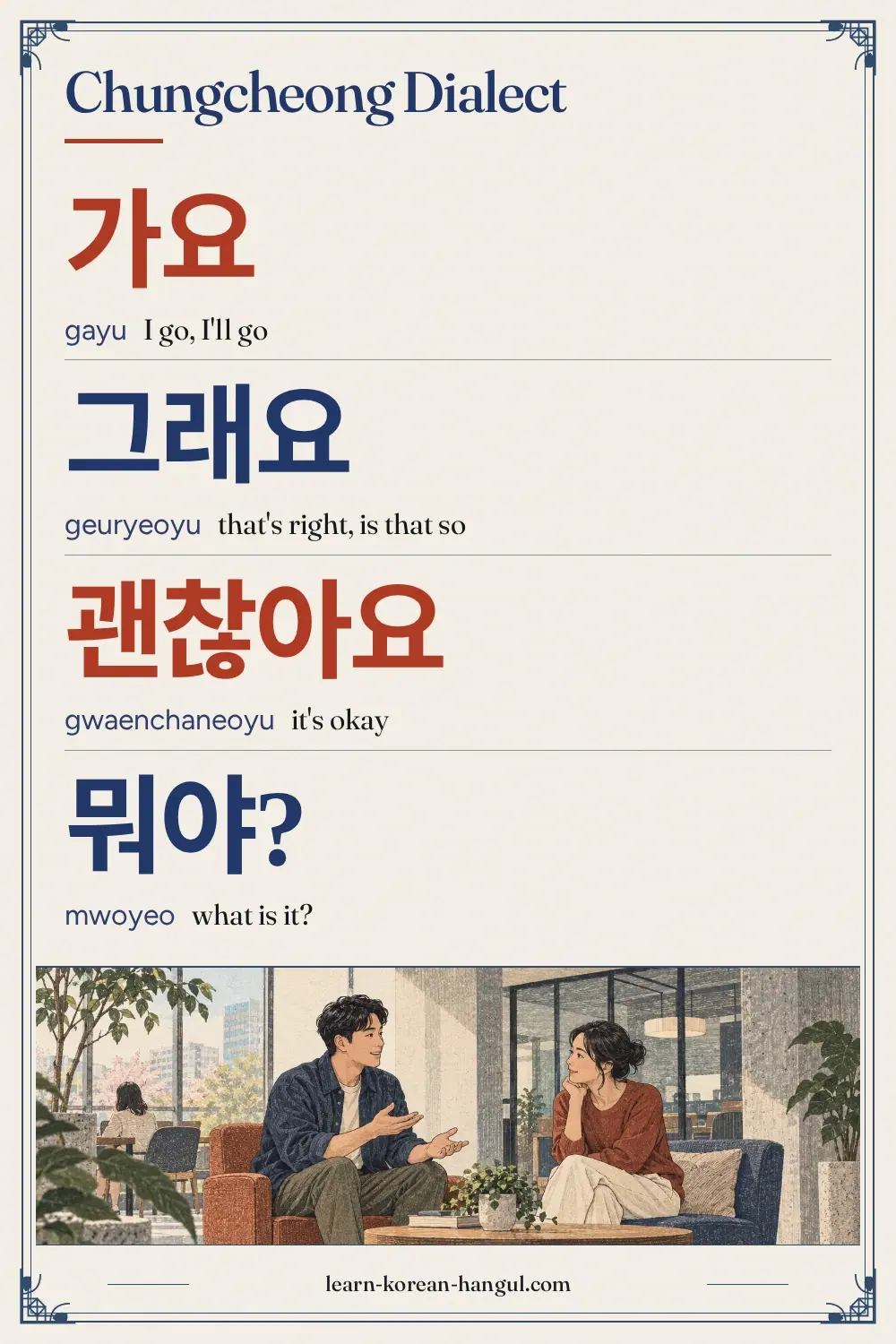
The Chungcheong dialect is the speech of central Korea (Daejeon, Cheongju, Chungju, Hongseong), best known for the polite ending -유 (as in 가유, "I'll go") and the ending -여 (as in 뭐여, "what is it?"). It is close to Seoul speech, so Standard Korean speakers follow it easily. This lesson teaches five phrases, shows how they differ from the standard and separates the "slow" stereotype from what can be checked.
Key facts
- Its best-known endings are -유 (a polite ending, like -요) and -여 (a casual ending, as in 뭐여).
- The tempo is often called slow, but that is a stereotype, and this lesson cites no measurement for it.
- It is close to Seoul speech, so Standard Korean speakers understand it without much trouble.
- Standard Korean is the language of school, news and exams, and it is understood throughout the region.
- Younger speakers tend to use these endings less, and some use them mainly for fun or for local colour.
Last updated: 2026-10-09.
What you'll learn
- Name the area where Chungcheong speech is used and say how close it is to Seoul speech.
- Recognise the endings -유 and -여 and turn five phrases back into Standard Korean.
- Tell the stereotype of "slow speech" from facts you can check.
- Say why a learner studies the standard first and treats Chungcheong speech as a listening skill.
Prerequisites: you know the polite -요 style and have read Standard Korean. Estimated time: 20 minutes.
What Is Chungcheong Dialect?
Chungcheong dialect is the regional speech of the Chungcheong provinces, called 충청도 사투리 (Chungcheongdo satoori, "Chungcheong regional speech") in everyday Korean. The name 충청 (Chungcheong) joins the first syllables of two old cities, Chungju and Cheongju. The region lies south of Seoul and the surrounding Gyeonggi area, and it covers four modern units: 충청북도 (North Chungcheong), 충청남도 (South Chungcheong), 대전 (Daejeon, a metropolitan city) and 세종 (Sejong, a special self-governing city).
Three facts frame this lesson. First, the grammar is the same as Standard Korean: the verb comes last and particles follow nouns. Second, the differences are mostly in sentence endings, a few vowels and the way people speak, not in a separate vocabulary like the one described in Jeju dialect. Third, the region is close to Seoul, which makes Chungcheong speech one of the easiest regional varieties for a learner to follow.
A dialect here means a regional variety of Korean (a 방언, bangeon). It is not a lesser form of Korean, and it is not "bad grammar". It is the way many people in one region speak, especially older speakers and especially at home.
Why English Speakers Struggle Here
English speakers struggle with Chungcheong speech for a reason that has nothing to do with sounds: the dialect is a layer on top of a standard that they are still learning. A learner who knows 가요 (gayo, "I go") may hear 가유 (gayu) and think it is a new word. In fact it is the same word with a different ending.
There is a second difficulty, and it comes from English habits. In English, a speaker who sounds slow or relaxed often sounds uncertain or unhelpful. In Korean, many people hear Chungcheong speech as gentle and indirect, and a speaker who answers in a roundabout way is often being polite. If you read the style through English habits, you may judge people wrongly. It reads the written forms in a standard-style voice, so it shows how the words are built but not how a person from Daejeon sounds. Listen to local speakers in interviews and on television to hear the real rhythm.
Where Is Chungcheong Speech Used?
Chungcheong speech is used across central Korea. The table lists the four units, with example cities. The cities are only examples, and speech varies inside each unit.
| Unit | Korean | Example cities | Note |
|---|---|---|---|
| North Chungcheong | 충청북도 (Chungcheongbuk-do) | Cheongju, Chungju | inland, no coast |
| South Chungcheong | 충청남도 (Chungcheongnam-do) | Cheonan, Gongju, Hongseong | has a west coast |
| Daejeon | 대전 (Daejeon) | Daejeon | a large city, with many people from other regions |
| Sejong | 세종 (Sejong) | Sejong | a planned city with many government offices |
Two notes help a learner. First, big cities mix people from every region, so the standard-like Korean of Daejeon and Sejong is common, and the traditional endings are more often heard in smaller towns and among older speakers. Second, the region borders Gyeonggi in the north, Gangwon in the north-east, Gyeongsang in the east and Jeolla in the south, so speech near each border can share features with the neighbour. Border speech does not stop at a province line.
What Are the Endings?
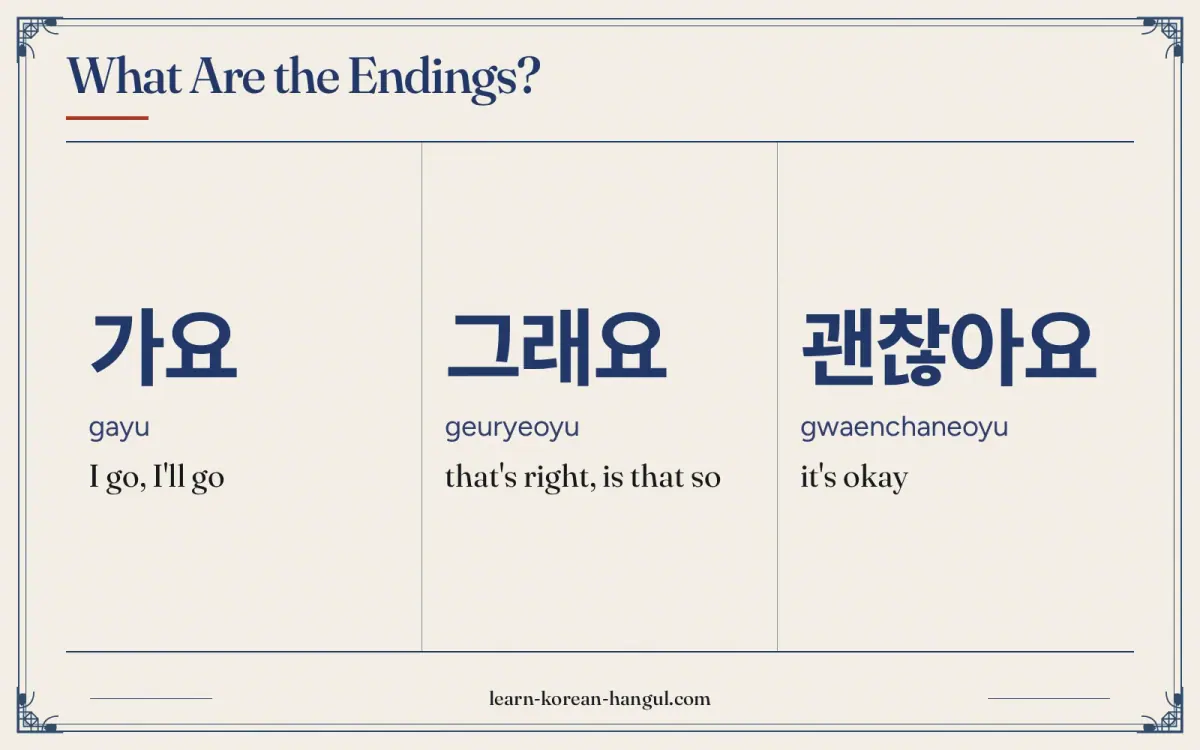
The endings are the easiest feature to recognise. The first, -유, replaces the polite -요. The second, -여, appears in casual speech where Standard Korean has -야 or -어.
| Chungcheong | Revised Romanization | Standard Korean | Meaning |
|---|---|---|---|
| 가유 | gayu | 가요 | I go, I'll go |
| 그려유 | geuryeoyu | 그래요 | that's right, is that so |
| 괜찮어유 [괜차너유] | gwaenchaneoyu | 괜찮아요 | it's okay |
| 뭐여? | mwoyeo | 뭐야? | what is it? |
| 왜 그려? | wae geuryeo | 왜 그래? | what's wrong? |
Read the table from left to right. In each row the dialect form keeps the same word and changes only the ending, and sometimes a vowel. In 가유, the stem 가 stays and 유 replaces 요. In 그려유, the stem changes from 그래 to 그려, and 유 replaces 요. In 뭐여, the ending -여 stands where 야 would be in 뭐야.
Two points about how the endings behave. The ending -유 is polite and soft, so it fits conversation with an older person or a stranger, but it is a spoken, regional form. It is not used in formal writing, in news or in exams. The ending -여 is casual, like the standard -야, so use it only with people you would speak casually to. A question that begins with a question word, such as 뭐여 or 왜 그려, does not need a rising end. The question word already marks it as a question, and the tone often falls or rises and then falls, as in Standard Korean.
Is Chungcheong Dialect Really Slow?
Many Koreans describe Chungcheong speech as slow, and comedy sketches often use that image. A slow, relaxed, indirect manner is the stereotype. It is worth taking apart, because the stereotype mixes three different things.
| Claim | What is behind it | Can it be checked? |
|---|---|---|
| "They speak slowly" | Longer final vowels and soft endings such as -유 can make a sentence sound unhurried | This lesson cites no measurement of speech rate, so treat it as an impression |
| "They answer indirectly" | A manner of speaking, not a grammar rule: a speaker may agree or refuse by hint | It is a social style, and it varies from person to person |
| "They are slow to act" | A joke about character | It has no basis in language, and it is not a fair statement about people |
For a learner the useful point is this: the ending -유 does not slow the speaker down. It adds a soft end to the sentence, and listeners then hear it as relaxed. Do not copy a "slow" voice when you try the phrases, and do not assume that a person from the region is slow because of how they sound. The next section compares the dialect with Seoul speech.
How Is It Different from Seoul?
Chungcheong speech is close to Seoul speech, so the list of differences is short. The table compares the two, one feature per row.
| Feature | Seoul (standard) | Chungcheong | Note |
|---|---|---|---|
| Polite ending | -요 (가요) | -유 (가유) | -유 is regional and spoken |
| Casual "it is" ending | -야 (뭐야) | -여 (뭐여) | casual only |
| Agreement | 그래요 | 그려유 | the vowel shifts from 래 to 려 |
| Writing and news | Standard Korean | Standard Korean | the region uses the standard in print |
| Vocabulary | standard words | mostly the same words | few separate words, unlike Jeju |
| Intelligibility | full | high for Seoul speakers | tempo and endings are the main cue |
The row "Writing and news" matters. Chungcheong speech is a spoken variety. A newspaper from Daejeon, a textbook used in Cheongju and a TV news reader from Hongseong all use Standard Korean (표준어, pyojuneo), which the Standard Language Regulations (표준어 규정), maintained by the National Institute of Korean Language (국립국어원), define as the modern speech of Seoul that educated people use widely. So a learner who studies the standard reads and writes the same Korean as people in Chungcheong.
Here is a short exchange in both forms. Seoul speech: 어디 가요? 시장에 가요. Chungcheong speech: 어디 가유? 시장에 가유. Only the endings change.
어디 가요?
eodi gayo?
Where are you going? (Seoul)
어디 가유?
eodi gayu?
Where are you going? (Chungcheong)
Where Do You Hear It?
You can hear Chungcheong speech in several places, though a learner should keep expectations modest.
Callout: where to listen. Variety shows and comedy sketches often give a relaxed, kind character a Chungcheong ending such as -유. Local interviews and radio from Daejeon and Cheongju use more of it than national news. When you hear it on screen, check whether it is natural speech or a joke: a performer may exaggerate the ending for comic effect.
Three habits help. Watch with subtitles in Standard Korean, listen only for the last syllable of each sentence, and write down the endings you notice. After a week you will hear -유 and -여 easily. Do not expect every Chungcheong speaker to use them, because speakers move between the standard and the local ending, depending on who they are talking to.
Worked Example: 그려유
The phrase 그려유 shows how the dialect sits beside the standard. Follow these steps.
- Start from the standard. 그래요 (geuraeyo) means "that's right" or "is that so?", and it comes from the verb 그러다 (to be so).
- Change the stem. The standard stem 그래 becomes 그려 (geuryeo). The vowel ㅐ is replaced by ㅕ.
- Change the ending. The polite -요 becomes -유, which gives 그려유.
- Say it. It has three syllables, 그-려-유, with no sound change, so the sound matches the spelling: [그려유]. Revised Romanization writes geuryeoyu.
- Check the meaning. The meaning depends on the tone. With a falling tone it agrees, "yes, that's right". With a rising tone it asks, "is that so?".
You will know it worked when you can say 그래요 and then 그려유 and hear that only the middle vowel and the last syllable change. The same two changes appear in 왜 그려, where the casual 그려 stands for 그래.
그려유.
geuryeoyu.
That's right. (Chungcheong)
Common Learner Mistakes
Mistake 1: using -유 in formal writing or at an exam. Learners often think -유 is simply the polite form of the region. Actually it is a spoken regional form, and exams, news and essays use the standard -요 or -습니다. Fix: write 가요, and say 가유 only when you are copying local speech for fun.
Mistake 2: assuming that everyone in the region speaks it. Learners often expect every person from Daejeon or Cheongju to say -유. Actually many people, especially younger ones and people who work in big cities, speak a standard-like Korean. Fix: listen for the ending, but do not expect it.
Mistake 3: copying the "slow" voice. Learners often stretch their speech to sound regional. Actually that copies a stereotype, and it can sound mocking. Fix: say the ending clearly at your normal speed.
Mistake 4: using -여 with a person you should be polite to. Learners often hear 뭐여? and use it with a teacher. Actually -여 is casual, like 뭐야, so it is rude to a stranger or an older person. Fix: use -유 forms with polite speech, and keep -여 for close friends.
Mistake 5: taking the audio as the sound of a local voice. Learners often treat the clips as real Chungcheong speech. Fix: use it for the forms, and listen to local speakers for the rhythm.
Practice and Answer Key
Give the Standard Korean form of each phrase.
- 가유
- 그려유
- 뭐여?
Then answer.
- Which two endings are best known in Chungcheong speech?
- Is Chungcheong speech close to or far from Seoul speech?
- Is "slow" a measured fact about the dialect on this page?
Answers.
- 가요 (I go).
- 그래요 (that's right).
- 뭐야? (what is it?).
- -유 (polite) and -여 (casual).
- Close. Seoul speakers understand it easily.
- No. It is a stereotype, and this lesson cites no measurement.
If you answered five or six correctly, you have the main points.
Practice · 5
Which ending in Chungcheong speech replaces the polite -요?
Show answer
-유
-유 replaces -요, as in 가유 for 가요.
What is the Standard Korean form of 그려유?
Show answer
그래요
그려유 is the Chungcheong form of 그래요, which agrees with the speaker.
Which ending is casual and should not be used with a stranger?
Show answer
뭐여
-여 is casual, like -야. The forms ending in -유 are polite.
Which statement about the 'slow' tempo is accurate on this page?
Show answer
It is a stereotype with no measurement cited here
The tempo is an impression. This lesson cites no measurement, and it says nothing about character.
What is the Standard Korean form of 괜찮어유?
Show answer
괜찮아요
괜찮어유 is the Chungcheong form of 괜찮아요 (it's okay): the vowel 아 becomes 어 and -요 becomes -유.
Where to Go Next
The lesson before this one is the Jeolla dialect. A related comparison is Seoul versus Busan Korean, and the next lesson is Gangwon dialect. The standard for comparison is Standard Korean, and the section hub Korean accents and dialects lists all regional lessons.
This lesson does not teach the full grammar of Chungcheong speech, the differences between towns or the pitch of the speech. It names five phrases and two endings. In short, the Chungcheong dialect is the speech of central Korea, close to Seoul speech, easy to follow and best recognised by its endings -유 and -여, while the slow tempo is a stereotype.
Frequently Asked Questions
What does 그려유 mean? 그려유 (geuryeoyu) is the Chungcheong form of the Standard Korean 그래요. It means "that's right" when the tone falls and "is that so?" when the tone rises. The vowel changes from 래 to 려 and the polite ending -요 becomes -유.
Is Chungcheong dialect slow? It is often called slow, but that is a stereotype. The soft ending -유 and a relaxed manner can make speech sound unhurried, and this lesson cites no measurement of speech rate. It is not a fair statement about the people of the region either.
Is it close to Seoul speech? Yes. The region lies just south of Seoul and Gyeonggi, the grammar is the same, and most words are the same. Seoul speakers understand Chungcheong speech with little difficulty. The main differences are in endings such as -유 and -여.
How do I recognise it? Listen to the last syllable of each sentence. A polite sentence that ends in -유 (가유, 그려유) or a casual question that ends in -여 (뭐여?) is a strong sign. Remember that many people in the region use the standard form with strangers, so the absence of these endings proves nothing.