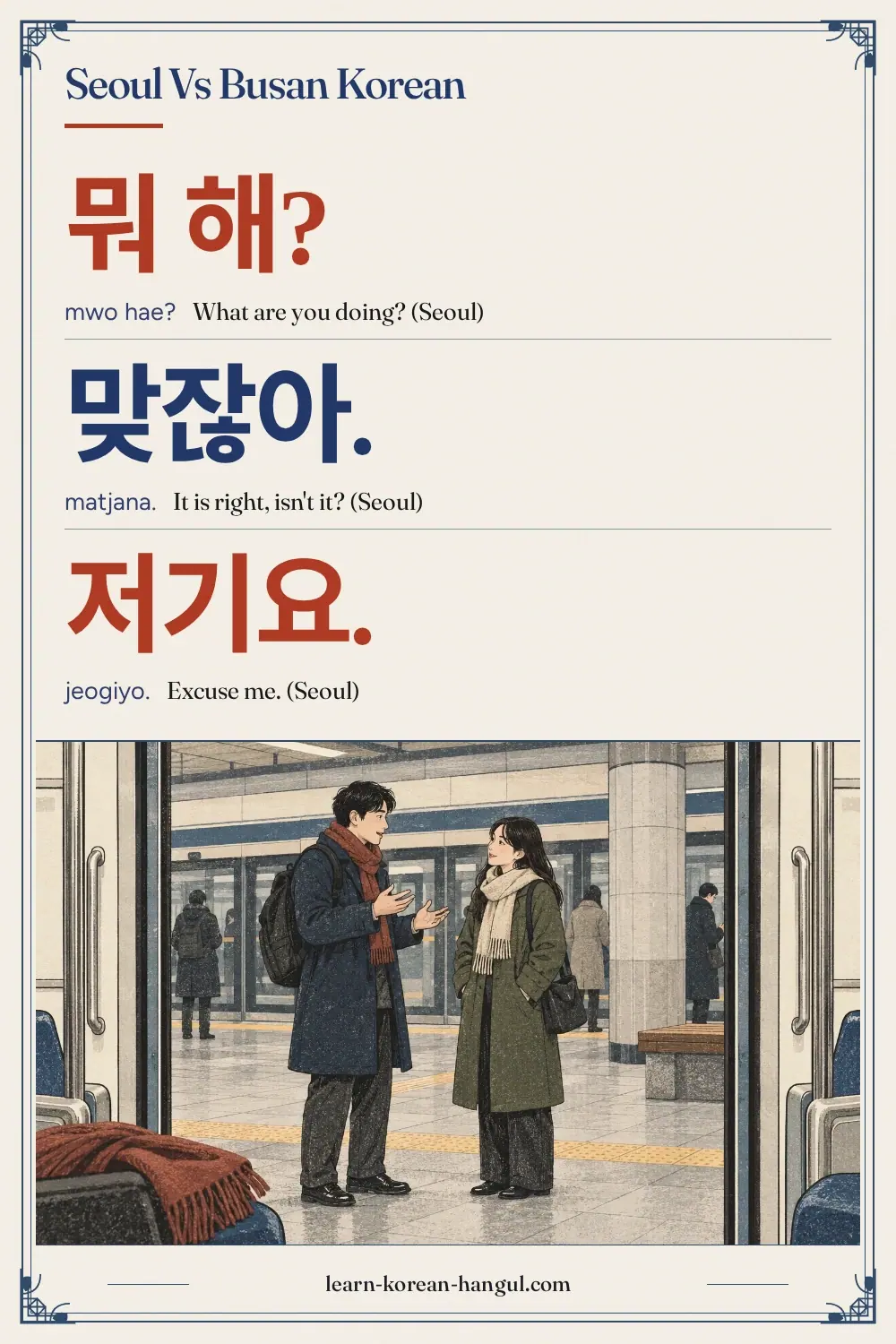
Seoul vs Busan Korean comes down to four differences: Busan speech keeps word-level pitch patterns, ends casual questions with -나, -노 or -꼬, does not always separate ㅓ from ㅡ or ㅅ from ㅆ, and uses words such as 억수로 and 보소. This lesson puts ten Seoul and Busan phrases side by side, with audio for each one.
Key facts
- Busan speech has word-level pitch accent. Seoul speech groups pitch by phrase.
- 밥 먹었나? is a casual phrase for friends and family, not for elders or strangers.
- Standard Korean is understood everywhere in Korea, so it stays the base for study.
Last updated: 2026-10-09.
What you'll learn
- State four differences between Seoul and Busan speech: pitch, endings, sounds and words.
- Understand ten Busan phrases by matching each to its Seoul equivalent.
- Use the question-ending rule to decode a new Busan question.
- Decide when to imitate Busan speech and when to listen only.
Prerequisites: the polite -요 style and Standard Korean. Estimated time: 20 minutes.
Seoul vs Busan Korean: What Is the Difference?
Seoul vs Busan Korean is a comparison between the standard base and the best-known regional variety of the Gyeongsang group. Seoul speech is the base of the standard language (표준어, pyojuneo). Busan speech (부산 사투리, Busan saturi) is the regional speech of Korea's largest port city. Both are Korean, share most grammar and words and are understood by speakers on both sides.
The difference is not in what is said but in how. Four areas change:
- Pitch. Busan words carry a pitch pattern; Seoul pitch belongs to the phrase.
- Endings. Busan casual questions use -나, -가, -노 and -꼬.
- Sounds. Some contrasts that Seoul keeps, such as ㅅ and ㅆ, are less clear.
- Words. A small set of common words differs, such as 억수로 and 보소.
The rest of the lesson takes each area in turn. A Busan speaker who talks to someone from Seoul often moves toward the standard, so the strongest forms appear mostly among locals and in dramas. The next section explains why a learner finds this difficult.
Why Busan Speech Is Hard for Learners
Busan speech is hard for learners because every textbook, app and dictionary teaches Seoul-based Standard Korean. When a Busan speaker changes the ending, the pitch and a few words together, a sentence made of known pieces sounds unfamiliar. Question endings are the clearest case: you listen for -어 or -야, and the speaker says -나 or -노.
The perception that Busan sounds strong or angry has a mechanical cause. Pitch moves up and down inside words, casual endings are short and the polite -요 is often missing. Together these features give the speech a clipped, fast shape. It is a normal rhythm for the region, not a sign of anger. The next section compares the four areas in a table.
How Do Seoul and Busan Speech Sound Different?
Seoul and Busan speech differ in four areas, listed in the table with one example each.
| Area | Seoul (standard) | Busan | Example |
|---|---|---|---|
| Pitch | pitch grouped over a phrase; no pitch pattern stored in single words | word-level pitch accent | the same word can have a different high point |
| Endings | -어, -야 for casual questions | -나, -가 (yes/no); -노, -꼬 (question word) | 밥 먹었어? / 밥 먹었나? |
| Sounds | ㅓ and ㅡ differ; ㅅ and ㅆ differ | the two pairs can sound alike | 쌀 may sound like 살 |
| Words | 왜, 아주, 부추 | 와, 억수로, 정구지 | 억수로 좋다 |
These are tendencies, not laws. A young Busan speaker may use the standard sounds and keep only a few words and the pitch, while an older speaker uses all four. Descriptions of the sound mergers vary by researcher and town, so treat the third row as "can sound alike" and not as "always". The full regional lesson is Gyeongsang dialect, and the lesson ㅅ and ㅆ trains the standard contrast.
The Busan Endings: -나, -노, -가 and -꼬
The Busan endings follow one rule: -나 and -가 are for yes/no questions, and -노 and -꼬 are for questions that contain a question word such as 뭐 (what), 누구 (who), 어디 (where) or 와 (why). Seoul speech does not make this split in casual style, because -어 and -야 serve both.
| Question word? | Busan ending | Example | Meaning |
|---|---|---|---|
| no (yes/no) | -나 | 밥 먹었나? | Did you eat? |
| no, after 이다 or a noun | -가 | 니 거가? | Is it yours? |
| yes, after a verb | -노 | 뭐 하노? | What are you doing? |
| yes, after 이다 or a noun | -꼬 | 이게 뭐꼬? | What is this? |
The endings -나 and -노 attach to verbs and adjectives, while -가 and -꼬 attach to nouns and 이다. As in Standard Korean, the question word carries the prominence, so a Busan wh-question does not rise sharply at the end. For the general rule, see question intonation. The next section covers the pitch.
What Is Pitch Accent in Busan Speech?
Pitch accent in Busan speech means that the high and low pitch of a word is part of the word. In Seoul speech, a word has no stored pitch; the melody sits on the phrase, as in the lesson Korean pitch and phrasing. In Busan speech, the place of the high pitch is learned with the word.
You do not need to produce it to be understood, because context and vocabulary carry the meaning. The practical effect for a listener is that Busan words sound as if they move more. Researchers describe the number of patterns differently and the patterns differ by town, so this page gives the idea and not a chart. The glossary entry pitch accent defines the term, and the Gyeongsang dialect lesson explains it with a simple model.
Ten Phrases, Seoul and Busan Side by Side
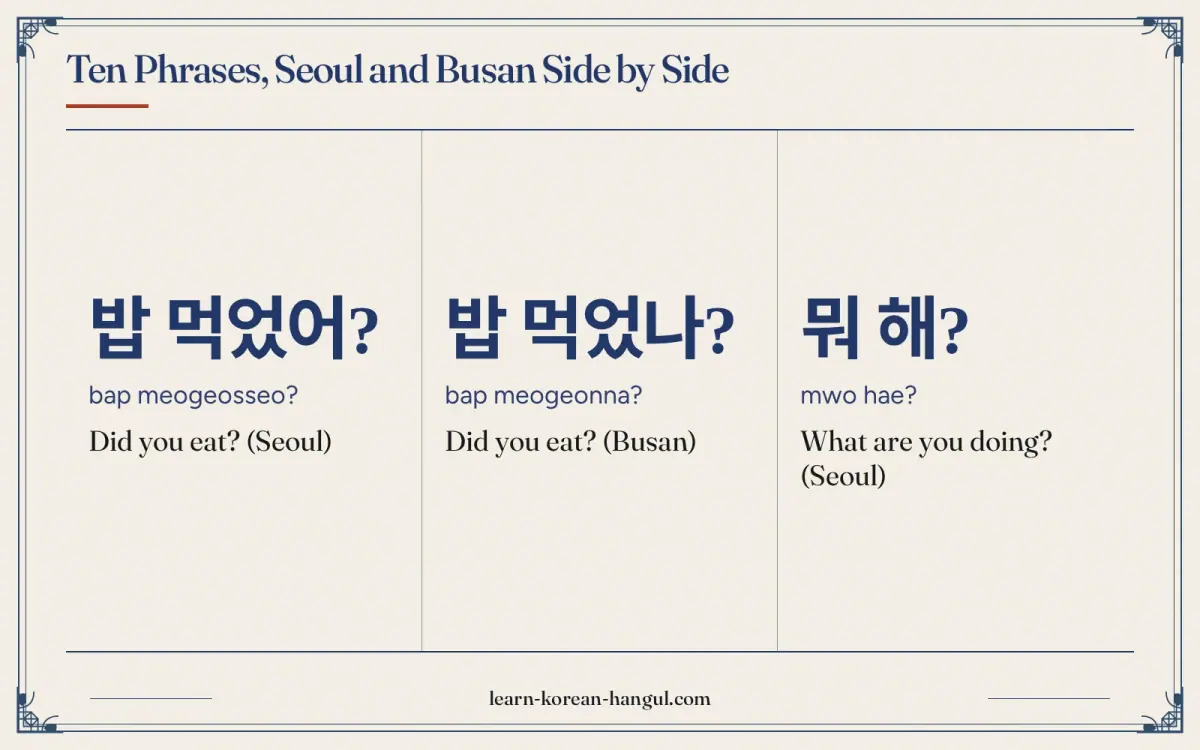
Each pair below has a Seoul line and a Busan line with the same meaning. Play the Seoul clip, then the Busan clip, and notice what changes: the ending, the word or both. The cue shows the spoken forms.
Seoul [밤 머거써] / Busan [밤 머건나]
| Korean | Romanization | Meaning | Sound |
|---|---|---|---|
| 밥 먹었어? | bap meogeosseo? | Did you eat? (Seoul) | |
| 밥 먹었나? | bap meogeonna? | Did you eat? (Busan) |
Seoul [뭐 해] / Busan [뭐 하노]
| Korean | Romanization | Meaning | Sound |
|---|---|---|---|
| 뭐 해? | mwo hae? | What are you doing? (Seoul) | |
| 뭐 하노? | mwo hano? | What are you doing? (Busan) |
Seoul [왜 그래] / Busan [와 그라노]
| Korean | Romanization | Meaning | Sound |
|---|---|---|---|
| 왜 그래? | wae geurae? | What is wrong? Why are you like that? (Seoul) | |
| 와 그라노? | wa geurano? | What is wrong? (Busan) |
Seoul [맏짜나] / Busan [맏따 아이가]
| Korean | Romanization | Meaning | Sound |
|---|---|---|---|
| 맞잖아. | matjana. | It is right, isn't it? (Seoul) | |
| 맞다 아이가. | matda aiga. | It is right, isn't it? (Busan) |
Seoul [이게 뭐야] / Busan [이게 뭐꼬]
| Korean | Romanization | Meaning | Sound |
|---|---|---|---|
| 이게 뭐야? | ige mwoya? | What is this? (Seoul) | |
| 이게 뭐꼬? | ige mwokko? | What is this? (Busan) |
Pairs 6 to 10 continue with a word, a call for attention, a command and two polite forms.
Seoul [엄청 조아] / Busan [억쑤로 조타]
| Korean | Romanization | Meaning | Sound |
|---|---|---|---|
| 엄청 좋아. | eomcheong joa. | It is really good. (Seoul) | |
| 억수로 좋다. | eoksuro jota. | It is really good. (Busan) |
Seoul [저기요] / Busan [보소]
| Korean | Romanization | Meaning | Sound |
|---|---|---|---|
| 저기요. | jeogiyo. | Excuse me. (Seoul) | |
| 보소. | boso. | Excuse me, hey. (Busan) |
Seoul [이리 와] / Busan [이리 온나]
| Korean | Romanization | Meaning | Sound |
|---|---|---|---|
| 이리 와. | iri wa. | Come here. (Seoul) | |
| 이리 온나. | iri onna. | Come here. (Busan) |
Seoul [식싸하셛씀니까] / Busan [식싸하셛씀니꺼]
| Korean | Romanization | Meaning | Sound |
|---|---|---|---|
| 식사하셨습니까? | siksahasyeotseumnikka? | Have you eaten? (formal) (Seoul) | |
| 식사하셨습니꺼? | siksahasyeotseumnikkeo? | Have you eaten? (formal, Busan) |
Seoul [어서 오세요] / Busan [어서 오이소]
| Korean | Romanization | Meaning | Sound |
|---|---|---|---|
| 어서 오세요. | eoseo oseyo. | Welcome. (Seoul) | |
| 어서 오이소. | eoseo oiso. | Welcome. (Busan) |
The same ten pairs as a quick-reference table:
| # | Seoul | Busan | Meaning |
|---|---|---|---|
| 1 | 밥 먹었어? [밤 머거써] | 밥 먹었나? [밤 머건나] | Did you eat? |
| 2 | 뭐 해? [뭐 해] | 뭐 하노? [뭐 하노] | What are you doing? |
| 3 | 왜 그래? [왜 그래] | 와 그라노? [와 그라노] | What is wrong? Why are you like that? |
| 4 | 맞잖아. [맏짜나] | 맞다 아이가. [맏따 아이가] | It is right, isn't it? |
| 5 | 이게 뭐야? [이게 뭐야] | 이게 뭐꼬? [이게 뭐꼬] | What is this? |
| 6 | 엄청 좋아. [엄청 조아] | 억수로 좋다. [억쑤로 조타] | It is really good. |
| 7 | 저기요. [저기요] | 보소. [보소] | Excuse me. |
| 8 | 이리 와. [이리 와] | 이리 온나. [이리 온나] | Come here. |
| 9 | 식사하셨습니까? [식싸하셛씀니까] | 식사하셨습니꺼? [식싸하셛씀니꺼] | Have you eaten? (formal) |
| 10 | 어서 오세요. [어서 오세요] | 어서 오이소. [어서 오이소] | Welcome. |
Three notes on the pairs. Pair 4 shows that 아이가 is a tag meaning "right?", not the noun 아이 (child). Pair 8 uses 온나, a command to come. Pairs 9 and 10 show polite Busan forms (-습니꺼, -이소), which Busan speakers use with elders. It reads the written forms, so it shows the words and endings but not the true Busan pitch. For the melody, listen to Busan speakers in dramas such as 응답하라 1997 (Eungdaphara 1997, Reply 1997), which is set in Busan.
Should You Learn Busan Speech?
No, a learner should not study Busan speech as a first goal: learn the standard first, then treat Busan speech as listening practice. The standard is what every textbook, class and exam uses, and Busan speakers understand it. A Busan phrase used in the wrong setting can also sound like mockery.
The order below works for most learners:
- Learn the standard sounds and the polite -요 style.
- Learn casual speech with friends.
- Learn to recognise Busan endings and ten common words by listening.
- Copy Busan phrases only if you live in the region or a Busan friend invites you to.
Moving to Busan is a good reason to go further, and a Busan friend will usually enjoy teaching you. The next section applies the rules to one famous phrase.
Worked Example: 밥 먹었나?
The phrase 밥 먹었나? is the best-known Busan line, and it can be decoded in five steps.
- Find the question type. There is no question word, so it is a yes/no question.
- Choose the ending. Yes/no questions take -나. So 먹었나 is "did (you) eat?".
- Compare with Seoul. The Seoul version is 밥 먹었어?, with -어 where Busan has -나.
- Say the sound. 밥 먹었나 is [밤 머건나]. In connected speech the ㅂ of 밥 becomes ㅁ before the ㅁ of the next word, and inside 먹었나 the final ㅆ of 었 sounds like ㄷ, which turns into ㄴ before ㄴ. Revised Romanization romanizes the two spaced words separately and shows the change only inside 먹었나: bap meogeonna.
- Check the register. The phrase is casual, for friends and family.
You will know it worked when you can say the Seoul and Busan versions back to back and hear that only the ending changed. Many Busan speakers also say 묵었나 (mugeonna) for "ate", with 묵다 where Seoul has 먹다.
Common Learner Mistakes
Mistake 1: using Busan endings with elders. Learners often assume 밥 먹었나? is the polite Busan phrase. Actually it is casual, and to an elder you would say 식사하셨습니꺼? or the standard 식사하셨어요?. Fix: keep -요 until invited to relax.
Mistake 2: choosing the wrong ending. Learners often put -노 on a yes/no question. Actually -노 goes with a question word. Fix: look for 뭐, 누구, 어디 or 와 first.
Mistake 3: treating Busan and Seoul as different languages. Learners often think they must learn two grammars. Actually the grammar is the same, and a dozen endings and words are enough for recognition. Fix: keep a short list.
Mistake 4: copying the sound from a drama. Learners often try to imitate the pitch from a clip. Actually actors vary and some use a softened version for a national audience. Fix: use clips for listening, not as a model.
Mistake 5: assuming Daegu is the same. Learners often use Busan as the word for the whole region. Actually Daegu is in the same group but has its own details. Fix: say "Gyeongsang" for the group.
Key Terms Used in This Lesson
| Term | Revised Romanization | Meaning |
|---|---|---|
| 방언 | bangeon | dialect in the technical sense |
| 사투리 | saturi | everyday word for regional speech |
| 표준어 | pyojuneo | the standard language |
| 억양 | eogyang | intonation |
| 경상도 | Gyeongsangdo | the south-east region |
| 부산 | Busan | the port city |
Practice and Answer Key
Give the Seoul line for each Busan phrase.
- 뭐 하노?
- 이게 뭐꼬?
- 이리 온나.
- 억수로 좋다.
Then answer.
- Which ending would you expect in a Busan question that contains 뭐: -나 or -노?
- Is 밥 먹었나? suitable for a teacher you have just met?
Answers.
- 뭐 해? (What are you doing?)
- 이게 뭐야? (What is this?)
- 이리 와. (Come here.)
- 엄청 좋아. (It is really good.)
- -노, because 뭐 is a question word.
- No. It is casual. Use 식사하셨어요? or the polite style.
If you answered five or six correctly, you can follow the main Busan patterns.
Where to Go Next
The lesson after this one is Gyeongsang dialect, which covers the whole region. For the standard, review Standard Korean. The section hub is Korean accents and dialects.
This lesson does not cover the other regions, the full set of Busan words or how to speak the dialect with a native-like melody. The forms here are widely cited examples, and speakers vary by age and town. In short, Seoul vs Busan Korean is a difference of pitch, endings, a few sounds and a short list of words on top of shared grammar, and the standard remains the right starting point.
Frequently Asked Questions
Is Busan dialect hard to understand? Not for long. The grammar and most words are the same as Standard Korean, so the first week of listening feels hardest, mainly because of the endings -나, -노 and -꼬 and a few words like 억수로. After you know those, most sentences become clear. Fast speech between friends is the hardest case.
Why does Busan sound strong? Busan words carry pitch patterns, endings are short and casual speech often leaves out the polite -요, so the speech sounds clipped to Seoul ears. The speaker is not angry. Drama makers also use the dialect for tough or direct characters, which strengthens the impression.
What does 아이가 mean? In Busan speech, 아이가 at the end of a clause is a tag meaning "right?" or "isn't it?", as in 맞다 아이가. It asks for agreement. It is not the noun 아이 (child). Seoul speakers say 맞잖아 for the same meaning.
Can I use Busan phrases? You can, with care. Use them with friends who speak the dialect and who invite you to try, and avoid them with elders or strangers. Used without that invitation, a dialect phrase can sound like imitation. Understanding the phrases is useful for everyone; speaking them is optional.
Does Busan speech drop the polite -요? In casual talk, yes, as Seoul casual speech also drops it. For politeness, Busan speakers use their own endings, such as -습니꺼 in formal questions and -이소 in invitations. Many also use -예 as a soft politeness marker. A learner who uses the standard -요 is polite everywhere.