The Jeolla dialect (전라도 사투리, Jeollado saturi, also spelled "Jeolla satoori") is the speech of south-west Korea (Gwangju, Jeonju, Mokpo). It is best known for the filler 거시기, for endings such as -잉 and -랑께, and for words such as 허벌나게 (a lot). This lesson teaches you to recognise it, so that you can follow it in dramas, songs and travel.
Last updated: 2026-10-09.
What you'll learn
- Describe three features of Jeolla speech: the filler 거시기, the sentence endings and the vocabulary.
- Recognise and understand five common Jeolla phrases.
- Tell what is a stereotype and what is a real feature of the dialect.
- Explain why a learner studies the standard first and treats the dialect as listening practice.
Prerequisites: you know the Standard Korean polite style and have read Standard Korean. Estimated time: 20 minutes.
What Is the Jeolla Dialect?
The Jeolla dialect is the regional variety of Korean spoken in the south-west, in the area that was historically called Jeolla (전라). Korean uses 사투리 (saturi) for any regional speech and 방언 (bangeon) for dialect in the technical sense. A Jeolla speaker speaks Korean. The variety differs from the standard in its sentence endings, a set of common words, a few sound habits and its rhythm. The south-west is also called Honam (호남) in news and conversation, so you will see "Honam dialect" as another name.
The region has more than one centre, and speech changes from place to place.
| Place | Where | What to know |
|---|---|---|
| Gwangju (광주) | the largest city of the south-west, a metropolitan city in its own right | the variety most learners hear first in films and the news |
| Jeonju (전주) | the main city of Jeonbuk (전북특별자치도), in the north of the region | a historic city known for Jeonju bibimbap (전주비빔밥) |
| Mokpo (목포) | a port city on the south-west coast | a coastal variety with its own local words |
| Suncheon and Yeosu | cities on the south coast | share the main endings, with local words |
| Namwon (남원) | a city in Jeonbuk | the setting of the pansori story 춘향가 (Chunhyangga) |
| Rural Jeolla | villages in both provinces | the strongest traditional forms, heard mostly from older speakers |
The table shows a spread, not sharp borders. Dialects blend into each other, so a person from a town between two cities may use features of both. Younger speakers also move toward the standard in school, work and media, which reduces the strongest forms. The next section explains why the dialect is hard to follow at first.
Why English Speakers Struggle Here
English speakers find Jeolla speech hard because they learn the standard first, and the dialect changes three things that standard listening relies on: the sentence endings, a handful of very common words and the filler 거시기, which can stand in for any noun. When all three change at once in fast speech, a sentence made of familiar parts can sound foreign.
There is also a spelling problem. Regional speech has no fixed spelling, so the same ending may be written -랑께 or -라니까 in different sources, and a textbook may give a form you never see on a screen. And there is a perception effect. Listeners often describe Jeolla speech as sing-song, warm and fast, with long vowels on the final syllable. These are impressions, and they vary by speaker. A learner should not read emotion into the sound of a dialect they do not yet know.
It reads the written dialect forms clearly, so it shows you the words and endings, but it cannot reproduce real regional rhythm. Treat it as a guide to the forms, and listen to Jeolla speakers in dramas, interviews and songs for the melody. The next section shows where you will meet the dialect.
Where Is Jeolla Speech Used?
Jeolla speech is used in daily life across the south-west, and in media whenever a story is set there. Local people use it at home, with friends, in markets and in shops. In offices, schools and on the news, many of the same speakers switch toward the standard.
| Setting | What you hear | Learner note |
|---|---|---|
| Street, market and taxi in Gwangju, Jeonju or Mokpo | strong dialect, casual endings | listen for -잉, -랑께 and 거시기 |
| Family and friends | the fullest dialect | not a model for polite speech |
| Dramas and films set in the region | dialect used for local colour | read the Standard Korean subtitles first |
| Pansori (판소리) | sung storytelling with Jeolla-linked words and rhythm | a classical art, not everyday speech |
| News and textbooks | standard | the form this site teaches |
A drama that uses the dialect gives you two advantages for listening practice: subtitles in Standard Korean, and the same lines repeated in different scenes. The practice section at the end of this lesson gives a short routine. For a contrast, compare the Gyeongsang dialect, the speech of the south-east, which marks questions in a different way.
What Does 거시기 Mean?
거시기 (geosigi) is a filler that stands for any word. A speaker uses it when the exact word is gone, when the word would be rude or awkward, or when both people already know what is meant. The dictionary meaning is "that thing" or "that person whose name I cannot say". In a sentence it can be a noun, a name or a pause.
| Use | Example | Standard idea |
|---|---|---|
| a thing | 거시기 좀 줘 봐. | 그거 좀 줘 봐. (Pass me that.) |
| a person | 어제 거시기를 만났어. | 어제 그 사람을 만났어. (I met what's-his-name yesterday.) |
| a pause | 저기, 거시기… | 음, 저기… (Um, well…) |
Two points protect you from the stereotype. First, 거시기 is listed in the standard dictionary (표준국어대사전) as a Korean word, so it is not a dialect form that Seoul speakers never use. Second, popular culture makes it the symbol of Jeolla speech, but speakers in other regions use it too, much as English speakers use "thingy" or "you know". It is a real feature of the dialect only in the sense that Jeolla speech is where jokes and songs most often place it.
The tone of 거시기 matters. Said with a smile among friends it is warm and ordinary. Said in front of an elder or in a business meeting, the same word can sound careless, because the speaker has not chosen the noun. The next section moves from the filler to the endings.
What Are the Jeolla Sentence Endings?
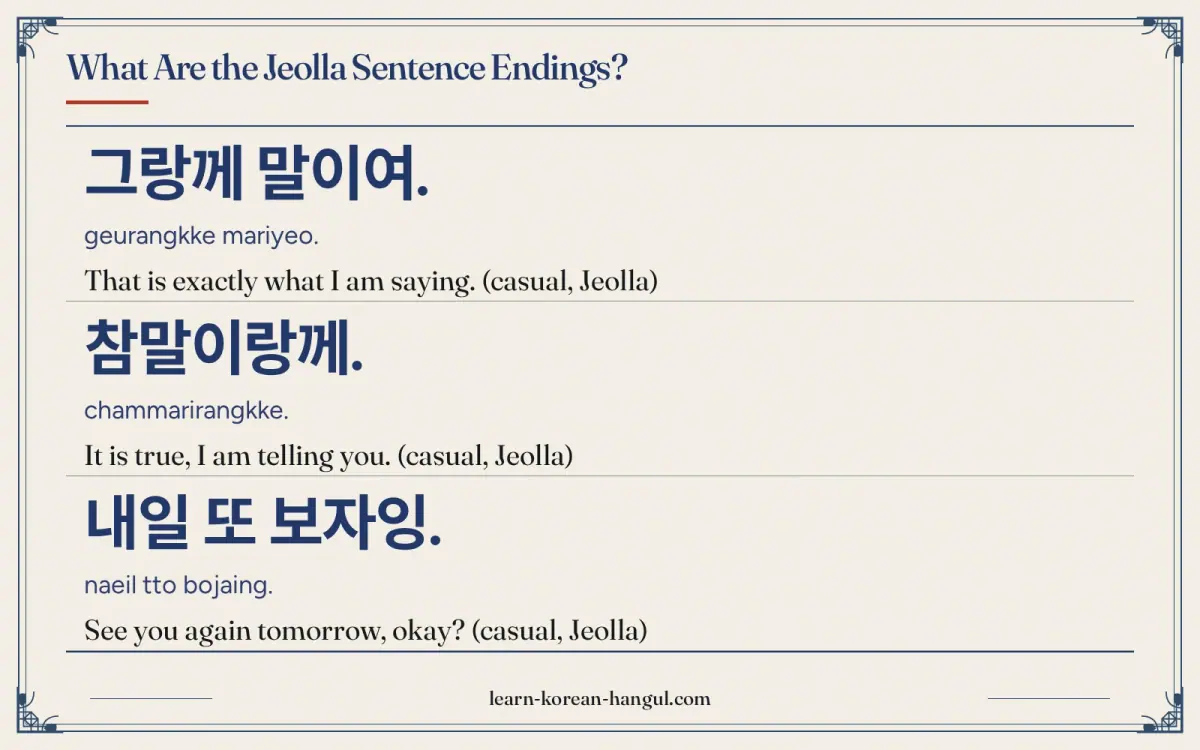
The Jeolla endings change the feeling of a sentence more than its meaning. Four are worth knowing for recognition: -잉, -랑께 and -당께, -여 and -제. The table gives each with a Standard Korean version.
| Ending | Job | Jeolla example | Standard version | Sound and Revised Romanization |
|---|---|---|---|---|
| -잉 | a soft tag that asks for agreement or friendliness | 내일 또 보자잉. | 내일 또 보자. | [내일 또 보자잉] naeil tto bojaing |
| -랑께 / -당께 | insistence, "I am telling you" | 참말이랑께. | 정말이라니까. | [참마리랑께] chammarirangkke |
| -여 / -이여 | a plain statement | 그랑께 말이여. | 그러니까 말이야. | [그랑께 마리여] geurangkke mariyeo |
| -제 | a tag for agreement, "right?" | 그라제? | 그렇지? | [그라제] geuraje |
The -랑께 and -당께 endings come from the Standard Korean -라니까 and -다니까, which also express "I am telling you". A Jeolla speaker may say 했당께 where Standard Korean says 했다니까 (I did it, I tell you). In 했당께 the final consonant of 했 and the ㄷ of 당 are said [핻땅께], and the RR is haetdangkke. The tense ㄸ comes from the neighbouring sound, so RR does not write it, but the tense ㄲ in 께 is written, so it appears as kk.
The -잉 ending is easy to hear because it is a long nasal at the end of the sentence. It softens a suggestion, an order or a goodbye: 잘 가잉 (take care on your way). It is a friendly tag, not a politeness marker like 요. It is not a polite ending, so you should not use it with a teacher or an older stranger.
그랑께 말이여.
geurangkke mariyeo.
That is exactly what I am saying. (casual, Jeolla)
참말이랑께.
chammarirangkke.
It is true, I am telling you. (casual, Jeolla)
내일 또 보자잉.
naeil tto bojaing.
See you again tomorrow, okay? (casual, Jeolla)
As in Standard Korean, a question with 뭐 or 왜 usually puts the prominence on the question word rather than ending with a sharp rise, although regional melodies vary from speaker to speaker. See question intonation for the general rule. The next section covers the words.
Common Words in Jeolla Speech
Six words cover most of what a visitor hears: 거시기, 허벌나게, 겁나게, 오메, 아따 and 쪼까. The table gives each with the Standard Korean word that a textbook uses.
| Jeolla | Revised Romanization | Meaning | Standard Korean |
|---|---|---|---|
| 거시기 | geosigi | that thing, what's-his-name, a pause | 그거, 그 사람, 저기 |
| 허벌나게 [허벌라게] | heobeollage | very, a lot | 아주, 엄청 |
| 겁나게 [검나게] | geomnage | very, a lot | 아주, 엄청 |
| 오메 | ome | oh my, wow | 어머나, 세상에 |
| 아따 | atta | an exclamation of strong feeling, such as "oh, come on" | 참, 아이고 |
| 쪼까 | jjokka | a little | 조금 |
Notes on the words:
- 허벌나게 is an informal intensifier before an adjective or verb: 허벌나게 많다 (a huge amount). It is slangy, for friends and family.
- 겁나게 also means "very". The short form 겁나 is now heard across Korea, so it is no longer only a Jeolla marker.
- 오메 is a cry of surprise, for good or bad news. You may also hear 워메 as a variant spelling.
- 아따 is a flexible exclamation. It can show wonder, teasing or impatience, depending on the tone of voice.
- 쪼까 is a small amount, as in 쪼까만 기다려 (wait a little). The Standard Korean 조금 is the version for writing.
사람이 허벌나게 많아요.
sarami heobeollage manayo.
There are a huge number of people.
오메, 깜짝 놀랐네.
ome, kkamjjak nollanne.
Oh my, what a surprise! (casual, Jeolla)
The word 허벌나게 is a regional word, and regional words like it are usually marked as dialect in a dictionary or left out of it, so use the standard words in writing. The next section covers sounds.
How Does It Sound?
Sound differences in Jeolla speech are described in general terms, and they vary by town and by speaker. Three are mentioned most often. The sentence is usually said with a stretched final syllable, especially before -잉. Some words keep an older sound: 김치 (kimchi) is often heard as 짐치 and 기름 (oil) as 지름 in traditional speech. And some speakers change the vowel ㅢ to ㅣ. These are tendencies, and many younger speakers use the standard sounds.
| Feature | Seoul (standard) | Common Jeolla pattern | Example |
|---|---|---|---|
| ending rhythm | the last syllable is short | the last syllable can be stretched | 보자잉 for 보자 |
| 김치, 기름 | 김치, 기름 | 짐치, 지름 in traditional speech | 짐치 for 김치 |
| ㅢ and ㅣ | 의 keeps its own sound | 의 can sound like 이 | 의사 may sound like 이사 |
The first row matters for listening, because the long ending can hide the end of a sentence. The second row matters for reading: you will meet 짐치 on handwritten signs and in older writing, and you can read it once you know the pattern. This lesson names only these features, because others differ widely across the region. The standard keeps its own sounds, and so does this site's audio.
Pansori and the Jeolla Voice
Pansori (판소리) is a Korean art in which one singer tells a long story with song, speech and gesture, while a drummer keeps the beat and calls out encouragement. It is closely linked with the Jeolla region. 춘향가 (Chunhyangga), one of its best-known stories, is set in Namwon, and two of its traditional styles, 동편제 and 서편제, are named for places east and west of a river in Jeolla. UNESCO recognised pansori in 2003 as a Masterpiece of the Oral and Intangible Heritage of Humanity; the current listing is on unesco.org.
Pansori is not everyday speech. Its language is a blend of regional speech, older literary Korean and humour. Still, many learners first hear Jeolla-flavoured Korean in pansori, in films that use it, and in songs. Hearing the long lines helps with the rhythm of the ending particles.
Worked Example: 거시기
The word 거시기 shows how a dialect word still follows the standard sound rules. Follow these steps.
- Read the blocks. 거 (geo), 시 (si), 기 (gi). The word has three blocks.
- Find the final consonants. None of the three blocks ends in a consonant, so no sound change can happen between them.
- Say it evenly. The result is three even syllables, [거시기], with no tense or aspirated sounds. The ㅓ is unrounded: keep your lips relaxed and wide.
- Check the Revised Romanization. The romanization is geosigi.
- Put it in a sentence. 거시기 좀 줘 봐. geosigi jom jwo bwa, "Pass me that thing." The Standard Korean version is 그거 좀 줘 봐, and the polite form is 거시기 좀 주세요. In the polite form the word is still an informal filler, so use 그거 with an elder.
거시기 좀 줘 봐.
geosigi jom jwo bwa.
Pass me that thing. (casual)
You will know it worked when the clip and your own voice both give three even blocks with a relaxed ㅓ in the first one. Say the sentence with an even, relaxed rhythm first. Then listen to how a Jeolla speaker stretches the ending in a drama, and copy it only if you have a reason to.
Common Learner Mistakes
Mistake 1: treating dialect forms as errors. Learners often assume 보자잉 is a bad version of 보자. Actually it is a normal form in its region, with its own rules. Fix: label it "Jeolla" in your notes, not "wrong".
Mistake 2: believing the "soft" stereotype. Learners often assume that all Jeolla speech is gentle. Actually the endings -랑께 and -당께 are insistent, and the speakers use the full range of moods. Fix: describe the endings, not the personality, and do not repeat jokes about regional accents.
Mistake 3: using dialect endings in polite situations. Learners often copy the casual -랑께 or -잉 to a boss or a teacher. Actually these endings are for friends and family, and strangers may hear them as rude or as mockery. Fix: keep the standard -요 style and use the dialect for listening.
Mistake 4: expecting one Jeolla dialect. Learners often assume Jeonju and Gwangju are the same. Actually they share the group but differ in details. Fix: say which town a speaker comes from before you generalise.
Mistake 5: writing dialect in an exam answer. Learners sometimes carry spoken forms such as 그랑께 into writing. Actually exam and school writing use the standard 그러니까. Fix: use the dialect to understand speech, and the standard to write.
Practice and Answer Key
Say each Jeolla form aloud, then give the Standard Korean word or sentence.
- 허벌나게
- 그랑께
- 참말이랑께
- 내일 또 보자잉
- 쪼까
Then answer these.
- What does 거시기 stand for?
- Is -랑께 a polite ending or an insistent casual one?
- Which city is in Jeonbuk: Jeonju or Gwangju?
Answers.
- 아주 or 엄청 (very).
- 그러니까 (that is why, that is what I am saying).
- 정말이라니까 (I am telling you it is true).
- 내일 또 보자 (see you tomorrow).
- 조금 (a little).
- A word the speaker cannot or will not say: a thing, a person or a pause.
- An insistent casual one. It is not polite.
- Jeonju.
Seven or eight correct means you can recognise the main features. If you scored lower, reread the endings table.
For a listening routine, pick a short clip of 30 seconds from a drama or interview with a speaker from Gwangju or Jeonju, read the Standard Korean subtitles once, and listen three times: first for the endings, then for the words, then for the melody. Write down only what you heard, not what you expected.
Where to Go Next
The lesson before this one is the Jeju dialect, the most distinct regional variety. The Gyeongsang dialect, the speech of the south-east, is a good contrast because it marks questions differently. The next lesson in the sequence is the Chungcheong dialect, the speech of the central west. The section hub is Korean accents and dialects, and the glossary entry 사투리 (saturi) defines the term. For the wider picture of Korean life and arts, see Korean culture.
This lesson does not cover every Jeolla town, the full list of sound changes, dialect writing or how to speak the dialect. Spoken forms vary by speaker and age, and the forms here are widely cited examples, not a complete description. In short, the Jeolla dialect is the south-western variety of Korean, known for the filler 거시기, the endings -잉 and -랑께, and words such as 허벌나게, and a learner who studies the standard first can recognise it with the help of this lesson.
Frequently Asked Questions
What does 거시기 mean?
거시기 (geosigi) stands in for a word that the speaker cannot remember or prefers not to say. It can mean "that thing", "what's-his-name" or just "um". The listener works out the meaning from the situation. The standard dictionary lists 거시기 as a real Korean word for this purpose, so it is not slang, although it is most often joked about in connection with Jeolla speech.
Is Jeolla dialect soft?
Many Koreans describe it as warm, rhythmic or soft, but this is an impression, not a linguistic rule. The same speakers can sound blunt in other moods, and the strong endings -랑께 and -당께 are insistent, not gentle. Linguists do not measure a dialect as soft or hard. Treat the idea as a stereotype and listen to the endings and the words instead.
Is Jeolla dialect used in dramas?
Yes. Dramas, films and variety shows use it for characters from Gwangju, Jeonju, Mokpo and other places in the south-west, and for comic or warm effect. The version on screen is often a light, easy-to-follow form, because writers adapt it for a national audience. Listen for 거시기, -잉, -랑께 and 오메, and read the Standard Korean subtitles at first.
What is 허벌나게?
허벌나게 (heobeollage) is an informal Jeolla adverb meaning "very" or "a lot", as in 사람이 허벌나게 많아요 (there are a huge number of people). Standard Korean says 아주, 매우 or 엄청. It is slangy, so people use it with friends and family and not in formal or polite situations. A close relative, 겁나게, means the same and is heard more widely.
Is 거시기 only Jeolla?
No. 거시기 is a standard-dictionary word and speakers all over Korea use it as a filler, but it is most closely linked in popular culture to Jeolla and Chungcheong speech. The idea that every Jeolla speaker says it all the time is a stereotype. What is more particular to Jeolla are the endings such as -잉 and -랑께 and words such as 허벌나게 and 오메.
Is Jeonju the same as Gwangju?
No. Jeonju is the main city of Jeonbuk (전북특별자치도), and Gwangju is a metropolitan city in the south-west, next to Jeollanam-do. Both belong to the Jeolla region and share the main features in this lesson, but speakers notice differences in words, endings and rhythm between the north and south. A learner can treat them together at first.