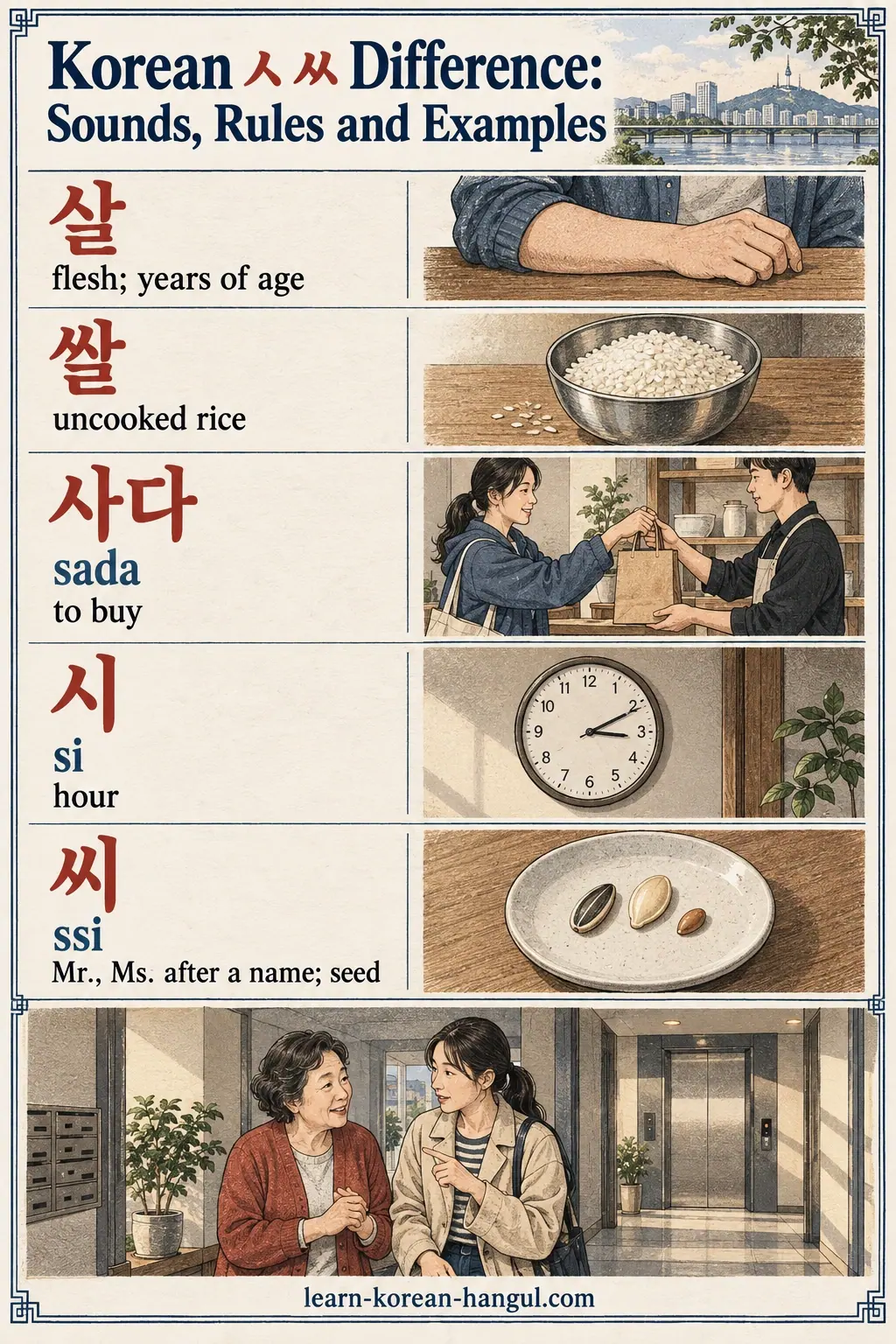
The Korean ㅅ ㅆ difference is a difference in tension and hiss between two sibilants: plain ㅅ is a soft s with a little breath, and tense ㅆ is a tight, sharper s. It is the only two-way set among the plain, tense and aspirated consonants, and it separates 살 (flesh, years of age) from 쌀 (uncooked rice).
What you'll learn
- Pronounce 살 and 쌀 distinctly.
- Use 사다 (to buy) and 싸다 (to be cheap) in the right meanings.
- Explain why this set has only two members.
- Predict how ㅅ and ㅆ sound before ㅣ and at the end of a syllable.
Prerequisites: Korean Consonant Sounds and the overview Plain Tense Aspirated Consonants. Estimated time: 25 minutes.
What Is the Korean ㅅ ㅆ Difference?

The Korean ㅅ ㅆ difference is a two-way contrast in the hissing consonants. A sibilant is a consonant made by pushing air through a narrow gap between the tongue and the ridge behind the teeth, which produces a hiss. English has s and z, and Korean has ㅅ and ㅆ, separated by tension.
| Letter | Name | Type | Hiss and breath | Throat | Example |
|---|---|---|---|---|---|
| ㅅ | 시옷 (siot) | plain (평음) | soft hiss, a little breath | relaxed | 살 (flesh; years of age) |
| ㅆ | 쌍시옷 (ssangsiot) | tense (경음) | tight, sharper hiss | tight | 쌀 (uncooked rice) |
Both letters use the same tongue position: the tip or blade of the tongue sits close to the ridge behind the upper teeth, and the air is squeezed through a narrow channel. The letter ㅆ is two ㅅ letters side by side. Each letter has its own lesson: ㅅ and ㅆ. The next question is why this set is a pair and not a triplet.
Why Does the ㅅ Set Have Only Two Members?
The ㅅ set has only two members because Korean has no aspirated ㅅ. In the other four sets, the three letters are plain, tense and aspirated, and the aspirated letter adds a strong puff. Phoneticians often note that plain ㅅ already carries a little breath after the hiss, which leaves no room for a third, more breathy member.
| Set | Plain | Tense | Aspirated |
|---|---|---|---|
| back of tongue | ㄱ | ㄲ | ㅋ |
| tongue tip | ㄷ | ㄸ | ㅌ |
| lips | ㅂ | ㅃ | ㅍ |
| tongue blade | ㅈ | ㅉ | ㅊ |
| tongue tip, with a hiss | ㅅ | ㅆ | (none) |
The missing third member changes how to practise. The breath test used for the other sets does not work well for ㅅ and ㅆ, because both letters push a steady stream of air. The cues are tension and sharpness: ㅆ feels tighter in the throat and sounds sharper and slightly longer. The same system is explained in Plain Tense Aspirated Consonants. With the set clear, the English problem comes next.
Why Do English Speakers Mix up ㅅ and ㅆ?

English speakers mix up ㅅ and ㅆ because English s has only one setting, and English does not use throat tension to separate words. An English s is fairly strong and sharp already, so a learner hears ㅅ as "s" and has no reason to expect a tighter version. The tense ㅆ then falls into the same category.
Three habits cause most of the errors:
- Hearing ㅆ as ㅅ. The ear sorts both into English "s", so 쌀 is heard as 살.
- Making ㅆ longer instead of tighter. Learners stretch the hiss like "sssal". The tension should come from the throat.
- Using English "sh" for every ㅅ. Before ㅣ, ㅅ does sound close to sh, but before other vowels it is a plain s.
English s in "sun" is a reasonable match for ㅅ, though the Korean sound is gentler. ㅆ is close to an English s that you start with a held breath and the throat tight, as if you were about to whisper a strong "s". With the problem named, each sound can be taken in turn.
How Do ㅅ and ㅆ Sound on Their Own?
Each letter has one clear mouth recipe at the start of a syllable. The examples below keep the vowel ㅏ so only the consonant changes.
ㅅ: the Plain Sound
Plain ㅅ is a soft, relaxed s with a little breath after it and a lower start to the vowel. Bring the tongue close to the ridge, keep the throat loose and let the air flow gently. Example: 살 (flesh; years of age) and 사다 (to buy). The sound stays voiceless between vowels, unlike ㄱ, ㄷ, ㅂ and ㅈ.
ㅆ: the Tense Sound
Tense ㅆ is a tight, sharp s with a higher start to the vowel. Tighten the throat for a second as if holding your breath, bring the tongue close to the ridge and release a short, firm hiss. Example: 쌀 (uncooked rice) and 싸다 (to be cheap). It is not louder than ㅅ. It is tighter.
Plain ㅅ: Relaxed, Breathy; Tense ㅆ: Tight Throat, Sharp Hiss
| Korean | Romanization | Meaning | Sound |
|---|---|---|---|
| 살 | sal | flesh; years of age | |
| 쌀 | ssal | uncooked rice |
Plain ㅅ: Relaxed, Breathy; Tense ㅆ: Tight Throat, Sharp Hiss
| Korean | Romanization | Meaning | Sound |
|---|---|---|---|
| 사다 | sada | to buy | |
| 싸다 | ssada | to be cheap |
The verb pair 사다 and 싸다 shows the same contrast in everyday words. 사다 means to buy, and 싸다 means to be cheap (it also means to wrap, as in wrapping food). A mix-up changes the meaning of the whole sentence.
Play each clip twice before continuing. The vowel after the consonant changes how ㅅ sounds, which leads to the next question.
Is Korean ㅅ an S or an Sh?
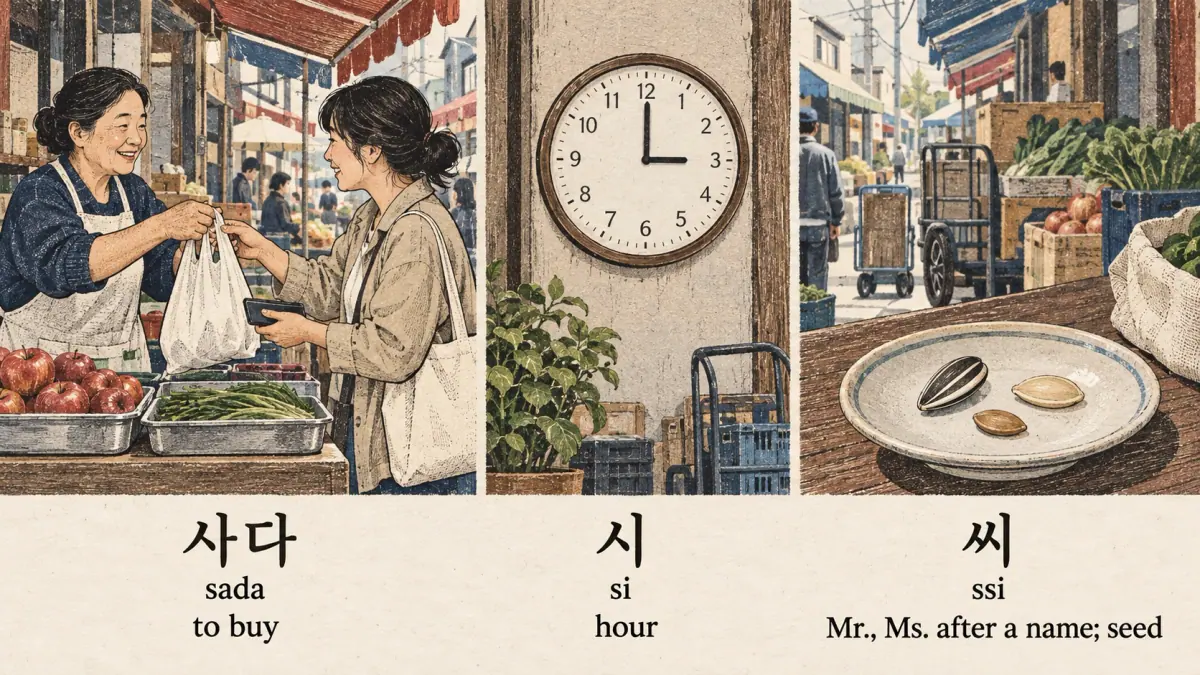
Korean ㅅ is an s before most vowels and an sh before ㅣ and the y-vowels. The tongue moves toward the roof of the mouth to prepare for the high front vowel, and the hiss changes colour. The change is automatic, and Korean speakers do not hear it as a different letter. The page Korean S or Sh Sound covers it in full.
| Syllable | What you hear | Example | Revised Romanization |
|---|---|---|---|
| 사, 소, 수 | s | 사다 (to buy) | sada |
| 시 | sh, like "shee" | 시 (hour) | si |
| 씨 | tight sh, like "sshee" | 씨 (Mr., Ms. after a name; seed) | ssi |
RR writes si and ssi, so a reader who says "see" will sound foreign. Let the tongue rise a little toward the palate before ㅣ. The tense ㅆ follows the same rule, so 씨 is a tight sh. With both sounds placed, one worked example puts them side by side.
Worked Example: 살 and 쌀

The worked example takes the two words in order, then uses them in a sentence. It checks each against tension and pitch.
- Set your mouth. For both words, bring the front of the tongue close to the ridge behind the upper teeth. Keep the lips relaxed for the vowel ㅏ.
- Say 살. Let the air flow softly with a relaxed throat. The vowel starts low. The final ㄹ is a light l.
- Say 쌀. Tighten the throat first, then release a short, sharp hiss. The vowel starts higher and sounds clipped.
- Check by ear. Record both words and play them back. 쌀 should sound tighter and slightly sharper than 살.
Now use ㅆ in a sentence: 쌀이 싸요 means "the rice is cheap". One sound change appears: the ㄹ of 쌀 moves to the next syllable before the vowel of 이, so 쌀이 is spoken [싸리]. The sentence is therefore [싸리 싸요].
The sentence 쌀을 사요 (I buy rice) uses both letters, ㅆ in 쌀 and ㅅ in 사요, and is spoken [싸를 사요]. Saying it correctly requires the contrast, which is why this pair is worth drilling. Note also that 살 has a second life as a counter for age: 한 살 is "one year old", and 몇 살이에요? asks "How old are you?" See Korean ages for the counting system.
What Happens to ㅅ and ㅆ at the End of a Syllable?
At the end of a syllable, ㅅ and ㅆ both sound like an unreleased [ㄷ]. The hiss disappears: the tongue closes against the ridge and the sound stops. A consonant in this position is a batchim (받침), and the ㄷ batchim lesson gives the full rule.
| Written | Meaning | Spoken | Final letter |
|---|---|---|---|
| 옷 | clothes | [옫] | ㅅ |
| 있다 | to be; to have | [읻따] | ㅆ |
| 갔다 | went | [갇따] | ㅆ |
The sibilant returns when a vowel follows, because the consonant moves to the next syllable: 옷이 is [오시] and 있어요 is [이써요]. The second example shows ㅆ coming back as a tense sound. This pattern is the key to the next section, because the ㅆ in many verbs is a past-tense marker.
Why Is ㅆ Pronounced Tense in 갔어요?

The ㅆ in 갔어요 is tense because the past-tense ending -았/었 is written with a tense ㅆ. In 갔어요 (went), the final ㅆ of 갔 moves to the next syllable and the word is spoken [가써요]. The past tense is taught in the grammar section. The same happens in 먹었어요 (ate), spoken [머거써요], and 있었어요 (was), spoken [이써써요].
| Written | Spoken | Meaning |
|---|---|---|
| 갔어요 | [가써요] | went |
| 먹었어요 | [머거써요] | ate |
| 했어요 | [해써요] | did |
This means learners meet ㅆ every day, not only in rare words like 쌀. A learner who flattens the ㅆ to a plain ㅅ says a sound that does not match the word. A related rule makes a plain ㅅ tense after a final stop, as in 학생 (student), spoken [학쌩], and 국수 (noodles), spoken [국쑤]. That belongs to Korean tensification. The common errors follow.
Common Learner Mistakes
Four mistakes cause most of the confusion between ㅅ and ㅆ. Each follows the same pattern: what learners assume, what is true and the reason.
Learners often assume ㅆ is a long ㅅ; actually it is a tight ㅅ, because the doubled letter shows tension, not length. Fix: tighten the throat and keep the hiss short.
Learners often assume ㅅ is always s; actually it sounds like sh before ㅣ, because the tongue rises toward the palate. Fix: say 시 as "shee".
Learners often assume ㅆ in 갔어요 is silent or weak; actually it is a full tense sound, because the final ㅆ moves to the next syllable. Fix: say [가써요] with a tight ㅆ.
Learners often assume 옷 ends with an s hiss; actually it ends with an unreleased [ㄷ], because of final-consonant neutralization. Fix: close the tongue and stop.
A further misconception is that 사다 and 싸다 can be told apart by context alone. They can in many sentences, but not in short answers such as 싸요 or 사요, where the only clue is the first consonant. The consonant mistakes page lists further patterns.
Practice and Answer Key
Work through the exercises in order. The answers follow after Exercise 4.
Exercise 1: listen and choose. Play each clip once, then write ㅅ or ㅆ for the first consonant.
Practice · Read
Show answer
살
listen-first clip 1: 살, flesh or years of age (plain ㅅ)
Show answer
쌀
listen-first clip 2: 쌀, uncooked rice (tense ㅆ)
Show answer
사다
verb pair: 사다, to buy
Show answer
싸다
verb pair: 싸다, to be cheap
Show answer
살 쌀
worked example: 살, 쌀 in a row
Show answer
쌀이 싸요
sentence: 쌀이 싸요, the rice is cheap
Show answer
시 씨
ㅅ and ㅆ before ㅣ: 시, 씨
Show answer
갔어요
ㅆ in the past tense: 갔어요, went, spoken [가써요]
Show answer
옷 있다
final position: 옷, 있다 in a row
Exercise 2: sort the letters. Name the type (plain or tense) of the first letter in each word: 1 쌀 (rice), 2 사람 (person), 3 쓰다 (to write; to use), 4 소금 (salt), 5 아저씨 (middle-aged man; the consonant of the last syllable).
Exercise 3: pick the meaning. Choose buy or cheap: 1 사요, 2 싸요, 3 쌀이 싸요 (last word).
Exercise 4: pronunciation. Write how each is pronounced: 1 옷, 2 있다, 3 갔어요, 4 시.
Answers.
Exercise 2: 1 tense. 2 plain. 3 tense. 4 plain. 5 tense.
Exercise 3: 1 buy. 2 cheap. 3 cheap.
Exercise 4: 1 [옫]. 2 [읻따]. 3 [가써요]. 4 [시], like "shee".
If you answered the written exercises correctly but missed some in Exercise 1, your hearing is behind your knowledge, which is typical. Repeat the clips daily for a week and add the plain, tense and aspirated listening practice. The minimal pairs page has more pairs.
Where to Go Next
Continue with How to Pronounce Korean Tense Consonants, which gives a four-step method for all five tense letters. If you skipped the earlier sets, Korean ㅈ ㅊ ㅉ Difference covers the neighbouring set. The full lesson list is in Plain, Tense and Aspirated Sounds, and the letter shapes are in the Hangul consonants section.
This lesson covers ㅅ and ㅆ at the start and end of a syllable, before ㅣ and in the past-tense ending. It does not cover every tensification pattern, regional differences or the acoustic measurements behind the pitch cue. Those topics have their own pages.
The Korean ㅅ ㅆ difference comes down to tension: ㅅ is a soft hiss with a little breath and ㅆ is a tight, sharp hiss. Learn the pair by ear, remember that ㅆ appears in everyday past-tense verbs, and trust the audio over the romanization.
Frequently Asked Questions
Why does Korean have only two sounds in the ㅅ set? Korean has ㅅ and ㅆ but no aspirated ㅅ. Phoneticians often note that ㅅ already carries a little breath after the hiss, so a third, more breathy version has no room. Every other set has three members: plain, tense and aspirated. This set has two, and the tense member needs the practice.
Is ㅅ an s or an sh? Both, depending on the vowel. Before most vowels, ㅅ sounds like an s. Before ㅣ and the y-vowels, it sounds like sh, so 시 is close to 'shee'. Revised Romanization writes s in both cases. The change is automatic and Korean speakers do not hear it as a different letter.
How do I tell 사다 and 싸다 apart? 사다 means to buy and 싸다 means to be cheap, or to wrap. The only difference is the first consonant: plain ㅅ in 사다 and tense ㅆ in 싸다. Say 싸다 with a tight throat and a sharper hiss. The sentence 쌀이 싸요 (the rice is cheap) uses ㅆ twice.
Why is ㅆ in 갔어요 pronounced like a tense s? The ㅆ in past-tense endings is a real tense ㅆ. In 갔어요 (went), the final ㅆ of 갔 moves to the next syllable, so the word is spoken [가써요]. The tense sound is part of the past-tense ending -았/었, so learners meet ㅆ in many common verbs, not only in 쌀 and 싸다.
Do ㅅ and ㅆ sound the same at the end of a syllable? Yes. At the end of a syllable, both become an unreleased [ㄷ], so 옷 (clothes) is [옫] and 있다 (to be) is [읻따]. The sibilant hiss disappears and the tongue closes. The difference returns when a vowel follows, as in 옷이 [오시] and 있어요 [이써요].