
Take the Days of the Week in Korean Quiz
Practice
월요일
Question 1 replay clip
일요일
Question 2 replay clip
주말
Question 3 replay clip
금요일
Question 4 replay clip
토요일
Question 5 replay clip
오늘 무슨 요일이에요
Question 9 replay clip
내일
Question 11 replay clip
어제는 일요일이었어요
Question 12 replay clip
매주
Question 13 replay clip
Practice · 14
What day is 월요일 (woryoil)?
Show answer
Monday
월 (月) means moon, and 월요일 is Monday. It is said [워료일].
Which day is 일요일 (iryoil)?
Show answer
Sunday
일 (日) means sun, so 일요일 is Sunday. It is said [이료일].
What does 주말 (jumal) mean?
Show answer
weekend
주 means week and 말 means end, so 주말 is the weekend.
Which day is 금요일 (geumyoil)?
Show answer
Friday
금 (金) means metal or gold, so 금요일 is Friday. It is said [그묘일].
Which day is 토요일 (toyoil)?
Show answer
Saturday
토 (土) means earth, so 토요일 is Saturday, the first day of the weekend.
How do you say Wednesday?
Show answer
수요일
수 (水) means water, so 수요일 (suyoil) is Wednesday. 화요일 is Tuesday and 목요일 is Thursday.
Which day name contains 火 (fire)?
Show answer
화요일
화 (火) means fire, so 화요일 (hwayoil) is Tuesday. 수 is water and 목 is wood.
How is 목요일 (mogyoil) said in Korean?
Show answer
[모교일]
The final ㄱ of 목 moves onto the silent ㅇ of 요, so the word is said [모교일].
What does 요일 (yoil) mean in 오늘 무슨 요일이에요? (oneul museun yoirieyo?)
Show answer
day of the week
요일 means day of the week. The question asks "What day of the week is it today?"
Which word means weekday, Monday to Friday?
Show answer
평일
평일 (pyeongil) is a weekday. 주말 is the weekend and 공휴일 is a public holiday.
What does 내일 (naeil) mean?
Show answer
tomorrow
내일 is tomorrow. Today is 오늘 and yesterday is 어제. None of the three takes 에.
어제는 일요일이었어요 (eojeneun iryoirieosseoyo) means "Yesterday was Sunday." What day is today?
Show answer
Monday
The day after Sunday is Monday, so today is 월요일.
What does 매주 (maeju) mean in 매주 일요일에 운동해요?
Show answer
every week
매 means every and 주 means week, so 매주 is every week.
Which phrase means next week?
Show answer
다음 주
다음 (next) plus 주 (week) is 다음 주. 지난주 is last week and 이번 주 is this week.
Follow these steps. Each one tells you what you should see.
- Read the question and say any Korean text aloud once. You should see four choices.
- Pick one choice by click, tap or by pressing 1, 2, 3 or 4. The Check button turns active.
- Select Check. You see "Correct" or "Not quite", the right answer and a one-sentence reason. Select Next.
- After question 14, read the summary. It shows how many answers were correct in this session and links to the days of the week lesson and the deck for the questions you missed.
Question order and choice order change every session, so a retake is never the same sequence. Day names are given with their Revised Romanization in the prompts, and the reason line shows the spoken form where it differs from the spelling.
What Does This Days of the Week in Korean Quiz Cover?
The quiz has 14 questions. Five ask which day a name is, two ask about the element behind a name or how it is pronounced, three ask for the meaning of 요일, 평일 and 주말, and four use today, tomorrow, every week and next week. The full lesson also covers 휴일 and 공휴일 and the weeks and months words; the quiz keeps to the first ones you need.
| Question type | Count | Example |
|---|---|---|
| Which day is this name? | 5 | What day is 월요일? |
| Element meaning and pronunciation | 2 | Which day has 火 (fire)? |
| Weekday, weekend and 요일 | 3 | What does 주말 mean? |
| Today, tomorrow and week words | 4 | What does 매주 mean? |
The lesson behind the quiz is days of the week in korean, which lists 20 words with Revised Romanization, audio and an example sentence. The quiz uses the seven day names and eight of the other words.
How Is the Days of the Week in Korean Quiz Scored?
The quiz gives one point for each of the 14 questions you answer correctly on the first try in the current session. At the end it shows a line such as "You answered 11 of 14 correctly in this session". There is no timer, no streak and no ranking, so you can slow down and say each answer aloud.
The count is not a CEFR level, a TOPIK level or a measure of fluency. It only shows what you recalled today. Your answers and score stay in your browser and disappear when you close the tab, unless you choose to save progress on your own device. The element questions are not trivia: each day has a one-syllable name that is easier to remember once you know what it means.
What Do the Day Names Mean?
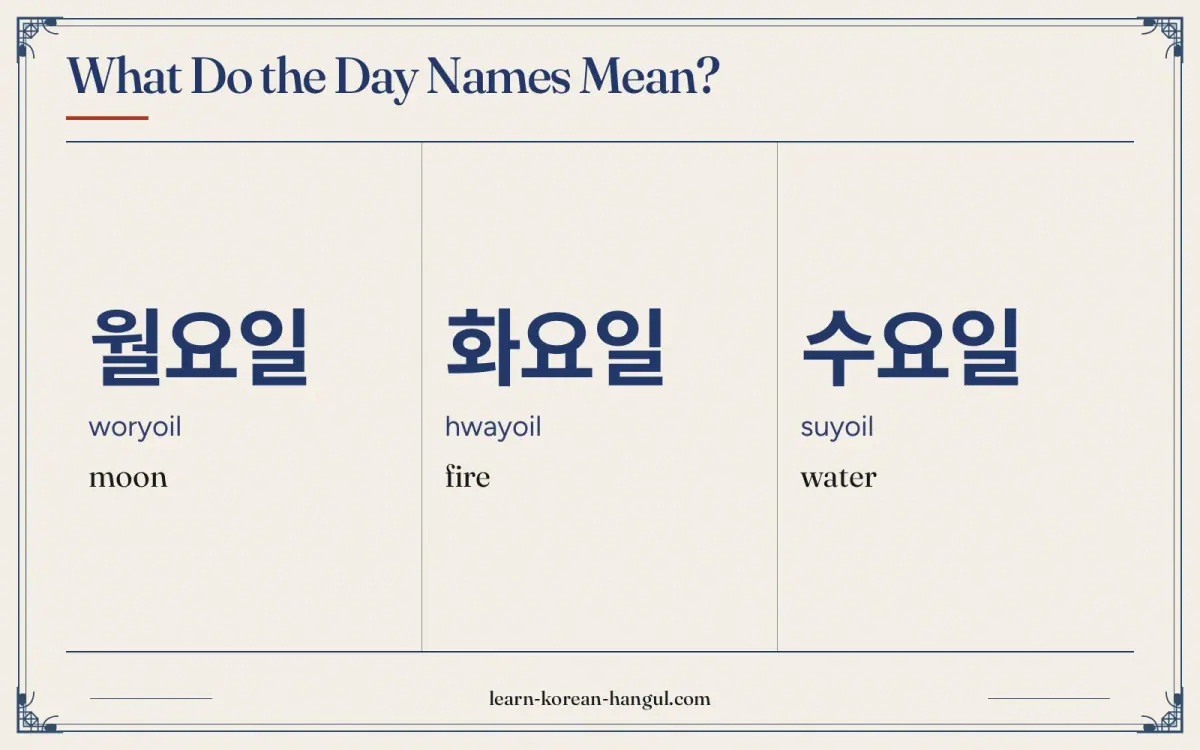
Each of the seven day names is a Sino-Korean word: one syllable from the Chinese characters for the moon, the sun or one of five elements, followed by 요일 (yoil, 曜日, "day of the week"). Learn the first syllable and you know which day it is.
| Day | Korean | Revised Romanization | First syllable | Meaning | Said as |
|---|---|---|---|---|---|
| Monday | 월요일 | woryoil | 월 (月) | moon | [워료일] |
| Tuesday | 화요일 | hwayoil | 화 (火) | fire | [화요일] |
| Wednesday | 수요일 | suyoil | 수 (水) | water | [수요일] |
| Thursday | 목요일 | mogyoil | 목 (木) | wood | [모교일] |
| Friday | 금요일 | geumyoil | 금 (金) | metal; gold | [그묘일] |
| Saturday | 토요일 | toyoil | 토 (土) | earth | [토요일] |
| Sunday | 일요일 | iryoil | 일 (日) | sun; day | [이료일] |
Four names change when spoken. A final consonant in 월, 목, 금 or 일 moves onto the empty ㅇ of 요, so 월요일 sounds like 워료일 and 목요일 like 모교일.
Which Week Words Does the Quiz Use?
These words appear in the questions. Most of them are short, and the three words for today, yesterday and tomorrow take no 에 when you use them in a sentence.
| Korean | Revised Romanization | Meaning | Note |
|---|---|---|---|
| 요일 | yoil | day of the week | 오늘 무슨 요일이에요? asks the day |
| 평일 | pyeongil | weekday | Monday to Friday as a block |
| 주말 | jumal | weekend | 주 is week and 말 is end |
| 오늘 | oneul | today | takes no 에 |
| 어제 | eoje | yesterday | takes no 에 |
| 내일 | naeil | tomorrow | takes no 에 |
| 매주 | maeju | every week | 매 means every |
| 다음 주 | daeum ju | next week | two words |
To say a day with "on", add 에 after the name: 월요일에 학교에 가요 (woryoire hakgyoe gayo) means "I go to school on Monday".
Sample Questions with Answers
These six questions come from the quiz, with the answer and the reason for each. They also work as a no-JavaScript preview. Samples 1, 2, 4 and 5 name a day, and sample 3 asks about the weekend.
Sample Question 1 and Its Answer
Question: What day is 월요일 (woryoil)?
Choices: Tuesday; Monday; Sunday; Thursday.
Answer: Monday. Why: 월 (月) means moon, and 월요일 is Monday. It is said [워료일].
Sample Question 2 and Its Answer
Question: Which day is 일요일 (iryoil)?
Choices: Saturday; Wednesday; Monday; Sunday.
Answer: Sunday. Why: 일 (日) means sun, so 일요일 is Sunday. It is said [이료일].
Sample Question 3 and Its Answer
Question: What does 주말 (jumal) mean?
Choices: weekend; weekday; every week; next week.
Answer: weekend. Why: 주 means week and 말 means end, so 주말 is the weekend.
Sample Question 4 and Its Answer
Question: Which day is 금요일 (geumyoil)?
Choices: Thursday; Friday; Saturday; Tuesday.
Answer: Friday. Why: 금 (金) means metal or gold, so 금요일 is Friday. It is said [그묘일].
Sample Question 5 and Its Answer
Question: Which day is 토요일 (toyoil)?
Choices: Saturday; Sunday; Friday; Monday.
Answer: Saturday. Why: 토 (土) means earth, so 토요일 is Saturday, the first day of the weekend.
Sample Question 6 and Its Answer
Question: How do you say Wednesday?
Choices: 목요일; 화요일; 수요일; 금요일.
Answer: 수요일. Why: 수 (水) means water, so 수요일 (suyoil) is Wednesday. 화요일 is Tuesday and 목요일 is Thursday.
Tips before You Start
- Learn the pairs: 월 moon, 화 fire, 수 water, 목 wood, 금 metal, 토 earth, 일 sun.
- Always add 요일 when you mean the day of the week. 월 alone is not the day name.
- Say 화요일 and 수요일 aloud one after the other. They differ only in the first syllable, so many learners swap them.
- For the pronunciation question, remember that a final consonant moves forward when the next syllable starts with ㅇ.
Which Mistakes Does the Days of the Week in Korean Quiz Catch?
Four errors cover most misses.
- Mixing 화요일 and 수요일, which share the same ending and differ only in the first syllable.
- Forgetting 요일 and answering with just the first syllable.
- Mixing up 월요일 (Monday) with month words, because 월 (月) also appears in month names such as 일월.
- Adding 에 to 오늘, 어제 or 내일, which do not take it.
What Should You Study after the Quiz?
Drill the names with the days of the week in korean flashcards, and reread the days of the week in korean lesson for any group you missed. To train your ear on the changed sounds, try the korean listening discrimination tool. The next quiz in the sequence is the months in korean quiz. You can also return to the korean vocabulary quiz list, or take the korean level test for a wider check.
Answer Key for Questions 7 to 14
Prefer to test yourself first? Take the quiz above, then check this table. The first six answers are in the sample questions.
| # | Question | Correct answer | Reason |
|---|---|---|---|
| 7 | Which day name contains 火 (fire)? | 화요일 | 화 (火) means fire, so 화요일 (hwayoil) is Tuesday. 수 is water and 목 is wood. |
| 8 | How is 목요일 (mogyoil) said in Korean? | [모교일] | The final ㄱ of 목 moves onto the silent ㅇ of 요, so the word is said [모교일]. |
| 9 | What does 요일 (yoil) mean in 오늘 무슨 요일이에요? (oneul museun yoirieyo?) | day of the week | 요일 means day of the week. The question asks "What day of the week is it today?" |
| 10 | Which word means weekday, Monday to Friday? | 평일 | 평일 (pyeongil) is a weekday. 주말 is the weekend and 공휴일 is a public holiday. |
| 11 | What does 내일 (naeil) mean? | tomorrow | 내일 is tomorrow. Today is 오늘 and yesterday is 어제. None of the three takes 에. |
| 12 | 어제는 일요일이었어요 (eojeneun iryoirieosseoyo) means "Yesterday was Sunday." What day is today? | Monday | The day after Sunday is Monday, so today is 월요일. |
| 13 | What does 매주 (maeju) mean in 매주 일요일에 운동해요? | every week | 매 means every and 주 means week, so 매주 is every week. |
| 14 | Which phrase means next week? | 다음 주 | 다음 (next) plus 주 (week) is 다음 주. 지난주 is last week and 이번 주 is this week. |
What Does This Quiz Not Do?
The quiz covers the seven day names and a small set of week words. It does not test 휴일 and 공휴일, date formats, months or the week-of-the-month words. It does not teach the hanja characters beyond their meanings, and a hanja question never needs you to read them. Written schedules and calendars often shorten day names to the first syllable, such as 월 and 화; in speech, say the full name. All Korean text in the questions and answers was generated and is waiting for review by a Korean reviewer.
Frequently Asked Questions
Do I need to know hanja to take the days of the week quiz?
No. The quiz only uses the meanings of the first syllable, such as moon, fire and water, and every reason line gives the meaning in English. The characters appear as a memory aid. You will not be asked to read or write them.
Why does every day name end in 요일?
요일 (曜日) means day of the week, and it is added to a one-syllable name for the sun, the moon or an element. So 월 plus 요일 gives Monday. If you say only 월, listeners may hear month, as in 일월 (January), not the day.
Does the quiz use audio?
Most questions have a replay button for the Korean word or phrase. If a clip is missing, the replay button is hidden and the question still works as text.
How do I say "on Monday" in Korean?
Add the particle 에 after the day name: 월요일에 (woryoire). You do not add it to 오늘, 어제 or 내일. The quiz does not test this directly, but its example sentences use the pattern, so you can practise it as you read the reasons.
Is the quiz free?
Yes. The quiz is free, needs no account and runs in your browser on a phone, tablet or computer. Nothing you answer is uploaded to a server. If you choose to save progress, it is stored on your own device only, and you can delete it in the settings at any time.
Retake the Days of the Week in Korean Quiz
Retake the days of the week in korean quiz once you can recite 월, 화, 수, 목, 금, 토, 일 with their meanings. The reason line for each question is also a mini-lesson, so reading it twice often helps more than a fast retake. When the week feels easy, move on to the months.