
Take the Fruits in Korean Quiz
Practice
사과
Question 1 replay clip
포도
Question 3 replay clip
바나나
Question 4 replay clip
수박
Question 6 replay clip
배를 먹어요
Question 7 replay clip
감
Question 8 replay clip
참외
Question 11 replay clip
과일
Question 12 replay clip
양파
Question 14 replay clip
무
Question 15 replay clip
Practice · 15
What is 사과 (sagwa)?
Show answer
apple
사과 is the apple. The same spelling also means apology, so context decides.
Which word means strawberry?
Show answer
딸기
딸기 (ttalgi) is the strawberry. Its ㄸ is a tense consonant, said with no puff of air.
What is 포도 (podo)?
Show answer
grapes
포도 is the grape, and a bunch of grapes is 포도 한 송이.
What is 바나나 (banana)?
Show answer
banana
바나나 is a loanword from English, so the sound is close to "banana".
Which word is the loanword for the large imported orange?
Show answer
오렌지
오렌지 (orenji) comes from English. 귤 is the small tangerine, a different fruit.
What is 수박 (subak)?
Show answer
watermelon
수박 is the watermelon, a summer fruit sold whole or by the slice.
배를 먹어요 (baereul meogeoyo) means "I eat a ___." What is 배 here?
Show answer
pear
배 also means belly and ship. You can eat only the fruit, so it is a pear.
What is 감 (gam)?
Show answer
persimmon
감 is the persimmon, an autumn fruit. A soft ripe one is called 홍시.
Which fruit is small, easy to peel and a winter favourite?
Show answer
귤
귤 (gyul) is the tangerine. The watermelon, melon and peach are summer fruits.
How is 복숭아 (boksunga) said in Korean?
Show answer
[복쑹아]
After a final ㄱ, the ㅅ becomes a tense ㅆ, so the word is said [복쑹아].
What is 참외 (chamoe)?
Show answer
Korean melon
참외 is the Korean melon, small, yellow and striped. It is said [차뫼].
What does 과일 (gwail) mean?
Show answer
fruit
과일 is the general word for fruit. It is useful for asking what fruit a shop has.
Which counter fits "a bunch of grapes" in 포도 한 ___ 주세요?
Show answer
송이
송이 (songi) counts bunches and clusters. 병 is for bottles, 마리 for animals and 잔 for cups.
What is 양파 (yangpa)?
Show answer
onion
양파 is the onion. The parts mean Western (양) and green onion (파).
What is 무 (mu)?
Show answer
Korean radish
무 is the Korean radish, used in soups and in the cubed kimchi 깍두기.
Follow these steps. Each one tells you what you should see.
- Read the question and say any Korean text aloud once. You should see four choices.
- Pick one choice by click, tap or by pressing 1, 2, 3 or 4. The Check button turns active.
- Select Check. You see "Correct" or "Not quite", the right answer and a one-sentence reason. Select Next.
- After question 15, read the summary. It shows how many answers were correct in this session and links to the fruits and vegetables lesson and the deck for the questions you missed.
Question order and choice order change every session, so a retake is never the same sequence. Fruit names are given with Revised Romanization in the prompts, and the reason line shows the spoken form where it differs from the spelling.
What Does This Fruits in Korean Quiz Cover?
The quiz has 15 questions. Nine ask what a fruit or vegetable word means, three ask you to match a description to a word, two use a short sentence or a counter, and one asks how a fruit name sounds. The fruits are 사과, 딸기, 포도, 바나나, 오렌지, 수박, 배, 감, 귤, 복숭아 and 참외. The vegetables are 양파 and 무.
| Question type | Count | Example |
|---|---|---|
| What does this word mean? | 9 | What is 사과 (sagwa)? |
| Which word fits this description? | 3 | Which fruit is small and easy to peel? |
| Short sentence or counter | 2 | 포도 한 ___ 주세요 |
| How does the word sound? | 1 | 복숭아 [복쑹아] |
The lesson behind the quiz is fruits in korean, with full lists of 40 fruits and 40 vegetables behind it. The quiz uses the fruit words you will meet first in a shop, a cafe or a school lunch.
How Is the Fruits in Korean Quiz Scored?
The quiz gives one point for each of the 15 questions you answer correctly on the first try in the current session. At the end it shows a line such as "You answered 12 of 15 correctly in this session". There is no timer, no streak and no ranking, so you can slow down and say each answer aloud.
The count is not a CEFR level, a TOPIK level or a measure of fluency. It only shows what you recalled today. Your answers and score stay in your browser and disappear when you close the tab, unless you choose to save progress on your own device. A miss on 귤 or 복숭아 is normal at this level, because those are native or Sino-Korean words with no English link to help you.
Which Fruit Words Should You Know before You Start?
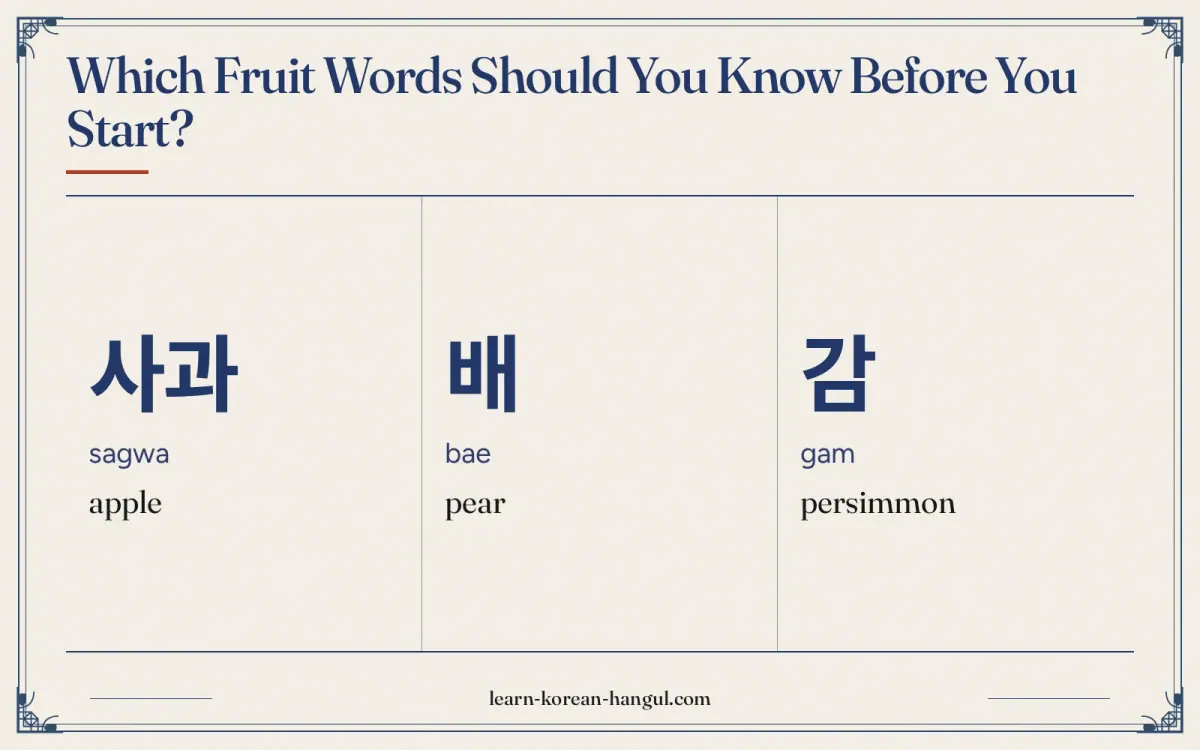
Fruit names come from three sources. Loanwords are easy to guess, native words need memorising, and Sino-Korean words are built from Chinese characters. The table lists the words the quiz uses.
| Korean | Revised Romanization | Meaning | Origin and note |
|---|---|---|---|
| 사과 | sagwa | apple | Sino-Korean; the same spelling also means apology |
| 배 | bae | pear | native; also belly and ship |
| 감 | gam | persimmon | native; an autumn fruit |
| 귤 | gyul | tangerine | Sino-Korean; small and easy to peel |
| 바나나 | banana | banana | loanword |
| 오렌지 | orenji | orange | loanword; the larger imported orange |
| 딸기 | ttalgi | strawberry | tense ㄸ, said with no puff of air |
| 포도 | podo | grape | counted by the bunch with 송이 |
| 수박 | subak | watermelon | a summer fruit |
| 복숭아 | boksunga | peach | said [복쑹아] |
| 참외 | chamoe | Korean melon | said [차뫼] |
| 양파 | yangpa | onion | vegetable |
| 무 | mu | Korean radish | vegetable |
Two lessons follow. First, 오렌지 and 귤 are different words: 오렌지 is the loanword and 귤 is the tangerine. Second, 배 and 사과 each have another meaning, so the sentence tells you which one is meant.
Which Fruit Sounds Change in Speech?
Three fruit names need care when you say them: 복숭아 and 참외 are not said the way they look, and 딸기 needs a tense sound. The quiz asks about 복숭아, and the others are good to know.
| Spelling | Sounds like | What happens |
|---|---|---|
| 딸기 | [딸기] | The tense ㄸ is short and sharp, with no puff of air. |
| 복숭아 | [복쑹아] | The ㅅ after a final ㄱ becomes a tense [ㅆ]. |
| 참외 | [차뫼] | The ㅁ moves to the start of the next syllable, which begins with ㅇ. |
This is the same sound pattern you meet in many nouns: a final stop sound makes the next plain consonant tense. Learning it for 복숭아 also helps with other words.
Sample Questions with Answers
These six questions come from the quiz, with the answer and the reason for each. They also work as a no-JavaScript preview. Samples 4 and 5 are loanwords, and sample 2 shows a tense consonant.
Sample Question 1 and Its Answer
Question: What is 사과 (sagwa)?
Choices: pear; apple; peach; plum.
Answer: apple. Why: 사과 is the apple. The same spelling also means apology, so context decides.
Sample Question 2 and Its Answer
Question: Which word means strawberry?
Choices: 포도; 수박; 복숭아; 딸기.
Answer: 딸기. Why: 딸기 (ttalgi) is the strawberry. Its ㄸ is a tense consonant, said with no puff of air.
Sample Question 3 and Its Answer
Question: What is 포도 (podo)?
Choices: grapes; cherries; lemons; plums.
Answer: grapes. Why: 포도 is the grape, and a bunch of grapes is 포도 한 송이.
Sample Question 4 and Its Answer
Question: What is 바나나 (banana)?
Choices: pineapple; mango; banana; lemon.
Answer: banana. Why: 바나나 is a loanword from English, so the sound is close to "banana".
Sample Question 5 and Its Answer
Question: Which word is the loanword for the large imported orange?
Choices: 귤; 오렌지; 레몬; 자몽.
Answer: 오렌지. Why: 오렌지 (orenji) comes from English. 귤 is the small tangerine, a different fruit.
Sample Question 6 and Its Answer
Question: What is 수박 (subak)?
Choices: melon; peach; watermelon; pumpkin.
Answer: watermelon. Why: 수박 is the watermelon, a summer fruit sold whole or by the slice.
Tips before You Start
- Say each fruit name aloud once before you choose. Sound often reveals loanwords.
- Loanwords like 바나나 are easy, so save your memory work for 귤, 감 and 복숭아.
- Link each fruit to a season: 수박 and 참외 in summer, 감 in autumn, 귤 in winter.
- Learn the counter with the fruit: 사과 세 개 for apples, 포도 한 송이 for grapes.
Which Mistakes Does the Fruits in Korean Quiz Catch?
Four errors cover most misses.
- Mixing up 귤 (tangerine) and 오렌지 (orange), which are two separate words.
- Dropping the tense ㄸ in 딸기 and saying it like a plain ㄷ.
- Answering "ship" or "belly" for 배 in a sentence about eating.
- Using 개 for bunches of grapes instead of 송이.
What Should You Study after the Quiz?
Drill the words with the korean fruits and vegetables flashcards, and reread the fruits in korean lesson for any group you missed. To practise reading the words quickly, try the korean reading practice tool. The next quiz in the sequence is the korean animal quiz. You can also return to the korean vocabulary quiz list, or take the korean level test for a wider check.
Answer Key for Questions 7 to 15
Prefer to test yourself first? Take the quiz above, then check this table. The first six answers are in the sample questions.
| # | Question | Correct answer | Reason |
|---|---|---|---|
| 7 | 배를 먹어요 (baereul meogeoyo) means "I eat a ___." What is 배 here? | pear | 배 also means belly and ship. You can eat only the fruit, so it is a pear. |
| 8 | What is 감 (gam)? | persimmon | 감 is the persimmon, an autumn fruit. A soft ripe one is called 홍시. |
| 9 | Which fruit is small, easy to peel and a winter favourite? | 귤 | 귤 (gyul) is the tangerine. The watermelon, melon and peach are summer fruits. |
| 10 | How is 복숭아 (boksunga) said in Korean? | [복쑹아] | After a final ㄱ, the ㅅ becomes a tense ㅆ, so the word is said [복쑹아]. |
| 11 | What is 참외 (chamoe)? | Korean melon | 참외 is the Korean melon, small, yellow and striped. It is said [차뫼]. |
| 12 | What does 과일 (gwail) mean? | fruit | 과일 is the general word for fruit. It is useful for asking what fruit a shop has. |
| 13 | Which counter fits "a bunch of grapes" in 포도 한 ___ 주세요? | 송이 | 송이 (songi) counts bunches and clusters. 병 is for bottles, 마리 for animals and 잔 for cups. |
| 14 | What is 양파 (yangpa)? | onion | 양파 is the onion. The parts mean Western (양) and green onion (파). |
| 15 | What is 무 (mu)? | Korean radish | 무 is the Korean radish, used in soups and in the cubed kimchi 깍두기. |
What Does This Quiz Not Do?
The quiz covers 11 fruits, two vegetables and one counter. It does not test the larger fruit and vegetable lists, cooking words, or shopping phrases. It does not teach prices or quantities beyond the counter 송이. Colloquial and regional names may differ from the standard words. All Korean text in the questions and answers was generated and is waiting for review by a Korean reviewer.
Frequently Asked Questions
Why does a fruit quiz include vegetables?
Korean shops, menus and the lesson itself group fruits and vegetables together, and learners often confuse a few of the words. The quiz includes two vegetables, 양파 and 무, so you practise telling them apart from fruit. The full lesson lists many more vegetables.
Does the quiz use audio?
Most questions have a replay button for the Korean word or phrase. If a clip is missing, the replay button is hidden and the question still works as text.
What is the difference between 귤 and 오렌지?
귤 is the small, easy-to-peel tangerine that is a winter fruit in Korea. 오렌지 is a loanword for the larger imported orange. English speakers often assume they are the same, which is why the quiz asks about both in separate questions.
Does the quiz teach how to count fruit?
Only partly. One question asks for the counter 송이, used for a bunch of grapes. The counter 개 for single pieces, such as 사과 세 개, appears in the lessons and in the counters quiz. Counting in general belongs to the counters lessons.
Is the quiz free?
Yes. The quiz is free, needs no account and runs in your browser on a phone, tablet or computer. Nothing you answer is uploaded to a server. If you choose to save progress, it is stored on your own device only, and you can delete it in the settings at any time.
Retake the Fruits in Korean Quiz
Retake the fruits in korean quiz once you can sort the loanwords from the native and Sino-Korean words. The reason line for each question is also a mini-lesson, so reading it twice often helps more than a fast retake. When the fruits feel easy, move on to animals.