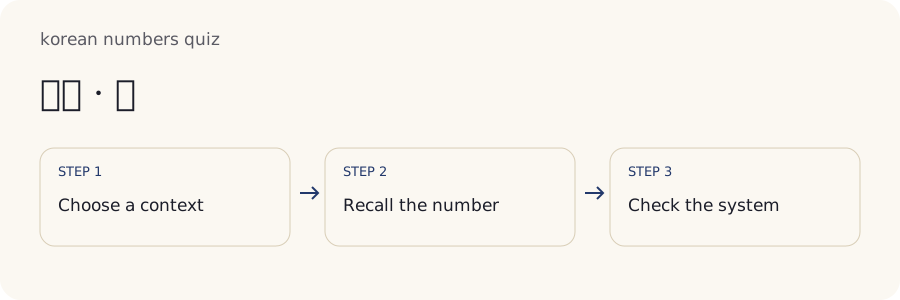
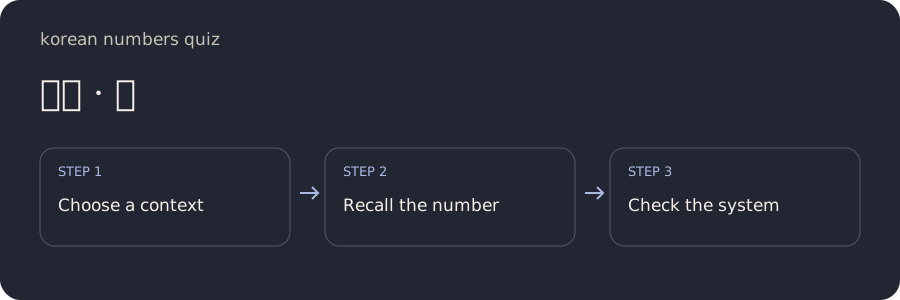
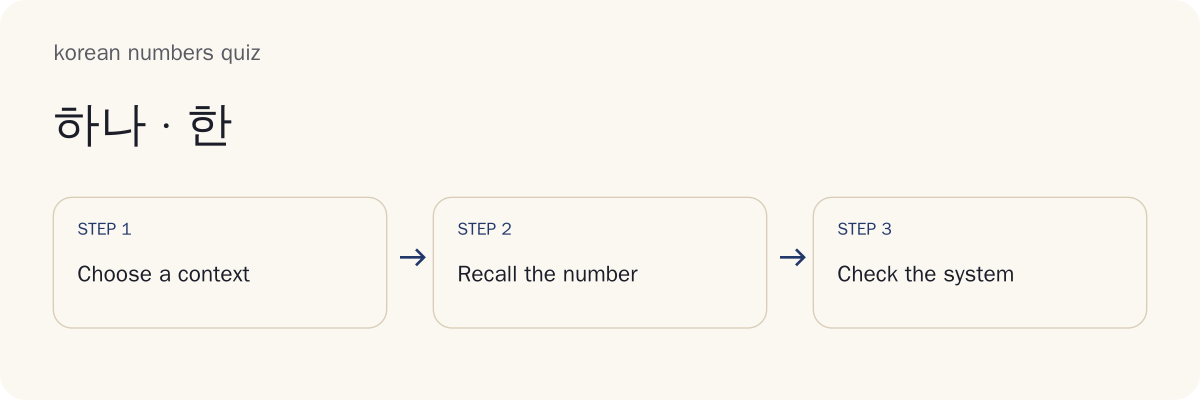
How to Use the Korean Numbers Quiz
Choose a context and mode, answer one item, inspect the explanation, then practise the category that caused difficulty. The quiz gives you a controlled way to separate remembering a number from using it in a situation.
- Choose the task. Select a context such as people, time or prices and a range you can manage. Begin with recognition if you are still learning the forms. Your checkpoint is knowing whether the task expects a quantity, a label or a complete phrase.
- Answer before revealing help. Read the whole prompt, including the requested number system. Enter or select an answer, then check it. Finish any Korean keyboard composition before checking typed Hangul.
- Inspect each part of the feedback. A correct amount can still use a different system or counter from the target. Find the reason for the result rather than remembering only its colour.
- Repeat the weak category. Use the explanation to choose a focused follow-up. If short forms caused the error, practise those forms before mixing them with prices and clock times.
The original numbers preset has twenty questions, while the focused counter preset has fifteen. These counts describe exercises, not learner results. Different modes can reveal different difficulties, so choose the next mode deliberately.
Practice Modes and Range Settings
Recognition asks you to identify an answer; Hangul input asks you to produce it. Reverse mode asks for digits from Korean text, listening starts with sound, and tiles let you construct an answer using available pieces. Each mode changes what you must recall, even when the underlying amount stays the same.
Recognition is useful when forms are new. Typed input exposes spelling and shortening mistakes that answer choices can hide. Reverse practice checks whether you understand the quantity independently of writing it. Tiles support construction when keyboard entry is difficult; they still require choosing and ordering the right material.
Set a small range when you are learning a new category. Expanding the range and switching context simultaneously makes it harder to identify the source of an error. Keep one setting stable, then change the other after a successful practice session.
Listening depends on audio available on your device. Do not interpret an unavailable Korean voice as a wrong answer, or treat device speech as professional narration. The choice between a short session and a challenge matters more after the forms are familiar.
Choose a Short Session or a Timed Challenge
Untimed practice lets you concentrate on the rule and use manual advance. A timed challenge adds a separate demand: retrieving the answer quickly. Begin without a timer when a counter or number form is new, then use timing to test recall after you can explain the answers.
Keep assisted answers distinct from first answers. Revealing a solution can teach you something, but it does not demonstrate independent recall. Compare sessions only when their range, context, mode and help use are similar. A higher percentage from an easier range does not show the same improvement as stronger performance on the same task.
Which Number System Fits the Situation?
Choose the number system from the meaning of the situation and its unit. Native numbers are common for everyday counts, clock hours and age with the age counter used in conversation. Sino-Korean numbers are common for money, calendar dates, minutes, measurements and numbered labels.
| Situation | Common System | Example From the Lessons |
|---|---|---|
| Counting apples | Native | 사과 세 개: three apples |
| Counting people | Native | 학생 두 명: two students |
| Clock hour | Native | 한 시: one o'clock |
| Minutes | Sino-Korean | 십오 분: fifteen minutes |
| Price | Sino-Korean | 오천 원: five thousand won |
| Calendar month | Sino-Korean | 오월: May |
| Phone digits | Sino-Korean | 공일공: 010 |
| Floor label | Sino-Korean | 삼 층: third floor |
The table is a starting point, not a rule that every small number must be native. A price of five still belongs to the price context, and a floor label is different from counting five objects. Likewise, a hundred objects uses the everyday Sino-Korean word for a hundred.
Formal contexts can differ from conversational examples. Read the requested unit and style instead of applying a blanket cutoff such as “native below one hundred.” The exercise may explicitly ask you to practise a particular system, even when real usage permits alternatives. Before considering that distinction, learn the short forms required by many everyday counters.
Native Numbers before Counters
Five native forms shorten before a counter: 하나 becomes 한, 둘 becomes 두, 셋 becomes 세, 넷 becomes 네, and exactly 스물 becomes 스무. The standalone number and its counting phrase therefore need separate practice.
The original preset contrasts 스무 살, twenty years old, with 스물한 살, twenty-one years old. Exactly twenty changes to the special form. Twenty-one keeps the twenty part and shortens its final one before the counter. Do not change every number beginning with twenty into the exact-twenty form.
A useful checkpoint is to identify the final part of the number before choosing its counter form. Saying the standalone number correctly does not complete this step. Counter-form mistakes are often memory errors about the phrase, rather than errors about the quantity itself.
When Can a Valid Alternative Still Miss the Exercise?
A valid alternative can miss an exercise when the prompt explicitly requests another form. The quiz distinguishes the requested practice target from a claim that all other expressions are impossible. Read that distinction in the feedback before changing your understanding of real Korean usage.
For example, a drill designed to practise native counting checks that specific skill. Producing the intended quantity with another permitted number system may show that you know the amount, while leaving the requested native form untested. Feedback should keep those two observations separate.
Avoid two opposite mistakes. Treating any correct quantity as full success ignores the learning objective. Treating every non-target answer as universally ungrammatical turns a narrow drill into a false language rule. For an unfamiliar alternative, use the explanation and consult a teacher rather than generalising from one quiz result.
Context, requested form and accepted variants together determine what the exercise checks. The next step is selecting a counter that describes the thing or unit being counted.
Counters for People, Animals, Books and Drinks
A counter identifies the category or unit of a count. The common pattern is noun, number, then counter. Learning that phrase is more useful than learning a number in isolation, because a listener needs to know what the quantity refers to.
| What You Count | Counter | Existing Lesson Example |
|---|---|---|
| People | 명 | 학생 세 명: three students |
| Respected people | 분 | 손님 두 분: two guests |
| Animals | 마리 | 고양이 두 마리: two cats |
| Small objects | 개 | 사과 한 개: one apple |
| Books | 권 | 책 세 권: three books |
| Tickets or sheets | 장 | 표 두 장: two tickets |
| Cups | 잔 | 커피 두 잔: two cups of coffee |
| Bottles | 병 | 맥주 한 병: one bottle of beer |
The object counter is a useful fallback for small objects, but it is not a replacement for people or animals. A book exercise may also ask for the more specific book counter, so examine the noun before answering.
One spelling can represent different units. The respectful people counter and the minute unit are both written 분, but their meanings lead to different number choices. Practise the meaning with the form instead of memorising one system for a spelling. Restaurant situations make that principle especially clear.
Cups, Bottles and Servings in a Restaurant
Cups, bottles and servings describe different things. A café quantity may count cups of coffee, a bottle count may describe containers, and a serving count describes portions of food. Choosing a number correctly leaves the unit decision unfinished.
The counter lesson gives 커피 두 잔 for two cups of coffee and 맥주 한 병 for one bottle of beer. It also gives 이 인분 for two servings. The first two use native counting forms; the serving phrase uses Sino-Korean numbers. A table with two guests does not automatically imply exactly two servings of every dish.
When reading a restaurant prompt, ask what the staff member needs to know: the number of people, drinks, bottles or portions. Keep the answer tied to that unit. A phrase naming guests answers a people question, while a serving phrase answers a portion question.
A useful exercise is to describe each existing example in English before checking its Korean. If you cannot identify the unit, repeating the number list will not fix the problem. Clock practice also depends on separating units.
How Do Hours and Minutes Use Different Numbers?
Everyday clock time uses native numbers for the hour and Sino-Korean numbers for the minutes. Read the hour and minute parts separately, then join them. The original preset's 세 시 십 분 means 3:10: the hour uses the native three, while the minutes use Sino-Korean ten.
The native-number lesson also gives 세 시 십오 분 for 3:15. Compare these examples by holding the hour steady and changing the minutes. The hour's number system stays the same, while the minute expression changes with the amount.
Before checking, inspect both units. Using the correct hour with the wrong minute system is a partial understanding of the time phrase. Remember that the hour form can need shortening, just as a counting phrase can.
A clock reading and a duration answer different questions. A time of day tells you when something happens; a duration tells you how long it lasts. Do not extend a clock-hour drill automatically to every measurement of hours. Pay attention to morning or afternoon information when a prompt includes it, and keep calendar questions separate from elapsed time.
Calendar Months and Durations
A calendar month names a position in the year; a duration describes an amount of elapsed time. The Sino-Korean lesson gives 오월 for May and identifies two fixed exceptions: 유월 for June and 시월 for October. Learn those month names as complete forms.
A duration is not created by reusing a calendar label. The native lesson gives 두 달 for two months of duration. This expresses a length of time, rather than February. Check whether the prompt asks “which month?” or “how many months?” before constructing an answer.
For date drills, keep the requested date valid. Changing spelling cannot make an impossible day into a real calendar date. Prices and phone numbers bring another distinction: quantities are not read like sequences of digits.
Prices, Phone Digits and Large Numbers
Prices use Sino-Korean quantity words, while phone drills read digits individually. The original numbers preset gives 만 오천 원 for 15,000 won. Read the amount as ten thousand plus five thousand, followed by the currency unit. The same sequence of Arabic digits used as an identifier would require a different task.
Korean large-number units group digits around ten thousand rather than the English thousand grouping. The Sino-Korean lesson gives 만 for 10,000 and 억 for 100,000,000. It also gives 십오만 for 150,000: fifteen groups of ten thousand. Regrouping the amount before choosing the words can prevent a misplaced large unit.
For phone digits, 공일공 represents 010. Preserve the leading zero because the task is a sequence, not the quantity ten. Read a long digit string in manageable chunks without converting it into a large-number expression.
Zero has context-dependent readings. The lesson uses 영 in mathematics and 공 for phone digits; the phone drill states the requested target. A different zero reading may remain understandable even when it misses that target. Native tens need a different kind of preparation because their words are less regular.
Native Tens beyond the First Ten
Native tens are separate words rather than multiples built from one ten word. The lesson lists 열, 스물, 서른, 마흔, 쉰, 예순, 일흔, 여든 and 아흔. Recall each ten directly before practising compounds.
The original preset tests 마흔 for forty. If you hesitate there, a larger mixed session may keep repeating the same memory problem. Practise the tens first, then add the ones. The lesson's 스물다섯 is twenty-five and 마흔둘 is forty-two.
Keep standalone recall separate from counter forms. Recognising a compound number establishes its amount; a following counter can change the final form. Feedback helps identify which stage of that process needs work.
Why Is a Correct Amount Marked Differently from Spelling?
A correct quantity and correct spelling are separate achievements. The quiz can distinguish value, number system, counter, shortened form and spacing. That separation tells you whether to study the number itself or the way it appears in a phrase.
For value, ask whether your expression represents the intended amount. For system, ask whether the context and explicit request match your choice. For counter, ask whether you counted the right category. For form, check the shortened native ending. For spacing, compare the written boundaries between the number and its unit.
A learner can therefore understand twenty perfectly and still need help writing the age phrase. Relearning every number from one would waste effort if the actual problem is the exact-twenty short form. Conversely, accurate spacing cannot repair an answer representing the wrong amount.
Use feedback as a diagnosis rather than a collection of penalties. Read the reason, correct only the failing part, and try a nearby example without revealing help. Listening also introduces a distinct question: did you hear the quantity correctly? A typo in a listening answer does not necessarily mean that you misunderstood the sound. Compare the feedback categories before selecting the next practice task.
Allowed Spacing and the Month Exceptions
Spacing is part of writing the phrase, but permitted variants need careful treatment. The counter lesson cites the Korean spelling rule that treats a counter as a separate word: 세 개. With Arabic digits, attachment may be allowed, as in 3개. Do not apply one space pattern mechanically to every input format.
Month exceptions are different from ordinary spacing choices. June and October use the fixed forms 유월 and 시월. Adding or removing a space does not replace learning those names.
Follow the prompt's expected written format and use feedback to identify accepted variants. If a surprising form appears, keep the amount, context and spelling question separate rather than assuming every mismatch means the number is wrong.
Worked Examples with Answer Explanations
Use these four contrasts to explain why an answer fits, rather than merely recognise its appearance.
- Age twenty versus twenty-one: the preset answers are 스무 살 and 스물한 살. The quantity changes by one, and the shortened form applies to a different final part.
- Guests versus minutes: 손님 두 분 counts two guests, while 십오 분 measures fifteen minutes. The shared unit spelling does not make the number systems interchangeable.
- Frequency versus label: the counter lesson gives 두 번 for twice and 삼 번 for number three. Ask whether the prompt describes repeated occasions or an assigned number.
- A count versus a price: 사과 세 개 counts three apples, while 오천 원 gives a price of five thousand won. Naming an object in the situation does not make its price use native numbers.
The original preset key remains below for checking that fixed set. Its item numbers do not describe every randomly generated session. Answer a generated prompt from its own settings and feedback, then use the fixed key only when you are working through the matching preset.
| Number | Original preset answer |
|---|---|
| 1 | 셋 |
| 2 | 삼 |
| 3 | Sino-Korean |
| 4 | Native Korean |
| 5 | 스무 살 |
| 6 | 만 오천 원 |
| 7 | 한 잔 |
| 8 | 두 명 |
| 9 | 마흔 |
| 10 | 백 |
| 11 | 스물한 살 |
| 12 | 세 시 십 분 |
| 13 | 열두 명 |
| 14 | 삼천 원 |
| 15 | 오월 |
| 16 | 삼십 |
| 17 | 공 |
| 18 | 만 원 |
| 19 | 일곱 |
| 20 | 여덟 시 |
Review Weak Categories and Track Progress
Track improvement by comparing the same task with less help or fewer category errors. Optional local saving retains practice information on this device; it does not establish fluency or upload your answers to a teacher.
After a session, choose one weak category. If you confused the systems, return to context comparisons. If you knew the quantities but missed short forms, practise counters. If the larger amounts caused errors, focus on large units before adding more digits. This gives each follow-up a specific purpose.
Review a difficult item after a break and again in a later session. Immediate repetition can be useful for correction, but remembering the previous answer is easier than independently retrieving the form. Keep first answers, assisted checks and reveals distinct when judging progress.
Export saved progress before clearing browser storage or changing devices. A saved file is a personal backup, while a settings link is a way to recreate a practice set. Teachers can use that distinction when assigning exercises.
Can Teachers Print the Same Practice Set?
Teachers can share the same practice settings using a seed, range, context and rule version. Those settings make the intended set repeatable without including a learner's answers. Preserve the version information when comparing an assignment with an answer key.
Print the worksheet and key separately, and inspect the browser print preview before distributing them. The browser can print to PDF where the operating system supports it; a separate direct PDF download is not available. Data exports support the offered formats, including CSV, for arranging material outside the reader.
A shared worksheet does not automatically collect students' work. Students can answer on paper or keep their own local records.
Accessibility, Offline Use and Honest Limits
Keyboard operation and visible controls let you work without relying on colour or animation. Korean input may stay in composition while you assemble a syllable; finish composition before checking. Recognition, digits in reverse mode and the on-screen jamo bank offer alternatives to full keyboard entry.
Listening depends on available device speech; owned listening recordings are not supplied. No validated pronunciation score is provided. Standard text is used rather than a specialised handwriting font.
Do not assume that a page or voice will remain available offline simply because it worked online. Test your exact setup first, and keep printed exercises or local exports when dependable access matters.
Frequently Asked Questions
Can I practise without a Korean keyboard?
Yes. Recognition uses selectable answers, reverse mode accepts digits and the large on-screen jamo bank can build Hangul. You can also paste Korean text; checking waits until Korean input composition finishes.
Does changing languages reset my progress?
The local progress record is separate from interface text. It stays in this browser when explicitly saved. Export it before clearing browser storage or moving to another browser.
Can I accept 영 instead of 공 in a phone drill?
The prompt states its requested zero reading. A drill that requests 공 keeps that target, while other contexts can use 영. A requested form does not establish that another reading is universally ungrammatical.
What happens if I close a timed session?
Closing the page ends the active timer. Progress survives only if you chose device saving or exported a progress file. The timer pauses in a hidden tab, and your current answer is kept when time expires.
Can I share a practice set without sharing my answers?
Yes. The settings link contains the seed, range, context and rule version. Teacher exports contain prompts and keys, while learner answers remain outside those settings links and worksheet files.
Continue Your Korean Numbers Quiz Practice
Choose the next lesson from the kind of error, then return for a short focused attempt. The Korean numbers quiz is most useful when its explanation changes what you practise next, rather than when you repeatedly chase a higher total.
Use native Korean numbers for forgotten tens and short forms, and Sino-Korean numbers for prices, digits and large units. The Korean counters guide connects nouns to units. Try the focused counter quiz when unit selection is your main difficulty.
Check an unfamiliar amount with the Korean number converter, then close the result and recall it independently. One successful explanation of an earlier mistake gives you a clearer next step than a score alone.