What you'll learn
- Read a 14-sentence past-tense story aloud, including two quoted lines.
- Ask where you are (여기가 어디예요?) and whether something is nearby (근처에 … 있어요?).
- Follow a direction with 오른쪽으로 (to the right) and answer a map question.
- Spot -았/었어요 endings and the contraction 줬어요.
Before you start: You should know the polite style and the basic past ending. If -았/었어요 is new, read Korean past tense first. The story takes about 20 minutes. The Korean subway signs page shows the signs the traveller looks for.
What Happens in This Easy Korean Story Lost in Seoul?
In this easy Korean story lost in Seoul, the speaker loses the way on a Saturday, finds that the phone is off, and asks a man who passes where the place is and whether a subway station is near. The man says to go right. Five minutes later the station appears, and the speaker rides home. Play the narration once, then read along with the table.
지난 토요일에 저는 서울에서 길을 잃어버렸어요. 휴대폰이 꺼졌어요. 지도도 없었어요. 그때 한 아저씨가 지나갔어요. 저는 아저씨한테 물어봤어요. "실례합니다. 여기가 어디예요?" 아저씨가 대답했어요. "여기는 종로예요." 저는 또 물어봤어요. "근처에 지하철역이 있어요?" 아저씨가 말했어요. "네, 있어요. 저기 오른쪽으로 가세요." 아저씨가 길을 알려 줬어요. 저는 말했어요. "정말 감사합니다!" 저는 오른쪽으로 걸어갔어요. 오 분 후에 지하철역이 보였어요. 저는 지하철을 타고 집에 갔어요. 이제 저는 휴대폰을 항상 충전해요.
| # | Korean | Meaning |
|---|---|---|
| 1 | 지난 토요일에 저는 서울에서 길을 잃어버렸어요. | Last Saturday I got lost in Seoul. |
| 2 | 휴대폰이 꺼졌어요. | My phone turned off. |
| 3 | 지도도 없었어요. | I had no map either. |
| 4 | 그때 한 아저씨가 지나갔어요. | Then a man walked past. |
| 5 | 저는 아저씨한테 물어봤어요. "실례합니다. 여기가 어디예요?" | I asked the man, "Excuse me. Where is this?" |
| 6 | 아저씨가 대답했어요. "여기는 종로예요." | The man answered, "This is Jongno." |
| 7 | 저는 또 물어봤어요. "근처에 지하철역이 있어요?" | I asked again, "Is there a subway station nearby?" |
| 8 | 아저씨가 말했어요. "네, 있어요. 저기 오른쪽으로 가세요." | The man said, "Yes, there is. Go to the right over there." |
| 9 | 아저씨가 길을 알려 줬어요. | The man told me the way. |
| 10 | 저는 말했어요. "정말 감사합니다!" | I said, "Thank you so much!" |
| 11 | 저는 오른쪽으로 걸어갔어요. | I walked to the right. |
| 12 | 오 분 후에 지하철역이 보였어요. | After five minutes the subway station came into view. |
| 13 | 저는 지하철을 타고 집에 갔어요. | I took the subway and went home. |
| 14 | 이제 저는 휴대폰을 항상 충전해요. | Now I always charge my phone. |
The place name, the street layout and the five minutes are story details, not a guide to Seoul. Fourteen sentences give one full "lost, ask, follow, arrive" sequence. The next section shows why the text is easy and where it gets harder.
What Makes This Story Easy or Hard to Read?
The story is easy because each narration sentence is short and ends in a past verb you can spot at once. It is harder in four places: two sound changes, the move from narration to quoted speech, the contraction 줬어요 and the direction word.
| Feature | In the story | Note |
|---|---|---|
| Past frame | 꺼졌어요, 지나갔어요, 물어봤어요 | Each ends in -ㅆ어요, so the time is clear |
| Two voices | Narration in the past, quotes in the present | The quoted lines use 있어요? and 어디예요? |
| Liaison | 잃어버렸어요 [이러버려써요] | The ㅎ is silent and the ㄹ moves to the next block |
| Inserted ㄴ | 지하철역이 [지하철려기] | Same pattern as 서울역 [서울력] |
| Contraction | 줬어요 | Short for 주었어요 |
| Direction | 오른쪽으로 | -(으)로 marks the way you move |
The two voices matter most. In the narration the speaker looks back, so every verb is past. In the quotes the people talk about now, so the verbs are present: 있어요? and 가세요. Reading the same event in both registers is the main skill of this story.
Which New Words Should You Preview?
Preview these words, because they carry the plot. Match each one to its sentence number, and let the story teach the rest.
| Word | Revised Romanization | Meaning | Sentence |
|---|---|---|---|
| 길 | gil | road, way | 1, 9 |
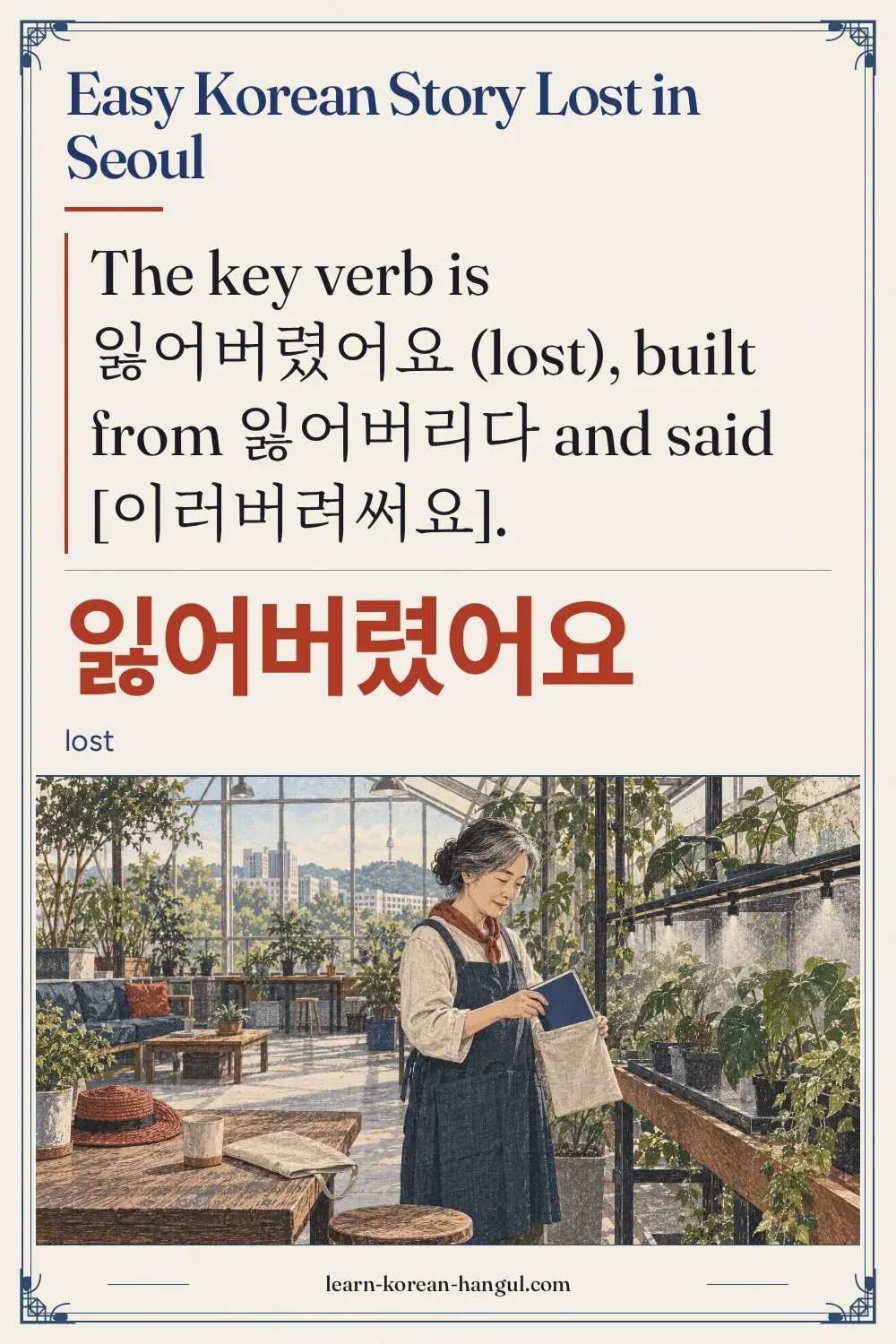
| 잃어버렸어요 | ireobeoryeosseoyo | lost | 1 |
| 휴대폰 | hyudaepon | mobile phone | 2, 14 |
| 꺼졌어요 | kkeojyeosseoyo | turned off | 2 |
| 지도 | jido | map | 3 |
| 아저씨 | ajeossi | a man of middle age you do not know | 4, 6 |
| 물어봤어요 | mureobwasseoyo | asked | 5, 7 |
| 실례합니다 | sillyehamnida | excuse me | 5 |
| 근처 | geuncheo | nearby area | 7 |
| 지하철역 | jihacheollyeok | subway station | 7, 12 |
| 오른쪽 | oreunjjok | right side | 8, 11 |
| 알려 줬어요 | allyeo jwosseoyo | told, showed | 9 |
| 걸어갔어요 | georeogasseoyo | walked | 11 |
| 보였어요 | boyeosseoyo | came into view | 12 |
| 항상 | hangsang | always | 14 |
Romanization is only a reading aid here. The verb 알려 줬어요 is two words in writing: 알려 (from 알리다, to let know) and 줬어요 (gave). Hear two of the harder words before you start.
Read the Story in Three Passes
Read the story three times, each pass with one job.
- Pass 1: read silently for the gist. Find the place name (종로) and the number of minutes (오). Do not look anything up.
- Pass 2: read with the table. Check only the words you could not guess. Re-read the Korean sentence before you look at the English.
- Pass 3: read aloud as two voices. Read the narrator in an even voice. Read the speaker and the stranger as if you were talking to someone.
Try the two question lines with the audio and then without it. In 여기가 어디예요?, put the weight on 어디 and let the pitch fall or dip at the end. A sharp rise on the last syllable can turn the question word into "somewhere".
Use them as a model, then say the lines in your own voice. The habit is the one described on the extensive reading page: finish an easy text, then read it again.
Comprehension Questions
Answer from the text. One question is a map task, so look at sentence 8.
- What happened to the speaker's phone? (a) it was lost (b) it turned off (c) it broke
- Where was the speaker? (a) Jongno (b) Seoul Station (c) Busan
- Map task: which way did the man say to go? (a) left (b) right (c) straight back
- How long did the walk take before the station appeared? (a) five minutes (b) ten minutes (c) one hour
- How did the speaker get home? (a) by subway (b) by bus (c) on foot
Answers
- 1 (b). Sentence 2: 휴대폰이 꺼졌어요 means the phone turned off.
- 2 (a). Sentence 6: 여기는 종로예요.
- 3 (b). Sentence 8: 오른쪽으로 가세요 means go to the right.
- 4 (a). Sentence 12: 오 분 후에 means after five minutes.
- 5 (a). Sentence 13: 지하철을 타고 집에 갔어요.
If you missed question 3 or 4, re-read sentences 8 and 12 aloud. Both give the answer in the first half of the sentence.
What Grammar Appears in the Story?
Eight patterns carry the story. Each can be spotted by its ending or its particle.
| Pattern | Example | What it does |
|---|---|---|
| Past -았/었어요 | 꺼졌어요, 물어봤어요 | a finished event |
| Place + 에서 | 서울에서 | where the event happened |
| Person + 한테 | 아저씨한테 | to a person |
| Direction + (으)로 | 오른쪽으로 | toward, by way of |
| Subject + 이/가 | 아저씨가, 지하철역이 | marks who or what |
| Place + 에 | 근처에, 집에 | existence or destination |
| -아/어 주다 | 알려 줬어요 | do something for someone |
| Verb + 고 | 타고 갔어요 | and then (two steps in order) |
Two details are worth a second look. 줬어요 is the short form of 주었어요, and in speech you will almost always hear the short form. The ending -고 attaches to the bare stem without a tense, so 타고 carries no tense of its own: the final verb 갔어요 supplies the past. For the full pattern of the past ending, see the Korean past tense lesson.
Worked Example: Reading the First Paragraph
Read sentence 1 in chunks: 지난 토요일에 저는 서울에서 길을 잃어버렸어요.
- 지난 토요일에: last Saturday. 에 marks the time, and the phrase is said [지난 토요이레].
- 저는: as for me. 는 marks the topic.
- 서울에서: in Seoul. 에서 marks the place where the event happened.
- 길을: the way. 을 marks the object of the verb.
- 잃어버렸어요: lost. The stem 잃어버리- plus -었어요 gives the past. Said [이러버려써요].
지난 토요일에 저는 서울에서 길을 잃어버렸어요.
jinan toyoire jeoneun seoureseo gireul ireobeoryeosseoyo
Last Saturday I got lost in Seoul.
근처에 지하철역이 있어요?
geuncheoe jihacheollyeogi isseoyo
Is there a subway station nearby?
To ask about something else, swap the noun: 근처에 편의점이 있어요? asks about a convenience store, and 근처에 화장실이 있어요? asks about a restroom. The frame 근처에 + noun + 이/가 + 있어요? stays the same, and the question rises at the end because it is a yes/no question.
What Mistakes Do Learners Make Here?
Learners often make four mistakes with this text.
| Learners often assume | Actually | Because |
|---|---|---|
| 잃어버렸어요 is said as written | It is said [이러버려써요] | The ㅎ is silent and the ㄹ moves to the next block |
| 지하철역 is said [지하철역] | It is said [지하철력] | An ㄴ is inserted, then the ㄹ matches it |
| 여기가 어디예요? ends with a sharp rise | Weight on 어디, then a fall or dip | It is a question-word question, not a yes/no question |
| 한 아저씨 means "one uncle" | It means "a man" you do not know | 한 can introduce a new person in a story |
The second error is the most useful to fix, because the same rule governs 서울역 [서울력] and many other station names. The last one explains why the story does not say "the man": a stranger gets 한 the first time.
Practice and Answer Key
Part A: fill the blank. Choose 에서, 한테 or (으)로.
- 서울___ 길을 잃어버렸어요.
- 아저씨___ 물어봤어요.
- 오른쪽___ 걸어갔어요.
Part B: map task. Draw a box for yourself in the middle of a page. Draw an arrow in the direction the man pointed, and write 지하철역 at the end. Label the arrow 오 분.
Part C: write. Write one sentence about a place you got lost, using 길을 잃어버렸어요 and a day of the week.
Answers
- Part A: 1 에서, 2 한테, 3 으로.
- Part B: the arrow points to the right, to the station, with 오 분 on it.
- Part C: for example 지난 일요일에 부산에서 길을 잃어버렸어요.
Where to Go Next
Continue with Easy Korean Story About a Trip to Busan, which tells a whole weekend in the past tense. To say a place or ask the way aloud, use the Korean directions phrases. Browse the rest of Graded Korean Stories, or return to the Korean short stories for beginners overview.
This easy Korean story lost in Seoul covers one situation: asking for the station and following one direction. It does not teach full directions such as turn left at the corner, and the polite request 가세요 is for recognition only. Reading it again a week later is a good way to keep the question frames ready.
Frequently Asked Questions
What Does 길을 잃어버렸어요 Mean and How Is It Said?
It means "I lost my way" or "I got lost". The set phrase 길을 잃다 means to lose the way, and 잃어버리다 adds the sense of having lost it completely. The past form is said [기를 이러버려써요], because the silent ㅎ lets the ㄹ move onto the next block.
How Do I Ask Whether Something Is Nearby?
Use 근처에 + noun + 이/가 + 있어요? For example, 근처에 지하철역이 있어요? asks whether a subway station is nearby. Say it with a rising tone at the end because it is a yes/no question. The answer is 네, 있어요 or 아니요, 없어요.
Why Is 줬어요 Written Differently from 주었어요?
줬어요 is the contracted form of 주었어요. The vowels ㅜ and ㅓ join into ㅝ. In everyday speech and writing you will see 줬어요 far more often. In 알려 줬어요, the pattern -아/어 주다 means doing something for someone, so it means "told me".
Why Are the Quotes in the Present Tense?
The quoted lines show what people said at that moment, so they talk about the present: 있어요? and 어디예요? The narrator looks back, so the narration uses the past. Mixing past narration with present quotes is normal in Korean stories and in English stories too.
Can I Use This Story to Practise Asking Directions?
Yes, for the first step. You can say 실례합니다 and ask 여기가 어디예요? or 근처에 … 있어요? Longer directions, such as turning at a corner, need more grammar and are covered in the directions phrases page.