What you will learn
- Read and explain 40 common words and phrases on street and building signs.
- Use the repeating syllables 입 (enter), 출 (go out) and 금 (forbid) to guess new sign words.
- Say what to do when you meet each warning word.
Before you start: you should read Hangul blocks, as covered in how to read Hangul. Time: about 30 minutes. Audio plays only when you press a button.
Key Facts
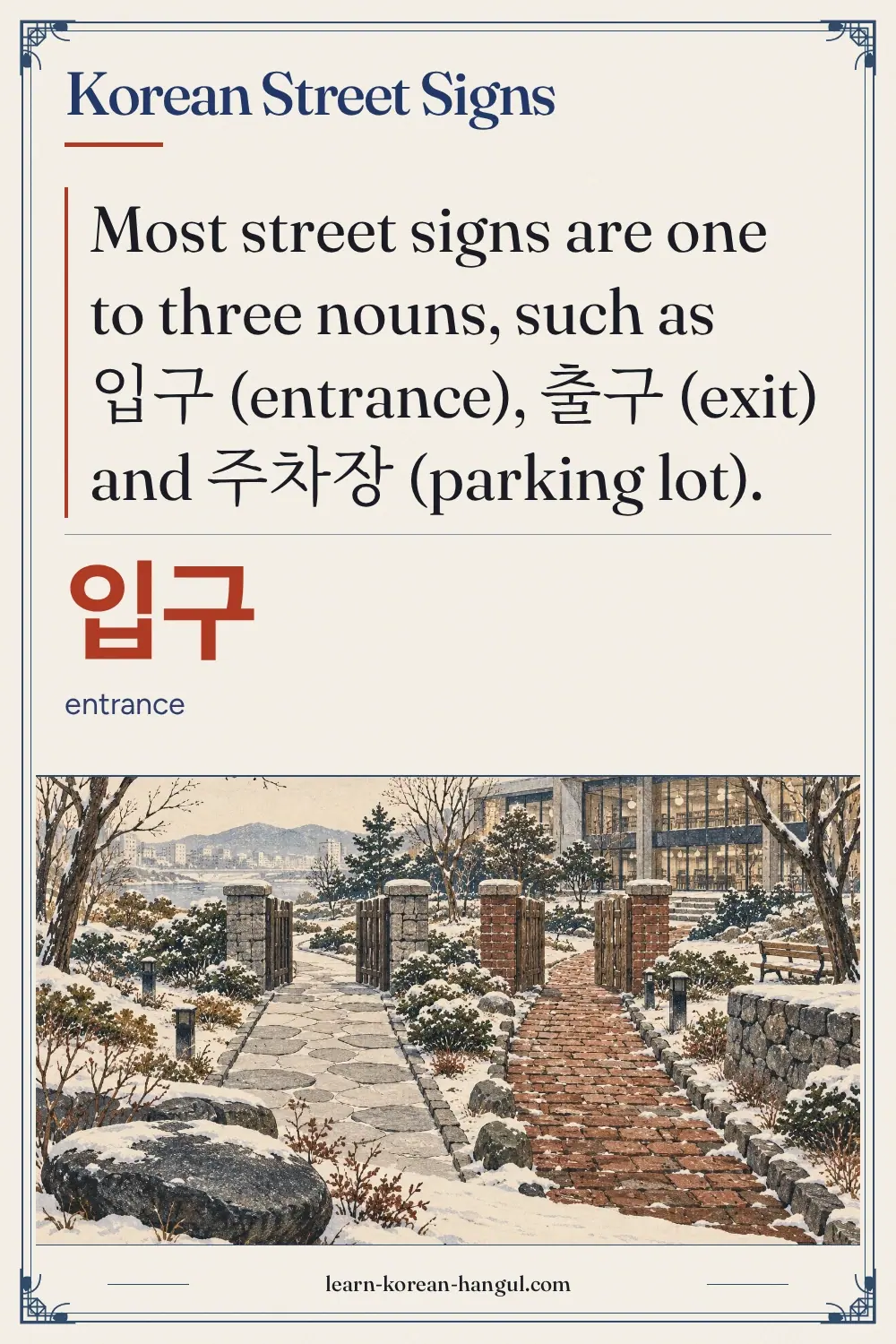
- Most street signs are one to three nouns, such as 입구 (entrance), 출구 (exit) and 주차장 (parking lot).
- Direction and place words attach to nouns, as in 출구 and 입구, which differ only in 출 (out) and 입 (in).
- Signs often show a symbol, the Korean noun and English, but small signs may show only Korean.
- The 40 words fall into six groups: entering, leaving, parking, crossing, services and warnings.
- Many sign words are Sino-Korean, and three syllables repeat: 입 (enter), 출 (go out) and 금 (forbid).
Last updated: 2026-10-09. The Korean text, romanization and audio scripts on this page are generated drafts that still await review by a Korean specialist.
What Are Korean Street Signs?
Korean street signs are short printed notices on streets, buildings, car parks and crossings that name a place or give an instruction. Most are one to three nouns, for example 입구 (entrance), 주차장 (parking lot) or 횡단보도 (crosswalk). Because the vocabulary is fixed, a small list covers most of the signs a visitor meets.
Sign language is not everyday speech. Signs use nouns and noun phrases, not full sentences, and many of the words are Sino-Korean, meaning built from Chinese-origin syllables. Everyday speech may use a different word for the same thing. A sign says 출구, while a person asks 어디로 나가요? (where do I go out?).
Signs also carry fixed warnings, and a misread warning can have real consequences. This lesson marks the safety words clearly and tells you what to do. First, why signs are harder to read than they look.
Why Do English Speakers Struggle with Korean Signs?
English speakers struggle because signs show no clues beyond the Hangul, and the words are unfamiliar even when the letters are known. In English, a sign such as "EXIT" is a word the reader has seen thousands of times. In Korea, a reader who has just learned Hangul can sound out 출구 as "chul-gu" but may not know that it means exit.
Two other habits get in the way. English speakers expect English on every sign, and in a busy city this expectation fails. Many signs show Korean, English and a symbol, but some small or local signs show only Korean. A second habit is reading the English first and ignoring the Hangul, which means the learner never builds the Korean word.
| English habit | Korean sign reality | What to do |
|---|---|---|
| Look for English first | Korean is always present, English is not | Read the Hangul first |
| Expect sentences | Signs are nouns | Look for the noun |
| Read one word at a time | Phrases such as 출입 금지 are one unit | Learn them whole |
| Treat the symbol as decoration | The symbol often carries the meaning | Use symbol, Korean, English in that order |
The solution is a routine. Read the symbol, then the Korean, then the English if there is any. The next section gives the words in order of use.
Which Sign Words Should I Learn First?
Learn the sign words in the order of the decisions you make on a walk: enter, leave, park, cross, find a service and avoid a hazard. The 40 words below are grouped by that order, with a short note to help each one stick.
Entering
| Word | Meaning | Note |
|---|---|---|
| 입구 | entrance | 입 = enter, 구 = opening |
| 정문 | main gate | 정 = main, 문 = gate |
| 후문 | back gate | 후 = back |
| 출입구 | entrance and exit | 출 + 입 combined |
| 입장 | admission, going in | 입 = enter, 장 = place |
| 진입 | entering, approach | Used for roads and car parks |
Leaving
| Word | Meaning | Note |
|---|---|---|
| 출구 | exit | 출 = go out, 구 = opening |
| 비상구 | emergency exit | 비상 = emergency |
| 출차 | vehicle exit | 출 + 차 (vehicle) |
| 환승 | transfer between lines | Seen at transit stops |
| 하차 | getting off | Seen on buses and trains |
| 퇴장 | leaving the venue | Seen at halls and events |
Parking
| Word | Meaning | Note |
|---|---|---|
| 주차장 | parking lot | 주차 = parking, 장 = place |
| 주차 금지 | no parking | 금지 = prohibition |
| 정차 금지 | no stopping | 정차 = stopping |
| 무료 주차 | free parking | 무료 = no fee |
| 유료 주차 | paid parking | 유료 = fee |
| 장애인 주차 | disabled parking | Reserved space |
| 방문객 주차 | visitor parking | 방문객 = visitor |
Crossing and Traffic
| Word | Meaning | Note |
|---|---|---|
| 횡단보도 | crosswalk | Crossing for pedestrians |
| 신호등 | traffic light | 신호 = signal, 등 = lamp |
| 보행자 | pedestrian | Walking person |
| 어린이 보호구역 | child protection zone | Slow down near schools |
| 일방통행 | one-way street | Traffic moves one way |
| 서행 | slow down | Drive slowly |
| 정지 | stop | Seen at junctions |
Services
| Word | Meaning | Note |
|---|---|---|
| 약국 | pharmacy | 약 = medicine |
| 은행 | bank | |
| 편의점 | convenience store | 편의 = convenience |
| 화장실 | restroom | See the bathroom signs lesson |
| 안내소 | information desk | 안내 = guidance |
| 병원 | hospital |
Warnings
| Word | Meaning | What to do |
|---|---|---|
| 주의 | caution | Slow down and look |
| 위험 | danger | Keep away |
| 출입 금지 | no entry | Do not go in |
| 공사 중 | under construction | Use another route |
| 금연 | no smoking | Do not smoke |
| 미끄럼 주의 | caution, slippery | Walk slowly |
| 접근 금지 | do not approach | Stay back |
| 비상 | emergency | Follow staff instructions |
That is 40: six, six, seven, seven, six and eight. They are not meant to be memorised in one sitting. Learn one group per day. The warnings come with an action because a warning is only useful if you act on it. The bathroom signs and door messages are taught in the Korean bathroom signs lesson, and subway and station signs are covered in Korean subway signs.
The table hides the shortcut: the same syllables appear again and again. That shortcut is the next topic.
What Do the Repeating Syllables Mean?
Three syllables repeat across the list, and each one carries a stable meaning: 입 (enter), 출 (go out) and 금 (forbid). Learning them turns forty words into three patterns plus a few extra nouns.
| Syllable | Meaning | Words in this lesson |
|---|---|---|
| 입 | enter | 입구, 출입구, 입장 |
| 출 | go out | 출구, 출입구, 출차, 출입 금지 |
| 금 | forbid | 금연, 주차 금지, 정차 금지, 출입 금지, 접근 금지 |
Six signs show the whole idea: 입구, 출구, 출입구, 금연, 주차 금지 and 출입 금지. A reader who knows 입 and 출 can decode 입구 and 출구 without a dictionary, and can guess that 출입구 combines both. A reader who knows the pattern for a prohibition (a noun plus 금지) can read 주차 금지 as "parking prohibition" at first sight.
Watch one trap. The syllable 금 also means gold and money in other words, such as 금 (gold). On a sign, if 금 stands before or after an action, as in 금연 (smoking prohibition), it means forbid. The word 금지 is the common form: it follows an action noun and says that action is not allowed. The syllable 구 is also the word for opening or mouth in 입구 and 출구, and it can mean district elsewhere, as in 강남구. Keep the context in mind.
These syllables are explained further in the lesson on how to guess unknown Korean words. First, a look at how a typical sign is laid out.
How Are Korean Signs Laid Out?
A typical Korean sign is laid out as a symbol, then the Korean noun, then English, and your eyes should follow that order. The symbol (an arrow, a car, a person) tells you the category at a glance. The Korean noun gives the exact word. The English, where present, confirms your guess.
| Position | What it shows | Example |
|---|---|---|
| Top or left | Symbol or arrow | An arrow pointing right |
| Centre | Korean noun, in large type | 출구 |
| Below or right | English | Exit |
| Corner | Number or letter | 1번 출구 |
Arrows give direction with the Korean words 왼쪽 (left), 오른쪽 (right) and 직진 (straight ahead). An exit may carry a number: 1번 출구 means exit number 1, and the number is Sino-Korean (일, 이, 삼), as covered in the Sino-Korean numbers section. Some old or traditional shop signs are written vertically, so read those top to bottom.
If the English is wrong or missing, trust the Korean. English on signs is sometimes translated loosely. The Korean noun is the standard form, and if you can read it, you do not need the English.
For asking where something is, the Korean directions phrases section has the spoken side. The worked example follows one sign through the full routine.
Worked Example: 출구
The worked example reads the sign 출구 with an arrow and the number 2, step by step.
- Look at the symbol. An arrow points up and to the right. A direction is being given.
- Read the Korean. 출 is ㅊ + ㅜ + ㄹ, and 구 is ㄱ + ㅜ. The word is "chul-gu", spoken [출구].
2번 출구로 나오세요.
ibeon chulguro naoseyo
Please come out through exit 2.
- Split the word. 출 means go out and 구 means opening. Together: the opening you go out through.
- Read the number. 2번 is "number 2", read 이번 [이번] with the Sino-Korean 이. The exit number matters in a big station.
- Check the English. If the sign says Exit, the guess is confirmed. If not, trust the Korean.
- Act. Walk in the direction of the arrow to exit 2.
You will know it worked when you can say what the sign says and what to do. The same routine works for 입구, 주차장 and 횡단보도. A few mistakes may catch you out.
What Mistakes Do Learners Make with Korean Signs?
The most common mistakes are swapping entrance and exit, ignoring the warning actions and trusting the English alone.
- Learners often mix up 입구 and 출구. The two words differ in only one syllable, 입 versus 출, and mixing them leads to the wrong door. Learn the pair together: 입 is in, 출 is out.
- Learners often assume 금 always means gold. Actually on signs, 금 in 금연 or 금지 means forbid. Look at the whole word, not one syllable.
- Learners often assume a warning word is only information. Actually each warning asks for an action: 주의 asks you to slow down, and 출입 금지 asks you not to enter. Act on the sign.
- Learners often assume the English is a reliable translation. Actually the English is sometimes loose or absent. Read the Korean first.
- Learners often assume sign words are the words people say. Actually people often say 나가는 곳 (the place to go out) as well as 출구, while signs keep to the short written noun.
The related vocabulary can be saved and reviewed in the Korean vocabulary section. Practice follows.
Practice and Answer Key
Use these ten questions to check your reading.
- What does 입구 mean?
- What does 출구 mean?
- Which sign says that parking is forbidden?
- What does 횡단보도 mean?
- A sign says 주의. What should you do?
- Which word means "no entry"?
- A sign says 공사 중. What does it tell you?
- What does 금연 mean?
- What is 약국?
- What do 입, 출 and 금 mean?
Answer key:
- Entrance.
- Exit.
- 주차 금지.
- Crosswalk.
- Slow down and look around.
- 출입 금지.
- Under construction, so use another route.
- No smoking.
- Pharmacy.
- Enter, go out and forbid.
Then try the speaking task: point at each word on the 40-word list and say it aloud, once for each group. Play the model for the pharmacy sign and say it back.
Where to Go Next
The lesson above covers 40 words from Korean street signs in six groups. It does not cover subway line maps, bathroom signs or the long text on notice boards, and the sign layouts are typical examples, not photographs of particular signs. Words on real signs vary slightly by city and by year.
Next: Korean subway signs, which reads lines, directions and exit numbers. To return to the other lessons, see Real-World Texts (Signs, Menus).
Frequently Asked Questions
What are the most common Korean street signs? The most common are 출구 (exit), 입구 (entrance), 주차장 (parking lot), 횡단보도 (crosswalk), 화장실 (restroom), 약국 (pharmacy) and the warnings 주의 (caution), 위험 (danger) and 출입 금지 (no entry). This lesson teaches 40 sign words in six groups, from entering to warnings.
Do Korean signs include English? Often, but not always. Major roads, stations and tourist areas usually show Korean, English and a symbol together, while small local signs may show only Korean. The English can also be loose or incorrect, so read the Korean noun first and use the English only to confirm your reading.
What does 출구 mean? 출구 means exit. It combines 출, meaning go out, and 구, meaning opening, and is spoken [출구]. In subway stations it carries a number, as in 2번 출구, which means exit number 2. Its opposite is 입구, entrance, and a combined sign for both is 출입구.
How do I read Korean road signs? Read the symbol, then the Korean noun, then any English. Road signs use fixed nouns such as 횡단보도 (crosswalk), 일방통행 (one-way), 서행 (slow down) and 정지 (stop). Learn them as whole words, and act on warning words such as 주의 and 위험 at once.