실례합니다. / 이 근처에 은행이 있어요? / 네, 쭉 가세요. / 오른쪽으로 가세요. / 횡단보도를 건너세요. / 지하철역이 어디예요? / 걸어서 오 분쯤 걸려요. / 감사합니다.
What you'll learn
- Shadow eight direction lines, keeping the final ㄱ of 쭉 closed.
- Say 은행이 as [으냉이] and 지하철역이 as [지하철려기].
- Use -으로 for direction and -세요 for a polite instruction.
- Keep a gentle fall at the end of an instruction instead of a rise.
Before you start: you need to read Hangul and know the polite -요 ending. Level: A2. Time: about 20 minutes. If shadowing is new, read how to shadow Korean first. Audio plays only when you press a button.
Key facts
- 은행이 is linked as [으냉이] in natural speech.
- 쭉 가세요 begins with a tense ㅉ, ends the first word in a closed ㄱ, and tenses the next sound: [쭉까세요].
- 오른쪽으로 uses -으로 to mark the direction of movement.
- 가세요 is a polite instruction, and it falls at the end.
What Does a Short Exchange about Directions Sound Like?
A short exchange about directions is a question with a place word, then a chain of instructions that each end in -세요. The asker uses a yes/no question or a wh-question, and the guide answers with a direction, a landmark and a time. The set follows that order, so you can hear how the pieces connect. For the meanings and extra phrases, see Korean directions phrases.
To hear the same situation as a listening task, play the Korean directions dialogue audio. Here the aim is different: you copy the sounds and the pitch of both roles yourself.
The next question is why these lines are hard to copy.
Why Is This Hard for English Speakers?
Direction lines are hard because they hide three sound traps. English speakers tend to drop or release a final ㄱ, so 쭉 turns into "jjoo" or "jjook-uh". They also read written syllables one by one, while Korean links and weakens them.
| What you see | What you hear | Why it surprises English speakers |
|---|---|---|
| 쭉 가세요 | [쭉까세요] | The ㄱ of 쭉 closes without a release, and the next ㄱ turns tense |
| 은행이 | [으냉이] | The ㅎ weakens after ㄴ, so the ㄴ joins 행 |
| 오른쪽으로 | [오른쪼그로] | The ㄱ of 쪽 moves to 으 |
| 지하철역이 | [지하철려기] | A ㄴ appears before 역, becomes ㄹ after ㄹ, and links to 이 |
The tensing after a final ㄱ is covered by Article 23 of the standard pronunciation rules (표준 발음법) of the National Institute of Korean Language (국립국어원), and the linking by Articles 13 and 14. The extra ㄴ in 지하철역 follows Article 29 and then becomes ㄹ, the same pattern as 서울역에 [서울려게]. The weak ㅎ in 은행 is a feature of natural speech, not a written rule; see Korean h weakening. Revised Romanization writes jjuk gaseyo and jihacheollyeogi, but it does not show the tensing caused by a neighbouring sound, so the brackets show the spoken form. For the three-way contrast in ㅉ, read plain, tense and aspirated sounds.
With the traps named, here is how a session runs.
How Does the Korean Shadowing Directions Set Work?
The set works in four passes. The whole session takes about 20 minutes, and you speak both roles. The passes compress the six steps of how to shadow Korean into one session; for step 6, record your last pass and compare it with the audio.
- Listen and read (3 minutes). Play the normal clip once with the script. Mark the lines that start with a place or direction word.
- Shadow slowly (6 minutes). Use the slow player and speak a beat behind, keeping the closed ㄱ of 쭉.
- Shadow at normal speed (6 minutes). Keep going when you slip.
- Shadow without the script (5 minutes). Hide the text and run the whole exchange. Count the stumbles.
You will know it worked when you can say 쭉 가세요 with a closed final ㄱ and a tense 까 every time. A common mistake is to speak only the guide's lines, which are the easier ones. The asker's lines hold the two harder liaison cases.
실례합니다. / 이 근처에 은행이 있어요? / 네, 쭉 가세요. / 오른쪽으로 가세요. / 횡단보도를 건너세요. / 지하철역이 어디예요? / 걸어서 오 분쯤 걸려요. / 감사합니다.
In the script, ↗ marks a rise and ↘ marks a fall.
Script Lines 1 to 4
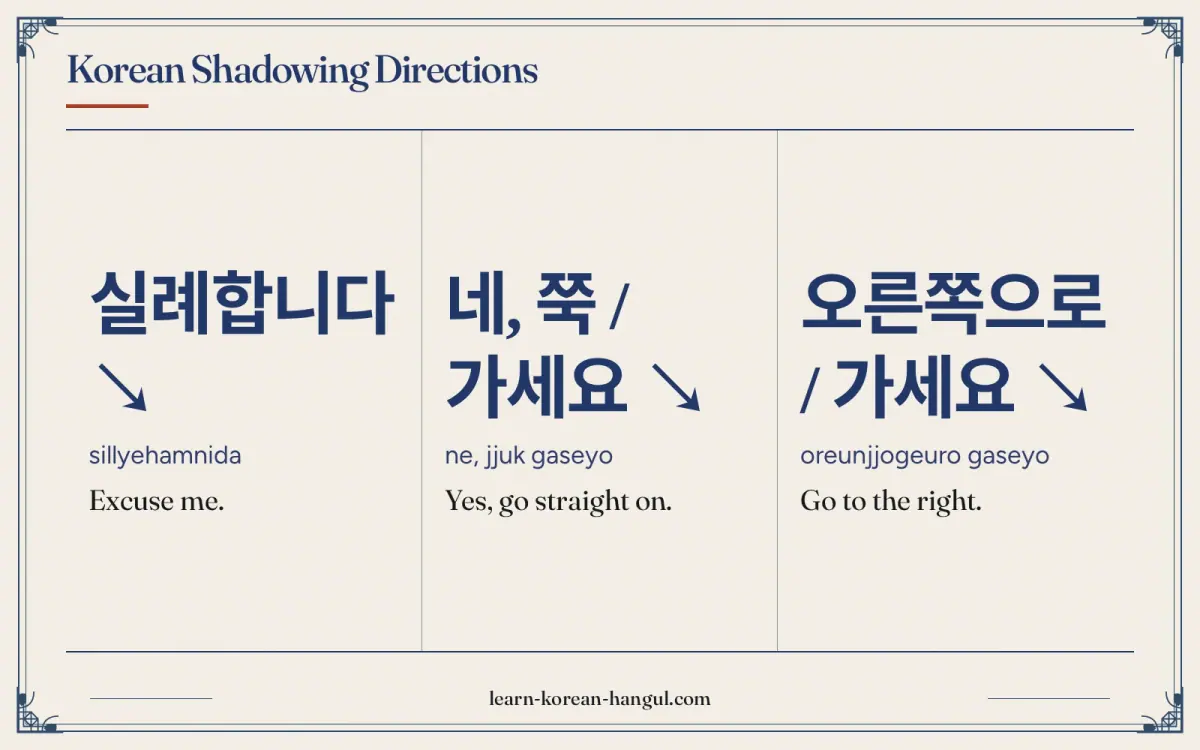
Lines 1 to 4 open the exchange and give the first two directions.
실례합니다 ↘
sillyehamnida
Excuse me.
이 근처에 / 은행이 있어요 ↗
i geuncheoe eunhaengi isseoyo
Is there a bank near here?
네, 쭉 / 가세요 ↘
ne, jjuk gaseyo
Yes, go straight on.
오른쪽으로 / 가세요 ↘
oreunjjogeuro gaseyo
Go to the right.
Lines 1 to 4 reach the corner, so lines 5 to 8 cover the crossing, the station and the thanks.
Script Lines 5 to 8
Lines 5 to 8 add a crossing, a second question, a walking time and the thanks.
횡단보도를 / 건너세요 ↘
hoengdanbodoreul geonneoseyo
Cross at the crosswalk.
지하철역이 / 어디예요 ↘
jihacheollyeogi eodiyeyo
Where is the subway station?
걸어서 / 오 분쯤 걸려요 ↘
georeoseo o bunjjeum geollyeoyo
It takes about five minutes on foot.
감사합니다 ↘
gamsahamnida
Thank you.
A short word list with arrows keeps the direction words straight.
| Word | Romanization | Meaning | Arrow |
|---|---|---|---|
| 쭉 | jjuk | straight on, all the way | ↑ |
| 오른쪽 | oreunjjok | right side | → |
| 왼쪽 | oenjjok | left side | ← |
| 건너다 | geonneoda | to cross | ↔ |
| 근처 | geuncheo | nearby area | ○ |
What Is the Speed Ladder?
The speed ladder is a fixed order of speeds that you climb only when the step below feels easy. In this set the ladder protects the closed ㄱ, because it is the first sound to disappear at speed.
| Step | Speed | Script | Move up when |
|---|---|---|---|
| 1 | Slow (0.8x) | visible | you keep the closed ㄱ of 쭉 every time |
| 2 | Normal | visible | you link [으냉이] and [지하철려기] smoothly |
| 3 | Normal | hidden | you finish the exchange with few stumbles |
A stumble is a hesitation, a repeated syllable or a lost beat. If the ㄱ vanishes at normal speed, go back one step.
How Do I Check Myself?
Record the whole exchange, listen once and tick each point.
- Closed ㄱ. Do you stop the air at the end of 쭉 and say a tense 까?
- Linking. Do you say [으냉이] and [오른쪼그로]?
- Station. Do you say [지하철려기], not "ji-ha-cheol-yeok-i"?
- Pitch. Does line 2 rise, and do the instructions fall?
- Beat. Do the asker and the guide join without a silent gap?
Fix one point per session.
Worked Example: 이 근처에 은행이 있어요?
Take the first question apart in four moves.
이 근처에 은행이 있어요?
i geuncheoe eunhaengi isseoyo
Is there a bank near here?
- Hear it. You hear [이 근처에 으냉이 이써요], with a lift on the last syllable.
- Split the written form. 이 (this) + 근처 (nearby area) + 에 (in) + 은행 (bank) + 이 (subject marker) + 있- (exist) + -어요 (polite).
- Match the sounds. The ㅎ of 행 weakens, so ㄴ joins it as [으냉]. The ㅆ of 있 moves to the next block, giving [이써요].
- Shadow it. Speak a beat behind: "i geun-cheo-e eu-naeng-i i-sseo-yo", with the pitch up on 요.
Swap 은행 for 편의점 (convenience store) or 약국 (pharmacy) and the rhythm holds. Next, look at the slips learners make most often.
What Mistakes Do Learners Make Here?
Learners often assume that every written final consonant is either pronounced fully or dropped. Korean closes it, and four slips are common.
- Dropping the ㄱ of 쭉. Without the closed stop the word turns into "jjoo". Stop the air, then say the tense 까.
- Rising on 지하철역이 어디예요? A sharp rise on a wh-question can turn 어디 into "somewhere". Let the pitch fall.
- Saying 지하철역이 as separate blocks. The spoken form is [지하철려기]. Link the blocks.
- Using 로 after a consonant. After a consonant the particle is 으로, as in 오른쪽으로. After a vowel or ㄹ it is 로, as in 카드로.
Fixing these slips takes one more pass, so the practice below tests them.
Practice and Answer Key
Answer from memory, then check the key.
- How is 쭉 가세요 pronounced?
- What does -으로 mark in 오른쪽으로 가세요?
- How is 은행이 pronounced in natural speech?
- Does 지하철역이 어디예요? rise sharply at the end?
Answers
- [쭉까세요], with a closed final ㄱ and a tense 까.
- The direction of movement: "toward the right".
- [으냉이]
- No. It is a wh-question, so the pitch falls, or rises and then falls, rather than rising sharply.
Where to Go Next
Shadow the exchange again tomorrow with the script hidden. When the closed ㄱ is steady, continue with Korean shadowing phone calls, which adds soft sentence endings. To revisit the earlier set, go to Korean shadowing shopping. Pitch is explained in Korean intonation, and more scripts are in Korean shadowing.
What this set does not cover. It does not teach every direction word, the full -으로 grammar or street-name addresses, which have their own pages. The audio is generated by text-to-speech and checked by a Korean teacher before publication, so a real passer-by may speak faster. Shadowing builds rhythm and sound, not new vocabulary.
Return to this Korean shadowing directions set whenever your final consonants start to fade.
Frequently Asked Questions
Why is 은행이 said [으냉이]?
In natural speech the ㅎ of 행 weakens after the ㄴ of 은, so the ㄴ joins the next block and the word sounds like 으냉. The ㅇ at the end of 행 stays put, and 이 follows it. The dictionary spelling does not change, and this weakening is a feature of fluent speech.
How do I say 쭉 correctly?
Start with a tense ㅉ, say the vowel ㅜ short, then close your throat on ㄱ without releasing any air. Do not say "jjoo" or add a vowel after the ㄱ. When 가세요 follows, the next ㄱ turns tense, so the pair is spoken [쭉까세요], with a tiny stop between.
What is -으로 for?
It marks direction or means: 오른쪽으로 가세요 is "go toward the right", and 카드로 할게요 is "I will pay by card". Use 으로 after a consonant, as in 오른쪽으로, and 로 after a vowel or ㄹ, as in 카드로 or 서울로. The particle never changes the verb.
Is 가세요 a command or a request?
It is a polite instruction. The -세요 ending is the honorific polite form, so 가세요 sounds like "please go" rather than a blunt order. Guides, staff and strangers all use it. Speak it with a gentle fall. The plain 가요 is a statement, and it does not carry the same instructing tone.