
Learning how to speak Korean fluently takes daily speaking time, repeated exposure to natural speech and tolerance for mistakes. This section collects the five lessons that build those habits: practising alone, handling nerves, sounding natural, finding a language exchange partner and following a 30-day plan.
How to Speak Korean Fluently: What Does Fluency Mean?
Fluency means speaking at a steady pace without long stops to search for words. It is only one of three goals, and learners often mix them up. Name the goal you are working on, because each one has a different fix.
| Goal | What it means | Sample | Best fix |
|---|---|---|---|
| Fluency | Steady speed, few long pauses | Saying a whole sentence in one breath | Daily shadowing and repeated retelling |
| Accuracy | Correct endings, particles and sounds | 먹어요 (present) versus 먹었어요 (past) | Feedback from a partner and recordings |
| Confidence | Willingness to start speaking | Opening your mouth when it feels risky | Small, planned steps up a ladder |
Here is a sentence a beginner can aim to say smoothly. Play it, then say it with the audio.
저는 한국어를 공부하고 있어요.
jeoneun hangugeoreul gongbuhago isseoyo.
I am studying Korean.
A learner can be fluent and inaccurate, or accurate and silent. Waiting until you are perfect is the most common way to stay silent, so this section never asks you to wait.
Where to Start with Speaking Korean Fluently
Start with the lesson that matches your situation, not the one that sounds most useful. Find yourself in the left column.
| If you are… | Start with | Why |
|---|---|---|
| studying alone with no one to talk to | Practice Speaking Korean Alone | it gives a 15-minute routine that needs no partner |
| afraid to speak even when you know the words | Korean speaking anxiety | fear needs a different fix from missing words |
| understood, but your Korean sounds like a textbook | sound natural in Korean | it shows rhythm, contractions and fillers |
| ready for real conversation | find a language exchange partner | it gives a first message and a 30-minute plan |
| wanting a day-by-day structure | 30 day Korean speaking plan | it assigns one 15-minute task per day |
How Do I Practise Alone?
You can practise alone with five methods: read aloud, shadow a clip, narrate your day, answer questions and record yourself. Together they fit into one 15-minute routine with about three minutes each. The Practice Speaking Korean Alone lesson gives the minute-by-minute plan and explains why a voice assistant can check sounds but not grammar.
A habit this small is easy to keep. Here is a line to say at the end of each session:
매일 십오 분씩 말해요.
maeil sibo bunssik malhaeyo.
I speak for fifteen minutes every day.
How Do I Overcome Fear?
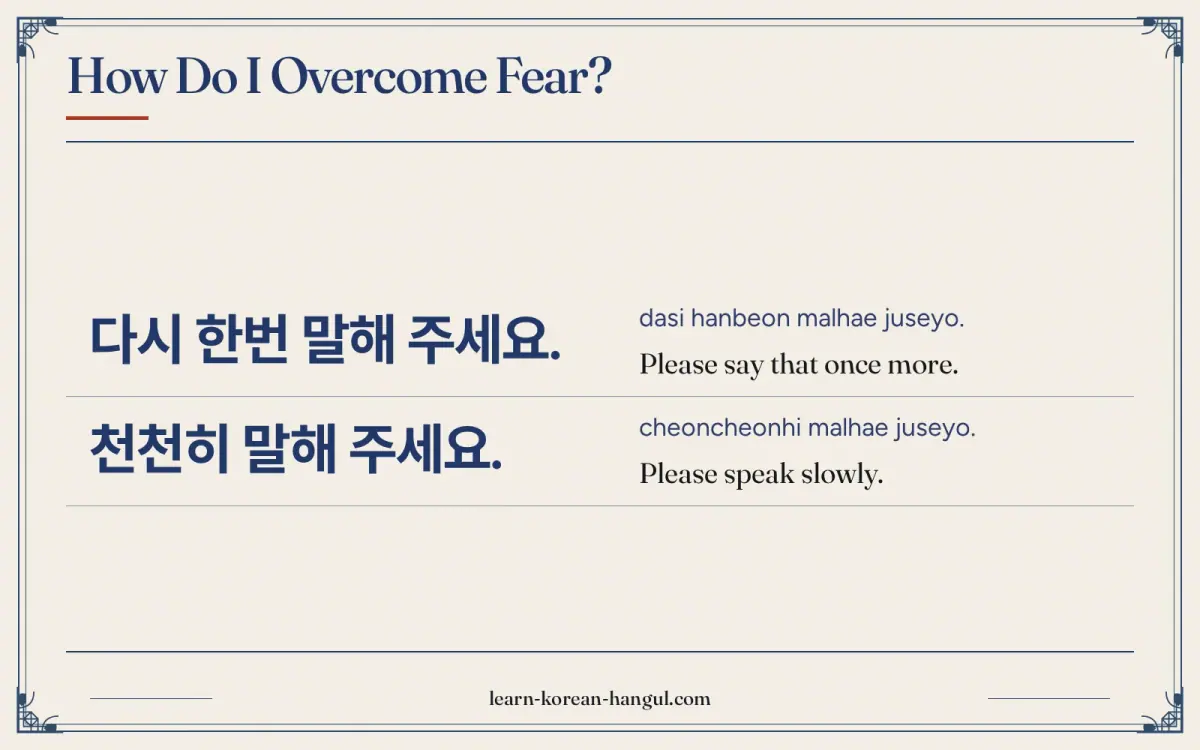
Overcome fear by climbing a ladder of small steps, from whispering to yourself up to a live conversation. The Korean speaking anxiety lesson names six steps, gives a success test for each, and shows how to treat mistakes as information. Two repair phrases help at every step because they keep a conversation going instead of ending it.
다시 한번 말해 주세요.
dasi hanbeon malhae juseyo.
Please say that once more.
천천히 말해 주세요.
cheoncheonhi malhae juseyo.
Please speak slowly.
How Do I Sound Natural and Find Partners?
Sound natural by changing how you say a sentence, not only what it says: even rhythm, dropped subjects, contractions, fillers and a fitting ending. The sound natural in Korean lesson rewrites five textbook sentences into spoken forms. For extra help with small words such as 음 and 그러니까, see Korean filler words, and for common sound slips see Korean pronunciation mistakes.
Natural speech also needs a listener. The find a language exchange partner lesson shows where to look, what to write in a first message and how to split a 30-minute session so it does not drift into English. A kind reply from a partner is worth hearing early:
괜찮아요. 천천히 해도 돼요.
gwaenchanayo. cheoncheonhi haedo dwaeyo.
It's okay. You can take your time.
Is There a Plan to Follow?
Yes. The 30 day Korean speaking plan gives one task of about 15 minutes for each day. Week 1 is shadowing, week 2 role plays, week 3 questions and self-talk, and week 4 a partner session and a final recording. It has four rest days and a catch-up rule for missed days, and it reuses the other pages in this section.
Comparing the Lessons
The five lessons differ in what they fix and how long a session takes. Levels and times are editorial estimates.
| Lesson | What it fixes | Level | Time | Audio |
|---|---|---|---|---|
| Practice Speaking Korean Alone | no speaking partner | A1 | 15 minutes a day | yes |
| Korean Speaking Anxiety | fear of mistakes | A1 | 10 minutes a day for two weeks | yes |
| Sound Natural in Korean | textbook-stiff speech | A2 | one 30-minute session | yes |
| Find a Language Exchange Partner | no live feedback | A1 | 30-minute sessions | yes |
| 30 Day Korean Speaking Plan | no routine | A2 | 15 minutes a day for 30 days | yes |
How Do You Practise Speaking Korean Fluently?
Practise with short, regular, spoken sessions and mix three kinds of work: copying, producing and talking. Copy with Korean shadowing, produce with the role plays and question sets in Korean conversation practice, and talk with a partner. Add Korean listening practice so your ear keeps pace with your mouth, and check individual sounds in Korean pronunciation.
Study Order at a Glance
Use this order if you are not sure where to begin:
- Practise alone for the first two weeks, 15 minutes a day.
- Add the anxiety ladder if nerves stop you from speaking.
- Work through the sound-natural lesson once your sentences are correct but stiff.
- Book your first exchange session after you can answer simple questions aloud.
- Follow the 30-day plan to tie it together, then repeat it at a higher level.
Audio, Review Status and Scope
The audio in this section is pronunciation audio generated with text-to-speech. Audio gives a clear model but cannot react to you, so it supports live conversation and does not replace it.
This section does not score your speech automatically, does not prepare you for a speaking exam and does not teach individual sounds or grammar rules in depth.
Related Sections
- Korean speaking practice: the full ladder from shadowing to conversation.
- Korean shadowing and Korean conversation practice: the two skill steps.
- Korean listening practice: ear training for faster replies.
Frequently Asked Questions
How long does it take to speak Korean fluently?
There is no fixed date, because fluency depends on study time, your first language and how often you speak with real people. As an editorial estimate, learners who speak aloud for about 15 minutes most days can manage a short, simple conversation about themselves after a few months, if they also study words and basic grammar. Comfortable conversation on many topics takes much longer. For official time estimates, see the Foreign Service Institute language-learning pages at state.gov.
Can I become fluent without living in Korea?
Yes, but you must create the speaking time that living there would give you. Shadow audio, rehearse role plays, talk to yourself, and book regular sessions with an exchange partner or tutor. Daily aloud practice and weekly live conversation replace much of what immersion supplies. What you cannot copy easily is hearing Korean everywhere, so add listening practice to every week.
How do I overcome fear of speaking Korean?
Lower the stakes first and raise them in small, planned steps. Start by whispering lines to yourself, then record a short answer, then send a voice message, then talk to a friendly partner. Each step should be a little harder than the last, and each should have a clear goal. The anxiety page sets out a six-step ladder you can climb at your own pace.
What is the fastest way to improve speaking?
Speak aloud every day, record yourself once a week, and get feedback from another person. Those three habits matter more than any single app or textbook. Short daily sessions give your mouth repetition, a weekly recording shows progress you cannot hear in the moment, and a partner or tutor catches errors you do not notice yourself.
In short, learning how to speak Korean fluently means short daily sessions aloud, one weekly recording and regular conversation, with fear and skill treated as separate problems.