To sound natural in Korean, speak with even syllable rhythm, drop obvious subjects, use contractions and fillers such as 음 and 그러니까, and match the sentence ending to your relationship with the listener. Correct textbook sentences are often stiff because they are complete, formal and carefully spaced. This guide shows five of them next to their natural versions, so you can hear the difference and say the new forms aloud.
What Does It Mean to Sound Natural in Korean?
Sounding natural in Korean means speaking in the way people actually speak in daily life, not the way full sentences are written in a textbook. Natural speech is shorter, smoother and more flexible. It leaves out words the listener already knows, joins small words together, uses a filler when a speaker is thinking and ends sentences in a way that suits the situation.
This is a goal for learners who already form correct sentences, which is why the page is marked A2. If you are still building simple sentences, use the solo practice routine first and return here later. Natural does not mean perfect or fast. A slow, clear, natural-sounding sentence beats a fast stiff one.
What Makes Speech Sound Natural?
Five habits make the biggest difference. Each is explained in a section below, and the table shows the pattern at a glance.
| Habit | Stiff version | Natural version |
|---|---|---|
| Even rhythm | uneven stress, long stops | steady beat, phrase by phrase |
| Dropped words | 당신은 어디에 갑니까? | 어디 가요? |
| Contractions | 이것은, 그것을, 무엇을 | 이건, 그걸, 뭘 |
| Fillers | silence while thinking | 음, 그러니까 |
| Fitting endings | -ㅂ니다 with a friend | -요 with most people |
Five Textbook Sentences and Their Natural Versions
The fastest way to feel the difference is to compare. Each pair below has the same meaning. Play the natural version, say it with the audio, and then say the textbook version once so you can hear how much longer it is.
| Textbook sentence | Natural version | What changed |
|---|---|---|
| 저는 지금 커피를 마시고 있습니다. | 지금 커피 마셔요. | subject and particle dropped, -고 있습니다 replaced by the simple polite present |
| 이것은 얼마입니까? | 이거 얼마예요? | formal question ending replaced by -요, 이것은 shortened to 이거 |
| 저는 그것을 몰랐습니다. | 그건 몰랐어요. | subject dropped, 그것은 contracted to 그건 |
| 저는 오늘 매우 피곤합니다. | 오늘 너무 피곤해요. | subject dropped, 매우 replaced by everyday 너무 |
| 내일 만나는 것이 어떻습니까? | 내일 만날까요? | long question frame replaced by -ㄹ까요 |
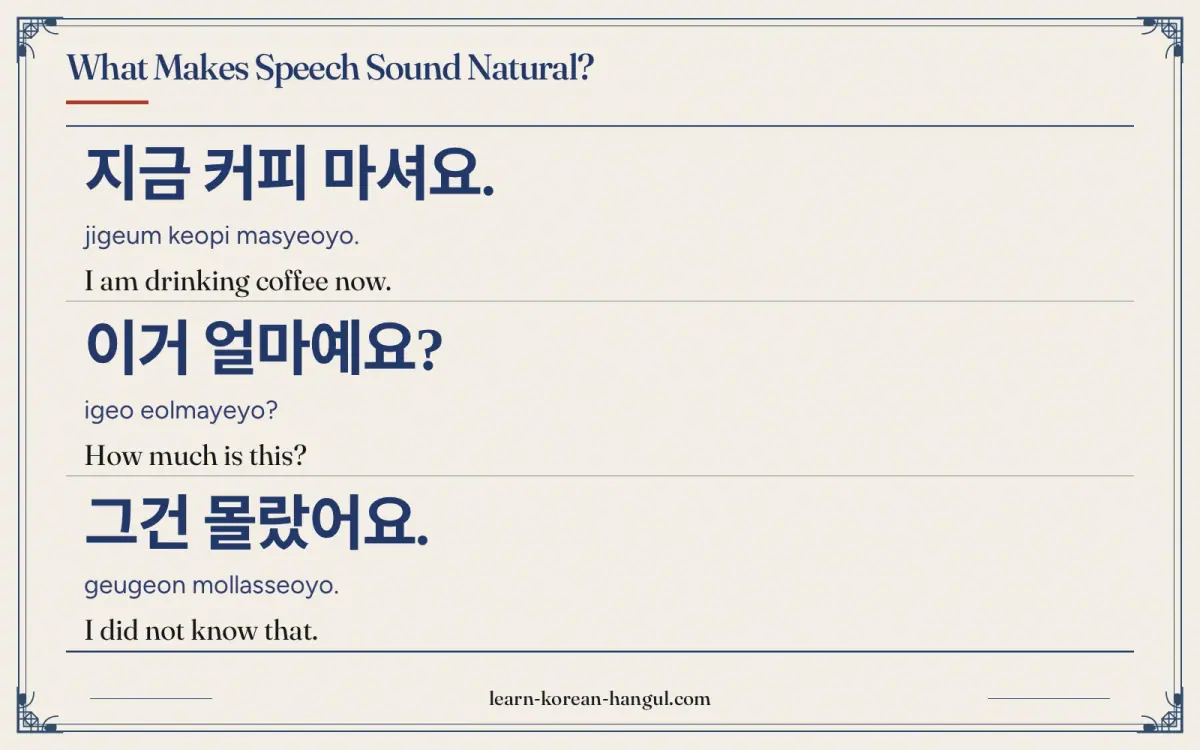
지금 커피 마셔요.
jigeum keopi masyeoyo.
I am drinking coffee now.
이거 얼마예요?
igeo eolmayeyo?
How much is this?
그건 몰랐어요.
geugeon mollasseoyo.
I did not know that.
오늘 너무 피곤해요.
oneul neomu pigonhaeyo.
I am very tired today.
내일 만날까요?
naeil mannalkkayo?
Shall we meet tomorrow?
The textbook versions are not wrong. The formal -습니다 and -ㅂ니다 endings belong in speeches, announcements and some workplaces, and they are covered in polite speech and its neighbouring lessons. The point is that in a café or among classmates, using them for everything sounds like reading aloud.
Rhythm and Pronunciation
Korean speakers give syllables fairly even weight, so natural speech has a steady beat. English learners tend to bring English habits: they stress one syllable strongly, shorten the others and turn unstressed vowels into a vague "uh". In Korean, each vowel keeps its full sound, and no syllable is hammered. Compare saying 피곤해요 as four near-equal beats, pi-gon-hae-yo, with a stressed version such as PI-gon-hae-yo.
Three practical rules help:
- Say a phrase as one unit. 오늘 너무 피곤해요 is said as one flowing line, with small pauses between phrases, not between every word. The Korean rhythm lesson explains phrase groups.
- Keep vowels clean. Do not let 아 or 오 slide into a vague English "uh", and keep 어 and 오 apart. Each vowel keeps its full quality, even in a fast phrase.
- Apply the sound changes. Written Korean shows spelling, and speech joins sounds. 감사합니다 is said [감사함니다], because ㅂ before ㄴ becomes ㅁ (RR gamsahamnida). The sound change rules lessons list the common ones.
감사합니다.
gamsahamnida.
Thank you, spoken [감사함니다].
Pitch matters too. Yes/no questions usually rise at the end, as in 내일 만날까요?, while questions with a question word such as 어디 ("where") put the emphasis on that word and often end with a fall or a rise-fall. The question intonation lesson gives the details, and the wider Korean intonation section shows more patterns.
Dropping Words and Using Contractions
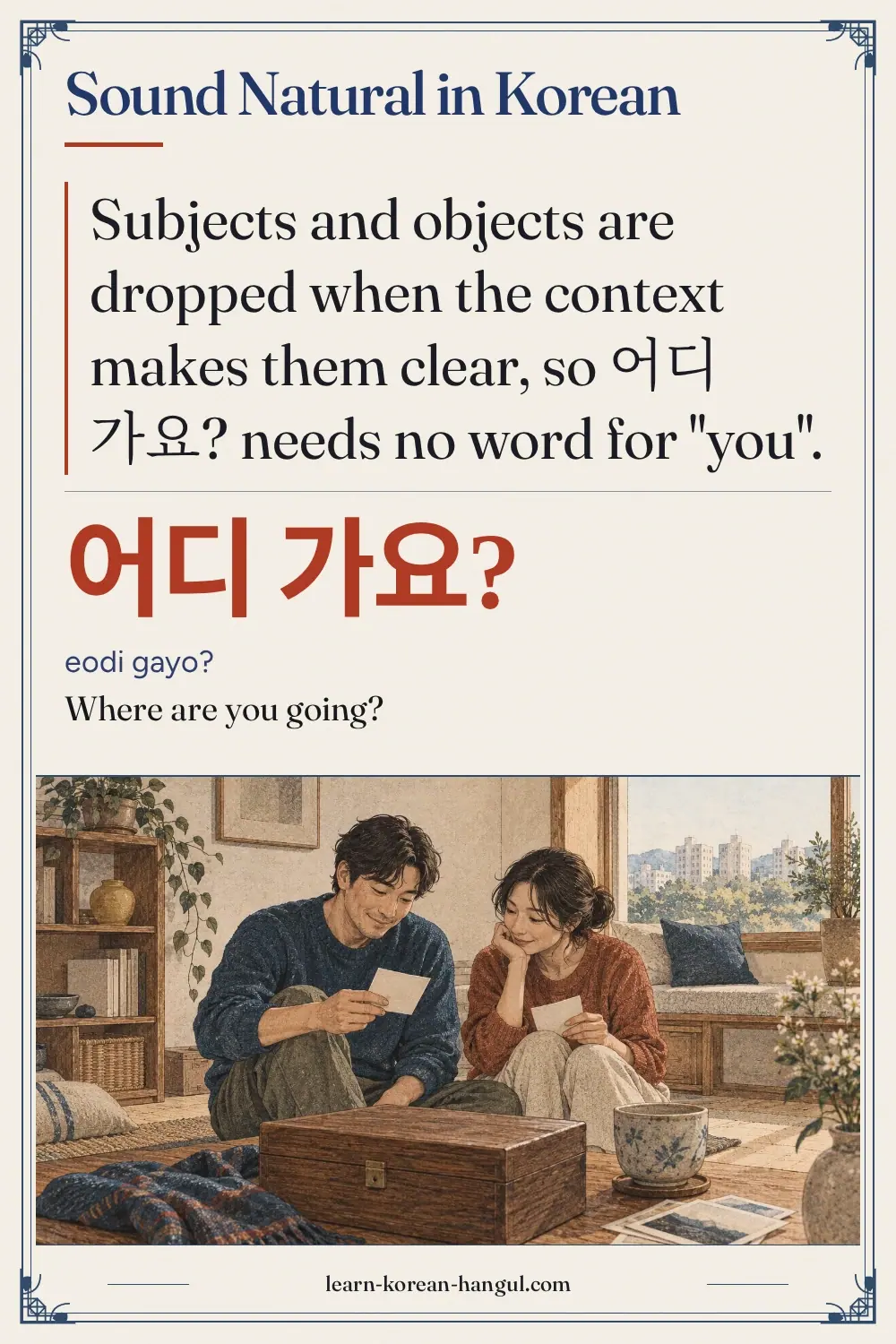
Korean drops words that the listener can supply from context. This is not careless; it is the normal way the language works. If you ask a friend 어디 가요?, nobody needs the word for "you".
어디 가요?
eodi gayo?
Where are you going?
Keep the subject when it is needed: when you introduce a new topic, when two people could be meant, or when you contrast two things. Drop it when the sentence before has made it clear.
Contractions join a noun and its particle into one short unit. They are everywhere in speech and some are fine in polite speech.
| Full form | Contraction | RR | OK in polite speech? |
|---|---|---|---|
| 저는 | 전 | jeon | yes |
| 이것은 | 이건 | igeon | yes |
| 그것을 | 그걸 | geugeol | yes |
| 이것이 | 이게 | ige | yes |
| 무엇을 | 뭘 | mwol | yes |
| 나는 | 난 | nan | casual only |
Hear 전 in a natural self-introduction:
전 학생이에요.
jeon haksaengieyo.
I am a student.
The lesson on spoken Korean contractions trains your ear for the more extreme shortenings you will hear in fast speech. For your own mouth, the list above is enough to start.
Fillers and Endings
Fillers are small sounds that hold your turn while you think. Korean speakers use them freely, and so should you. Three are useful from the start.
- 음 (eum) is "um", a neutral hesitation.
- 어 (eo) is a lighter "uh", often when you notice something.
- 그러니까 (geureonikka) means "so" or "I mean", and it also restarts a sentence after a pause.
음, 잘 모르겠어요.
eum, jal moreugesseoyo.
Um, I am not sure.
그러니까, 내일은 어때요?
geureonikka, naeireun eottaeyo?
So, how about tomorrow?
A few fillers are enough. Overuse makes speech hard to follow. More reaction words and fillers are collected under Korean filler words.
Softening Endings: -는데요 and -거든요
Two sentence endings make speech sound less blunt and more connected. Both are common in conversation and both trail off slightly, leaving the listener room to answer.
-(으)ㄴ/는데요 states a situation and invites a reaction. 지금 바쁜데요 means "I'm busy right now (so…)". It is softer than a flat 지금 바빠요, because it lets the listener finish the thought.
지금 바쁜데요.
jigeum bappeundeyo.
I am busy right now (so…).
-거든요 gives a reason that the listener may not know, as in "you see". 내일 시험이 있거든요 means "I have an exam tomorrow, you see", and it quietly explains why you cannot do something.
내일 시험이 있거든요.
naeil siheomi itgeodeunyo.
I have an exam tomorrow, you see.
Use -거든요 only for information the listener does not already have. Saying it about something obvious sounds like you are explaining the obvious, which can feel impatient.
Natural Does Not Mean Casual
Natural speech depends on the relationship, so it is not always short and casual. A close friend of the same age may hear 반말 (casual speech) without any problem. A stranger, an older person or a colleague expects the polite -요 style. Learners who copy dramas and use casual forms with everyone can sound rude. A safe rule: default to -요, switch to casual only when the other person invites it.
Three over-formal habits mark learner speech most clearly:
- -습니다 everywhere. Use -요 in daily talk.
- A subject in every sentence. Drop 저는 when it is clear.
- 당신 for "you". In daily talk it usually sounds odd or confrontational. Use the person's name with 씨, a title, or no word at all.
A Worked Example: One Sentence in Four Steps
Here is how a single stiff sentence becomes natural. Start with the textbook version, 저는 내일 친구를 만나고 싶습니다 ("I want to meet a friend tomorrow"), and change one thing at a time.
- Drop the subject. 내일 친구를 만나고 싶습니다. The context shows who wants to meet, so 저는 can go.
- Soften the ending. 내일 친구를 만나고 싶어요. The -요 ending replaces the formal -습니다 (RR naeil chingureul mannago sipeoyo).
- Drop the object particle. 내일 친구 만나고 싶어요. In speech, a short object noun often goes without -를.
- Add a softener if you are explaining. 내일 친구 만나고 싶은데요. The -(으)ㄴ/는데요 pattern (here -은데요, after the adjective-like 싶다) leaves the sentence open, so the listener can answer, for example with a time (RR naeil chingu mannago sipeundeyo).
You do not need every step each time. Steps 1 and 2 are the most useful for beginners, and steps 3 and 4 are for when you want to sound relaxed. After you have done the exercise with one sentence, do it with the next four from your own notes.
A Recording Checklist for Rhythm
Record yourself saying the five natural sentences from the table, then listen with this checklist. Tick each item or note what to retry.
- No long stop inside a phrase; pauses fall between phrases.
- Syllables have similar length, with no single beat hammered.
- Vowels are clean and not reduced to "uh".
- Sound changes are applied, as in [감사함니다].
- Each ending fits the person you imagined, usually -요.
- Questions rise or fall in the way the lesson describes.
Do the same five sentences again a week later. The Korean shadowing sets are a good source of more material to practise the same habits.
Your Practice Task: Rewrite Five Sentences
Take five sentences from your own textbook or notes and rewrite each in its natural spoken form. For each one, ask: Can I drop the subject? Can I contract a noun and particle? Is the ending right for this listener? Could a filler or softener help? Then say the new version aloud five times and record it once. This task works at any level, because it uses your own sentences.
What Are the Most Common Mistakes and How Do You Fix Them?
- Dropping the subject when it changes the meaning. If two people are possible, keep the subject. Fix: add the subject whenever the sentence would be unclear.
- Using casual contractions in polite speech. 난 belongs to friends. Fix: use 전 and 이건 with people you do not know well.
- Overusing fillers. Too many 음 sounds stall the conversation. Fix: use one at the start of a thought, then continue.
- Using -거든요 for obvious facts. It can sound defensive. Fix: use it only for news to the listener.
- Copying drama speech wholesale. Characters are written for story, not for a job interview. Fix: use drama for listening and polite forms for your own speaking.
- Rushing. Speed is not the same as naturalness. Fix: aim for steady rhythm at a comfortable pace.
Listening for the Same Habits
You will notice these habits faster if you listen for them. When you watch a clip or hear a conversation, listen for three things: which words are missing, which small words have been joined, and where the speaker pauses and what fills the pause. Write down one example of each, then try the same pattern in your own sentence. A few minutes of this kind of active listening, mixed with shadowing, trains your ear and your mouth together.
Audio and Scope
The audio on this page is pronunciation audio generated with text-to-speech. Synthetic voices give a clean model of rhythm but cannot show every variety of fast speech or regional accent. This page teaches common spoken habits of standard Korean as used in Seoul and does not cover dialects or slang. Next, find someone to try these habits with in find a language exchange partner, or return to how to speak Korean fluently.
Frequently Asked Questions
How do I sound more natural in Korean?
Change five habits: give syllables even weight, drop subjects and objects that are clear from context, use common contractions, add a filler when you need to think, and choose a sentence ending that fits your relationship with the listener. Record yourself saying five textbook sentences in their natural versions and compare them with the audio on this page.
Do Koreans drop the subject?
Yes, very often. Korean speakers leave out words that the listener can work out from context, including "I", "you" and objects. A sentence such as 어디 가요? is complete and means "Where are you going?" without any word for "you". Adding the subject every time is one of the clearest signs of textbook Korean, although it is not wrong.
What are filler words?
Fillers are small sounds or words that fill a pause while you think, such as 음 and 어, or words like 그러니까 ("so", "I mean"). Korean speakers use them just as English speakers use "um" and "well". Using a few of them makes your pauses sound natural and also gives you time to find the next word.
Should I use contractions?
Yes, in speech, but know where each one is allowed. 이건 (이것은), 그건 and 뭘 (무엇을) are fine in polite speech. 전 (저는) is also fine. 난 (나는) is casual and should be kept for friends. In formal writing you would normally use the full forms, so treat contractions as a speaking habit.
In short, to sound natural in Korean, speak in steady phrases, drop what is obvious, contract common words, use a filler when you think and keep the polite -요 ending until someone invites you to relax.