To find a language exchange partner, use an exchange app or a local group, write a clear first message, agree on a 50/50 time split and run a first session with a plan. A partner gives you what solo practice cannot: a listener who reacts, asks unexpected questions and shows you what your Korean sounds like to someone else. This guide covers where to look, how to choose, how to write the first message, how to plan the first 30 minutes and how to give and take corrections kindly.
What Does It Mean to Find a Language Exchange Partner?
Finding a language exchange partner means looking for a person who speaks the language you are learning and is learning the language you speak. You help each other: you speak English (or another language) so your partner can practise, and your partner speaks Korean so you can practise. The arrangement is usually free, and both people share the time equally.
An exchange is different from a lesson. Nobody is the teacher, so nobody is responsible for explaining grammar or following a syllabus. That is its strength and its weakness. Conversation feels natural, but errors may go unexplained. Use an exchange as a supplement to study, not a substitute. If you are very new to speaking, build a base first with the solo practice routine; a good time to start is when you can introduce yourself and answer simple questions aloud.
Where Do I Find a Partner?
You can find partners in four kinds of places. Each has benefits and limits.
| Where | How it works | Benefit | Limit |
|---|---|---|---|
| Exchange apps and websites | Browse profiles, then message | Many people, flexible hours | Quality varies; some users want other things |
| University and community groups | Meet at scheduled events | Safer first contact, a shared setting | Fixed times, may be local only |
| Local meetups and language cafés | Attend in person | Face-to-face, social | Needs a city with active groups |
| Online learner communities | Post a request | Learners often share a goal | Slower to get a reply |
A paid tutor is a fifth option. It is not an exchange, but it is a reliable way to practise when you cannot find a partner. Study apps help with vocabulary and grammar, but they are separate from exchange services.
Look for a platform that lets you read a profile before you write, lets you block or report a user and does not force you to share contact details. Check the platform's own help pages for age rules and safety tools, and keep to the rules it sets.
Choosing and Messaging a Partner
Choose a partner by fit, not by speed of reply. A partner is a person you will talk to for weeks, so spend a few minutes comparing before you commit.
Partner-Fit Checklist
Check these six things on a profile or in the first messages:
- Goals. Do you both want conversation practice, or does one person want exam preparation?
- Level. A partner whose English is at about the level of your Korean keeps both halves of the session fair; a big gap can make one person impatient.
- Time zone and schedule. Can you both meet at a regular time? Korea is ahead of many countries, so check the hours before you propose them.
- Topics. Do you share interests such as food, music or travel?
- Format. Do you prefer voice messages, calls or text? Agree which.
- Reliability. Do they reply, and do they turn up? Missed meetings are the main reason exchanges end.
The First Message
A good first message is short, friendly and specific. It names your level and your available hours, because that tells the other person whether you are a match without a long exchange. A template in English:
Hi! I'm [name]. I'm learning Korean at beginner level and I'd like to practise speaking. I can help with English. Could we talk for 30 minutes, twice a week? I'm free on [days] at [time and time zone].
You can add a few Korean lines to show effort. Keep them simple and correct. The lesson on a Korean language exchange message gives a full writing template; the lines below are enough to start.
안녕하세요! 한국어를 공부하고 있어요.
annyeonghaseyo! hangugeoreul gongbuhago isseoyo.
Hello! I am studying Korean.
저는 한국어 초급이에요.
jeoneun hangugeo chogeubieyo.
I am a Korean beginner.
영어 공부를 도와드릴 수 있어요.
yeongeo gongbureul dowadeuril su isseoyo.
I can help with English.
일주일에 두 번 이야기하고 싶어요.
iljuire du beon iyagihago sipeoyo.
I would like to talk twice a week.
Send the same message to three or four people, because some will not reply. Do not copy-paste without reading the profile; add one personal detail, such as a shared interest, to each.
A Safety Checklist
Stay safe the same way you would with any stranger you meet online. These steps are sensible defaults, not a guarantee:
- Keep early chats inside the platform; do not share your phone number, address, workplace or school at first.
- Never send money, and do not agree to anyone's request for financial help or private photos.
- Try a short video or voice call before meeting in person.
- If you meet in person, choose a public place in daytime and tell a friend where you are going.
- Block and report anyone who pressures you, ignores your boundaries or turns a language chat into something else.
- Trust your instincts: you can end any exchange at any time without explaining.
Planning the First Session
Plan the first session on paper, because unplanned exchanges slide into English. A 30-minute plan works well:
| Minutes | Block | What happens |
|---|---|---|
| 0–5 | Greet | Say hello in both languages, confirm the plan |
| 5–15 | Korean | Speak Korean on a prepared topic; your partner helps |
| 15–25 | English | Switch; you help your partner in English |
| 25–30 | Feedback | Each person says one good thing and two things to fix |
Agree the plan in the first message or at the start of the call. Use a visible timer, and switch when it rings, even in the middle of a sentence. Fairness is the foundation of the arrangement.
Prepare three questions and one story for the Korean block. The Korean conversation questions lesson gives ready-made questions, and the self-introduction role play prepares your first minute. To start the Korean block, you can say:
먼저 십 분 동안 한국어로 이야기해요.
meonjeo sip bun dongan hangugeoro iyagihaeyo.
First, let us talk in Korean for ten minutes.
Here 십 분 is said [십뿐], because the unit 분 is tense after a stop sound. If nerves are the problem, the Korean speaking anxiety guide will help you prepare.
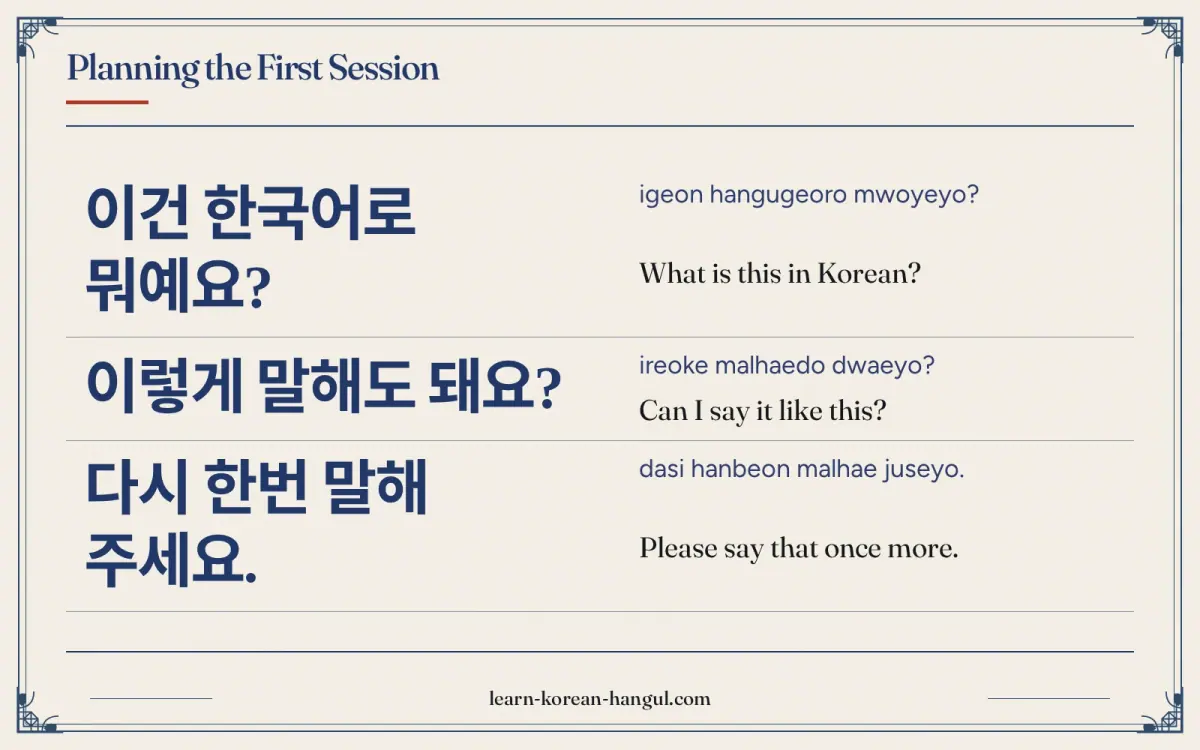
Rescue Phrases for the Korean Block
Learn three short phrases to use when you get stuck. They let you keep the conversation in Korean instead of switching to English.
이건 한국어로 뭐예요?
igeon hangugeoro mwoyeyo?
What is this in Korean?
이렇게 말해도 돼요?
ireoke malhaedo dwaeyo?
Can I say it like this?
다시 한번 말해 주세요.
dasi hanbeon malhae juseyo.
Please say that once more.
Giving and Taking Corrections
Agree on a correction style before you start, because the wrong style ends exchanges. Some people want every error fixed at once; others lose heart if interrupted. Ask, and write down the answer.
A good default for beginners is this: do not interrupt during a block; note errors and discuss them in the feedback block. Interrupt only when a mistake stops you understanding. Ask your partner to follow the same rule for your English.
Ask for corrections with a short, polite request:
고쳐 주세요.
gochyeo juseyo.
Please correct me.
When you correct your partner:
- Say one good thing first. "Your pronunciation of that word was clear."
- Give only the top two errors. Too many corrections overwhelm.
- Show the corrected sentence. Say it once, slowly, and let your partner repeat it.
- Explain only if asked. Native speakers often know that a sentence is wrong without knowing the rule, so be ready to say "I am not sure why".
When you receive a correction, repeat the corrected sentence aloud and write it down. A partner who is a native speaker is not a teacher, so check a doubtful rule against a lesson or a dictionary. Being corrected can sting; the anxiety guide shows how to treat errors as information.
A Four-Week Topic Plan for Your Exchange
A topic list stops you wasting the first five minutes deciding what to say. Use one topic per week and repeat it in two sessions, so you can improve on the first attempt. This plan suits learners at A1 to A2.
| Week | Korean-block topic | What to prepare |
|---|---|---|
| 1 | Introducing yourself | Name, country, job or study, one hobby |
| 2 | A normal day | Five actions in order, with times |
| 3 | Food and places | What you eat, where you go, one question about Korea |
| 4 | Weekend plans | One plan and one invitation |
Prepare by writing three or four sentences on paper, then speak without reading them. In the session, your partner may ask follow-up questions; answer with a short sentence and then ask the same question back. Asking back is the simplest way to keep a conversation balanced. If your partner is also a beginner in English, speak slowly and keep sentences short in the English block, because patience is part of the exchange.
Scheduling is the other thing that breaks exchanges. Agree a regular slot, confirm it a day ahead and say clearly when you will cancel. Reliable timing is a kindness, and it is the main reason some partnerships last for months while others end after one chat.
Tutor or Partner?
Tutors and partners complement each other. The table compares them.
| Partner | Tutor | |
|---|---|---|
| Cost | Usually free | Paid |
| Structure | Informal, you plan it | Planned by the tutor |
| Feedback | Casual, may not explain | Trained to explain |
| Time split | 50/50 between languages | All in your target language |
| Flexibility | Depends on both schedules | Booked in advance |
| Best for | Real use, fluency | Accuracy, a clear path |
If you can afford only one, choose by your weakness: a tutor if you keep making the same mistakes, a partner if you know a lot but rarely speak.
What Are the Most Common Mistakes and How Do You Fix Them?
- Drifting into English. The conversation switches whenever you are stuck. Fix: use the timer and the rescue phrases, and save English words for the feedback block.
- Sharing too much too soon. Fix: follow the safety checklist and let trust build slowly.
- One-sided sessions. One person talks more. Fix: stick to the 50/50 split.
- Waiting for perfect Korean. Fix: send the first message at beginner level, as the template does.
- No follow-up. Fix: end each session by agreeing the next date and one topic.
- Giving up after one bad match. Fix: try three or four partners before judging the method.
After a month of regular sessions, you will probably want more structure; the 30 day Korean speaking plan can add it, and the hub on how to speak Korean fluently shows the other options.
After the Session
Spend five minutes alone after each session. Write down the new words and the two corrections, say the corrected sentences aloud once, and add the words to your flashcards. Then choose one thing to try next time, such as a new question or a longer answer. This short review turns a pleasant chat into progress, and it makes the next session easier to start because you already know what to practise.
Audio and Scope
The audio on this page is pronunciation audio generated with text-to-speech. This guide does not recommend a particular app or service and cannot verify any platform's safety features, so read each service's own rules before you join.
Frequently Asked Questions
Where can I find a Korean language partner?
Look in four places: language exchange apps and websites, university or community language groups, local meetups in your city, and online communities for Korean learners. Choose a place that lets you read a profile before you write. Wherever you look, write a clear first message that states your level and your free hours, and expect to talk to a few people before you find a good match.
How long should a language exchange last?
Thirty minutes is a good start: five minutes to greet, ten in Korean, ten in English and five for feedback. Beginners tire quickly when they speak a new language, so a short session keeps quality high. Once you can talk comfortably, you can extend to 45 or 60 minutes, still splitting the time equally between the two languages.
Is a tutor better than a partner?
They do different jobs. A tutor is paid, trained to teach, and plans lessons and gives structured feedback. A partner is free, chats more naturally and gives you real use, but may not explain why something is wrong. Many learners use a tutor for accuracy and a partner for practice. Neither replaces daily solo speaking.
How do I stay in Korean during an exchange?
Set a clear split and use a timer. Agree which ten minutes are Korean only, prepare a topic list in advance, and learn a few rescue phrases for when you get stuck. Write down words you need in English and ask for them afterwards instead of switching language. When the timer ends, switch to your partner's target language.
In short, to find a language exchange partner, pick a safe place to look, send a clear first message, split sessions 50/50 with a plan, and agree how you will give corrections.