A 30-day Korean speaking plan sets one 15-minute task per day: week 1 shadowing, week 2 role plays, week 3 questions and self-talk, week 4 a partner session and a final two-minute talk. Every task uses a page already on this site, so you never have to hunt for material. This guide gives the full 30 days, a way to compare your first and last recordings and a rule for missed days.
What Is a 30 Day Korean Speaking Plan?
A 30-day Korean speaking plan is a fixed schedule of short daily speaking tasks that ends with a test. It exists to turn a vague wish ("speak more Korean") into something you can do tomorrow. Each day tells you what to practise, for how long and with which page.
The plan follows the four-step ladder used across the speaking section: shadow, role play, answer questions and converse. It assumes you can read Hangul and say a few polite sentences. If you cannot read Hangul yet, start with the Hangul lessons and come back. If you need nerves handled first, read Korean speaking anxiety before day 1. The overview of the whole group is in how to speak Korean fluently.
How Does the 30-Day Plan Work?
The plan works by giving you one small task a day, with a rest day at the end of each week, and testing yourself on day 30. The rules are simple.
- Time: about 15 minutes a day, spoken aloud. A timer helps.
- Rest days: days 7, 14, 21 and 28. On these, take the day off or do a five-minute review of the week's best line.
- Recording: record yourself on day 1 and day 30, and add short recordings on days 18 and 26 if you like.
- Level: choose A1 or A2 at the start (see below) and stay with it.
- Rubric: score recordings with the four-part rubric: sounds, flow, form and task, 0 to 2 each, for a total out of 8.
- Catch-up: follow the catch-up rule if you miss a day.
The full 30 days take roughly seven hours: 26 task days of about 15 minutes, plus a little extra on the two recording days. That is a typical estimate, not a promise.
Choose Your Level: A1 or A2
Choose A1 if you are still learning basic phrases, or A2 if you can already make short sentences of your own.
| A1 option | A2 option | |
|---|---|---|
| Scripts | Say the script as written | Change two details of each script |
| Shadowing | 2-line clips | 4-line clips |
| Questions | Answer in one sentence | Answer in two or three sentences |
| Day-30 talk | About one minute, mostly scripted | About two minutes, some of it your own |
| Past and future | Optional | Include at least one past and one future sentence |
Pick the option at the start and use it for the whole plan. You can repeat the plan later at the higher level.
What Is the Day-1 Recording?
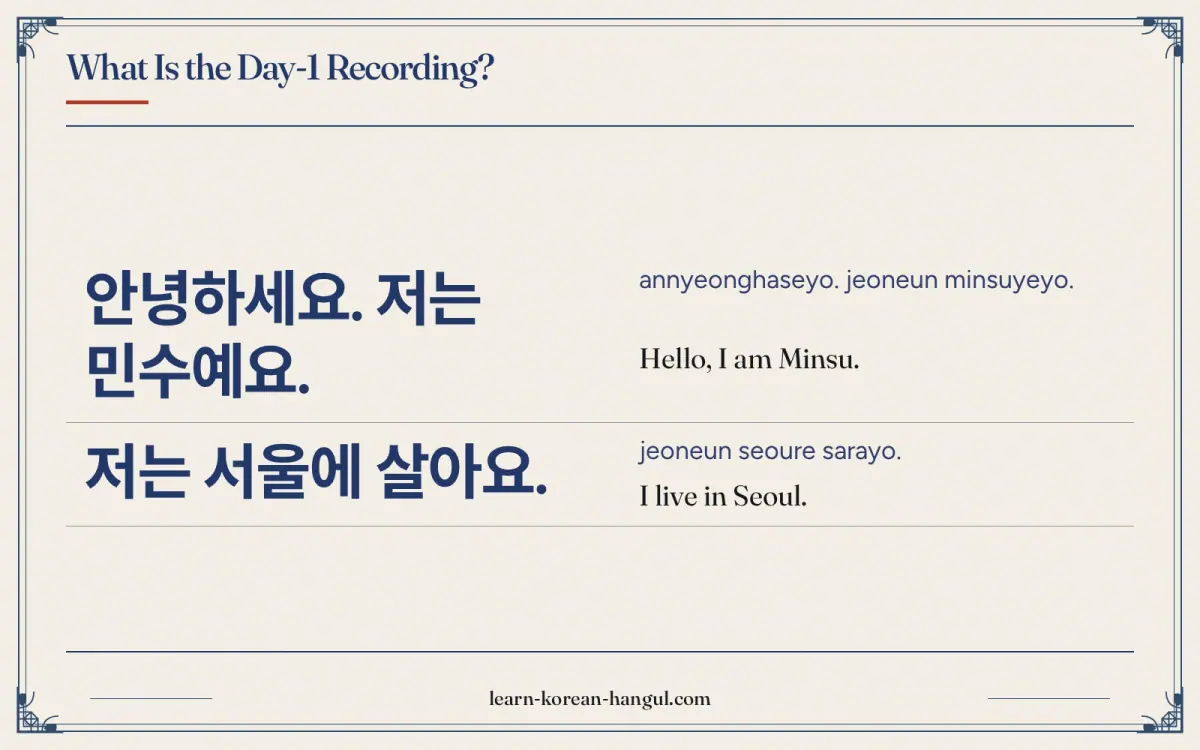
The day-1 recording is the baseline you will compare with on day 30. Record it before you study anything else, so it reflects where you really are. Use this short script, and change the name and city to be true for you. Play each line first, then say it:
안녕하세요. 저는 민수예요.
annyeonghaseyo. jeoneun minsuyeyo.
Hello, I am Minsu.
저는 서울에 살아요.
jeoneun seoure sarayo.
I live in Seoul.
저는 매일 한국어를 공부해요.
jeoneun maeil hangugeoreul gongbuhaeyo.
I study Korean every day.
Save the file with the date. Do not re-record it, because an imperfect start is what makes the comparison meaningful.
Week 1: Shadowing
Week 1 trains your mouth: clear sounds, steady rhythm and speed. Each day you shadow a short clip, which means speaking along with it a split second behind. The method is explained in how to shadow Korean. For each task, play the clip, shadow it five times and then say it once without the audio.
| Day | 15-minute task | Page to use |
|---|---|---|
| 1 | Record the baseline script, then shadow the three lines five times each | This page |
| 2 | Learn the method: take one two-line clip through the six steps | How to shadow Korean |
| 3 | Shadow a greetings set | Shadowing greetings |
| 4 | Shadow an ordering-food set | Shadowing ordering food |
| 5 | Shadow a shopping set | Shadowing shopping |
| 6 | Shadow the daily routine set | Shadowing a daily routine |
| 7 | Rest day, or replay your favourite line | none |
A rest day is part of the plan. A line you can already say well is a good thing to replay, and it keeps the habit warm.
오늘은 쉬는 날이에요.
oneureun swineun narieyo.
Today is a rest day.
Week 2: Role Plays
Week 2 moves from copying to rehearsing real exchanges. A role play gives you a situation, such as ordering coffee, with two parts. You play both parts aloud until you can say your lines without reading. Each day, do the role play three times: once reading, once with the script half-hidden, once from memory.
| Day | 15-minute task | Page to use |
|---|---|---|
| 8 | Both roles of a self-introduction | Self-introduction role play |
| 9 | Order a coffee | Coffee order role play |
| 10 | Order a meal | Restaurant role play |
| 11 | Ask a price and buy something | Shopping role play |
| 12 | Ask for and follow directions | Directions role play |
| 13 | Answer and make a phone call | Phone call role play |
| 14 | Rest day, or run your best role play once | none |
At the A2 level, change two details in each role play: the drink, the price, the street. Changing details is where repetition turns into speaking. The section hub, Korean conversation practice, lists more role plays if you want extras.
Weeks 3 and 4: Questions, Self-Talk and a Partner
Week 3 asks you to produce your own answers, and week 4 puts you in front of a real listener. These two weeks are the heart of the plan, so the table is longer.
| Day | 15-minute task | Page to use |
|---|---|---|
| 15 | Answer ten questions aloud, one sentence each | Korean conversation questions |
| 16 | Narrate your room and your actions for 10 minutes | Talk to yourself in Korean |
| 17 | Talk about a hobby, with three follow-up questions | Hobbies conversation practice |
| 18 | Answer the same ten questions in two sentences; record one answer | Korean conversation questions |
| 19 | Make and accept an invitation | Making plans conversation |
| 20 | Run the 15-minute solo routine | Practice speaking Korean alone |
| 21 | Rest day, or review your day-18 recording | none |
| 22 | Pick one rung of the anxiety ladder and do its success test | Korean speaking anxiety |
| 23 | Rewrite five of your own sentences into spoken forms | Sound natural in Korean |
| 24 | Write a first message and send it to two partners | Find a language exchange partner |
| 25 | Prepare three questions and a topic for a first session | Find a language exchange partner |
| 26 | Hold a 15-minute live session with a partner or tutor, or send a voice message | Find a language exchange partner |
| 27 | Repeat the session topic with changes; note three corrections | none |
| 28 | Rest day, or practise your corrections | none |
| 29 | Rehearse the final talk twice, then once without notes | none |
| 30 | Record the final two-minute talk and score both recordings | This page |
The week 4 tasks assume you can find a partner or tutor, but the plan still works without one: on day 26, record your answers to ten questions and send the recording as a voice message to a friend.
What Goes in the Day-30 Talk?
The day-30 talk is a two-minute recording that repeats your day-1 script and adds new material. Plan it on day 29. At A1, a one-minute version is enough. A good structure has four parts:
- Day-1 lines. Say the three lines from day 1 again, so the comparison is fair.
- Something you did. One or two past-tense sentences.
- Something you will do. One or two future sentences.
- A closing line. Thank the listener or say how you feel about speaking.
Sample lines for parts 2 to 4 follow. Change them to be true for you.
어제 친구를 만났어요.
eoje chingureul mannasseoyo.
I met a friend yesterday.
주말에 영화를 볼 거예요.
jumare yeonghwareul bol geoyeyo.
I will watch a film at the weekend.
한국어로 이야기해서 즐거웠어요.
hangugeoro iyagihaeseo jeulgeowosseoyo.
I enjoyed talking in Korean.
In 영화를 볼 거예요, the ending -(으)ㄹ 거예요 is said [볼꺼예요], with a tense ㄲ sound after the -ㄹ.
At A2, add two more sentences of your own, for example about your work, your study or a place you like. Keep every sentence short enough that you can say it without stopping. A talk with ten clear sentences scores higher than one with five long, broken ones, so aim for clarity first.
Comparing Day 1 with Day 30
Compare the two recordings on four criteria. Listen to day 1 first, then day 30, and score each from 0 to 2 for sounds, flow, form and task.
| Criterion | What to listen for | Day 1 | Day 30 |
|---|---|---|---|
| Sounds | Clear vowels, tense and plain consonants, sound changes | … / 2 | … / 2 |
| Flow | Fewer pauses inside sentences, a steady pace | … / 2 | … / 2 |
| Form | Correct polite -요 endings and particles | … / 2 | … / 2 |
| Task | The script or talk is complete, without reading | … / 2 | … / 2 |
| Total | … / 8 | … / 8 |
Self-scores are rough. Your ears improve faster than your mouth, so your day-1 score may feel generous when you listen back. Ask a tutor or partner to score the same two files if you can, and count a rise of two points or an obvious change you can hear as a good result.
What If You Miss a Day?
Use the catch-up rule: never double up, never quit. A missed day is normal, and the plan is built to survive it.
- One missed day: skip that task and carry on, or swap it with the next rest day.
- Two or three missed days: repeat the last task you finished, then continue.
- A missed week: restart that week from its first day and move the end date back.
- Rest days are flexible: if you have missed a task, use the nearest rest day for it.
Moving the finish line is not failure. A plan that lasts 36 days with the same result as one that lasts 30 is a plan that worked.
What Are the Most Common Mistakes and How Do You Fix Them?
- Skipping the baseline. Without the day-1 recording you cannot see progress. Fix: record it first.
- Making the sessions too long. An hour on day 3 leaves you too tired for day 4. Fix: stop at 15 minutes.
- Reading the script every time. The half-hidden and memory rounds are where learning happens. Fix: follow the three rounds.
- Avoiding week 4. The live task is the scariest. Fix: use the voice-message version, then upgrade next time.
- Judging yourself on one bad day. Fix: compare only the two recordings.
- Stopping at day 30. Fix: repeat the plan at the next level, or choose one habit to keep, such as the 15-minute solo routine.
Audio and Scope
The audio on this page is pronunciation audio generated with text-to-speech. The plan does not score your speech automatically and does not prepare you for a speaking exam. It builds habits that make later study easier, and its time estimates are typical for adult learners, not guarantees. Return to how to speak Korean fluently for the other lessons in this group.
Frequently Asked Questions
Can I improve my speaking in 30 days?
You can make visible progress in 30 days if you speak aloud almost every day. Expect clearer sounds, a steadier pace and a handful of sentences you can say without a script. You will not become fluent in a month. The aim is a habit and a measurable improvement between your day-1 and day-30 recordings.
How do I catch up after a missed day in the plan?
Do not double up. If you miss one day, skip it and carry on, or use the next rest day for the missed task. If you miss two or three days, repeat the last task you finished and then continue. If you miss most of a week, restart that week from its first day. Moving the end date back is always fine.
Do I need a partner?
Not for the first three weeks, which use audio and solo tasks. Week 4 includes a session with a partner or tutor, because live conversation is the final test of the plan. If you cannot find one, record yourself answering the question list aloud and send it as a voice message to a friend instead.
How do I measure progress?
Record the same short script on day 1 and a longer talk on day 30, and score both with the four-part rubric: sounds, flow, form and task, each 0 to 2, for a total out of 8. Listen to the two recordings back to back as well. A rise of two or more points, or a clear change you can hear, is a good result.
In short, the 30 day Korean speaking plan gives you a shadow, role play, questions and partner path with four rest days, a catch-up rule and a day-1 versus day-30 recording to prove it worked.