To practice speaking Korean alone, combine five methods in a 15-minute routine: read aloud, shadow, narrate, answer questions and record. Each method trains a different part of speaking, and together they give you the repetition that a partner cannot supply every day. This guide shows the routine minute by minute, a script to record each week and the point where you will need a real listener.
What Is Practising Speaking Korean Alone?
Practising speaking Korean alone means saying Korean out loud with no other person present and checking the result yourself. The key word is out loud. Reading silently, listening and flashcards build knowledge, but only speech trains your mouth, your timing and your nerve. A learner who knows 저는 한국어를 공부해요 ("I study Korean") on a flashcard but has never said it aloud will often stumble on the first real try.
You will need three things: a phone or computer that records audio, a quiet corner and the audio clips on the pages you are studying. You do not need a microphone headset or any paid software. The only strict rule is that you speak at normal volume. Whispering is a fine first step if you feel shy, and the anxiety guide shows how to move up from it, but mouthing words silently does not train your voice.
Can You Practice Speaking Korean Alone?
You can learn a great deal alone, but not everything. Solo practice reliably builds four things: clear sounds, steady rhythm, a stock of ready sentences and the habit of starting. It builds a fifth thing weakly, which is choosing words quickly. It cannot build two things at all: reacting to unpredictable questions and hearing corrections you did not ask for.
That is not a reason to wait for a partner. For most beginners, 15 minutes alone each day does more than one conversation a week, because daily repetition is what makes a sentence automatic. Think of solo practice as training and a conversation as the match. This page is the training, and the language exchange guide covers the match.
The Five Solo Methods
Each method does one job. The table shows what each one trains and what it cannot do, so you can see why the routine uses all five.
| Method | What it trains | What it cannot do | Needs audio? |
|---|---|---|---|
| Read aloud | Linking spelling to sound | Teach you to build sentences | Helpful |
| Shadow | Rhythm, melody, speed | Make you choose words | Yes |
| Narrate | Building your own simple sentences | Check that they are correct | No |
| Answer questions | Retrieving words under mild pressure | Surprise you | Helpful |
| Record | Hearing yourself, tracking progress | Fix errors by itself | No |
1. Read Aloud
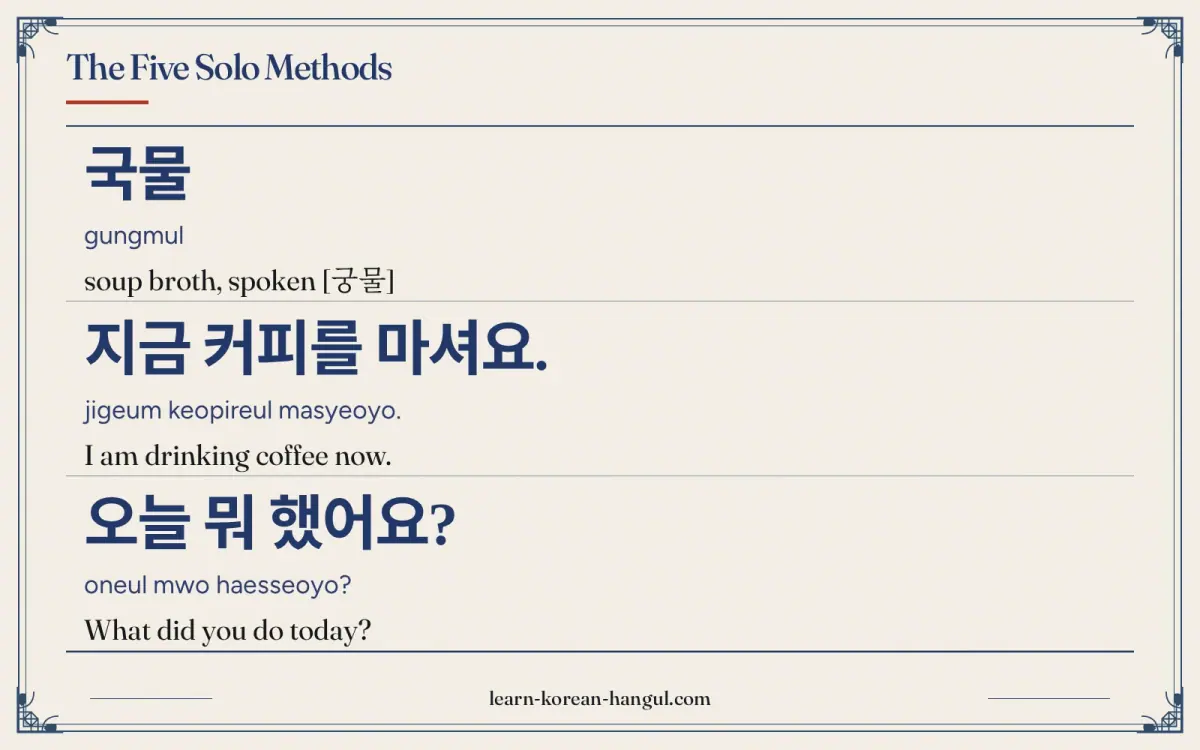
Read a short text aloud, at normal speed, and listen for the places where your mouth wants to say the letters and the language says something else. Korean spelling shows the word's base form, while speech applies sound changes. The word 국물 ("soup broth") is written with ㄱ but said [궁물], because ㄱ before ㅁ turns into ㅇ (RR gungmul). Reading aloud makes you notice and fix this kind of mismatch. The page on how to read Korean aloud has texts graded by level.
국물
gungmul
soup broth, spoken [궁물]
Read the same three or four sentences twice. The first pass finds the trouble spots, and the second pass fixes them. The rules behind such changes are in the sound change rules lessons.
2. Shadow
Shadowing means speaking along with an audio clip, a split second behind it, so that your timing and melody match. Play a line, repeat it right after, and then speak with the audio while looking away from the text. Choose clips that are short, clear and slightly easy; difficult clips teach you to mumble.
The most common mistake is reading ahead of the audio. If you are ahead, you are reading, not shadowing. The full method is in how to shadow Korean, and the sets are in the Korean shadowing section.
3. Narrate
Narrating means describing what you see or do in short Korean sentences, as if you were speaking to a friend. This is the first method that makes you produce language. Start with sentences you already know and change one word at a time:
지금 커피를 마셔요.
jigeum keopireul masyeoyo.
I am drinking coffee now.
Say it, then replace 커피 with 물 (water) or 차 (tea). Next change the verb: 지금 책을 읽어요 ("I am reading a book now"). Within a week you will be narrating ten or twelve actions around your room. If you cannot find a word, say the sentence in English except for that word, look it up afterwards and repeat the whole sentence in Korean. The extra lesson on how to talk to yourself in Korean gives more prompts.
4. Answer Questions
Ask yourself a question and answer it aloud before you check any model answer. Questions with a short natural reply work best at first. Both lines below are on audio, so you can hear a model after your own try.
오늘 뭐 했어요?
oneul mwo haesseoyo?
What did you do today?
일하고 운동했어요.
ilhago undonghaesseoyo.
I worked and exercised.
Notice that a question with a question word such as 뭐 ("what") puts its emphasis on that word and does not end with a sharp rise. A sharp rise at the end can turn 뭐 into "something", so the sentence would mean "Did you do something today?" Say your answer in two parts, as in the model: one action, then another, joined by -고 ("and"). A set of ready-made questions is in Korean conversation practice.
5. Record
Recording means saving your voice and listening back later. It is the only solo method that tells you something you could not hear while speaking, because speaking and listening critically use the same attention. Record once a week, using the same script each time (given below), and listen the next day.
A 15-Minute Routine
Use this routine on most days. It uses a timer and a rule: when the timer ends, stop the method and move on, even if you want to do more.
| Minutes | Method | What to do |
|---|---|---|
| 0–3 | Read aloud | Read three or four sentences from your current lesson, twice |
| 3–6 | Shadow | Shadow one clip of two or three lines, five times |
| 6–9 | Narrate | Describe six things you see or do, one sentence each |
| 9–12 | Answer questions | Answer three questions aloud, then compare with a model |
| 12–15 | Record or repeat | Once a week, record the script below; on other days, repeat the line that went worst |
Three rules keep the routine from collapsing. First, speak at normal volume. Second, prepare one list of three questions and one list of six narration objects the night before, so you do not waste minutes choosing. Third, finish with the line you can say best, so the session ends on a success. When you repeat a weak line, cue yourself with a short phrase:
한 번 더 말해 볼게요.
han beon deo malhae bolgeyo.
I will try saying it once more. (spoken [볼께요])
If 15 minutes is too long at first, drop to 10 by shortening each block to two minutes, and build back up. A short habit that you keep beats a long one that you quit. If you want a month of ready-made tasks, the 30-day Korean speaking plan assigns one for every day.
A Weekly Recording Script
Use one script every week so that you compare the same words. This one is short enough for week one and grows by a line or two as you learn more. Each line has audio.
안녕하세요. 저는 민수예요.
annyeonghaseyo. jeoneun minsuyeyo.
Hello, I am Minsu.
저는 서울에 살아요.
jeoneun seoure sarayo.
I live in Seoul.
저는 한국어를 공부해요.
jeoneun hangugeoreul gongbuhaeyo.
I study Korean.
주말에 친구를 만났어요.
jumare chingureul mannasseoyo.
I met a friend at the weekend.
Change the name, the city and the weekend event to be true for you. Saying true things makes the practice more memorable than repeating someone else's life.
How Do I Track Progress?
Track progress with a four-part score after each weekly recording. Listen once for each part and give 0, 1 or 2 points, so the total is out of 8. The same rubric is used across the whole speaking section, so your scores line up with the other pages.
| Part | 0 points | 1 point | 2 points |
|---|---|---|---|
| Sounds | often hard to understand | understood with effort | clear, small slips only |
| Flow | long pauses inside sentences | pauses between sentences | steady pace |
| Form | endings or particles often missing | mostly correct polite -요 forms | correct throughout |
| Task | script not completed | completed with the script in view | completed without the script |
A self-score is a rough guide. Your ears improve faster than your mouth, so you may give yourself a lower score in week four than in week one even though you speak better. That is a sign of progress, not failure. Write each score and one sentence of notes in a log, and keep the audio files.
What about Voice Assistants?
A voice assistant or dictation tool can show whether your words were recognised, which is a quick check on sounds. It is a poor judge of accuracy for three reasons. First, speech recognition guesses the most likely words from context, so it may write the correct sentence even when your ending was wrong. Second, it is tolerant of an accent that a listener would still notice. Third, it says nothing about whether your sentence sounds natural. Use it for one thing: if it keeps writing a different word from the one you meant, work on that word's sounds.
Adjusting the Routine to Your Level
Absolute beginners can spend more time on the first two blocks, because reading aloud and shadowing need few words. After about two months, shift minutes towards narrating and answering, which are the blocks where you make your own sentences. Keep the total at 15 minutes and keep the recording day. When a block feels easy for two weeks in a row, make it harder: shadow a longer clip, narrate what you did yesterday with past forms such as 마셨어요 ("drank"), or answer in three sentences instead of two.
When Do You Need a Real Person?
You need a real person once solo practice stops giving you new information. There are two clear signs. The first is that you can answer ten common questions in two or three sentences each and still feel stuck in real talk. The second is that your weekly scores have not moved for three or four weeks. Both mean you have reached the limit of what you can hear yourself.
At that point, book a session with a tutor or an exchange partner. The find a language exchange partner guide shows how. You do not have to stop solo practice; the daily routine keeps your sentences fast for the live sessions.
Common Mistakes and How to Fix Them
These are the habits that most often stall solo learners.
- Whispering every time. Whispering skips the breath control of normal speech. Fix: speak at normal volume, even if you close the door first.
- Reading ahead of the audio. This turns shadowing into reading. Fix: look away from the text after the third pass.
- Only repeating. If every method is copying, you never build sentences. Fix: keep the narrate and answer blocks every day.
- Never recording. Without recordings you cannot see progress. Fix: set a weekly reminder and keep a log.
- Trusting a voice assistant as a teacher. It checks recognition, not grammar. Fix: use it only as a sound check and ask a person about form.
- Skipping days, then doing an hour. A long catch-up session builds fatigue, not fluency. Fix: restart the next day with the normal 15 minutes.
For nerves that make you freeze even when alone, read the Korean speaking anxiety guide next. For the wider picture, see how to speak Korean fluently.
Audio and Scope
The audio on this page is pronunciation audio generated with text-to-speech. It gives you a clean model for shadowing, but it cannot hear you or respond. This guide covers speaking practice only; it does not teach the grammar of the sentences it uses.
Frequently Asked Questions
Can I learn to speak Korean alone?
You can build a lot alone: pronunciation, rhythm, ready-made sentences and the habit of speaking aloud. What you cannot get alone is a listener who reacts, asks unexpected questions and corrects mistakes you cannot hear. Plan to use solo practice as your base and add a partner or tutor once you can answer simple questions aloud.
What is the best solo speaking method?
No single method is best, because each trains something different. Shadowing builds rhythm, reading aloud links spelling to sound, narrating builds your own sentences, and recording lets you judge yourself. If you can do only one, choose narrating simple things in front of you, since it makes you build your own sentences from the first day instead of repeating someone else's.
Do voice assistants help?
They help a little. If a voice assistant understands your sentence, your sounds are probably clear enough to be recognised. But the software guesses the most likely words, so it may accept a sentence with a wrong ending and it cannot say whether your sentence sounds natural. Treat it as a quick sound check, never as a teacher.
How often should I record myself?
Once a week is enough. Record the same short script each time, so you compare like with like, and listen the next day when the memory of speaking has faded. Keep the old files. Hearing your first recording next to your fourth one is the most reliable proof of progress.
In short, practise speaking Korean alone with a timed 15-minute routine of five methods, record one script a week and add a real listener when your scores stop moving.