Korean speaking anxiety is the fear of making mistakes aloud, and it is common among learners. This guide explains why speaking feels scary, separates fear from missing vocabulary and gives a six-step ladder with a clear success test on every rung. It ends with a two-week plan to climb one step.
What Is Korean Speaking Anxiety?
Korean speaking anxiety is nervousness, dread or freezing that appears when you must speak Korean to another person, even when you know the words. A typical sign is that you can write a sentence perfectly at your desk and still say nothing in a café. Another is rehearsing a line so long that the moment passes. Both are normal and both are fixable.
Anxiety is a feeling about a situation, not a measure of your skill. Two learners with the same vocabulary can behave very differently: one speaks with errors and learns from them, and the other stays silent and learns nothing new. The aim of this page is not to make you fearless. It is to make the next small step so small that you can take it while still nervous.
Why Does Speaking Feel Scary?
Speaking feels scary because it is live, it is public and it is hard to take back. Writing lets you check and revise, but speech leaves you no time. Four causes come up again and again with Korean:
- Fear of being judged. You imagine the listener thinking less of you. In practice, most listeners are thinking about their own reply.
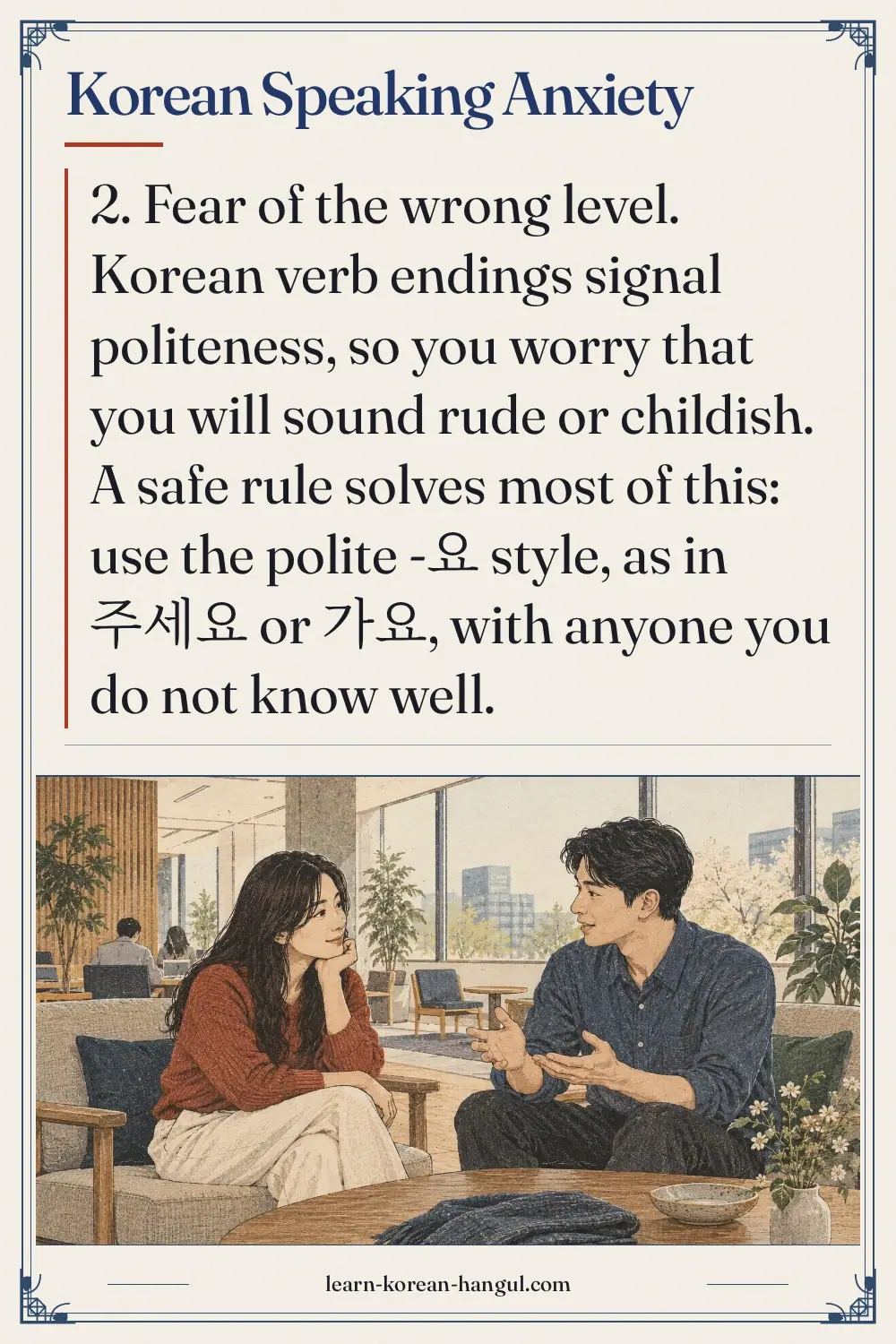
- Fear of the wrong level. Korean verb endings signal politeness, so you worry that you will sound rude or childish. A safe rule solves most of this: use the polite -요 style, as in 주세요 or 가요, with anyone you do not know well.
- Unfamiliar sounds. Sounds such as the tense consonants feel exposed because you are never sure you are making them right. The Korean pronunciation lessons let you practise them alone first.
- Perfectionism. If you will only speak when the sentence is right, you will not speak, and without speaking you will not improve.
Knowing the cause helps you pick the cure. If the fear is of judgement, practise with someone kind. If it is of the wrong level, memorise a safe default. If it is of sounds, rehearse alone first. If it is perfectionism, set goals that are about finishing, not about being correct.
Fear or Skill Gap?
Fear of mistakes and missing vocabulary look similar from outside, because both end in silence, but they need different treatment. Use this test.
| Question | If yes, it is mostly… | Best fix |
|---|---|---|
| Can you say the sentence aloud alone, but not to a person? | fear | the ladder below |
| Can you say it to a friendly person but not a stranger? | fear | steps 5 and 6, with prepared lines |
| Do you know what you want to say but not the Korean word? | skill gap | vocabulary and narration practice |
| Do you know the word but say the wrong ending? | accuracy | feedback from a partner or tutor |
Most learners have a mix. If your answer is mostly fear, adding more vocabulary will not help, and if it is mostly a skill gap, a pep talk will not help either.
The Six-Step Speaking Ladder
The ladder moves from fully private to fully live. Each step has one goal and one success test. You pass a step when you meet the test, not when you feel relaxed. Stay on a step for as long as you need, and move back down for a day if a step goes badly.
| Step | What you do | Success test |
|---|---|---|
| 1. Whisper | Whisper three lines to yourself | Finish all three without stopping |
| 2. Say aloud | Say five lines at normal volume, alone | Finish all five, then repeat |
| 3. Record | Record 30 seconds and play it back once | Do not delete it, and note one good thing |
| 4. Send a voice message | Send 20 seconds to a friendly person | Send it after at most three attempts |
| 5. Talk live, with a plan | Hold a five-minute talk with one friendly listener | Ask your three prepared questions |
| 6. Meet the unplanned | Complete one short real exchange, such as ordering | Finish the exchange in Korean |
Steps 1 to 3: Private
Steps 1 to 3 build comfort in your own voice. Use lines from the solo practice routine. The record-and-listen step is the hardest for many people, because hearing your own voice in a second language feels strange. Listen once, say one good thing aloud, such as "my 감사합니다 sounded clear", and stop there. Resist the urge to find faults on the first listen.
Steps 4 and 5: Friendly Company
Steps 4 and 5 add a listener who wants you to succeed. Choose a patient friend, a tutor or an exchange partner. A voice message is easier than a call because you can retry, and a five-minute live talk is easier if you prepared three questions. A good opening line is honest and sets expectations:
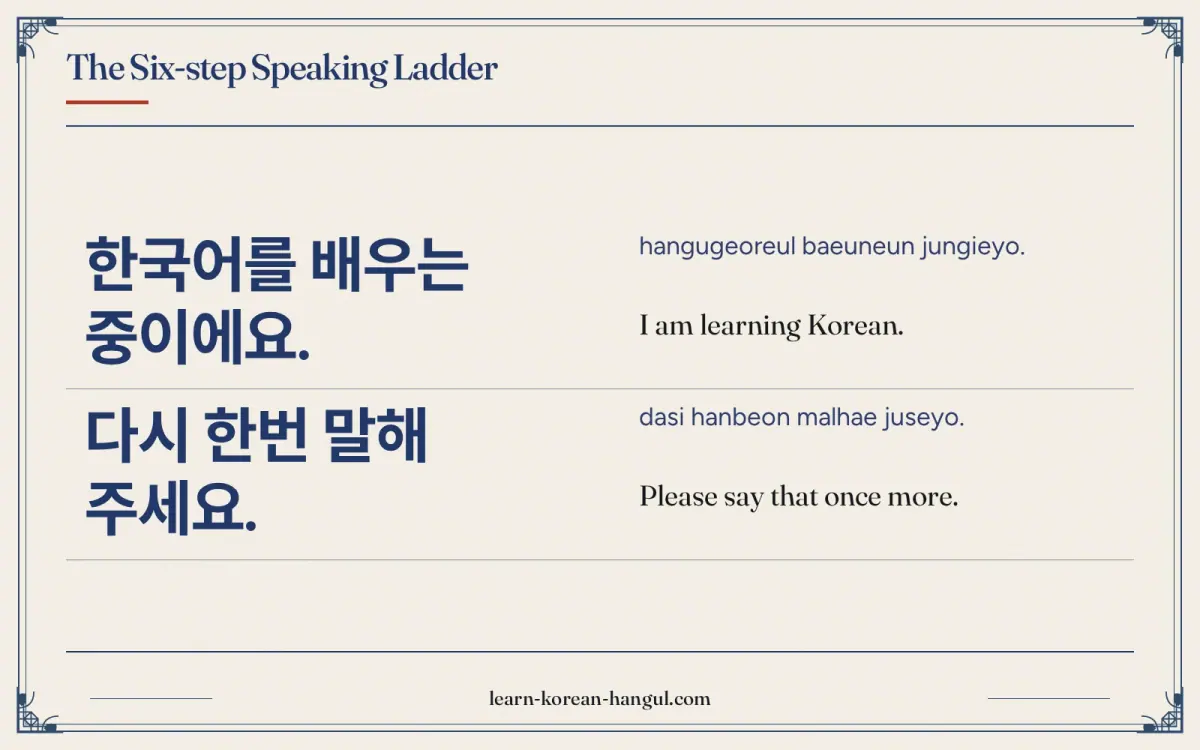
한국어를 배우는 중이에요.
hangugeoreul baeuneun jungieyo.
I am learning Korean.
When you lose the thread, use the repair phrase instead of going silent:
다시 한번 말해 주세요.
dasi hanbeon malhae juseyo.
Please say that once more.
A tutor can make step 5 safer because the session is built for mistakes, and the language exchange guide for a free route.
Step 6: the Unplanned Exchange
Step 6 is a short real-life exchange where the other person does not know you are practising, such as ordering a drink. You do not have to be flawless. You only have to finish it in Korean. The next section gives you three lines that cover most first exchanges.
Scripts for Your First Three Real-Life Lines
Start with three lines that are short, polite and useful. Learn them until you can say them without thinking, then use them whenever the chance appears.
안녕하세요.
annyeonghaseyo.
Hello.
이거 주세요.
igeo juseyo.
This one, please.
감사합니다.
gamsahamnida.
Thank you.
Each line works because it asks little of you: a greeting, a request you can point at, and thanks. Say all three in order, with a small nod, and a short exchange is complete. More polite words are in the polite Korean phrases lessons, and full role plays are in Korean conversation practice.
Handling Mistakes
Handle mistakes by treating them as information, not as verdicts. A mistake tells you exactly which piece to practise next, which is more than a perfect sentence can do. Three ideas help.
Most mistakes do not block meaning. Here is a correct sentence. The slip after it has a wrong particle, and yet a listener would still follow it:
저는 학교에 가요.
jeoneun hakgyoe gayo.
I go to school. (correct form)
A typical slip is 저는 학교가 가요, with the subject particle -가 instead of the place particle -에. A listener would still understand, because 학교 (school) and 가요 (go) carry the meaning. This is a good example of a low-cost mistake.
Rank your mistakes. Not all errors matter equally. A wrong sound that changes the word, such as confusing 사 and 싸, can block meaning. A wrong ending or particle usually does not, though it may sound less natural.
Keep a mistake log. After each speaking session, write three short entries: what you said, what the listener understood, and what you will try next time. A small example looks like this:
| What I said | What happened | Try next |
|---|---|---|
| 학교가 가요 | understood at once | use 학교에 가요 |
| 이거 사요? (meaning "is it cheap?") | heard as "buying this?" | tense ㅆ: 이거 싸요? |
| (silence on 뭐 했어요?) | conversation stopped | prepare two answers |
A phrase worth repeating to yourself, because it is true:
틀려도 괜찮아요.
teullyeodo gwaenchanayo.
It is okay to be wrong.
A Two-Minute Warm-up before You Speak
Warm up your mouth before any live step, the way a runner warms up before a race. A short routine lowers the shock of the first sentence:
- Breathe out slowly twice. A long exhale steadies the voice before you start.
- Say your opening line three times alone. Use 안녕하세요 or 한국어를 배우는 중이에요 so the first words are already warm.
- Name your goal for this session. For example: "I will ask my three questions." A goal of that size is easy to meet.
- Decide your fallback. Choose in advance what you will do if you lose the thread: use the repair phrase, switch to English for one word, or point.
None of this removes nerves, and it is not meant to. It gives your attention something to do other than imagine failure.
Taking the First Real-Life Step
Take the first real-life step in a place where the exchange is short and scripted by nature. Cafés, convenience stores and taxis work well because the staff expect a few words and the situation tells them what you mean. Prepare the whole exchange in advance: greeting, request, thanks. Rehearse it aloud three times on the way. Afterwards, write one line in your mistake log, even if everything went well.
If you freeze, do not apologise at length. Point, smile and say 이거 주세요. Pointing is a normal part of communication and not a failure. The goal is to complete the step, and a successful pointed exchange completes it.
A Two-Week Plan to Climb One Step
Use this plan to move up exactly one rung in two weeks. Pick the first step you have not yet passed. Each daily session takes about 10 minutes.
| Days | Task |
|---|---|
| 1–2 | Choose three lines for your step. Say each one ten times. |
| 3–4 | Say the three lines in order without looking at the text. |
| 5–6 | Add one repair phrase and say the full set twice. |
| 7 | Rest, or one easy repeat. Write one good thing you noticed. |
| 8–9 | Do the step with a partner, a recording or a real-life task. |
| 10–11 | Repeat it, changing one detail, such as the drink or the time. |
| 12–13 | Repeat it again, with no script. |
| 14 | Do the success test. Note the result and choose the next step. |
If the test goes badly, repeat the plan; it only means you were close. After two weeks, a fixed weekly routine will help you keep going, and the 30 day Korean speaking plan gives one.
Common Mistakes and How to Fix Them
- Waiting to feel ready. You will not feel ready first. Fix: define a test and take it.
- Jumping from step 2 to step 6. A big leap risks a bad experience that sets you back. Fix: take every rung.
- Over-preparing a script. A script you cannot adapt makes you panic if the other person says something unexpected. Fix: prepare two short lines plus a repair phrase.
- Counting only perfect days. A day with errors still counts. Fix: log what you learned, not whether it was clean.
- Comparing yourself to fluent speakers. They have had far more practice. Fix: compare your recording this month with your recording last month.
- Treating nerves as a sign to stop. Nerves usually peak just before the action. Fix: begin with the first line and see what happens.
If your fear is intense, constant or affects daily life beyond language learning, a qualified professional is the right source of help. This guide covers ordinary learner nerves only.
Audio and Scope
The audio on this page is pronunciation audio generated with text-to-speech. This guide offers study strategies, not psychological treatment. For the next lesson in the sequence, continue with sound natural in Korean, or return to how to speak Korean fluently.
Frequently Asked Questions
Why am I afraid to speak Korean?
Most learners fear being judged or misunderstood, and Korean adds two extra pressures: the polite-ending system makes you worry about choosing the wrong level, and unfamiliar sounds make you feel exposed. The fear is common and does not mean you are bad at languages. It usually shrinks when you take small, planned steps and let each one succeed before the next.
How do I stop being nervous speaking Korean?
You cannot switch nerves off, but you can lower them. Prepare the first two sentences, rehearse them aloud until they are automatic, and keep early conversations short and friendly. Climb the ladder one step at a time, and count a step as done when you complete it, not when you feel calm. Calm usually arrives after the action, not before it.
Do Koreans mind mistakes?
Experiences vary, but many Korean speakers are glad when a foreigner tries and will help with a word. Mistakes with endings or particles rarely block understanding, and a listener can usually guess your meaning from context. Where a mistake can matter is in the level of politeness, so use the polite -요 style as your default with people you do not know well.
How do I start speaking with native Korean speakers?
Start with a prepared greeting and a prepared request in a low-pressure place, such as ordering in a café or chatting with an exchange partner who is also learning. Tell the person you are learning, say the repair phrases 다시 한번 말해 주세요 and 천천히 말해 주세요 if you need them, and keep the first exchange to a few minutes.
In short, Korean speaking anxiety shrinks with small, planned, measurable steps: choose one rung of the ladder, set one goal for this week and let each success count.