How Do You Use the Korean Name Generator?

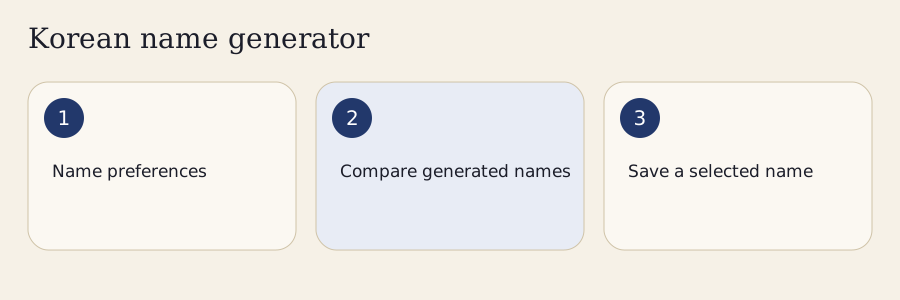
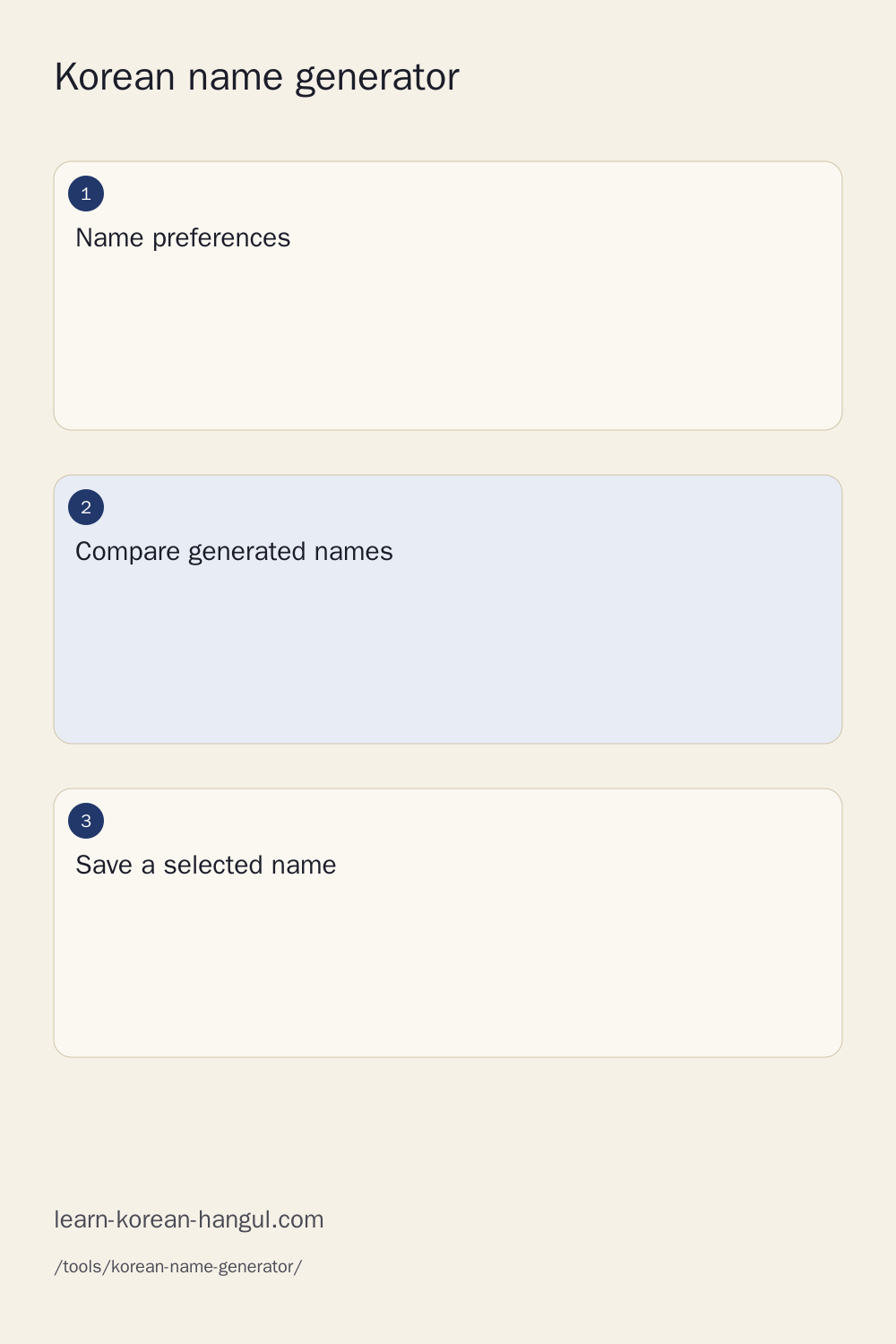
Choose a usage option and surname, set the number of suggestions, generate a batch and inspect one name at a time. The current result shows Hangul, a labelled Latin spelling and its meaning state. Save choices you want to compare rather than accepting the first suggestion simply because it appeared first.
- Choose Any usage for a broad starting point, then select a random or fixed surname.
- Request a small batch and select Generate. Read the current name before moving through the results.
- Inspect the family-name boundary, Latin spelling and meaning state. A blank Hanja choice leaves the meaning unspecified.
- Save promising choices with your notes, then export a backup before assigning names across a story.
Choose Filters and Generate
Start with Any usage and Random surname. Ask for a small batch, such as ten names. The checkpoint is a paged result with no duplicate name-pair IDs in that batch. A fixed surname narrows the choices; exact meaning and historical filters need corresponding source information and can return no matches.
Save a Name with Its Evidence
Open More to save a name, copy the entire batch or examine the card preview. Keep a source or uncertainty note with your shortlist. The checkpoint is that the saved item retains its surname, given name, spelling choice and selection settings. Export a JSON backup if your story depends on the collection.
Family Names, Given Names and Hangul

A Korean name has separate family-name and given-name parts. Many familiar examples use a one-block surname with a two-block given name, but that pattern is not a rule that can parse every possible name. Preserve complete records and ask for a surname boundary when a raw string admits several interpretations.
Can a Korean Surname Have Two Syllables?
Yes. Compound surnames are a reason to avoid automatically splitting every name after its first block. For an illustrative selection, 남궁 plus 민 gives 남궁민. The family-name part is 남궁, while the given-name part is 민. The character count by itself would not identify that boundary reliably.
The fixed-surname selector provides the boundary explicitly. A custom prefix is a label until its naming context is established; it should not acquire an invented clan, census count or historical origin. Choosing a Korean-looking string does not prove that it is an attested family name or that a fictional character belongs to a particular lineage.
Name Order in Korean and English
| Name parts | Hangul display | Labelled Latin order |
|---|---|---|
| 김 + 민준 | 김민준 | Kim Min-jun, family first |
| 김 + 서연 | 김서연 | Seo-yeon Kim only when Western order is chosen |
| 남궁 + 민 | 남궁민 | Namgung Min, with the complete surname retained |
| Given name only | The selected given name | No surname silently added |
Changing Latin order is a display choice. It does not move the Hangul surname boundary or change the person's intended given name. For a deeper explanation, read Korean name structure alongside the visible parts in your selection.
Can Korean Names Be Unisex?
A name can have overlapping usage across people, periods and communities. A filter describes the association supplied by the selected data; it does not decide who may use the spelling. Leave Any selected when an association is irrelevant to your fictional character, or compare mixed options without treating the label as a personal identity classifier.
Usage Labels and Overlapping Name Choices
The current example pack uses usage associations for exploring suggestions. It does not provide dated registered-sex counts, percentages or a complete population sample. Those are different forms of evidence and should never be blended into a made-up numerical confidence score. A mixed label is also different from simply combining all male-associated and female-associated lists.
When reading a source about name usage, check the year, population and definition. A statistic about registered names in one period cannot establish how every present-day person identifies. Usage associations can be useful prompts for a writer, but they are weaker than a dated, well-defined aggregate for a quantitative claim.
What Does a Gender Filter Actually Describe?
It describes the eligible record tags used for that selection. It does not infer a real person's gender from a name, and it does not assign personality traits. Avoid naming rules such as “beauty names are female” or “strong names are male.” If a tag feels unsuitable for your character, change the filter or select a name independently.
Keep the choice in your story notes as a creative decision. A character's motivations, occupation or presentation come from the story; they are not hidden facts generated from the Hangul spelling. The same care applies to era and style filters.
Why Can One Hangul Name Have Different Meanings?

Hangul records the Korean spelling, but it does not always determine the Hanja characters or intended native-word interpretation behind a name. Different characters can share a Korean reading. Without a chosen character sequence or a specified origin, the honest output is that the meaning is unspecified.
Which Hanja Characters Were Actually Selected?
Start by recording the exact character sequence and its readings. For an illustrative 지안 selection, choosing 智 and 安 can lead to a discussion of the chosen characters' reference glosses, such as wisdom and peace. That interpretation belongs to the specified characters; it cannot be assigned to everyone whose Hangul name is 지안.
The Hanja choice control checks listed readings against the given-name blocks before retaining a sequence. A general character gloss is still a reference gloss, not a complete personal etymology or a family's explanation. Keep the source and the particular reading together. Look up selected Hanja characters when a meaning or reading needs closer inspection.
Native-Word Meanings and Unspecified Origins
An intended native-word name can carry a stated interpretation. For example, discussing 하늘 as a deliberately chosen native-word name involves the Korean word for sky. An imported string with the same spelling does not automatically establish that origin or the bearer's intended meaning. The chooser keeps unknown origin separate from a confirmed native-word interpretation.
Meaning search should find records whose stored senses actually match your request. Searching “wisdom” cannot turn an unrelated calm-sounding name into a wisdom name. If no sourced sense matches, the result should say so. The name meaning guide explains why choosing meaning requires more than dividing Hangul into attractive syllables.
Which Name Fits Your Character's Era?

Choose an era only when you have evidence that supports that period. A name can sound unfamiliar or old-fashioned to one reader without being historically appropriate for a specific setting. Historical filters should use attestation or a clearly stated source scope, and missing evidence should remain unknown rather than being filled with a plausible-sounding date.
Historical and Contemporary Contexts
The current example pack does not certify historical or contemporary popularity. Exact era filters can therefore produce no matches. That is a useful boundary: an unverified record should not be presented as an attested Joseon name just because your story is set in Joseon. Research the intended time and region before using a historical label in published work.
Separate historical attestation from historical inspiration. Automatic invented-name combinations are disabled. Choose from existing catalogue records or keep your own supplied spelling as a user-edited note. A supplied spelling does not gain a census weight, attestation date or legal-name badge merely because it sounds plausible.
Is a Rare Surname Automatically Historical?
No. Rarity and period are different questions. A rare surname does not by itself establish age, class, occupation or region. Likewise, a common surname can occur in many settings. A quantitative common/rare distinction needs a specific dated source and threshold; a generator should not quietly substitute an impression for those counts.
For a historically detailed story, check the complete name in context, not just the surname. Era evidence for one part does not prove the other part's appropriateness. If the sources remain uncertain, label the choice as fictional inspiration and keep your research note.
Korean Name Generator Versus Name-to-Hangul Conversion

Use a generator when you want to choose a fictional name. Use transcription when you want to write an existing name from its pronunciation. These tasks can share a card layout and Hangul tools, but they begin with different information and produce different kinds of result.
Transcription Keeps the Original Name's Pronunciation
| Your task | Appropriate starting point | What the result means |
|---|---|---|
| Write Michael in Korean letters | The person's chosen pronunciation | A proposed Hangul transcription |
| Choose 김민준 for a fictional character | Complete surname and given-name examples | A creative name selection |
| Discuss a meaning for 지안 | The selected Hanja or stated origin | An interpretation of that choice |
| Inspect a character reading | The exact Hanja scalar | A dictionary/reference investigation |
To write your existing name in Hangul, choose the source pronunciation language in the converter. Entering an English name as a seed here does not perform that conversion. It merely gives the sampler repeatable input.
An optional card label is also a label. José remains José on the card if you entered it that way, but the label does not establish that the generated Korean name translates José. State the relationship clearly when sharing: a chosen fictional name, nickname or phonetic transcription are distinct choices.
How Are Random Names Selected?
The local sampler selects complete eligible surname and given-name records, keeping the parts together. The default is uniform selection among eligible pairs. It removes selected pair IDs within a batch, so a request for ten suggestions does not fill its list by repeating the same pair. That rule does not promise worldwide uniqueness.
Uniform Selection, Sourced Weights and Versions
Uniform selection gives every eligible pair the same chance. It is a property of the example pool, not a model of the Korean population. Population-related weighting needs real counts with dates, coverage and source conditions. The current pack has no sourced population counts, so requesting sourced weighting explains that the data is unavailable and offers uniform selection.
A useful weighted test might use two explicitly fictional items with weights one and three. That example shows how relative weights affect selection; it says nothing about Korean demographics. Quantitative source fields should remain separate from editorial usage tags so a style label cannot be mistaken for a measured probability.
Does the Same Seed Always Produce a Unique Name?
The same seed reproduces a batch only with the same dataset, sampler version, filters and generation index. Generate Again changes the index; changing a filter changes the eligible pool. Two different seeds can still produce the same name, especially in a small pool. Random selection is not a uniqueness guarantee.
JSON preserves the recorded versions and settings. If an imported collection comes from another dataset version, retain its text and source notes rather than silently reinterpreting it under the current bank. Reproducibility is useful for a writer's roster because it makes a creative decision inspectable by collaborators.
Four Worked Character-Name Examples
These examples illustrate explicit name-part and meaning decisions. They are practice selections rather than demographic, historical or legal claims. Use the settings as checkpoints, then inspect the actual output and source state. When the result is uncertain, retain that uncertainty in the character notes instead of removing it from the card.
Any Usage with a Fixed Surname
Choose Any usage, select 김 and request a small batch. A possible example pair is 김 plus 민준, displayed as 김민준. With the conventional surname option and given-name hyphen selected, the Latin form is Kim Min-jun. Switch the surname option to RR to compare Gim Min-jun.
The interpretation is a surname and given-name selection, not a meaningful translation of the entire name. Unless a Hanja sequence is chosen, the meaning stays unspecified. Save the row with that state and your story role, rather than assigning a guessed definition to 민 or 준 from unrelated characters.
One Hangul Spelling and Two Meaning States
Take an illustrative 지안 given-name spelling. In the first state, no Hanja is selected: the result says meaning unspecified. In the second, explicitly choose 智安 and check the listed Korean readings against 지 and 안. The result now records the exact characters and their reference glosses.
The difference comes from the chosen character sequence, not from changing the Hangul. A user note explaining how a fictional family interprets those characters should remain a story note. It is not evidence that a real bearer of the same spelling chose the same Hanja.
Compound Surname with a Short Given Name
Select 남궁 as the fixed surname and compare a short given-name example such as 민. The visible parts are 남궁 and 민, while the joined Hangul is 남궁민. The surname record keeps both blocks, so the converter does not mislabel 궁민 as the given name merely because three blocks are visible.
The checkpoint is that the full surname remains present in the Latin and saved-source fields. This selection assigns no clan or genealogy. A fictional character can use a compound surname without the generator inventing historical facts about a real family.
A Writer's Roster with a Shared Syllable
For a fictional roster, request a shared block 진 in the second given-name position. In a small example pool containing 유진, that constraint can leave only a few eligible records. If you ask for more names than exist, the generator reports the shortage and preserves the valid choices.
This is a story constraint, not a claim about a real clan's generational sequence. Keep the position, fixed surname, seed and dataset with the roster. Change a constraint deliberately if the choices become too narrow, and save a backup before making a large edit to the collection.
Name Cards, Pronunciation and Writer's Shortlists

Save names with their parts and uncertainty notes before making visual cards. A card is useful for reading practice or a story reference, while a JSON or tabular export preserves more detail for revision. Choose the format based on the information you need to keep, rather than using an attractive image as the only record.
Can You Download a Name without Losing the Source Note?
Yes. JSON stores the selected record, versions, seed and notes. CSV and TSV provide readable columns for Hangul, Latin spelling, parts, meaning state and source. Spreadsheet export quotes cells and protects formula-leading text; JSON preserves literal notes when you need an exact backup.
The card preview can include the selected meaning note and a private label. PNG is available in square, portrait and landscape sizes; SVG retains accessible text. The card identifies the name as a fictional suggestion and avoids resembling a government document. Preview the content before downloading or deliberately sharing it.
Fonts, Name Order and Editable Collections
Use a readable Korean font and inspect every Hangul or Hanja character. A font style should change presentation, not replace the underlying Unicode text with decorative lookalikes. If a selected glyph is missing, use another font or keep the text/SVG export rather than treating an unreadable image as successful.
Hangul fonts and legible cards explains presentation choices. Learn to write a name in Korean for handwriting practice. Audio uses the selected Korean spelling, while personal-name romanization rules explain why Latin spelling and connected pronunciation serve different purposes.
Sources, Corrections and Legal-Name Limits
A source note identifies what is known, where it came from and what remains unchecked. The current example bank is not a complete attested-name census or a legal-name service. A source about a character reading cannot prove the naturalness, history or eligibility of an entire fictional name.
Does a Unicode Name Flag Prove Current Registration Eligibility?
No. A historical Unicode field and a current court list are different reference sources. A character's presence or absence in an old field is not an approval or rejection of a current name. Exact character, reading, effective date and source scope matter. This tool states that current eligibility has not been checked.
For a real document, ask the institution receiving it and consult the current relevant rules. A generated name does not confer identity, citizenship, legal status or a family lineage. When reporting a correction, keep the selected IDs, parts, characters and settings so the discrepancy can be investigated without inventing facts.
Do You Need to Provide Your Birthday?
No. Generation works without a name label, birthday or private story. A seed is enough for reproducible selection. Optional personal input stays on your device unless you deliberately choose a sharing action that includes it. The clean public selection link excludes private labels, dates and context by default.
Local Seeds and Private Story Context
A birthday can change the seed used to select suggestions. A date must be valid before it can be used. Reusing the same date and settings helps you return to the same choices, compare their stored notes and keep a consistent shortlist for your character or story.
The local context option can reorder existing notes by matching your words. It does not create new meanings or claim evaluated linguistic reasoning. Keep private context separate from public record IDs. Transfer collections through JSON files. Ordinary local generation never needs a private story upload; local context matching does not translate or create new meanings.
Frequently Asked Questions
Can two generated characters receive the same name?
Yes. A fictional suggestion can match another generated character or a real person. Removing duplicates within one batch does not guarantee uniqueness across stories or future batches. Use your shortlist to compare names you have already assigned, and consider changing a selected spelling if two characters become difficult to distinguish.
Why are fewer names returned than I requested?
The selected filters can leave fewer unique surname and given-name pairs than the requested count. The generator returns the eligible choices and explains the shortage. Broaden a filter, remove a fixed shared syllable or choose another name type. It does not silently repeat names to fill the list.
Can I change an imported name's meaning?
You can edit your own note, but editing does not validate a new Hanja interpretation. Keep the original spelling and source context, then choose characters with matching readings when you intend a particular interpretation. An imported meaning remains an imported note; it does not become an approved fact through loading or saving.
Will my saved shortlist expire?
The local shortlist has no artificial guest expiry. Browser storage can still be cleared by you, your device or a private browsing session. Export a JSON backup when the collection matters. Saving is explicit, and a storage failure keeps your choices for the current session with an export option.
Can I keep using the generator without internet?
Loaded selection rules and example records work locally. Save an offline pack while connected for a later visit. Uncached fonts, Hanja data or speech resources may need their own download. Listening uses only device voices marked local. Transfer collections through JSON files; local generation does not upload your story.
Choose and Check Your Next Fictional Name
Use the Korean name generator to make a creative choice you can explain. Confirm the family-name boundary, selected given name, Latin profile and meaning state. Keep unknown Hanja or period evidence unknown. Check for duplicates in your own story and listen to the chosen Hangul when an appropriate Korean voice is available.
Save a source-bearing shortlist before making a card. Export a backup, inspect the exact preview and choose deliberately what to share. If your actual task is introducing yourself, the Korean introduction lesson develops the conversation; if you want to preserve an existing pronunciation, return to the name converter.
The tool uses independently authored examples and the NIKL personal-name romanization rules. Hanja references preserve exact selected characters, general glosses and source limits. No universal naturalness, historical popularity, hidden meaning or official identity claim is implied by a fictional suggestion.