How Do I Use the Korean Name Converter?
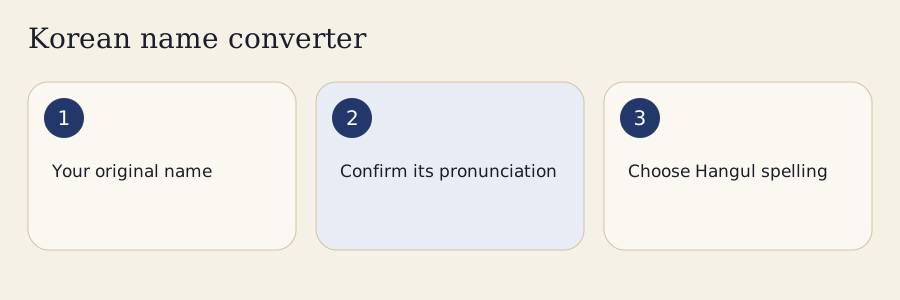
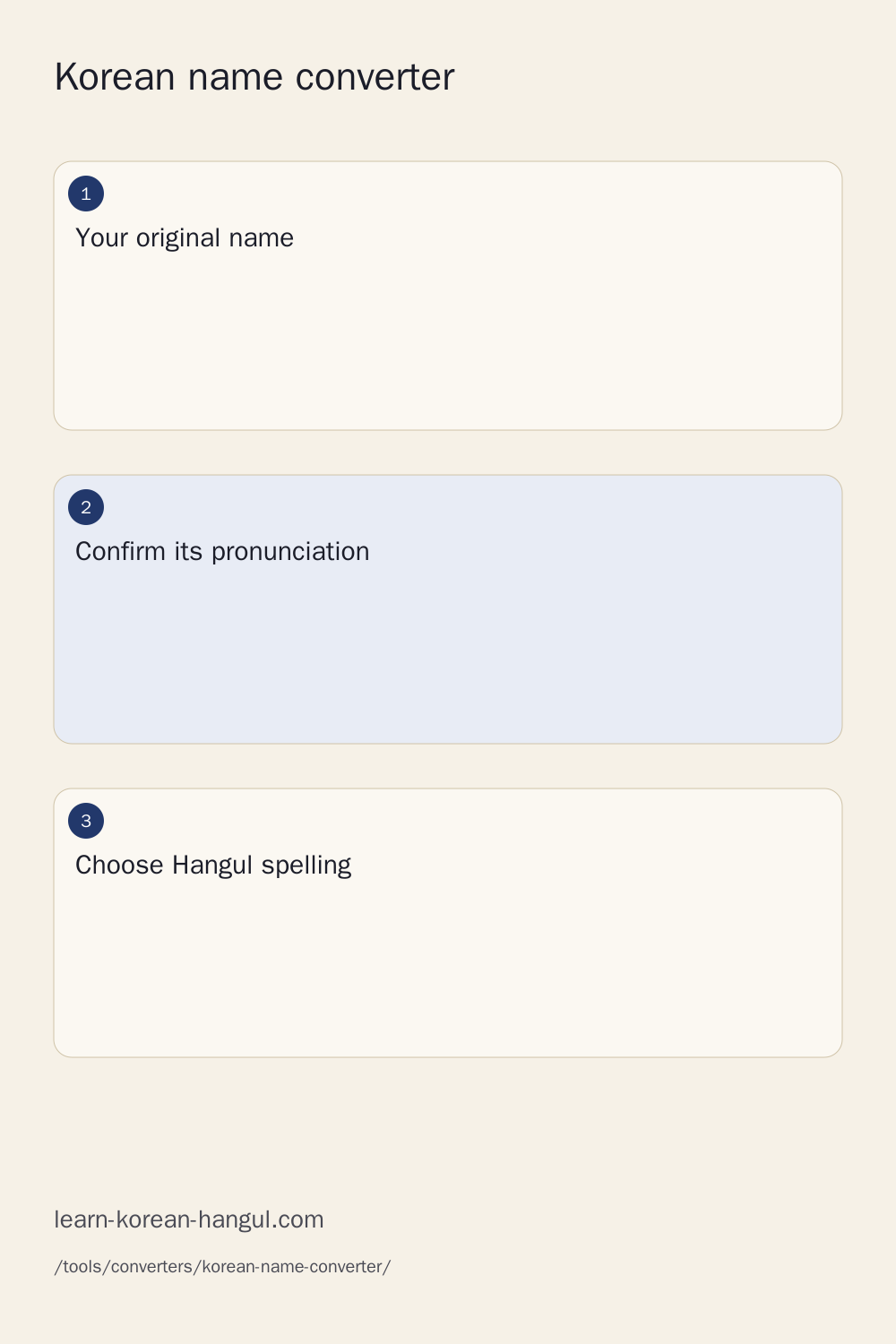
Enter your name, choose the language that describes its pronunciation, compare any sound choices, edit your preferred Hangul and copy or export the result. Start with a short first name so you can inspect every block. For a full name, confirm each part's language and retain the original order unless you deliberately want to change it.
Choose the Language and Pronunciation
Type the spelling exactly as you use it, including accents, apostrophes and hyphens. Choose Spanish for a name pronounced according to Spanish sounds, even if you are reading an English interface. Choose English US only when that pronunciation is appropriate. The profile describes a sound convention; it does not infer nationality, ethnicity or how a particular person must say a name.
The checkpoint is a plausible Hangul suggestion and a visible assumption. If the tool offers several candidates, choose the one that fits your own pronunciation. A familiar spelling can still have unfamiliar sounds: Sean is an example where English letter-by-letter guessing is unhelpful. Open Sound Builder when the offered candidates do not represent what you say.
Check, Edit and Export the Spelling
Read the blocks separately, then listen to the whole chosen form if a Korean voice is available. Edit the result to keep a spelling you already use. The checkpoint is that the reading and card reflect the edited Hangul. Copy returns your selected spelling. More provides a text export or a private card preview; inspect that preview before downloading or sharing a name badge.
What Does Writing a Name in Hangul Mean?
Writing a foreign name in Hangul adapts its sounds to Korean letters and syllable patterns. It keeps the connection to an existing name. It does not automatically give the name a Korean meaning, assign a family name or create an identity. A person can prefer a spelling different from a mechanical suggestion, especially when they have used that spelling for years.
Sound Conversion, Meaning and Nickname Selection
Three tasks often appear together in search results but require different decisions. Transcription starts with an existing pronunciation and asks how to write it in Hangul. Romanization starts with Korean spelling and asks how to represent it in Latin letters. Choosing a nickname starts with personal preferences and asks which new name you want to use.
Use this converter for the first task. For the second, compare Korean romanization using the exact Hangul you selected. For the third, choose a Korean nickname in the separate name generator. A nickname with a discussed meaning is still a chosen nickname, not a translation of your original name.
An attractive card can make these tasks look interchangeable, so retain the context when sharing. “This is how I write my existing name in Hangul” tells a reader something different from “This is a nickname I chose.” Neither statement requires invented luck, personality traits or a supposed hidden meaning inside foreign-name syllables.
How Does the Conversion Work?
The converter looks for an authored example under the chosen pronunciation profile, then uses pronunciation information or a labelled spelling-pattern suggestion when the name is unfamiliar. You remain responsible for confirming the sounds. Korean spelling rules cannot infer every family's preferred pronunciation from a Latin string, so an editable result is part of the conversion process.
Name Examples and Pronunciation Dictionaries
An example can establish a useful starting point without proving that every person with the same written name says it identically. A cited individual's spelling has a particular context. An English pronunciation dictionary likewise records pronunciations, not a universal Korean spelling. The optional CMUdict pack supplies English phones and variants; its own documentation warns that entries can contain errors or omissions.
If your name has several source pronunciations, inspect each choice. Read can represent different English vowels; Andrea varies by speaker and language. Choosing one automatically because it appears first would hide the decision you need to make. Pronunciation assumptions are included in the explanatory view so that you can correct them instead of accepting an unexplained answer.
From Sounds to Legal Korean Syllables
Hangul blocks combine an initial consonant, a vowel and sometimes a final consonant. A vowel-initial block uses ㅇ as its written initial. Foreign consonant clusters can require added vowel sounds to make a Korean block sequence. That is why a Hangul name may have a different number of written blocks from the source name's spoken syllables.
The converter builds modern blocks with the same composition arithmetic as the site's syllable tool. It keeps the Hangul spelling separate from its Korean spoken form. The sound checker can explain what happens when chosen blocks are read together, but it cannot determine how an English or Spanish person originally pronounced their name. Inspect a Hangul syllable when you want to see its initial, vowel and final positions.
Worked Names: Michael, Sean, María and Javier
Use these four walkthroughs to check both the origin setting and the result. They show authored examples and proposed adaptations rather than a claim that every same-spelled name has one compulsory Korean form. When the person tells you a different pronunciation or preferred spelling, start from that information and keep the choice visible.
Michael and Sean: Hidden English Sounds
Enter Michael and select English US. The example suggestion is 마이클. Its three blocks are 마, 이 and 클. The Latin reading maikeul describes the selected Korean spelling; it is not an English pronunciation transcription. Open the block explanation to see that 클 includes the vowel ㅡ. That vowel is pronounced, rather than silently inserted as a decorative letter.
Now enter Sean under the same profile. The example suggestion is 숀. Reading the written letters one by one might lead to a quite different result, because the spelling does not transparently display the familiar English pronunciation. Confirm that the offered sound corresponds to the person you mean. If it does not, use the guided blocks or directly edit Hangul instead of treating the example as a rule about all people named Sean.
These examples also show why counting Latin letters is unhelpful. A short source spelling can require several Korean blocks, while a longer source spelling can be adapted into one. The important question is how the sounds are represented, not whether the two writing systems use the same number of characters.
María and Javier: Spanish Pronunciation
Enter María and select Spanish. The suggestion is 마리아, with the accent retained in your original label. A canonically decomposed accent should produce the same analysis as the ordinary accented spelling. The Hangul spelling does not copy the Spanish accent mark; the origin label explains which pronunciation you selected.
Enter Javier under Spanish. The suggestion is 하비에르. The Spanish j does not represent the usual English j sound, so selecting English US would make a different assumption. Inspect the final block and say your original name aloud when checking the adaptation. A familiar-looking Latin name is not enough evidence for choosing an English profile.
Next compare Jorge under Spanish with George under English. The examples give 호르헤 and 조지 respectively. Their superficial spelling similarity does not make their sounds equivalent. If you are making class badges, ask each person which pronunciation language or sound description is appropriate before converting an entire roster.
Which Spelling Should I Choose?
Choose a form that represents the intended pronunciation and respects the person's own preference. A spelling derived from a rule, a documented example and a personal spelling can each be useful for different purposes. Labels should explain those differences without turning an individual's established choice into a universal requirement.
Standard, Common and Personally Chosen Variants
| Situation | Useful choice | What still needs confirmation |
|---|---|---|
| A documented individual's name | That person's supplied spelling | Identity and context match |
| An example under a pronunciation profile | Compare the proposed adaptation | Your actual vowel and consonant sounds |
| More than one candidate | Select the pronunciation you use | No forced winner based on list order |
| An existing preferred Hangul spelling | Keep it in the editable result | Spacing and consistency for your task |
| An unfamiliar source spelling | Use the sound builder or a tentative suggestion | The assumed pronunciation |
Emma illustrates why two Hangul options should not be presented as a popularity contest. The example offers 에마 and 엠마 for comparison; a person can select the form they use. An automated page cannot establish how widespread a variant is without evidence. Likewise, Daniel under English and Spanish can produce different suggestions because the source vowels differ.
For practical name use, personal preference is often the most relevant evidence. For an academic discussion of transcription, a stated rule profile may be the relevant convention. Keep those purposes separate in your notes. The name spellings in Hangul lesson gives further examples, while this tool helps you inspect and retain a particular choice.
Spanish, Portuguese and Italian Sound Profiles
Choose each language deliberately. These profiles have their own spelling-to-sound conventions, and applying Spanish substitutions to Portuguese or Italian can produce misleading suggestions. The automatic output is assistance for a chosen profile; unfamiliar names, regional pronunciations and conventional personal spellings still need confirmation from the speaker.
Ñ, LL, J, Accents and Sounded Ü
Spanish ñ needs a different sound treatment from ordinary n. The examples Iñaki and Begoña retain that distinction in their source labels and give 이냐키 and 베고냐 as proposed adaptations. Silent h in a Spanish name is another reason not to copy letters mechanically. The example Hernández gives 에르난데스 under the stated profile.
Spanish ll and y vary with dialect and personal pronunciation. A normative spelling convention and a personally requested spoken adaptation may therefore differ. Do not infer a dialect from a surname or a person's location. Ask how they say the sound and use the builder if the profile's assumption is unsuitable. Sounded ü must likewise be distinguished from a silent u inside a spelling sequence.
Separate Portuguese and Italian Conventions
José under Spanish gives 호세 in the example pack, while the Portuguese example gives 주제. Carlos under the stated Spanish and Portuguese profiles similarly differs. These contrasts are useful checks against accidentally using one language's rules for every name containing familiar letters.
Italian has contextual combinations such as gn, gl and sc, alongside doubled consonants and c or g before particular vowels. Portuguese requires attention to nasal sounds, consonant context and regional d or t behavior. The European and Brazilian options are separate choices. The same written name may still have a personal pronunciation not captured by either automatic profile, so confirm unfamiliar output and preserve the speaker's preferred form.
Full Names, Surname Order and Multiple Parts
Keep the original order unless the task explicitly calls for a different presentation. A foreign-name transcription does not need a Korean surname inserted at the front, and it does not need every full name rearranged into a Korean naming pattern. Two given names or two surnames remain meaningful parts of the source identity.
Keep the Original Name Order
The converter supports up to twelve parts within a 120-character name. Spaces, apostrophes and hyphens remain visible separators. Ana María under Spanish becomes 아나 마리아 in the example, keeping both parts. A hyphenated name or a surname containing an apostrophe should be inspected part by part, especially when one element is not represented in the example pack.
More allows a language override for a selected part. Use that when a full name contains components with different pronunciation traditions. Confirm every part with the named person; appearance alone is not a reliable origin detector. Reverse Part Order is an explicit formatting action, so inspect the changed label before exporting.
Batch conversion handles up to 100 rows. Work with one consistent pronunciation profile, then edit individual names where needed. Paging keeps the current row readable rather than displaying an entire roster in the working frame. Exporting all rows should happen only after checking the selected spellings, not immediately after an uninspected automatic conversion.
Why Might My Result Need a Sound Check?
The most common reason is that the source spelling does not uniquely identify the spoken name. A dictionary can miss a name, record another accent or offer several alternatives. A spelling-pattern suggestion is an estimate you can revise. An unfamiliar result should prompt a sound check rather than a confident claim that the person has been saying their name incorrectly.
Unknown Names and Guided Sound Building
Start by saying the name slowly and separating sounds you can recognize. Sound Builder accepts Korean-style block notation such as je si for 제시 or al lek seu for 알렉스. Each token contains an initial when needed, a vowel and an optional final. A vowel-only token such as a builds 아 with the initial ㅇ.
If a block is incomplete, the error identifies it and retains your work. The jamo selectors also let you build one block at a time. Apply the preview only when it represents the sounds you intend. Advanced ARPAbet input is useful for a source dictionary pronunciation, but a phone sequence alone does not establish a conventional personal spelling.
Ask a Korean reader to compare the proposed form with your pronunciation when the distinction matters. They can help explain an inserted vowel or final consonant. Keep your original spelling with the chosen Hangul so that a future correction does not lose the connection to your name. A missing device voice affects playback, not the validity of keeping and editing your text.
Cards, Tracing Worksheets and Introductions
Make a card only after choosing the spelling you want to display. A private preview helps you check the Hangul, Latin label and reading before sharing. You can hide the Latin name or romanization if a Hangul-only practice card suits your purpose. Optional introduction and pronunciation-language labels make the card more useful for a classroom activity.
Private Exports and Readable Name Badges
The available PNG sizes are a 1080-pixel square, a 1000 × 1500 portrait and a 1200 × 630 landscape. SVG retains accessible text and can be useful when you need to enlarge or edit a printed badge. The font option chooses a Korean serif or system sans style; if image rendering fails, use the SVG or text export instead of accepting a blank file.
Native Print can save a PDF through your browser. Check paper orientation and margins in the print preview. For handwriting practice, write your name by hand block by block and use the syllable tool to inspect structure. Do not invent a stroke order for a block simply because you can draw a decorative card.
The polite introduction depends on the chosen Hangul ending. For the examples, 존 gives 저는 존이에요, while 마크 gives 저는 마크예요. Editing the name updates the phrase. The introduce yourself in Korean lesson explains the conversation, and ask someone's name politely develops the next exchange.
Quick Sound Reference and Practical Limits
Use this table to recognize conversion decisions, not as a universal substitution chart. The same Latin letter can represent different sounds under different languages. A romanized reading of the selected Korean is a further representation, so English or Spanish letter values should not be imposed on RR eo, eu or j.
| Decision | Example checkpoint | Practical caution |
|---|---|---|
| English hidden spelling | Sean → 숀 | Confirm the person's pronunciation |
| Spanish j | Javier → 하비에르 | Do not assume English j |
| Vowel-initial block | a → 아 | Written ㅇ has no initial sound here |
| Added vowel | Michael → 마이클 | ㅡ is a pronounced vowel |
| Full-name separator | Ana María → 아나 마리아 | Keep the intended parts and order |
| Personal choice | Editable Hangul | Confirm before distributing a badge |
Reference Table and Offline Behaviour
The loaded conversion rules work without a conversion server. Save an offline pack while connected for a later visit; optional dictionary or speech resources have separate availability. Playback offers only installed local Korean voices. Your name is never sent to a speech provider; if no local voice is available, keep editing the Hangul or choose on-device synthesis in the speech tool. Names remain in memory unless you explicitly save them. Deleting saved names affects the local library, while downloading an image merely creates a file on your device.
Save a Name Only When You Want a Local Library
Saving is an explicit action for each selected name. The library can hold up to 100 names within its text limit, and you can export it for your own backup. An imported library opens for the current session; it does not silently publish or share those names. Check its contents before saving individual entries on a shared device.
Use Delete All Saved Names when you no longer want that local collection. A file you previously downloaded remains a separate copy, so delete it through your device if needed. Sharing a clean tool link sends the page address without a name, while sharing a card deliberately includes the information visible in your preview. Choose the action that matches your intended audience.
Frequently Asked Questions
Can I keep the Hangul spelling a Korean friend gave me?
Yes. Edit the Hangul result to keep your preferred spelling. The reading, card and introduction update from that choice. A suggestion is a starting point, not an instruction to replace a spelling you already use. Ask the person who suggested it about any sound or spacing you do not understand.
Does switching the interface language change my name?
No. Interface language and pronunciation language are separate decisions. Keep the same pronunciation profile and chosen Hangul spelling when changing the interface. For example, Spanish and English descriptions can explain a sound differently without changing the selected Korean blocks. Changing the pronunciation profile deliberately can produce a different suggestion.
Can the card leave out my Latin name and romanization?
Yes. Card settings let you show or hide the Latin name, romanized reading, introduction, pronunciation language and site mark. Preview the selected information before downloading or sharing. Keeping only Hangul can make a clean practice badge; keeping both scripts can help a reader identify whose name the badge represents.
What happens when my phone has no Korean voice?
Your text conversion, editing and card export still work. The tool explains when a Korean voice is unavailable and links to the speech tool. You can practise reading the Hangul blocks instead, or open the speech tool for on-device synthesis. Only installed local Korean voices are offered here; your name is never sent to a speech provider.
Will a name card show up publicly in search results?
Downloading a card does not publish it. The image is created in your browser, and the public tool link contains no name. If you upload the card to a social platform or public website, that service controls its visibility. Check the preview and the destination before choosing to share a personal image.
Can I use the same spelling on an official form?
Ask the exact institution receiving the form. A name converter suggests a Hangul spelling from chosen sounds; it does not certify identity, issue documents or determine a recipient’s naming requirements. If you already have a required spelling, use it consistently and confirm any change with the relevant person or institution.
Continue Learning with the Korean Name Converter
Use the Korean name converter alongside Hangul reading, handwriting and introductions. The Korean converter tools hub helps you choose the next task, and Korean names in Latin letters explains the reverse direction. Keep the original, pronunciation choice and preferred Hangul together when reporting a correction.
Sources include the NIKL foreign-name principles, English rules, Spanish rules, Italian rules and Portuguese rules. Examples and explanations are independently authored. The page makes no universal name-accuracy or official-document eligibility claim; a useful result is one you can inspect, explain and personally confirm.