How Do You Use the Korean Particle Checker?
Enter a noun, choose the particle family you intend, and check the ending before copying the result. This tool helps with the written form inside a chosen family. It does not decide whether your sentence needs a topic, a subject, an object or another grammatical relationship.
- Enter a noun such as 사과, 책 or 서울. Keep the original spelling if you are entering a name or a quotation.
- Choose a family from the menu. The categories distinguish ordinary particles, copula forms, other endings and the separate word-ending spelling helper.
- Choose Check. Read the displayed final consonant and the short explanation.
- If a reading or boundary is uncertain, open More and supply the intended Korean reading or boundary policy.
- Copy the result. For a list, inspect individual rows and export the complete report, including unresolved rows.
The initial 서울 example uses 으로/로. It gives 서울로 because the written final is singleton ㄹ. Change the input to 여덟 and check again to see the cluster exception. Reset restores the initial example without deleting saved history; deleting local history is a separate deliberate action.
Choose the Noun and Particle Family
A particle family has a grammatical meaning, and that meaning comes before its spelling choice. Selecting 은/는 asks which form of that family follows your noun. Selecting 이/가 asks a different question even when the noun is identical.
The result does not call one family universally correct for that word. A noun can participate in several grammatical constructions. Use the Korean particle meanings guide when your uncertainty concerns the role rather than the ending. This utility makes the form distinction explicit so it does not quietly substitute a discourse decision for a consonant calculation.
Confirm the Ending and Copy the Result
A resolved result shows the written final and the selected output. An unresolved result names the missing decision: a Korean reading, a parenthesis policy or an unsupported letter sequence. Copyable alternatives are alternatives, not a confirmed answer.
For foreign spelling, the displayed noun remains unchanged while your confirmed Hangul reading determines the branch. If you enter María with reading 마리아, the ordinary topic form is María는. The accent is preserved. The tool records that the reading was supplied by you rather than representing it as an automatic pronunciation judgment.
How Does the Batchim Detector Work?
The detector decomposes the final modern Hangul syllable into its initial consonant, vowel and written final. Batchim is the final consonant component of a syllable block. A block without that component has no batchim; it is not missing a letter that the tool should invent.
Modern precomposed Hangul contains 11,172 syllable blocks. Each has one of 28 final positions: an empty position or one of 27 nonempty finals. The decomposition uses the stable arithmetic defined in Unicode's Hangul algorithms. The tool uses that arithmetic rather than a list of guesses based on the appearance of the last letter.
The reference workspace shows a selectable initial, vowel and final diagram. You can step through the modern blocks in your input. A cluster final belongs to one block; the number of consonant components in that final does not make it two syllables. The source span and normalized analysis distinguish what you entered from the representation used for calculation.
Modern Hangul and Unicode Normalization
Canonical conjoining jamo can represent the same modern syllable as a precomposed block. The checker normalizes the Hangul analysis to NFC so that these representations have equivalent final calculations. Ordinary output preserves the original source encoding.
Compatibility letters are a different input category. A sequence such as ㄱㅏㄴ is not silently treated as a complete word. Explicit composition can preview 간 for analysis while preserving the supplied letters in ordinary output. Incomplete or unsupported sequences need a reading. The tool does not apply global NFKC normalization to names, symbols or Hanja identities.
Written Finals and Spoken Endings
Written finals and surface sounds answer different questions. A written cluster can be reduced in standalone pronunciation without becoming a different written final for every suffix. This distinction is essential for the 으로/로 family.
The detector labels no final, single final, tense final or cluster final. A final such as ㄲ is a tense consonant, whereas ㄳ contains different consonant components. Both occupy one final position in a syllable. A pronunciation guide can explain what you hear in a specific context; it should not replace the written-final calculation with an unsupported universal sound shortcut.
Particle Forms at a Glance
The following table gives the main branches for familiar families. It describes mechanical agreement within a selected family, not whether the family belongs in your intended sentence.
| Family | No final | Singleton ㄹ | Other final |
|---|---|---|---|
| 은/는 | 는 | 은 | 은 |
| 이/가 | 가 | 이 | 이 |
| 을/를 | 를 | 을 | 을 |
| 과/와 | 와 | 과 | 과 |
| 으로/로 | 로 | 로 | 으로 |
Standalone pronouns have additional lexical contractions before subject 가. Other families include invariant forms, copula patterns, compounds and uncommon endings. The family menu identifies those categories rather than pretending that every Korean suffix is an ordinary particle pair. Min-ji Park reviewed and signed off the expanded and rare-family applicability described here on 15 October 2026.
Noun Particles and Forms That Stay the Same
Some particles keep the same form regardless of a preceding final. Examples in the catalog include 도, 에, 에서, 의, 만, 부터 and 까지. Their spelling is not chosen by the ordinary consonant-versus-vowel branch.
That does not make their meanings interchangeable. 에 and 에서 can relate differently to the predicate and intended situation. The catalog also includes explicit combinations such as 에는, 에서도 and 에게만. These are named sequences; selecting one does not authorize arbitrary stacking of every available particle.
Copula Forms and Word-Ending Helpers
Copula forms are separately labelled. The familiar 이에요/예요 pattern gives 책이에요 and 사과예요 in its supported noun construction. The checker asks for lexical context for 아니 rather than mechanically generating 아니예요 as a correction.
The 율/률 helper belongs to word formation. Its vowel-or-ㄴ branch differs from ordinary particle selection. Examples include 추진율 and 합격률. An output from this helper does not establish that every stem plus suffix is an attested dictionary word. Use an actual dictionary sense when the existence or meaning of a resulting compound matters.
Why Does 서울 Take 로 but 여덟 Take 으로?
서울 ends in singleton ㄹ, which selects 로. 여덟 ends in the written cluster ㄼ, so it selects 으로. The exception concerns exactly the singleton final, not every final that contains ㄹ as one component.
The National Institute of Korean Language's direct answer about 여덟으로 explains this example. Reducing the standalone spoken form of 여덟 does not make 여덟로 the mechanical result of the written-final rule. Keep the noun's written final visible when studying the exception.
The same caution applies to other clusters. 닭 and 삶 do not become singleton-ㄹ nouns just because their finals contain ㄹ. Their selected forms in this family are 닭으로 and 삶으로. The 으 로/로 lesson develops the grammatical uses of the family beyond the detector's spelling calculation. A correct branch is only one part of using the expression appropriately.
Worked Examples with Four Different Endings

Use the following examples as a short inspection exercise. Predict the branch, check the displayed final, then read the explanation. The first pair contrasts an empty final with a consonant. The second tests the exact ㄹ exception. The remaining examples show why a reading profile and boundary policy must be explicit.
The displayed outputs are form examples rather than complete sentences. They do not certify a communicative meaning, a social register or a dictionary compound. Min-ji Park reviewed and signed off the authored teaching examples and expanded catalog on 15 October 2026.
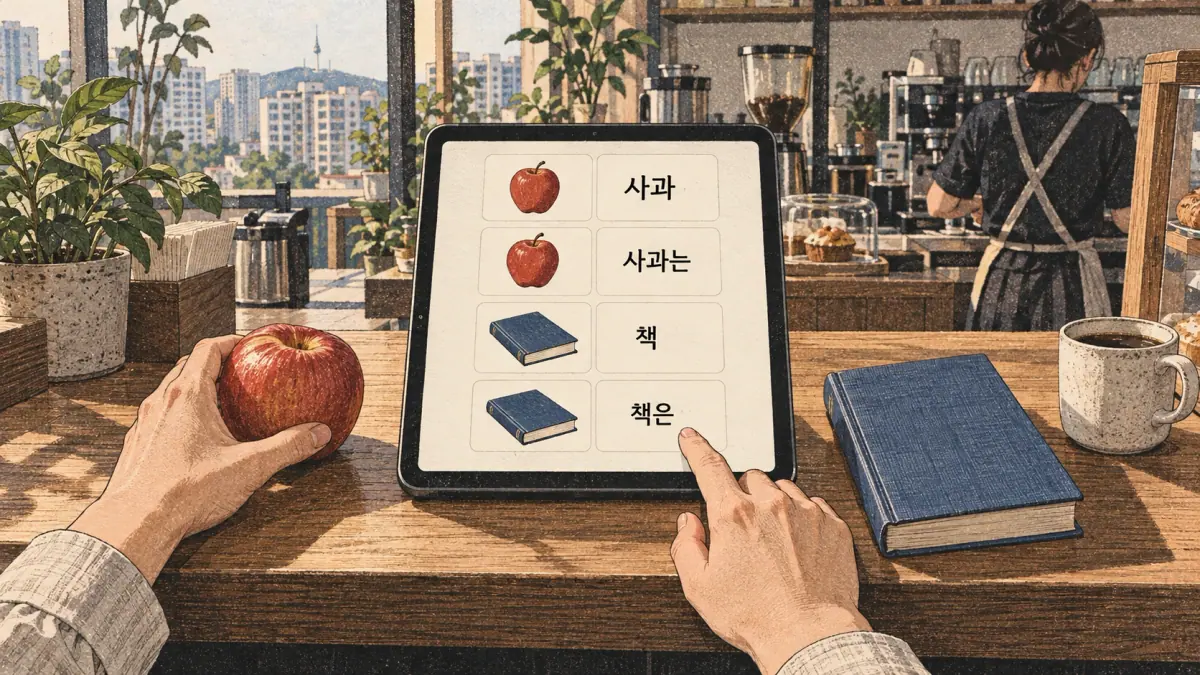
사과는 and 책은
사과 ends in 과, whose final position is empty. The topic family therefore selects 는 and gives 사과는. 책 has written final ㄱ, so the same family selects 은 and gives 책은.
Change only the selected family to 이/가. The outputs become 사과가 and 책이. The noun ending determines the form within that chosen family; it does not explain why you chose the topic family in one sentence and the subject family in another. That separate decision belongs to contextual grammar.
서울로 and 여덟으로
Enter 서울 with 으로/로 and inspect the final ㄹ. The short form 로 is selected. Enter 여덟 with the same family and inspect ㄼ. The longer form 으로 is selected.
The purpose is to notice the written final identity, not to memorize a rule saying that every word pronounced with a final l-like sound takes 로. Repeat the inspection with 연필, 손 and 값. The detector provides an explicit final label so you can explain which branch you used instead of inferring it from an unexplained green result.
Numbers and Confirmed Acronym Readings
A bare 7 has more than one possible Korean reading profile. Sino-Korean 칠 has singleton ㄹ and gives 7로 for this family. Native 일곱 has ㅂ and gives 7으로. The tool asks for the profile instead of using a universal last-digit shortcut.
An acronym also needs a confirmed reading. If you confirm URL as 유알엘, its final is ㄹ; the object-family result is URL을. A proposed letter-name string is a candidate until you decide that the abbreviation is actually read that way. Some abbreviations are read as words rather than a sequence of letter names.
Quotes and Spoken Parentheses
The default parenthesis policy asks whether its contents are spoken. For 둘리(공룡), annotation mode analyzes 둘리 and gives 둘리(공룡)는. Spoken mode analyzes the inner 공룡 and gives 둘리(공룡)은. Neither choice should be hidden.
Closing quotation marks can be ignored for analysis while remaining in the copied source. The quote-anchor setting chooses insertion after or inside the closing punctuation. This is a transparent product policy rather than a claim that every quoted expression has the same editorial convention. Inspect the full output before copying it into a sentence.
Can Batchim Choose between 은/는 and 이/가?

No. Batchim chooses an allomorph within the family you selected; it does not determine topic, subject, emphasis or contrast. The same noun can take different families in different contexts.
This distinction explains why a form checker should not call both 저는 and 제가 contradictory answers. They use different chosen families and serve different grammatical purposes. Subject contraction changes the standalone 저 to 제 before 가, whereas the topic form remains 저는. Mechanical form agreement alone cannot grade an arbitrary sentence.
If you are choosing between those meanings, read the 은 and 는 examples and the subject-particle and pronoun guide. The contextual particles quiz practices that separate task. The utility links to the quiz without presenting its own independent bank as a substitute for shared contextual assessment.
Which Reading Should Numbers and Foreign Words Use?
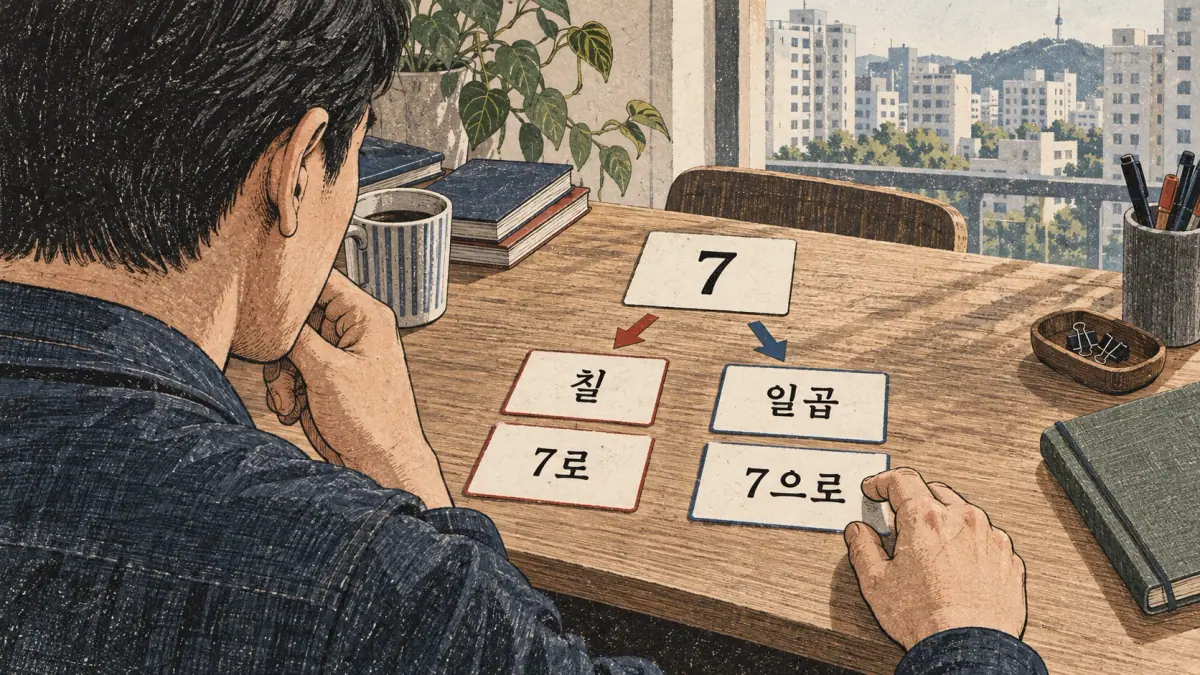
Use the reading that you intend to speak in the specific expression. A bare written number does not always provide enough evidence. Quantity, a digit sequence, a date and a number followed by a unit can have different readings.
The shared number reader uses exact decimal strings and BigInt arithmetic for supported Sino-Korean integers below 10 to the twentieth power. Native quantities are explicitly bounded to 1–99. Decimal and digit modes preserve relevant leading or trailing zeros. Ambiguous separators require a declared English or Spanish parser; the value is not silently reinterpreted from your interface language.
A written Korean unit can settle the final independently of a bare number. In 2026년, the terminal 년 determines the ending; it is misleading to analyze the bare 2026 instead. For 12kg, supply the intended full reading such as 십이킬로그램 rather than treating Latin g as a Korean consonant.
Foreign personal names require a confirmed Korean reading. A Hanja expression can also have reading alternatives; the Hanja workspace supplies source-attributed candidates, and you choose the intended word reading. Neither a Latin last letter nor a Chinese-language pronunciation is automatically a Korean particle rule.
Batch Lists, Templates and Developer Use

Batch mode supports up to 2,000 independent rows. Each row retains its original source and its own resolved or unresolved status. An unknown name is not skipped just because the following row contains a simple Hangul noun. Exports preserve the unresolved reason so you can complete the missing readings later.
Typed templates use named variables and explicit family directives. For example, the template {{name|이/가}} 왔어요. with name 저 produces 제가 왔어요. The pronoun contraction belongs to that variable substitution; unrelated template spans remain unchanged.
The downloadable static ESM SDK exposes detection, attachment, suffix selection, batches and template filling. A factory can bind a family and options for repeated use. Suffix-only and attached paths share the same resolver, including confirmed acronym readings. Developers still need to pass a chosen family; the API is not a semantic auto-picker.
Custom pairs use a bounded branch enum. They are labelled custom rules, not language-approved additions. Validate inputs and inspect warnings before integrating generated wording into another product.
Preserve Punctuation and Inspect Substitutions
Plain template variables are text, not executable code. The rich-template option uses an inert allowlist for emphasis, spans, line breaks and explicit HTTP/HTTPS links. Scripts, events, images, styles and remote resource elements are rejected. The live workspace displays a plain-text preview rather than attaching untrusted markup.
A missing or ambiguous variable remains visible with a diagnostic. It is not silently removed. Inspect the substitution trace and the unchanged surrounding text. CSV exports quote fields and defend formula-leading cells; JSON retains the original source precisely. These safeguards make local inspection possible without changing what your input originally contained.
Export Explained Results and Reuse the SDK
Choose TXT, CSV, TSV or JSON according to your next task. JSON includes the engine version, source, reading provenance, final and change trace. Printable rows show the input and result with their explanation rather than a bare unexplained suffix.
The SDK is a static download with a TypeScript contract and no paid API requirement. Browser processing stays local. An iframe example embeds the clean tool page without private input in its URL. Shared result fragments require a deliberate include-text choice and preview. Review that preview before sharing a name, a reading or a private template.
Accuracy, Sources and Review Boundaries
Unicode arithmetic can be verified independently of linguistic appropriateness. The engine tests all modern syllable blocks and explicit written-final branches. That mechanical coverage does not amount to Korean editorial approval for every uncommon ending or example.
Source references distinguish the ordinary topic forms, the exact ㄹ exception, pronoun contractions and the separate word-ending operation. The catalog and teaching prose are generated materials reviewed and signed off by Min-ji Park on 15 October 2026. The full expanded-family dictionary-entry audit is still pending.
When a result involves a supplied reading, it states that provenance. An override can intentionally force a different branch, but it does not become a verified correction. An unresolved outcome is a useful answer when the input lacks a spoken profile or boundary decision. It prevents a confident-looking guess from hiding a real ambiguity.
Common Mistakes and Quick Fixes

One common mistake is to treat a cluster containing ㄹ as singleton ㄹ. Inspect the final label: ㄼ, ㄺ and ㄻ remain clusters. Another is to search backward for the last Hangul block while ignoring a pronounced terminal number or foreign word. In 서울 2, the terminal 2 needs a reading.
Do not strip an existing marker automatically. The checker can warn that an input already appears to end in a marker, but such letters may also belong to a noun. Enter the noun you intend rather than expecting arbitrary sentence segmentation.
Finally, distinguish a written form from a semantic choice. If the suffix agrees but the sentence feels wrong, investigate the family meaning, predicate and context. Repeatedly changing 은 to 이 without that explanation will not teach the difference between topic and subject.
Frequently Asked Questions
Can I paste a whole sentence?
You can inspect its terminal form, but this tool does not identify every noun or choose every particle in arbitrary prose. Select the noun you mean or use explicit template variables. For sentence structure and contextual suggestions, use the separate sentence analyzer or spelling checker and review their own scope limitations.
Why does the checker ask how a name is pronounced?
Foreign spelling can support different Korean readings, and those readings may have different finals. Supply the reading you intend rather than assuming the final Latin letter decides the suffix. The displayed name remains unchanged, and the result records that the pronunciation was supplied by you rather than automatically verified.
Does a double batchim count as two syllables?
No. A cluster final belongs to one syllable block even when it contains two consonant components. The detector distinguishes clusters from tense finals such as ㄲ and ㅆ. These are written-final categories. Pronunciation in a specific word or suffix environment is a separate question requiring its own rules.
Can I use the result while offline?
The small deterministic chooser can work after its required assets have loaded or been saved through the offline control. An uncached Hanja pack may still need a connection to supply candidates. You can enter a Korean reading manually. Offline saving concerns public assets, not an automatic public cache of your inputs.
Why did my pronoun change before 가?
Standalone 저, 나 and 너 have the subject forms 제가, 내가 and 네가. The trace shows the changed noun span as well as the suffix. The same substitution is not applied inside a larger noun. 누구 can show the contracted 누가 and an uncontracted alternative instead of a blanket rejection.
Are worksheet and template outputs private?
Checks and substitutions run locally, and input is absent from the default page URL. Exporting or sharing is a deliberate action. A downloaded report or an included-text fragment can contain private information, so inspect its preview. Device history is opt-in and can be deleted separately from the current working input.
Your Next Step with the Korean Particle Checker
Use the Korean particle checker to confirm a form, then study the meaning that led you to select that family. For a final-consonant question, begin with what batchim means. For a numerical expression, use the Korean number converter to choose the intended reading first.
Try 서울 and 여덟 with the same direction family and explain the written-final difference aloud. Then choose a noun from your own reading and decide which grammatical family fits its sentence. Report a non-private minimal example through the site corrections information when a branch, boundary or explanation seems wrong. Include the intended reading so the issue can be investigated without guessing.