How to Use the Korean Particles Quiz
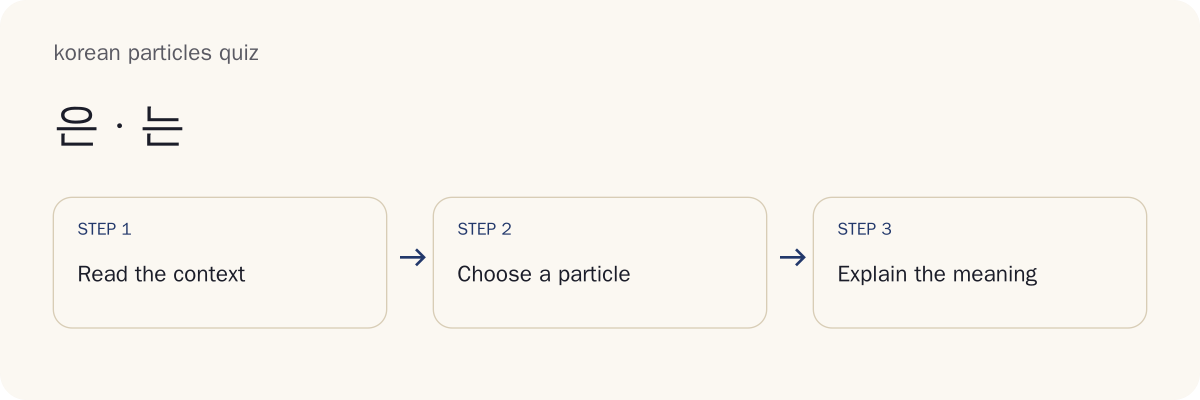
Read the task before answering. The Korean particles quiz asks you to select or type a particle under explicit instructions, then explains how the accepted answer fits. The current bank contains twenty original site questions, mainly focused on particle forms. A short form exercise is different from a complete conversation test.
- Read the situation and instruction. Identify whether the blank asks for a topic, subject, object or another named family. The instruction limits what you are practicing.
- Choose or type the answer. In choice mode, select a displayed option. In typed mode, enter the completed particle rather than an unrelated full sentence.
- Check the result. Read the feedback and explanation together. The label alone does not explain whether you confused meaning or spelling.
- Compare alternatives. Look for a stated alternative or meaning change before calling another answer ungrammatical.
- Retry deliberately. Explain the rule before trying again. A successful retry is useful learning, while your first attempt remains a separate result.
Your next decision is which kind of practice will help.
Choose Your Particle Family and Practice Mode
Form practice gives you the particle family and asks which member attaches to the noun. Meaning practice asks which role the noun plays. Contrast practice compares interpretations, and productive practice requires you to supply an answer without copying a choice.
Use a familiar noun and verb when first learning a new distinction. If both vocabulary and grammar are unfamiliar, a wrong choice does not identify which one caused the difficulty. Choose a manageable session length and a focused family when those controls are available. The activity settings organize practice; they do not turn a small beginner bank into an advanced diagnostic test.
Once the scope is clear, inspect the context.
Read the Situation before Choosing
Context tells you what the speaker wants to communicate. A sentence introducing a person differs from a sentence identifying which person did something, even if both mention the same noun. Read any English hint as part of the question rather than an optional translation.
Do not select 은/는 merely because the English sentence includes “the.” English articles and Korean particles do different jobs. Instead ask what information is already being discussed and what the speaker is adding.
For an explicit family task, follow that family instruction first. An exercise can intentionally test the correct form of a topic particle without testing every natural particle the sentence could contain. The feedback should be interpreted within that scope.
What Does Each Feedback Label Mean?
Feedback tells you how an answer relates to the stated task and its answer set. It should not be read as a verdict on every possible Korean sentence. Four useful distinctions are an accepted answer, a known alternative, a meaning change and a form issue.
An accepted answer fits the instructed task. A known alternative may be natural under a different interpretation, or may be accepted alongside the main answer. A meaning change identifies a different role or focus. A form issue means you chose the right family but the wrong member for the noun ending.
An unlisted answer needs separate attention: absence from the set is not proof of ungrammaticality. Read the instruction, compare the explanation and note the interpretation you intended. A question with one stored answer cannot automatically analyze every sentence a learner could produce.
Revealing an answer and then entering it is assisted work. Retrying after an explanation also differs from the first attempt. Keep those results separate when deciding what to study next.
A Valid Alternative Can Change the Meaning
A natural alternative can express a different focus from the requested answer. The linked comparison lesson contrasts 민수가 왔어요, “Minsu came,” with 민수는 왔어요, a topic or contrastive statement about Minsu coming. The second can invite a comparison with other people.
A quiz asking for the subject family expects 가 after 민수. Choosing 는 may be a meaningful sentence under another context, but it does not complete that explicit subject-form task. Explain both facts rather than treating naturalness and task completion as identical.
Likewise, do not assume every alternative must be accepted in every question. A useful explanation names the task and the alternative interpretation. Next, separate this meaning decision from the noun-ending rule.
Does Batchim Choose the Particle or Only Its Form?
Batchim chooses the form within a particle family; it does not decide which family expresses your meaning. Batchim is a consonant written at the bottom of a Hangul syllable block. For the main two-form pairs, inspect the final syllable of the noun directly before the particle.
For example, the topic family uses 은 after a consonant ending and 는 after a vowel ending. That rule can choose between those two forms. It cannot tell you whether the sentence needs a topic particle instead of an object or subject particle.
Apply the decisions in order: determine the role, select the family, then check the ending. A beginner who learns only “consonant means 은” will correctly spot a final consonant yet attach the wrong role to many nouns.
Software can inspect a complete Hangul syllable for a final consonant. In Unicode, complete syllables have a regular arrangement with a final-consonant position. That mechanical check supports form selection, not interpretation of the whole sentence. Latin spellings, numerals and incomplete input need appropriate handling rather than guessing from an English letter.
The following table summarizes the regular form choices.
은/는, 이/가, 을/를 and 와/과 Form Table
The pairs below represent four families, not eight unrelated meanings. Choose the row from the noun's role, then choose its column from the noun ending.
| Family | After a Vowel | After a Consonant | Main Question |
|---|---|---|---|
| Topic | 는 | 은 | What is being discussed or contrasted? |
| Subject | 가 | 이 | Who or what is being identified? |
| Object | 를 | 을 | What does the verb act on? |
| Partner or link | 와 | 과 | Who with, or which linked nouns? |
In 저는 학생이에요, 저 ends in a vowel and 는 supplies the topic form. In 물을 마셔요, the object noun 물 ends in a consonant and takes 을. Both sentences appear in the linked particle curriculum.
Attach the particle directly to the noun without a space. A form table is a useful reference, but some pairs have an additional exception.
The ㄹ Exception in 로 and 으로
The direction or means family has an exception for final ㄹ. Use 로 after a vowel or final ㄹ; use 으로 after other consonant endings. This is a family-specific rule, so do not transfer it to 은/는, 이/가 or 을/를.
Checking the actual final consonant is therefore more useful than writing only “consonant” in your notes. If the task is about this family, record whether the noun has no final consonant, final ㄹ or another final consonant.
Direction and means also require a meaning decision before the form decision. The linked particle curriculum groups these functions with location and direction. Topic and subject choices depend on a different kind of information.
How Do 은/는 and 이/가 Change Focus?
은/는 frames a topic or contrast, while 이/가 marks a subject and often identifies the person or thing that supplies the requested information. The choice depends on the conversation, rather than on the noun alone.
The linked lesson compares 저는 학생이에요 with 제가 학생이에요. The first is a normal statement about yourself as the topic. The second identifies you as the student when that identity is the relevant answer. The shared description does not make the focus identical.
“Known information versus new information” can be a useful beginner shortcut, but it should remain a shortcut. A speaker can choose a topic to establish a frame, and a sentence can include both a topic and a subject. The lesson's 저는 머리가 아파요 illustrates this: the speaker is the topic and the head is the subject of the description.
Avoid an absolute rule that a noun must take the same particle every time it reappears. Read the question being answered and any explicit contrast. Use the topic and subject focus lesson when a feedback explanation concerns meaning rather than merely an ending.
Two worked situations make the distinction concrete.
Worked Dialogue: Who Arrived?
Input: The situation asks which person came. The choices identify Minsu either as the subject or as a contrastive topic.
Answer: 민수가 왔어요 means “Minsu came” in the linked comparison lesson. It identifies Minsu in the report. The form is 가 because 민수 ends in a vowel.
Alternative: 민수는 왔어요 frames Minsu as a topic or contrast. The listener may expect a comparison with someone else who did not come.
Interpretation: The noun-ending rule is the same in both choices; the family changes the focus. If the instruction explicitly asks for the subject family, choose 가 and explain why the topic alternative addresses another task.
Worked Example: Coffee and Alcohol
Input: A speaker contrasts what they drink with what they do not drink. The linked comparison lesson uses coffee and alcohol for this situation.
Answer: 커피는 마셔요. 그런데 술은 안 마셔요. The meaning is “Coffee I drink, but alcohol I don't.” The topic particles organize an explicit comparison between the two drinks.
Interpretation: A topic can frame something that would otherwise be discussed as an object. Topic and subject are therefore not a universal two-choice system for every noun. Ask what the sentence is doing before applying a form rule.
Next action: Explain the contrast in English, then locate the two topic forms in the Korean example.
Why Do 에 and 에서 Both Appear with Movement?
에 and 에서 can both appear with movement because a journey has a destination and a starting point. 에 can mark the destination, and 에서 can mark the source. Looking only at whether the verb involves movement misses this difference.
The linked lesson compares 서울에 왔어요, “I came to Seoul,” with 서울에서 왔어요, “I came from Seoul.” The verb stays the same; the place has a different role. In a form exercise, neither particle changes according to whether the place noun ends in a consonant.
For other uses, 에 marks an existence location or a point in time, while 에서 marks where an activity takes place. The English word “at” can translate both, so an English preposition alone is insufficient.
Use the source, destination and action place lesson to compare those roles. The next examples show the decision in context.
Worked Example: Study and Book Location
Input: Describe an activity at the library. The linked lesson's sentence is 도서관에서 공부해요, “I study at the library.”
Answer: Choose 에서. The library is where studying happens. The sentence reports an activity, rather than simply locating an object.
Comparison: 집에 있어요 means “I am at home” in the same location lesson. Choose 에 for that existence location. The difference is what the place means in the sentence, not the last letter of the place noun.
Interpretation: A book's location belongs to the existence-location pattern, while reading or studying belongs to the activity-place pattern. Identify that role before checking the available choices.
Worked Example: from Seoul to Busan
Input: Say “I go from Seoul to Busan.” The linked location lesson provides 서울에서 부산에 가요.
Answer: Seoul takes 에서 as the starting point; Busan takes 에 as the destination. The two particles supply different pieces of the same route.
Interpretation: Changing both places to 에서 would label two sources and lose the intended destination. Changing both to 에 would lose the source. A moving verb therefore does not select a single particle for every place noun in its sentence.
Next action: Cover the particles and label the two places “source” and “destination” before restoring the Korean forms. Meaning-focused labels make the answer explainable.
What Changes with 도, 만 and 밖에?
도 adds an “also” or “too” meaning; 만 restricts the relevant set to “only”; 밖에 is used with a negative construction to express that nothing beyond the named amount or item is included. These meanings require attention to the whole sentence.
The curriculum's 저도 가요 means “I am going too.” The particle adds the speaker to a relevant group of people going. The previous situation matters: “too” makes sense because another person or action is already in view.
For exclusivity, ask what is being limited. A translation containing “only” is not enough to decide between all possible Korean constructions. In particular, 밖에 needs its accompanying negative pattern; treating it as a direct replacement for 만 can leave an incomplete or mismatched sentence.
These functions extend beyond the current twenty-item beginner bank. Do not infer that practicing one 도 question tests every additive or exclusive use. Use a focused lesson before authoring a question about a wider construction, and make the intended meaning explicit. Other families organize relationships among people and times.
Recipients, Partners and Time Ranges
Recipients, partners and time ranges answer different questions. A recipient receives something; a partner participates with someone; a time range gives its beginning or end. All can follow nouns, but that shared position does not make their particles interchangeable.
The curriculum groups 에게 and 한테 with giving or directing something to a person. 께 is a respectful recipient form. Choosing among recipient forms involves the people and style of the situation, rather than a simple vowel-versus-consonant table.
와/과, 하고 and (이)랑 can connect nouns or express a companion. The curriculum's 친구와 가요 means “I go with a friend.” A task using the 와/과 family should state that family if the goal is its form, because other partner expressions exist.
부터 and 까지 mark starting and ending boundaries in range expressions. The reader needs to know which boundary the blank asks for. A time point, a beginning and an endpoint are separate roles.
Keep advanced family choices out of an elementary form score unless the session actually includes them. Meaning remains the first decision, and explicit particles remain a useful learning scaffold.
Can a Natural Sentence Leave out a Particle?
Yes. Natural conversation can omit a particle when the role is clear from context, especially with common topic, subject and object patterns. That does not make every omission appropriate, and a quiz explicitly asking for a particle is testing the full form.
The linked curriculum compares 밥 먹었어? with 밥을 먹었어?. The shorter casual version omits the object particle. The complete form makes the role visible and is useful for learning how the sentence works.
A blank left empty in a form exercise does not fulfill an instruction to supply 을/를. Conversely, encountering a natural spoken omission does not mean the speaker has forgotten grammar. The task and the speaking situation differ.
Place and recipient relationships can become less clear when their markers disappear. A beginner should first learn the full pattern, then notice which parts familiar speakers omit in an understood context. Formality, sentence complexity and ambiguity all matter.
For your own practice, explain what information the omitted particle would have supplied. If you cannot identify the role with the particle present, omission hides the decision you still need to learn. Shortened and combined forms introduce another layer.
Short Forms, Stacking and Advanced Sets
Short forms need to be learned as forms, rather than produced by deleting arbitrary letters. The location lesson gives 여기서 기다려요 alongside the fuller 여기에서 기다려요. The shortened expression still marks the place of waiting.
Particles can also combine. The curriculum names 에서도 as a combined form: the location contribution and additive contribution remain relevant. A learner reading a combination should identify the pieces and the interpretation instead of assuming every longer ending is a new unrelated particle.
More advanced sets include distinctions within clauses and discourse that the twenty beginner questions do not fully measure. Topic patterns inside a longer sentence also require care; a beginner shortcut is insufficient to parse every clause.
A copula connects a noun with a statement such as being a student. It is not interchangeable with any particle simply because it appears near a noun. Keep the sentence ending and the noun's role separate when explaining an answer. This separation makes error notes more useful.
How Should You Learn from Your Mistakes?
Inspect mistakes by naming the decision that failed: role, family, form or task interpretation. A total score tells you how many answers fit the session, but the explanation tells you what to study.
- Wrong role: You treated a source as a destination or an activity location as an existence location.
- Wrong family: You supplied a topic form in a task explicitly asking for the subject family.
- Wrong form: You selected the intended family but missed the noun's final consonant.
- Unlisted interpretation: Your answer needs comparison with the stated context instead of an automatic grammar verdict.
For a form mistake, identify the noun's final syllable and rehearse the two family members. For a meaning mistake, paraphrase the situation and compare the roles. Repeating the same answer after seeing it mainly checks memory of that item.
Return to a related question after a gap and explain it before checking. Compare sessions with similar conditions, and keep first attempts separate from retries and reveals. The next step is recalling an answer without the clues supplied by choices.
Typed Recall and Learner-Authored Sentences
Typed recall removes the clue of seeing the correct particle among the options. Use it once the family and meaning are familiar; otherwise a typing problem can compete with the grammar problem. Enter the requested particle and check the field instructions before supplying a full sentence.
Learner-authored questions can focus on a recurring difficulty. Include a clear context, a stated family or meaning goal, an accepted answer and an explanation. Preview the question to check that the blank asks what you intended. Store a known alternative separately when it changes the interpretation.
A private question retains its author's answer key. The tool cannot guarantee that every independently written sentence is natural Korean or that its key covers every alternative. Use an existing lesson example as your starting point, and seek help with a new construction before teaching it to others.
Separate grammar practice from keyboard practice when either one obscures the result. Export options make this focused work usable beyond one session.
Classroom Practice, Worksheets and Offline Sets
Teachers can create private questions, preview them and export an assignment. A worksheet and a separate answer key make it possible to practice away from the screen without showing the answers beside every blank.
Write the intended family or context on the assignment. This prevents a classroom disagreement caused by one learner answering a form question and another interpreting an open sentence. Discuss a natural alternative as an interpretation rather than changing the task silently.
Local progress and export files belong to the browser and to the files you deliberately save. Hosted class services and automatic account synchronization are unavailable. Sharing an assignment does not automatically collect everyone's results.
Offline practice depends on the needed local material being available. A worksheet is usable without JavaScript; an interactive activity needs its working page and data. Check the intended setup before class.
Frequently Asked Questions
The practical answers below cover choice versus typing, local progress, answer-set limits and classroom use. They apply to the exercise on this page, rather than promising a complete grammar assessment.
Can I practise without installing a Korean keyboard?
Yes. Choose the particle from the answer choices. For typed practice, use your device’s Korean keyboard or an online Korean keyboard, then paste the completed particle into the answer field. Choice mode lets you focus on grammar while learning to type separately. A keyboard is needed only when you choose to enter Korean text.
Do I need to create an account to save my progress?
No. Turn on local progress saving or export a progress file. Browser storage belongs to this browser profile; transfer the file to another device deliberately. Hosted account sync is not available. Clearing browser data may remove saved progress, so keep an export if you want to retain your history while changing devices.
Why is my answer not in the answer set?
A question lists the answers covered by its stated task and context. An unlisted answer is not automatically ungrammatical. Compare its meaning and the requested particle family with the explanation before deciding what to change. If the intended interpretation is missing, record the question and context so the alternative can be assessed separately.
Can a teacher use a custom question set?
Yes. Create private questions with an explicit context, accepted answer and explanation. Preview them, then export an assignment or print a worksheet and separate key. Custom questions retain their author’s key; they do not receive independent approval automatically. State the task clearly so learners know whether they are practicing a form or interpreting meaning.
Are these questions official TOPIK exam questions?
No. These are original site practice questions. Session results describe your answers in this exercise; they are not official TOPIK marks, exam predictions or certified language levels. Use the explanations to identify the particle decisions you need to practice. A strong result here is evidence about this session and its question set.
Continue Korean Particles Quiz Practice
Use the Korean particles quiz to identify one decision you want to improve. Complete a short session, choose one missed item and explain its noun role, particle family and form. Then compare the answer with the particle curriculum before repeating the task.
If your note says “wrong ending,” return to the form table. If it says “different focus,” compare topic and subject contexts. If it says “source versus destination,” work through the route example again. A correction report is more useful when it includes the question and interpretation you intended. Keep your personal sentences and results private unless you deliberately choose to share them.