What you'll learn
- Look up the counter for any of 40 common objects.
- Check whether the counter takes native or Sino-Korean numbers.
- Build a correct phrase in the pattern noun + number + counter.
- Decide which five counters to learn first.
Prerequisites: how Korean counters work. Estimated time: 20 minutes.
Korean Counters Chart: All 40 Counters
This Korean counters chart groups counters by what they count: people and animals, things, food and drink, time, and times, places and money. Every row gives the counter, its Revised Romanization, what it counts, the number system it takes and one example. A counter is a word that tells you what kind of thing a number refers to, as in "two cups of coffee".
The pattern is always noun + number + counter, for example 사과 세 개 (three apples). The Number system column tells you which numbers to use. Native means 하나, 둘, 셋 (shortened to 한, 두, 세 before a counter). Sino means 일, 이, 삼.
Reference
| Counter | Romanization | Used for | Number system | Example |
|---|---|---|---|---|
| 명 | myeong | people | Native | 학생 세 명 |
| 분 | bun | people, politely | Native | 손님 두 분 |
| 마리 | mari | animals, fish, insects | Native | 고양이 두 마리 |
| Counter | Romanization | Used for | Number system | Example | Lesson |
|---|---|---|---|---|---|
| 개 | gae | general objects | Native | 사과 세 개 | yes |
| 권 | gwon | books, notebooks | Native | 책 두 권 | yes |
| 장 | jang | flat things: paper, tickets | Native | 표 한 장 | yes |
| 대 | dae | vehicles, machines | Native | 자동차 한 대 | yes |
| 켤레 | kyeolle | pairs of shoes, socks | Native | 신발 한 켤레 | yes |
| 벌 | beol | suits, sets of clothes | Native | 양복 한 벌 | yes |
| 쌍 | ssang | matched pairs, couples | Native | 귀걸이 한 쌍 | in the 켤레 lesson |
| 송이 | songi | flowers, grapes, clusters | Native | 장미 세 송이 | not yet |
| 그루 | geuru | trees, plants | Native | 나무 두 그루 | not yet |
| 자루 | jaru | pencils, pens, long handles | Native | 연필 세 자루 | not yet |
| 곡 | gok | songs, music pieces | Native | 노래 한 곡 | not yet |
| 편 | pyeon | films, poems, episodes | Native | 영화 한 편 | not yet |
| 채 | chae | houses, buildings | Native | 집 한 채 | not yet |
| 척 | cheok | ships, boats | Native | 배 한 척 | not yet |
| 부 | bu | copies of newspapers | Native | 신문 한 부 | not yet |
| 건 | geon | cases, items of business | Native or Sino | 사고 한 건 | not yet |
| Counter | Romanization | Used for | Number system | Example |
|---|---|---|---|---|
| 잔 | jan | cups and glasses of drink | Native | 커피 한 잔 |
| 병 | byeong | bottles | Native | 물 두 병 |
| 그릇 | geureut | bowls of food | Native | 밥 한 그릇 |
| 인분 | inbun | servings per person | Sino | 삼겹살 이 인분 |
| 접시 | jeopsi | plates of food | Native | 전 한 접시 |
| 공기 | gonggi | small rice bowls | Native | 밥 한 공기 |
| 캔 | kaen | cans | Native | 콜라 한 캔 |
| 봉지 | bongji | bags of snacks | Native | 과자 한 봉지 |
| Counter | Romanization | Used for | Number system | Example |
|---|---|---|---|---|
| 시 | si | o'clock | Native | 세 시 |
| 분 | bun | minutes | Sino | 십 분 |
| 시간 | sigan | hours of duration | Native | 두 시간 |
| 일 | il | days | Sino | 삼 일 |
| 주 | ju | weeks | Sino | 이 주 |
| 개월 | gaewol | months | Sino | 육 개월 |
| 년 | nyeon | years | Sino | 오 년 |
| 살 | sal | age in years | Native | 스무 살 |
| Counter | Romanization | Used for | Number system | Example |
|---|---|---|---|---|
| 번 | beon | times, occasions | Native (Sino for numbering) | 한 번 |
| 층 | cheung | floors | Sino | 삼 층 |
| 호 | ho | room or issue numbers | Sino | 이백일 호 |
| 회 | hoe | rounds, runs, sessions | Sino | 하루 삼 회 |
| 원 | won | Korean won | Sino | 오천 원 |
| Group | Number system | Typical numbers | Example |
|---|---|---|---|
| People, animals | Native | 한, 두, 세, 네 | 학생 두 명 |
| Things | Native | 한, 두, 세, 네 | 책 세 권 |
| Food containers | Native | 한, 두, 세, 네 | 물 두 병 |
| Servings (인분) | Sino | 일, 이, 삼, 사 | 삼겹살 이 인분 |
| Clock hours, hour spans | Native | 한, 두, 세 | 두 시간 |
| Minutes, days, weeks, years | Sino | 일, 이, 삼 | 십 분 |
| Floors, rooms | Sino | 일, 이, 삼 | 삼 층 |
| Money | Sino | 천, 만 | 오천 원 |
| Priority | Counters | What they unlock |
|---|---|---|
| First five | 개, 명, 마리, 권, 잔 | objects, people, animals, books, drinks |
| Next four | 병, 장, 대, 번 | bottles, tickets, vehicles, times |
| Then | 층, 원, 살, 시, 분 | floors, money, age, time of day |
People and Animals
The people and animal counters are the most used in conversation. Lessons: 명 counter, 분 counter and 마리 counter.
| Counter | Romanization | Used for | Number system | Example |
|---|---|---|---|---|
| 명 | myeong | people | Native | 학생 세 명 |
| 분 | bun | people, politely | Native | 손님 두 분 |
| 마리 | mari | animals, fish, insects | Native | 고양이 두 마리 |
Things
The counters for things start with 개, the default. Lessons: 개 counter, 권 counter, 장 counter, 대 counter and 켤레 and 벌.
| Counter | Romanization | Used for | Number system | Example | Lesson |
|---|---|---|---|---|---|
| 개 | gae | general objects | Native | 사과 세 개 | yes |
| 권 | gwon | books, notebooks | Native | 책 두 권 | yes |
| 장 | jang | flat things: paper, tickets | Native | 표 한 장 | yes |
| 대 | dae | vehicles, machines | Native | 자동차 한 대 | yes |
| 켤레 | kyeolle | pairs of shoes, socks | Native | 신발 한 켤레 | yes |
| 벌 | beol | suits, sets of clothes | Native | 양복 한 벌 | yes |
| 쌍 | ssang | matched pairs, couples | Native | 귀걸이 한 쌍 | in the 켤레 lesson |
| 송이 | songi | flowers, grapes, clusters | Native | 장미 세 송이 | not yet |
| 그루 | geuru | trees, plants | Native | 나무 두 그루 | not yet |
| 자루 | jaru | pencils, pens, long handles | Native | 연필 세 자루 | not yet |
| 곡 | gok | songs, music pieces | Native | 노래 한 곡 | not yet |
| 편 | pyeon | films, poems, episodes | Native | 영화 한 편 | not yet |
| 채 | chae | houses, buildings | Native | 집 한 채 | not yet |
| 척 | cheok | ships, boats | Native | 배 한 척 | not yet |
| 부 | bu | copies of newspapers | Native | 신문 한 부 | not yet |
| 건 | geon | cases, items of business | Native or Sino | 사고 한 건 | not yet |
Food and Drink
The food and drink counters follow the container. Lessons: 잔 counter, 병 counter, 그릇 counter and 인분 counter.
| Counter | Romanization | Used for | Number system | Example |
|---|---|---|---|---|
| 잔 | jan | cups and glasses of drink | Native | 커피 한 잔 |
| 병 | byeong | bottles | Native | 물 두 병 |
| 그릇 | geureut | bowls of food | Native | 밥 한 그릇 |
| 인분 | inbun | servings per person | Sino | 삼겹살 이 인분 |
| 접시 | jeopsi | plates of food | Native | 전 한 접시 |
| 공기 | gonggi | small rice bowls | Native | 밥 한 공기 |
| 캔 | kaen | cans | Native | 콜라 한 캔 |
| 봉지 | bongji | bags of snacks | Native | 과자 한 봉지 |
Time
The time counters mix both systems, and the split is easy to remember. Hours of the clock and spans of hours use native numbers, while minutes, days, weeks, months and years use Sino-Korean numbers. Lessons: 시간 counter, 일 counter, 주 counter, 달 and 개월 counters and 년 counter.
| Counter | Romanization | Used for | Number system | Example |
|---|---|---|---|---|
| 시 | si | o'clock | Native | 세 시 |
| 분 | bun | minutes | Sino | 십 분 |
| 시간 | sigan | hours of duration | Native | 두 시간 |
| 일 | il | days | Sino | 삼 일 |
| 주 | ju | weeks | Sino | 이 주 |
| 개월 | gaewol | months | Sino | 육 개월 |
| 년 | nyeon | years | Sino | 오 년 |
| 살 | sal | age in years | Native | 스무 살 |
Times, Places and Money
The last group counts occasions, floors, rooms and money. Lessons: 번 counter, 층 counter and 원 counter.
| Counter | Romanization | Used for | Number system | Example |
|---|---|---|---|---|
| 번 | beon | times, occasions | Native (Sino for numbering) | 한 번 |
| 층 | cheung | floors | Sino | 삼 층 |
| 호 | ho | room or issue numbers | Sino | 이백일 호 |
| 회 | hoe | rounds, runs, sessions | Sino | 하루 삼 회 |
| 원 | won | Korean won | Sino | 오천 원 |
How Do You Read the Chart?
To read the chart, find the group, find the row, then follow the number system. The lookup takes three steps, and you can repeat them for any object.
- Pick the group that matches what you want to count, such as food and drink.
- Find the counter in the Used for column, such as 잔 for cups and glasses.
- Check the Number system column and choose the matching numbers: native for 잔 (한 잔, 두 잔), Sino for 인분 (일 인분, 이 인분).
Then build the phrase: noun + number + counter. For one cup of coffee, the noun is 커피, the number is 한 and the counter is 잔, so the phrase is 커피 한 잔. The column Romanization is a learning aid in the Revised Romanization system. The Hangul is the real spelling.
Which Number System Goes with Each Counter?
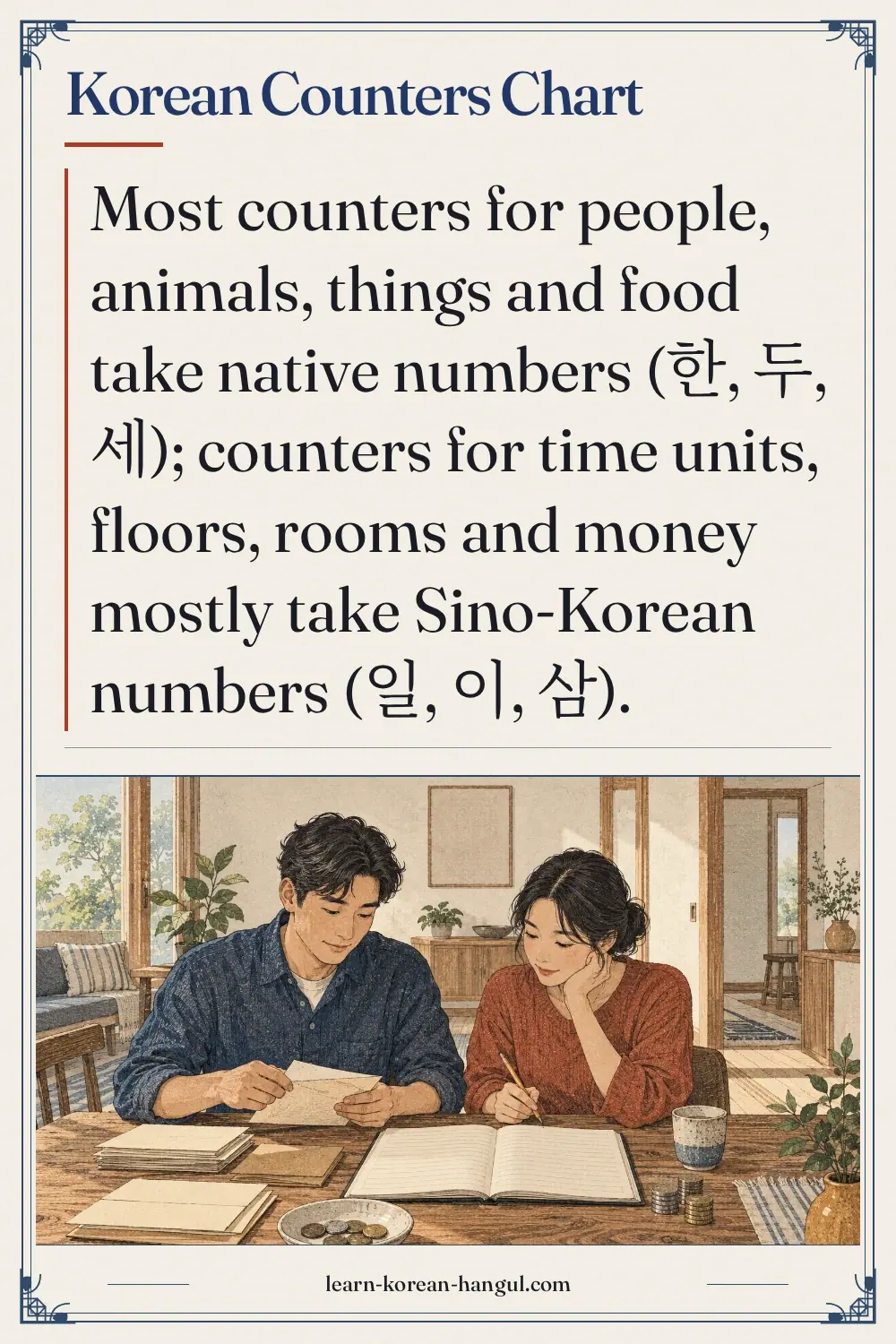
Counters for people, animals, objects and food containers take native numbers, and counters for minutes, days, weeks, months, years, floors, rooms, servings and money take Sino-Korean numbers. Hours of the clock and spans of hours (시, 시간) are the notable exception inside the time group.
| Group | Number system | Typical numbers | Example |
|---|---|---|---|
| People, animals | Native | 한, 두, 세, 네 | 학생 두 명 |
| Things | Native | 한, 두, 세, 네 | 책 세 권 |
| Food containers | Native | 한, 두, 세, 네 | 물 두 병 |
| Servings (인분) | Sino | 일, 이, 삼, 사 | 삼겹살 이 인분 |
| Clock hours, hour spans | Native | 한, 두, 세 | 두 시간 |
| Minutes, days, weeks, years | Sino | 일, 이, 삼 | 십 분 |
| Floors, rooms | Sino | 일, 이, 삼 | 삼 층 |
| Money | Sino | 천, 만 | 오천 원 |
A quick rule helps: native numbers go with counters that count things you can hold or see, and Sino numbers go with counters that count units of measure, time spans and money. The rule has exceptions, such as 시 and 살, which take native numbers, so check the column when in doubt. The details are in Sino vs native numbers.
Which Counters Should You Learn First?
Learn 개, 명, 마리, 권 and 잔 first, because they cover most beginner situations: objects, people, animals, books and drinks. Then add 병, 장, 대 and 번. About ten counters let you shop, order food and talk about people.
| Priority | Counters | What they unlock |
|---|---|---|
| First five | 개, 명, 마리, 권, 잔 | objects, people, animals, books, drinks |
| Next four | 병, 장, 대, 번 | bottles, tickets, vehicles, times |
| Then | 층, 원, 살, 시, 분 | floors, money, age, time of day |
Starting from the list above, a learner can practise the counters in order and meet the rest as they appear.
Which Counters Have No Lesson Yet?
Counters marked "not yet" in the Things table have no lesson of their own, and the chart gives one example for each. They are less common for beginners, but you will hear them. 송이 counts clustered things (장미 세 송이), 그루 counts trees (나무 두 그루), 자루 counts pencils (연필 세 자루), 곡 counts songs (노래 한 곡), 편 counts films (영화 한 편), 채 counts houses (집 한 채), 척 counts ships (배 한 척) and 부 counts copies (신문 한 부). If you cannot find a counter, the fallback is 개 for objects, as in the 개 counter lesson.
Can You Print the Chart?
A printable PDF of the top 20 counters is available in A4 and US Letter from the download card below. You can also print the tables on this page from your browser, because they are plain HTML tables.
Korean Counters Chart, Top 20 (PDF)
What This Chart Does Not Cover
This chart lists 40 common counters. It does not list every Korean counter, and it does not explain the grammar of particles, plurals and spacing around counters. For those rules, read how Korean counters work. It also leaves out measure words borrowed from English, such as 리터, 킬로그램 and 센티미터, which follow the same pattern.
What to Learn Next
The next step is to learn one counter well. Start with the 개 counter, the default for objects, or browse counters for people and animals and counters for things. Return to this korean counters chart whenever you meet an object you do not know how to count.
Frequently Asked Questions
How many counters should I learn first?
Start with five: 개 for objects, 명 for people, 마리 for animals, 권 for books and 잔 for cups. They cover most beginner situations. Then add 병, 장, 대 and 번. About ten counters let you shop, order food and talk about people, and the rest of the chart can be learned as you meet each object.
Which counters are on TOPIK I?
There is no published fixed list of counters for TOPIK I. Beginner exams and textbooks use everyday counters such as 개, 명, 마리, 권, 잔, 병, 장, 번, 시, 분, 층 and 원, which are all in this chart. Treat the chart as a study aid, not as an official exam list.
Is the chart complete?
No. Korean has more counters than any single chart can hold, including many for tools, crops and measures. This chart lists 40 common ones, grouped so you can find a counter by what you want to count. A few counters that have no lesson yet are marked in the table, and more are added over time.
Can I download the chart?
A printable PDF of the 20 most common counters is available in A4 and US Letter from the download card on this page. For practice, you can print the tables on this page from your browser. The tables are plain HTML, so they print and copy cleanly.
Which counters take Sino-Korean numbers?
Counters for time units such as 분, 일, 주, 개월 and 년, for floors and rooms (층, 호), for money (원) and for servings (인분) take Sino-Korean numbers. Most counters for objects, people and animals take native numbers. The Number system column in the chart shows which set each counter takes.