What Does a Korean Shoe-Size Number Mean?
A Korean shoe-size number is a label whose meaning depends on the manufacturer and chart. A label marked 260 may resemble a measurement in millimeters, but entering that label is different from entering a foot measured at 260 mm. The converter keeps those inputs separate because the primary charts themselves distinguish them.
Nike Korea's men's chart, for example, associates KR 260 with US men's 8 and a published foot measurement of 10 inches. Ten inches is exactly 254 mm. A calculator that replaces the chart lookup with “260 means a 260 mm foot” would erase that distinction and could select another row.
Mondopoint is a footwear-sizing system concerned with intended foot measurements. The ISO 9407:2019 catalogue identifies its scope. The catalogue description does not authorize reproducing a complete copyrighted conversion table or establish that every commercial Korean label follows identical conventions. A product's primary chart remains the practical source for that purchase.
Labels, Millimeters and the Five Measurements
Five measurements are easy to confuse when shopping: actual foot length, linear ball width, ball circumference or girth, insole length and shoe-last length. Each measures something different. A seller's column headed “length” needs clarification if it does not identify which object was measured.
| Input | What the number describes | Appropriate use |
|---|---|---|
| Known size label | Printed manufacturer identifier | Look up the exact chart row |
| Foot length | Heel to longest toe | Use a published foot-length chart |
| Linear ball width | Across the forefoot | Use a chart defining linear width |
| Ball girth | Around the forefoot | Use a circumference-specific chart |
| Insole length | Inside component of the shoe | Use an insole-specific table |
Width and girth cannot be interchanged. Insole length cannot be turned into foot length by subtracting a universal allowance. Correct measurement meaning comes before arithmetic.
Korean Shoe Size to US: Use the Selected Chart

Korean shoe size to US is a source-chart lookup, not one universal equation. Choose the brand, chart region and category, then select the system printed beside your known label. The result shows the published equivalents available in that chart. A missing field remains “Not provided”; the tool does not fill it from another brand.
The initial source examples are individually documented facts, with links to the complete primary tables. They are not an exhaustive licensed chart bank. If your label falls outside the available rows, open the primary source or import the seller's table locally. A complete source table, a known model and the intended measurement kind provide more evidence than a generic approximation.
Category refers to the manufacturer's chart family. Selecting Men, Women or Unisex does not infer the buyer's identity or personal fit. Children's families likewise preserve the publisher's category and suffixes. Keeping chart identity attached to every copied answer makes the conversion inspectable.
Worked Example 1: Nike Men's KR 260
The Nike Korea men's footwear chart gives KR 260 as US men 8, US women 9.5, UK 7, EU 41 and JP 26 in the documented example. Its published foot row is 10 inches. Using the NIST exact inch definition,10 ×25.4 gives 254 mm.
Those are two related facts: the label equivalence and the source's foot measurement. They do not say that every KR 260 shoe from every manufacturer has the same interior length. Copying the result preserves Nike, Korea, Men and the source date alongside the equivalents. The source-qualified answer is useful for checking a Nike product; the final product chart and fit still matter.
Worked Example 2: Nike Women's KR 260
The Nike Korea women's chart maps its KR 260 example to US women 9, US men 7.5, UK 6.5, EU 40.5 and JP 26. That differs from the men's KR 260 row. Neither category should be averaged with the other or transformed by an invented universal gender subtraction.
Compare mode places the categories side by side. The difference is a reason to confirm which table the product uses. A known US women 9 label is more informative when accompanied by the brand, region and model than when treated as a global measurement. The same principle applies when moving from labels to actual foot readings.
How Do You Measure Both Feet Accurately?

Foot measurement starts with heel-to-longest-toe length, taken using the selected manufacturer's instructions. Measure both feet, preserve both readings and identify the longer one. The tool converts mm, cm and inches exactly before comparing the readings; it does not decide that a rounded display is the original measurement.
- Prepare paper, a pencil and an independent ruler.
- Wear the socks appropriate for the intended shoes.
- Align the heel and mark the longest toe while following the manufacturer's standing-measurement method.
- Measure the heel-to-toe distance and repeat for the other foot.
- Check the longer reading against the product's explicit foot-length chart.
A source row is a candidate, not a promise of comfort. Between-row values show the neighboring source rows instead of silently selecting an unsupported rounding rule. Check the publisher's product-specific advice before choosing tighter or roomier alternatives.
A Ruler, Paper and Honest Measurement Precision
The original A 4 measurement ruler and Letter measurement ruler include a 100 mm verification bar. Print at 100% with fit-to-page disabled. Measure that bar using another physical ruler before measuring a foot. A 95 mm printed bar fails calibration and requires a 100% reprint.
A displayed screen ruler is not calibrated to physical size, because screen dimensions, scaling and browser zoom differ. The downloadable PDF uses physical page dimensions; printer settings can still change them. The verification step tests the actual print rather than assuming the settings worked.
Reported precision should reflect how you measured. A ruler reading to the nearest millimeter does not become a professionally measured hundredth of a millimeter merely because the converter displays extra decimal places. The exact arithmetic preserves the source's numerical information without inventing measurement quality.
Worked Example 3: Inches and Different Feet
Suppose the left foot is 10 inches and the right is 10 3/16 inches. The left converts to 254 mm. The right is 163/16 inches, multiplied by 127/5 mm per inch, giving exactly 258.7625 mm. The longer foot is the right. A two-decimal display of 258.76 mm is an approximation of that stored value.
The Nike men's examples include the corresponding imperial-source rows, with US 8 and US 8.5 labels. Showing those rows explains the evidence without automatically recommending a fit. Source intervals, rounded metric versions and manufacturer between-size advice need their own confirmation. Preserve the original fractional-inch reading when comparing charts so that display rounding does not change a boundary decision.
Why Do Brands and Categories Disagree?
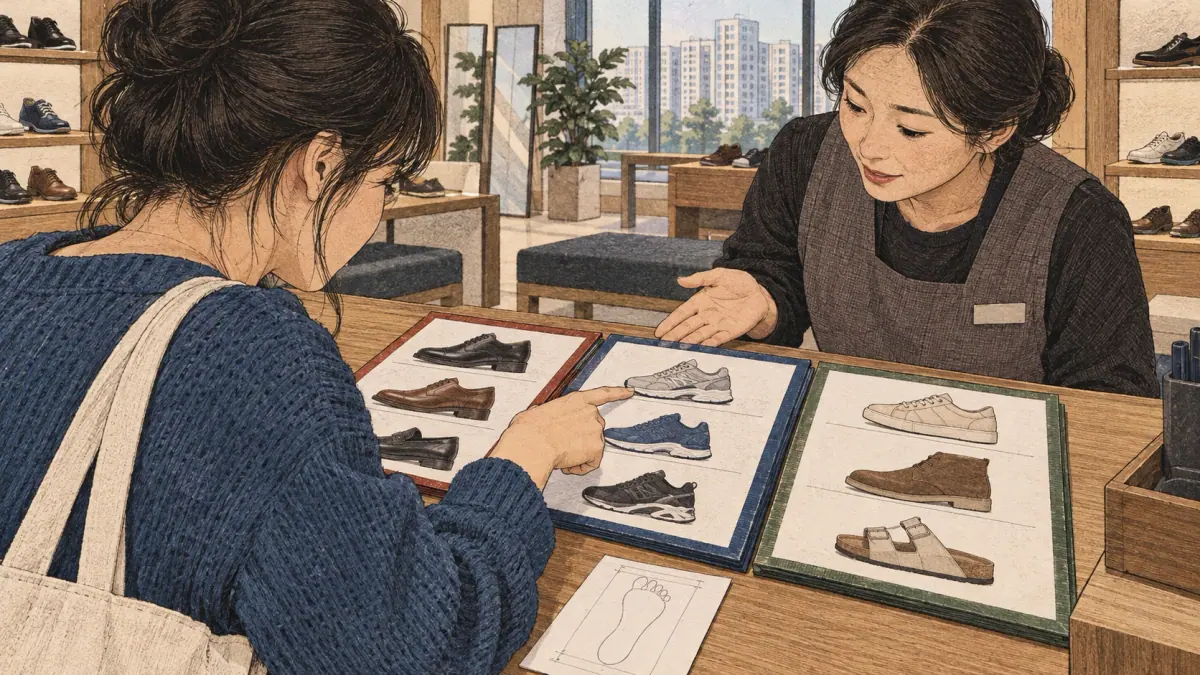
Brands and categories can publish different label mappings because their charts describe different sizing families and products. Region, model, source version and measurement headings can also differ. A comparison should expose those distinctions rather than hide them behind one generic equivalence table.
The following examples are factual readings of the linked primary charts, checked 10 October 2026. They are not universal brand rules or guarantees about products currently in stock.
| Source and input | USmen | USwomen | UK | EU | KR |
|---|---|---|---|---|---|
| Nike Korea men, KR 260 | 8 | 9.5 | 7 | 41 | 260 |
| Nike Korea women, KR 260 | 7.5 | 9 | 6.5 | 40.5 | 260 |
| Adidas US, foot 25.5 cm | 8 | 9 | 7.5 | 41⅓ | Not published |
| New Balance US men, US 8 | 8 | 9.5 | 7.5 | 41.5 | Not published |
The copied source identity helps a reader trace why two results disagree. A product-specific chart takes precedence over general shopping assumptions. A changed source should be checked explicitly before updating a saved profile.
Worked Example 4: Adidas 25.5 Cm Is Not a KR Label
The Adidas US adult chart gives a heel-to-toe length of 25.5 cm with US men 8, US women 9, UK 7.5, EU 41⅓ and JP 260. The 25.5 cm is 255 mm as a physical length. TheJP 260 is a published label in that table.
The table does not publish aKR row. TreatingJP 260 as automatically provingKR 260 would add a field that the source did not provide. The converter therefore shows the missing Korean system explicitly. Consult a primary Korean product chart or import a seller table that actually publishesKR before asserting that equivalence.
Duplicate Labels and Thirds on EU Charts
Nike men's KR 235 has two documented rows: US men 4.5 with EU 36.5, and US men 5 with EU 37.5. KR 240 likewise matches two examples. One label therefore does not always identify one candidate. Another published label, product model or complete source row may resolve the ambiguity.
EU thirds remain literal chart identifiers. AdidasEU 41⅓ must not becomeEU 41.5 through decimal rounding. Known-label parsing preserves thirds, halves and child suffixes. These tokens identify source rows; they are not length measurements to round into a nearby numerical label.
Can Width and a Model Change Your Choice?

Width and model can affect a shoe choice, but a valid numerical rule needs a product-specific source. The tool records linear width or girth separately for each foot and does not manufacture a universal size increase for wide feet. Length of one foot and width of the other remain separate observations.
A product chart may publish narrow, standard, wide or extra-wide options. The letter labels and associated measurements can depend on category and size. An unavailable width field should remain unknown rather than inherit a number from another chart. A general size table cannot establish the shape of every toe box, material or shoe type.
Narrow, Standard, Wide and Extra-Wide
The New Balance US size guide documents size-specific width choices. Its men's US 8 example publishesD 10.1 cm and 2E 10.5 cm. Those values belong to that source row. Their measurement meaning still needs manufacturer confirmation before using them as an automatic fitting rule.
Nike regional width explanations can refer to girth rather than a simple straight-line addition. Do not convert a circumference increment into linear width or add it to foot length. Record the requested width label and consult the product options. A missing width option is a stock or product question, not proof that another length size will solve the fit.
Which Fit Claims Need a Product-Specific Source?
Toe-box shape, intended sport, materials, orthotics and sock thickness need evidence tied to the actual shoe. Qualitative guidance can help formulate questions; it does not justify an automatic millimeter correction.
The Adidas Gazelle model guide provides a specific example. Its guidance distinguishes a snug preference from wider feet or a roomier preference. For a usualUS 8, the documented snug example suggestsUS 7.5; the roomier example keepsUS 8. That is guidance for the named Gazelle models, not an adjustment applied to every Adidas product. Confirm the model and current product chart before using it.
How Do Korean Children's Shoe Sizes Work?
Children's charts require the publisher's category, measurement method and suffix conventions. Infant, toddler, little-kids and youth labels are not interchangeable. A child's age can help navigate a shop category but cannot calculate a reliable shoe size without measurements and a matching chart.
The Nike Korea children's chart gives documented little-kids examplesKR 140→US 8C, KR 150→US 9C andKR 160→US 10C. The youth examples includeKR 200→US 1Y andKR 220→US 3Y. Those are source-qualified labels, not a formula connecting every child's age to a size.
The Adidas children's chart uses different tokens in the documented examples: foot 8.1 cm givesUS 1 k andEU 16; foot 14 cm givesUS 7.5 k andEU 24. Preserve those suffixes when copying or comparing a row.
Child Suffixes, Marketplace Tags and Growth
US 1C andUS 1Y are different tokens. A missing category must be resolved before treating either as a fit recommendation. Nike youthKR 235 also has two documented candidates, US 4.5Y/EU 36.5 andUS 5Y/EU 37.5. A generic calculator that erases the suffix or duplicate loses source information.
A modern seller'sCN label and an older China sizing system require separate source tables. The converter supports those systems when an imported chart explicitly publishes them; it does not invent a Chinese conversion formula. Marketplace tags alone do not establish a foot measurement or an authoritative category.
Growth and toe-room advice must remain manufacturer-specific. The tool does not add a universal 10 mm or 12 mm allowance. Recheck actual measurements, the product chart and return conditions, especially when the child is between published rows.
Compare Charts and Import a Seller's Table
A seller-table import can add product-specific evidence unavailable in the initial examples. PasteCSV, TSV or anHTML table, or choose a local file. The importer reads text and table cells; it does not execute scripts, load chart images or infer size labels from a product title.
Use explicit headers such asKR, USmen, USwomen, USkids, UK, EU, JP, CN orOldChina. A measurement column should identify its unit and meaning, for examplefoot mm. Preview the rows, confirm the category and select whether the measurement describes a foot or an insole before using the chart.
Imports are bounded at 256 KB,200 rows and 32 fields. Duplicate labels remain duplicate candidates. Your chart stays local and is not added to a public bank automatically. A sourceURL records where the table came from; it is not proof of permission, freshness or correct measurement semantics.
PublicURL loading first tries browser access. If the publisher blocks that access, paste the visible table instead. A configured public-chart adapter can retrieve approved chart text; it receives the chosenURL, never foot measurements. Unsupported layouts and unavailable pages get an explicit fallback.
When Should You Stop Instead of Guessing?
Stop when the source system is absent, the label falls outside the chart, measurement meaning is uncertain or published units conflict. A no-match state is more useful than a fabricated conversion. Another chart's nearby row is not evidence for the missing value.
An imported insole measurement of 260 mm needs an insole-specific chart. A seller table containingKR 250 withUS 7 andUS 8 has two candidates; averaging produces an unsupported third answer. Preserve the source, ask about the model and resolve the ambiguity with another published field. Language helps ask those questions clearly.
Ask for the Size in Korean
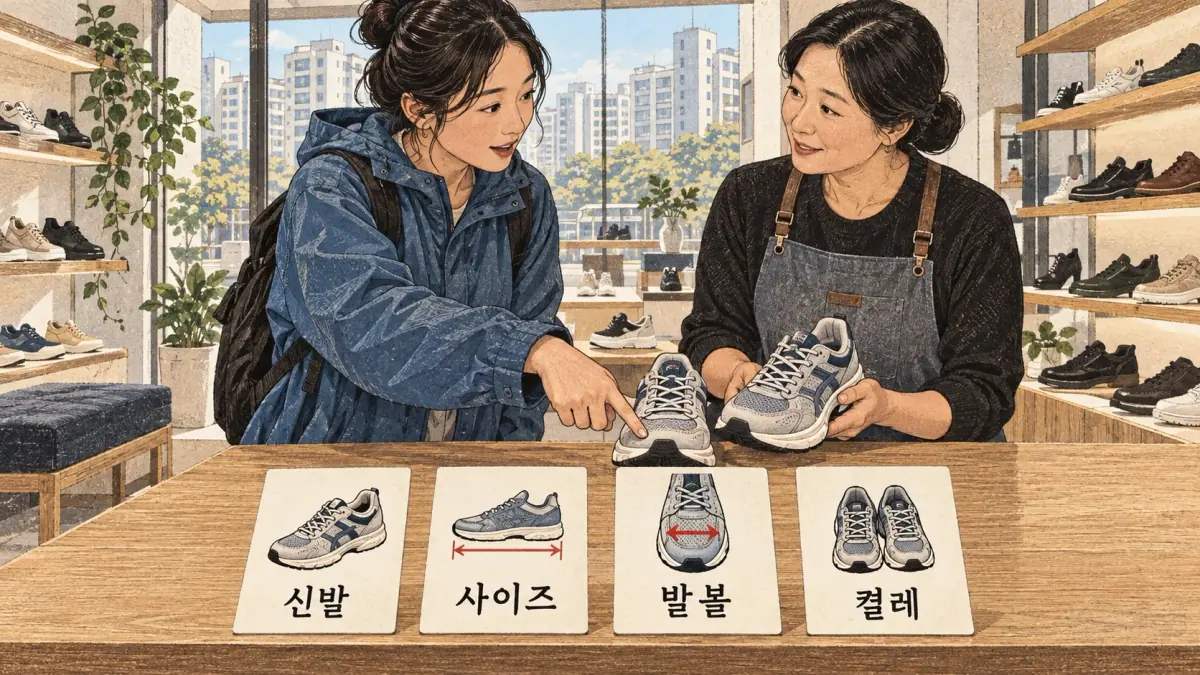
A size number and a pair counter perform different language tasks. The Korean number converter reads numeric labels, while Sino-Korean size numbers explains the number system used in many measurement contexts. The shoe converter delegates number reading to the shared engine instead of creating another competing number tool.
The Korean words신발, 사이즈, 발볼 and켤레 provide context for shoes, size, forefoot width and pairs. Read shoes in Korean and count pairs with 켤레 for the surrounding language. The numerical result alone does not tell you which question to ask about width or returns.
A Short Shop Conversation
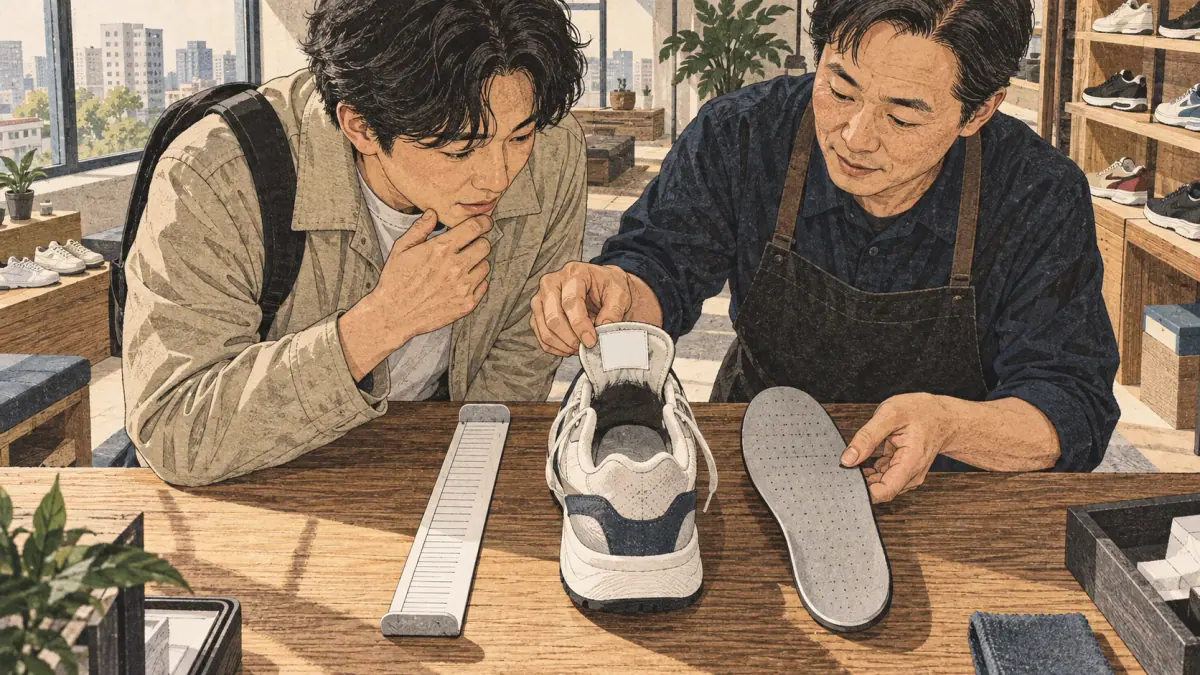
A practical conversation needs four decisions: identify the requested label, ask to try the shoes on, confirm available width options and check returns. Begin with the exact chart label and model rather than claiming that aKR number guarantees the right fit. If two candidate rows exist, show both to the seller.
Ask in plain language whether the table describes foot length or insole length. Ask which category the product follows, especially for unisex or youth footwear. Ask whether the indicated width is a linear measure, a circumference or only a named option. Finish by confirming the current exchange conditions. Shopping phrases supplies language practice for those tasks, while clothing and shoe vocabulary expands the product words. A chart lookup and a fitting conversation support different parts of the purchase.
What Should You Check before Ordering?
A charted size is not a stock guarantee. Confirm the actual product model, region, available width, selected label and seller's current returns. A category table can include a size that a particular color or shop does not carry. The converter has no live inventory connection.
Saved profiles preserve the chart date instead of silently updating your recorded choice. After a source change, recheck the new row and product chart before relying on the older conversion. Private profiles are optional and stored only in your browser; export important information because browser storage can be cleared.
A share link contains chart identity and a known label by default. Foot measurements require a deliberate inclusion choice. No photographs are collected. The loaded calculations work without a network; offline saving depends on supported browser storage and previously loaded assets. An uncached first visit still requires a connection. Those limits keep the tool useful without promising a remote fitting service.
What Information Does the Converter Retain?
The tool retains the original label or separate left and right readings in memory while you work. Selecting a chart changes the source context; it does not reinterpret a known label as a measured foot. Changing the source system clears the current result so an old candidate cannot appear to answer a new question. Clear removes current working measurements without silently deleting a deliberately saved profile.
Foot inputs accept millimeters, centimeters or inches, with up to three decimal places and supported mixed fractions. The ordinary measurement range is 30 to 500 mm after exact conversion. Width and girth must be greater than zero and at most 500 mm. These are interface safeguards, not claims about biological limits or an official sizing standard. A published known label can still be looked up independently of those measurement limits.
The result states whether a lookup is unique, ambiguous, between documented rows, outside the available range or unsupported by that source. Empty input produces instructions, not zero. A loading or import failure keeps the local fallback available. A successful clipboard action confirms copying; a blocked clipboard offers selectable text instead of claiming success.
Local profile export creates a user-owned backup. Restoring a backup validates its structure and chart identity before applying values. A source-date mismatch requires an explicit new lookup rather than silently replacing a recorded choice. Private information in a file deserves the same attention as information written on paper: review the selected report before sharing it.
Frequently Asked Questions
The questions below address the limits of a source-qualified conversion. Keep the chart identity beside the number when sharing an answer, and reopen the primary product source if its labels, category or measurement headings change.
Does Knowing My US Size Identify One Korean Size?
Not necessarily. A US label needs its chart category, brand and region before it identifies a source row. Nike Korea men and women give different equivalents for their documented KR 260 examples, and some KR labels match two rows. Preserve every candidate and confirm another published label or the actual product model.
Can I Use a Japan Label When KR Is Missing?
A JP label does not establish a Korean equivalent unless the same primary product source explicitly publishes that relationship. Adidas US gives JP 260 in its 25.5 cm foot example but does not publishKR. The converter leavesKR missing rather than inventing an equivalence from similar numbers. Seek a primary Korean chart or a clearly labelled seller table.
Does the Same Number Ensure the Same Insole Length?
No. A size label identifies a chart row, while insole length measures a physical shoe component. Foot length and last length are different measurements again. An insole-based comparison needs a matching insole-specific table. Do not subtract a universal allowance or assume equal interior length across brands, categories or models.
Is a Child’s Age Enough for a Shoe-Size Recommendation?
No. Age is shopping context, not a substitute for actual measurements and the appropriate child chart. Infant, toddler and youth systems can use different suffixes and category boundaries. Measure both feet, preserve the longer reading and consult the product instructions. Growth allowances must come from applicable guidance rather than an invented age-to-size formula.
Will a Charted Size Definitely Be in Stock?
No. A manufacturer chart describes labels and measurements, not a shop’s current inventory. Confirm the selected model, color, width and size on the product page, along with its exchange conditions. The converter does not query live stock or guarantee that a documented category example is available from a particular seller.
Choose Korean Shoe Size to US with a Source You Can Check
Choose Korean shoe size to US with a named chart, category and source date. Preserve duplicate candidates and missing fields. Measure both feet using a verified ruler, then check product-specific width and fit guidance. Use Korean learning tools for related number and shopping practice, and the contact channel to report a changed source row. A chart provides equivalent labels; the product and fitting check complete the decision.