What you'll learn
- Count pairs of shoes, socks and gloves with 켤레, and outfits with 벌.
- Choose between 켤레, 벌 and 쌍 for a given item.
- Say "a pair of pants" correctly and ask for a size in a store.
- Count one shoe or one sock with 짝.
Prerequisites: native Korean numbers 1-10. Estimated time: 30 minutes.
Korean Counter Kyeolle: the Essentials
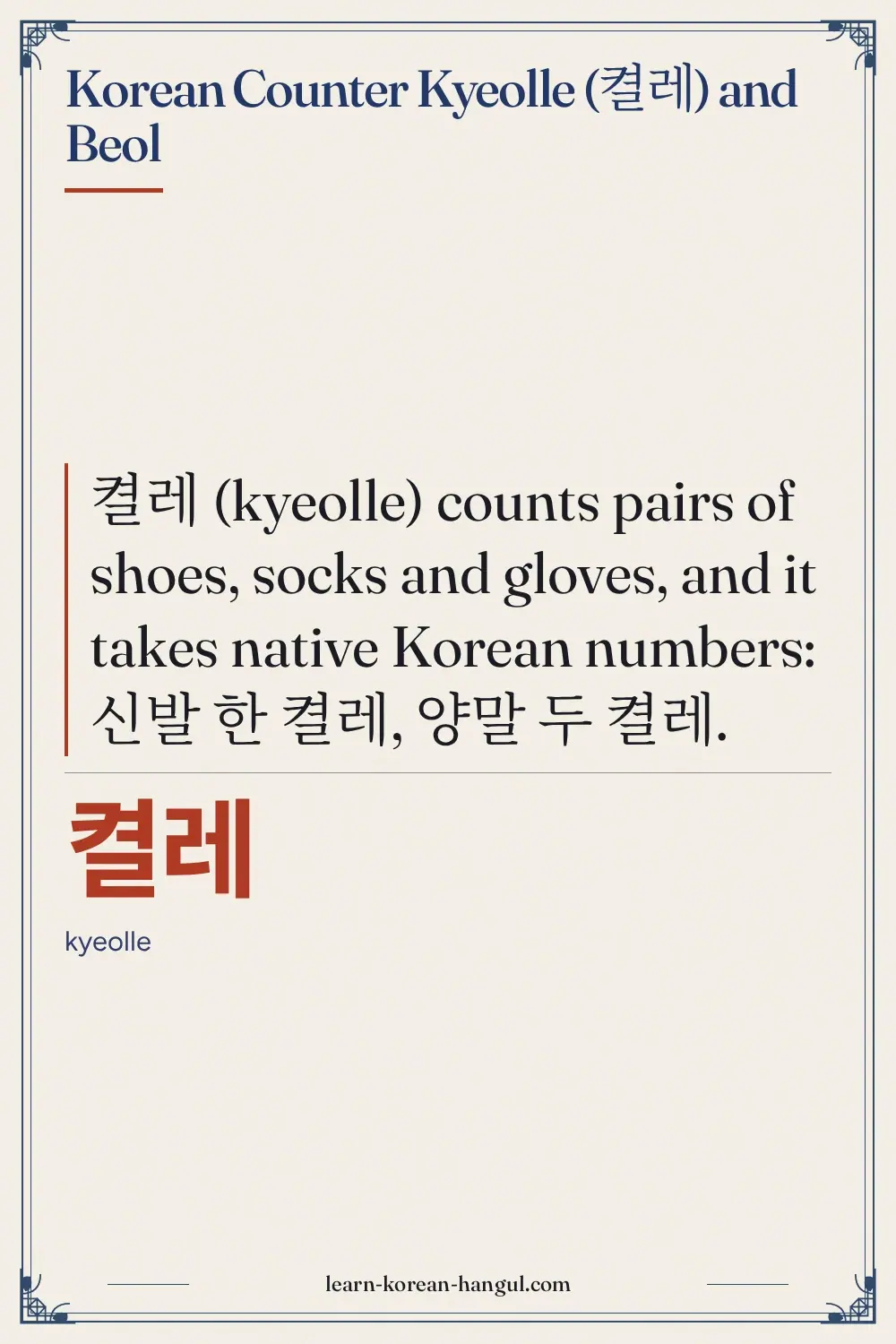
The Korean counter kyeolle (켤레) is a short word that follows a number and means "pairs of". A counter is a word that tells you what kind of unit a number refers to. English uses "pair" in a similar way: "two pairs of socks". Korean also needs a counter almost every time, and 켤레 is the one for footwear, socks and gloves, which come in left-and-right pairs.
The pattern is: item + native number + 켤레 (or 벌 for sets of clothes).
| Item | Number + counter | Meaning |
|---|---|---|
| 신발 (sinbal) | 신발 한 켤레 | one pair of shoes |
| 양말 (yangmal) | 양말 두 켤레 | two pairs of socks |
| 장갑 (janggap) | 장갑 세 켤레 | three pairs of gloves |
| 양복 (yangbok) | 양복 한 벌 | one suit |
| 한복 (hanbok) | 한복 두 벌 | two hanbok outfits |
| 옷 (ot) | 옷 세 벌 | three outfits |
The counter 켤레 counts things worn on the feet and hands in pairs. The counter 벌 counts clothes worn on the body as an outfit or a whole garment. A third counter, 쌍, counts matched pairs of anything, and a fourth word, 짝, counts one of a pair. This lesson covers all four, because they share a shopping scene.
Like most counters for things, these take native Korean numbers (하나, 둘, 셋), not Sino-Korean ones (일, 이, 삼). So 두 켤레 is correct and 이 켤레 is not. The wider system is explained in how Korean counters work. The next section puts the counters into sentences.
How Do You Use 켤레 and 벌 in a Sentence?
To use 켤레 or 벌 in a sentence, put the item first, then the native number, then the counter: 신발을 두 켤레 샀어요 (I bought two pairs of shoes). English puts the number before the noun, but Korean puts the counter phrase after the noun, and the counter is an extra word that English does not need.
Three patterns cover almost every real sentence.
| Job | Pattern | Example |
|---|---|---|
| Buying | Item + particle + number + counter + verb | 양말을 세 켤레 샀어요. |
| Owning | Item + 이/가 + number + counter + 있어요 | 정장이 두 벌 있어요. |
| Packing | Item + 은/는 + number + counter + 챙겼어요 | 운동화는 한 켤레 챙겼어요. |
More sentences to hear and repeat:
- 현관에 신발이 네 켤레 있어요. (There are four pairs of shoes at the entrance.)
- 결혼식에 입을 한복을 한 벌 빌렸어요. (I rented one hanbok to wear to the wedding.)
- 여행 가방에 옷 다섯 벌을 넣었어요. (I put five outfits in the suitcase.)
The particle 을/를 or 이/가 can sit on the item (양말을 세 켤레) or be dropped in speech (양말 세 켤레 샀어요). You never put a particle between the number and the counter. Writing 세를 켤레 is always wrong. A particle after the counter phrase is fine: 한 켤레만 있어요 means "I have only one pair".
Now you can build a full sentence. Next comes the number rule that makes the counters work.
Which Number System Do They Take?
The counters 켤레, 벌 and 쌍 take native Korean numbers from 1 to 99. Five native numbers shorten before any counter, and learning those five forms once covers every counter that takes native numbers, including 개, 권 and 잔.
| Number | 켤레 | 벌 | 쌍 |
|---|---|---|---|
| 1 | 한 켤레 [한켤레] | 한 벌 [한벌] | 한 쌍 |
| 2 | 두 켤레 | 두 벌 | 두 쌍 |
| 3 | 세 켤레 | 세 벌 | 세 쌍 |
| 4 | 네 켤레 | 네 벌 | 네 쌍 |
| 5 | 다섯 켤레 [다섣켤레] | 다섯 벌 [다섣뻘] | 다섯 쌍 [다섣쌍] |
| 6 | 여섯 켤레 [여섣켤레] | 여섯 벌 [여섣뻘] | 여섯 쌍 [여섣쌍] |
| 7 | 일곱 켤레 [일곱켤레] | 일곱 벌 [일곱뻘] | 일곱 쌍 [일곱쌍] |
| 8 | 여덟 켤레 [여덜켤레] | 여덟 벌 [여덜벌] | 여덟 쌍 [여덜쌍] |
| 9 | 아홉 켤레 [아홉켤레] | 아홉 벌 [아홉뻘] | 아홉 쌍 [아홉쌍] |
| 10 | 열 켤레 [열켤레] | 열 벌 [열벌] | 열 쌍 [열쌍] |
Look at the "Spoken" forms for 벌 after 5, 6, 7 and 9. A final ㅅ or ㅂ is said as a plain stop ([ㄷ] or [ㅂ]), and that stop usually makes the ㅂ of 벌 tense, so you hear [ㅃ]. This is tensification, covered by the National Institute of Korean Language (국립국어원) standard pronunciation rules (표준 발음법). The ㅋ of 켤레 and the ㅆ of 쌍 are already strong sounds, so they do not change. After ㄹ, as in 여덟 벌 and 열 벌, the standard form stays plain. The same effect gives 몇 벌 the sound [멷뻘].
Which Forms Shorten before the Counter?
Five numbers shorten before a counter: 하나 becomes 한, 둘 becomes 두, 셋 becomes 세, 넷 becomes 네 and 스물 becomes 스무. These short forms are numeral determiners (수 관형사). They stand in front of the counter the way an adjective stands in front of a noun.
| Full number | Counting form | Example with 켤레 | Example with 벌 |
|---|---|---|---|
| 하나 (1) | 한 | 한 켤레 | 한 벌 |
| 둘 (2) | 두 | 두 켤레 | 두 벌 |
| 셋 (3) | 세 | 세 켤레 | 세 벌 |
| 넷 (4) | 네 | 네 켤레 | 네 벌 |
| 스물 (20) | 스무 | 스무 켤레 | 스무 벌 |
The shortening applies at the end of larger numbers too: 열한 벌 (11), 열두 켤레 (12), 스물한 벌 (21). Round tens keep their full form: 서른 켤레 (30), 마흔 벌 (40).
Expert tip: learners often say 둘 켤레 because 둘 is the first form of two they learned. Say 두 켤레. A quick check: if a counter follows, the number is 한, 두, 세, 네 or 스무, never 하나, 둘, 셋, 넷 or 스물.
What Happens at 100 and Above?
Native numbers stop at 아흔아홉 (99) in everyday counting. A shoe factory that makes 백 켤레 (100 pairs) or a uniform supplier with 이백 벌 uses Sino-Korean numbers. Everyday shopping stays between 한 켤레 and 스무 켤레.
When you write with digits, attach the counter without a space: 3켤레, 12벌. When you write the number in Hangul, keep a space: 세 켤레, not 세켤레. The spacing rule is Article 43 of the 한글 맞춤법 (Hangul spelling rules).
You can now count a wardrobe. Next comes the choice between the two main counters.
Should You Use 켤레 or 벌?
Use 켤레 for things that come in left-and-right pairs, and 벌 for clothes that form an outfit or a whole garment. The test is simple: if you wear one on each foot or hand, it is 켤레. If you wear it on the body, it is 벌.
| Item | Counter | Example | Why |
|---|---|---|---|
| 신발 (shoes) | 켤레 | 신발 한 켤레 | left and right |
| 양말 (socks) | 켤레 | 양말 세 켤레 | left and right |
| 장갑 (gloves) | 켤레 | 장갑 두 켤레 | left and right |
| 양복 (suit) | 벌 | 양복 한 벌 | jacket and trousers |
| 한복 (hanbok) | 벌 | 한복 두 벌 | top and skirt or trousers |
| 정장 (formal wear) | 벌 | 정장 한 벌 | whole outfit |
| 잠옷 (pyjamas) | 벌 | 잠옷 두 벌 | top and bottom |
The word 옷 (clothes) always takes 벌: 옷 한 벌 is one outfit. The usual word for shoes is 신발, and it takes 켤레. Check the vocabulary in Korean clothing vocabulary when you meet a new item.
What Does 쌍 Count?
쌍 counts matched pairs and couples that belong together by nature, such as earrings, twins or a married couple. The counter 쌍 is wider than 켤레: it can be used for anything that forms a natural pair, not only things you wear.
| Item | Phrase | Meaning |
|---|---|---|
| 귀걸이 (earrings) | 귀걸이 한 쌍 | one pair of earrings |
| 부부 (married couple) | 부부 한 쌍 | one married couple |
| 쌍둥이 (twins) | 쌍둥이 한 쌍 | one pair of twins |
| 원앙 (mandarin ducks) | 원앙 한 쌍 | one pair of mandarin ducks |
| 신랑 신부 | 한 쌍의 신랑 신부 | a bride and groom |
One of a pair is 짝. A single shoe is 신발 한 짝, and a single sock is 양말 한 짝. If you lose one glove, you say 장갑 한 짝을 잃어버렸어요 (I lost one glove). The counter 짝 also means a partner, as in 짝을 찾다 (to find a partner), which shows its link with pairs.
| Counts | Counter | Example |
|---|---|---|
| a worn pair (feet, hands) | 켤레 | 신발 한 켤레 |
| a natural pair or couple | 쌍 | 귀걸이 한 쌍 |
| one of a pair | 짝 | 신발 한 짝 |
In practice, speakers sometimes use 쌍 for shoes too. 신발 한 쌍 is understood, but 켤레 is the neutral choice in shops, so learn that first.
How Do You Say "a Pair of Pants"?
To say "a pair of pants", use 바지 한 벌. Korean treats trousers as one garment, so there is no word for "pair" in the phrase. The counter 벌 fits a whole garment, and 바지 두 벌 means two pairs of pants.
| English | Korean | Note |
|---|---|---|
| a pair of pants | 바지 한 벌 | one garment |
| two pairs of jeans | 청바지 두 벌 | one garment each |
| a skirt | 치마 한 벌 | whole garment |
| a dress | 원피스 한 벌 | whole garment |
What about a single shirt? Usage varies here. Many speakers count shirts and T-shirts with 장, as in 티셔츠 두 장, because the garment lies flat in a shop. Others say 티셔츠 두 벌 or 티셔츠 두 개. All of these are understood. In a clothing store, listen for the counter the staff use and copy it. For an outfit or set, 벌 is always right.
Does 벌 Count Anything besides Clothes?
Yes. 벌 also counts matched sets that are not clothes, and the most common case is tableware. 수저 한 벌 means one set of a spoon and chopsticks. The idea is a set that belongs together.
| Item | Phrase | Meaning |
|---|---|---|
| 수저 (spoon and chopsticks) | 수저 한 벌 | one set of cutlery |
| 그릇 세트 | 그릇 한 벌 | one set of bowls |
| 교복 (school uniform) | 교복 한 벌 | one school uniform |
The point to remember is that 벌 means "a set that is worn or laid together". The 개 counter is the fallback for single objects when no set is meant.
How Do You Ask for a Size and a Count?
To ask for a count and a size, name the size and then the item with the counter: 이백육십으로 한 켤레 주세요 (one pair in size 260, please). Korean shoe sizes are given in millimetres and read with Sino-Korean numbers, so 260 is 이백육십. Clothes are often sized with the letters S, M and L.
Shoe Store Dialogue
- 직원: 어서 오세요. 뭐 찾으세요? (Welcome. What are you looking for?)
- 손님: 운동화 한 켤레 사고 싶어요. (I want to buy a pair of sneakers.)
- 직원: 사이즈가 어떻게 되세요? (What is your size?)
- 손님: 이백육십이에요. (It is 260.)
- 직원: 이 신발 한번 신어 보세요. (Please try on these shoes.)
Clothing Store Dialogue
- 손님: 정장 한 벌 맞추고 싶어요. (I would like to have a suit made.)
- 직원: 네. 몇 벌 필요하세요? (Yes. How many do you need?)
- 손님: 두 벌이요. 바지는 하나 더 주세요. (Two. Please add one more pair of trousers.)
Notice that 맞추다 means to have something made to measure, and the clerk asks 몇 벌 to count outfits. The last line uses the bare number 하나 for the extra trousers, because the item is clear from context. For more lines like these, see Korean shopping phrases.
How Do You Ask How Many with 몇 켤레 and 몇 벌?
To ask how many pairs, say 몇 켤레예요? To ask how many sets, say 몇 벌이에요? The word 몇 means "how many". 몇 켤레 is pronounced [멷켤레], and 몇 벌 is pronounced [멷뻘], because the final ㅊ of 몇 is said as [ㄷ].
| Situation | Question | Answer |
|---|---|---|
| Shoes | 신발이 몇 켤레 있어요? | 네 켤레 있어요. |
| Socks | 양말 몇 켤레 필요하세요? | 세 켤레 필요해요. |
| Outfits | 옷이 몇 벌 필요해요? | 다섯 벌 필요해요. |
| Uniforms | 교복이 몇 벌이에요? | 두 벌이에요. |
Daily-Life Phrases with 켤레 and 벌
Most real uses of 켤레 and 벌 fall into a few daily scenes: shopping, packing, laundry and events. Learn these phrases as whole chunks, because the number and counter then come out together without thinking.
| Scene | Phrase | Meaning |
|---|---|---|
| Shoe shop | 이 신발 한 켤레 주세요. | One pair of these shoes, please. |
| Sock shop | 양말 세 켤레에 오천 원이에요. | Three pairs of socks cost 5,000 won (example). |
| Travel | 속옷은 세 벌만 챙겼어요. | I packed only three sets of underwear. |
| Wedding | 한복 두 벌을 빌렸어요. | I rented two hanbok. |
| Gift | 아이에게 장갑 한 켤레를 선물했어요. | I gave a child a pair of gloves. |
| Laundry | 교복 한 벌을 세탁소에 맡겼어요. | I left a school uniform at the cleaner. |
The particle 에 in 세 켤레에 means "for" a price, and 만 in 세 벌만 means "only". Both attach to the counter phrase. Next, clear up the beliefs that trip up learners.
Misconceptions about 켤레 and 벌
Learners often assume that 켤레 counts every pair, or that 벌 counts any piece of clothing. Both ideas are only partly true.
Misconception 1: 켤레 counts every pair. 켤레 counts footwear, socks and gloves. Earrings use 쌍, and trousers use 벌, because trousers are one garment.
Misconception 2: 벌 means "one piece". 벌 means "one set" or "one whole garment". 옷 한 벌 is usually one outfit, not one shirt.
Misconception 3: 신발 한 켤레 means one shoe. It means a pair. One shoe is 신발 한 짝.
Misconception 4: Sino numbers sound more formal. These counters never take them below 100. Politeness lives in the verb ending, not in the number system.
Common Mistakes and Fixes
The most frequent errors with these counters are about number forms and counter choice. Each one has a simple fix.
| Mistake | Why it is wrong | Fix |
|---|---|---|
| 신발 이 켤레 | Sino number with a native counter | 신발 두 켤레 |
| 양말 셋 켤레 | Full number before a counter | 양말 세 켤레 |
| 두 벌 정장을 샀어요. | Counter phrase before the noun sounds unnatural | 정장을 두 벌 샀어요. |
| 스물 벌 | Full form of 20 before a counter | 스무 벌 |
| 바지 한 켤레 | Trousers are one garment | 바지 한 벌 |
| 귀걸이 한 켤레 | Earrings are a natural pair | 귀걸이 한 쌍 |
Remember the rule of thumb: footwear, socks and gloves use 켤레, whole garments and sets use 벌, and natural pairs use 쌍.
Practice Set
Try these five questions before you check the answers below.
- Fill in the blank: 양말 ___ 켤레 주세요. (three)
- Say "one suit" in Korean.
- Which counter fits a pair of earrings?
- How do you say "one shoe" (not a pair)?
- Correct this sentence: 바지 한 켤레 샀어요.
Practice · 8
Fill in the blank for three pairs of socks: 양말 ___ 켤레 주세요.
Show answer
세
켤레 takes native numbers, and 셋 shortens to 세 before a counter.
How do you say "one suit"?
Show answer
양복 한 벌
A suit is a whole outfit, so it takes 벌 with a native number.
Which counter fits a pair of earrings?
Show answer
쌍
Earrings are a natural matched pair, so they take 쌍: 귀걸이 한 쌍.
How do you say "one shoe" (not a pair)?
Show answer
신발 한 짝
One of a pair is 짝; 신발 한 켤레 means a whole pair.
Correct this sentence: 바지 한 켤레 샀어요.
Show answer
바지 한 벌 샀어요.
Korean treats trousers as one garment, so they take 벌.
Which counter fits a set of spoon and chopsticks (수저)?
Show answer
벌
벌 also counts matched sets that are laid together, such as 수저 한 벌.
How is a shoe size of 260 read?
Show answer
이백육십
Korean shoe sizes are given in millimetres and read with Sino-Korean numbers.
How is 다섯 벌 pronounced?
Show answer
[다섣뻘]
The final ㅅ is said as [ㄷ], which makes the ㅂ of 벌 tense: [다섣뻘].
Answers
- 세. The sentence is 양말 세 켤레 주세요.
- 양복 한 벌.
- 쌍, as in 귀걸이 한 쌍.
- 신발 한 짝.
- 바지 한 벌 샀어요. Trousers are one garment, so they take 벌.
What This Lesson Does Not Cover
This lesson covers 켤레, 벌, 쌍 and 짝 for clothes and shoes. It does not cover the general fallback for single objects (see the 개 counter), books (see the 권 counter) or machines (see the 대 counter). It also leaves out bedding counters, jewellery sizes and the full sizing systems for clothes.
What to Learn Next
The next lesson is the 개 counter, the default for objects that have no counter of their own. To see every counter for objects side by side, go back to Counting Things. Once the korean counter kyeolle feels natural, practise it with Korean shopping phrases and the numbers in native Korean numbers 1-100.
Frequently Asked Questions
Is 벌 for a single shirt?
Not always. 벌 counts a set or a whole garment such as a suit, a hanbok or a dress, so 옷 한 벌 can mean one outfit. For a single shirt or T-shirt, many speakers say 한 장 or 한 벌, and usage varies by shop. For sets, 한 벌 is always safe.
How do I count socks?
Count pairs with 켤레: 양말 두 켤레 means two pairs of socks. To count a single sock, use 짝: 양말 한 짝. In a shop, 양말 세 켤레 주세요 asks for three pairs. Packs of socks are often sold as a bundle, so you may also hear 양말 한 세트 for one pack.
What is the difference between 켤레 and 쌍?
켤레 is the counter for things you wear in pairs, such as shoes, socks and gloves. 쌍 is wider. It counts any matched pair or couple, such as earrings, twins, a pair of birds or a married couple. If the pair is footwear or a glove, use 켤레. If the pair is a natural match, use 쌍.
How do I say "a pair of pants" in Korean?
Say 바지 한 벌. Korean treats trousers as one garment, so there is no word for "pair" in this phrase, and the counter 벌 fits a whole garment. Do not use 켤레 for pants. The phrase 바지 두 벌 means two pairs of pants, and 청바지 한 벌 means one pair of jeans.
Do 켤레 and 벌 take Sino-Korean numbers?
No. Both take native Korean numbers from 1 to 99: 한 켤레, 두 벌, 스무 켤레. Sino forms such as 이 켤레 or 삼 벌 sound wrong. Above 99, Korean switches to Sino numbers, as in 백 켤레, which only a factory or a warehouse needs. Everyday shopping stays in the native range.