How Do You Use the TOPIK Score Calculator?
Start by choosing the exact exam product. PBT means the paper-based test; IBT means the internet-based test. TOPIK I, TOPIK II and the separate Speaking test do not share one universal score scale. The product selector displays the format and maximum so that a familiar-looking total is interpreted in the correct context.
Choose Section scores when you have the component marks from one attempt. Choose Total only when your report provides a total and you do not need section analysis. Mark the source as reported, practice or an arithmetic scenario in More. A practice estimate remains a practice estimate even when its number falls inside a published band.
Step 1: Choose the Exact Exam
Read the product name on your report before entering numbers. Do not infer the product from the size of the total. A score of 165 is possible on several scales and means something different on each. When changing products, clear the current marks or retain a separate attempt. The tool never doubles or halves your marks to make them fit another scale.
Step 2: Enter One Attempt
Enter all required sections from the same report. Blank input remains unknown; it does not become zero automatically. If writing has not been marked, explicitly mark it unknown to obtain an interval. A real awarded zero can be entered as zero. This distinction affects both the total and the possible levels.
Step 3: Read the Level and Target
Calculate to obtain the total or interval, the matching band and the points to the next minimum. Percent of maximum is labelled separately. More offers target capacity, what-if marks, weighted practice, local history and official-report guidance. Copy includes the selected product, score provenance and source version so the result remains interpretable outside the page.
How Is a TOPIK Score Calculated?
For a complete reported result, add the component scores and compare the total with the minimums for the selected product. The matching level is the highest published minimum that the total reaches. A score exactly at the minimum belongs to that band. There is no need to exceed the minimum by an extra point.
Current factual tables here follow NIIED Operating Regulation 218 and the published 2026 implementation notice. The tool preserves that source identity and provides separate historical IBT schemes where applicable. The official documents govern the rules; the calculator supplies an independent arithmetic interpretation of your inputs. NIIED regulation and annex, 2026 implementation notice.
Section Totals and Inclusive Boundaries
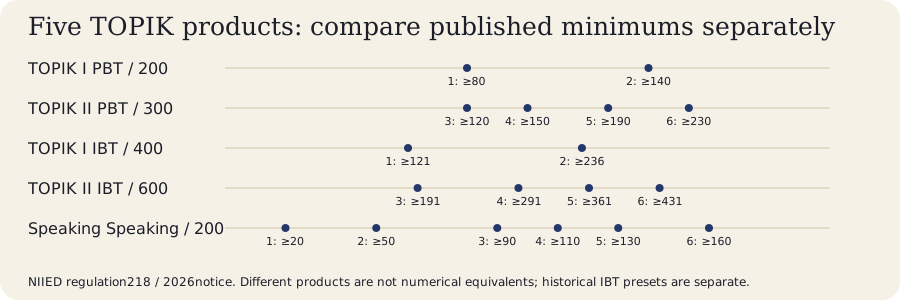
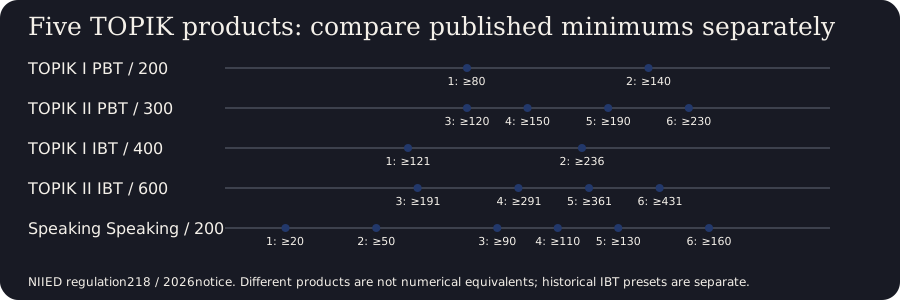
A total of 139 on PBT I is below 140, while 140 reaches level 2. A PBT II total of 149 reaches level 3, while 150 reaches level 4. Those one-point changes follow inclusive cutoffs rather than display styling. The accessible reference ruler prints the numerical minimums; color is never the only indication of a band.
Official reported scores use whole-number validation. A decimal practice mark is compared at its original value and is not rounded into a higher level. For example, 149.6 remains below 150 even if a different display rounds it to 150. The source, numerical value and interpretation must remain separate.
PBT I and II Passing-Score Tables
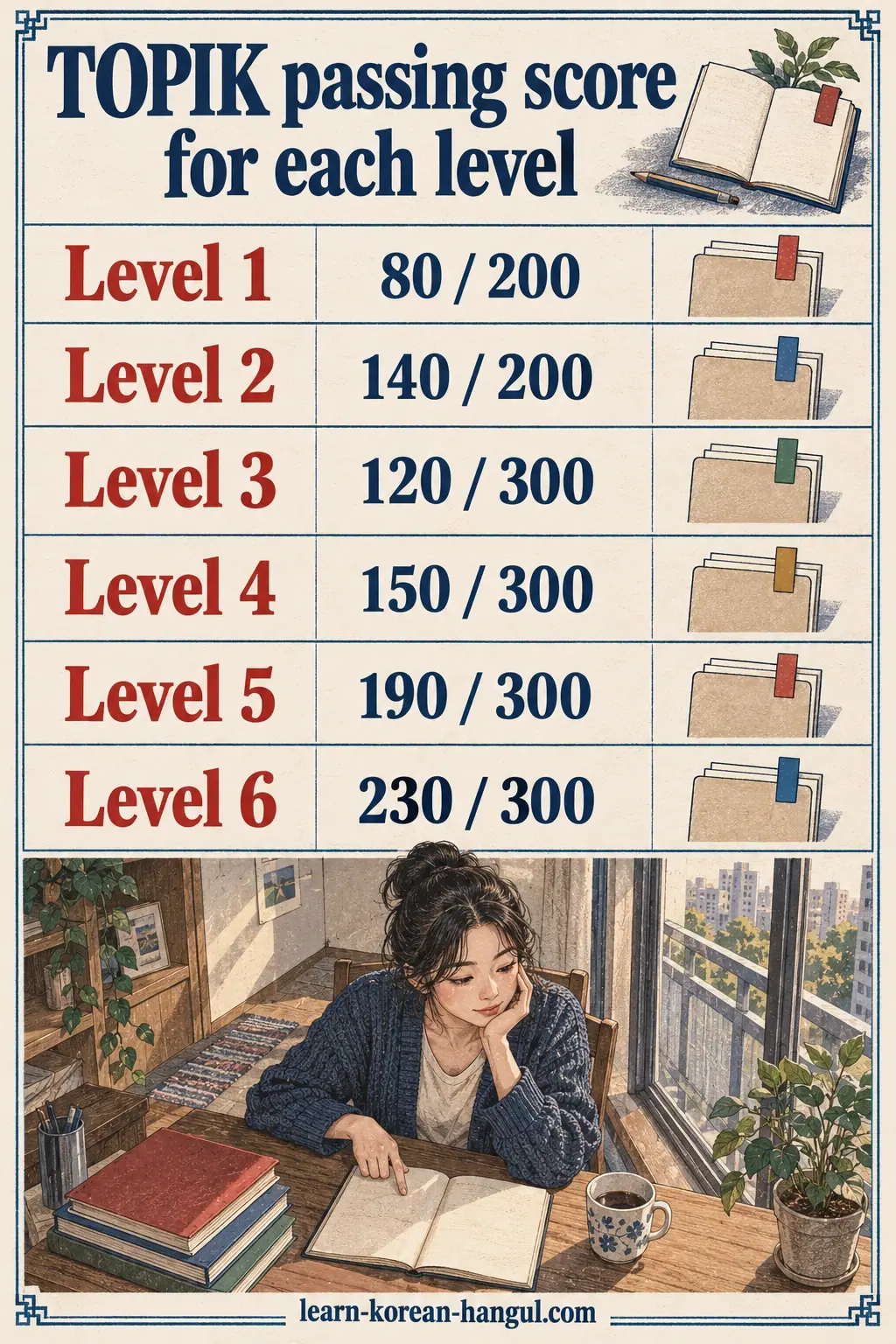
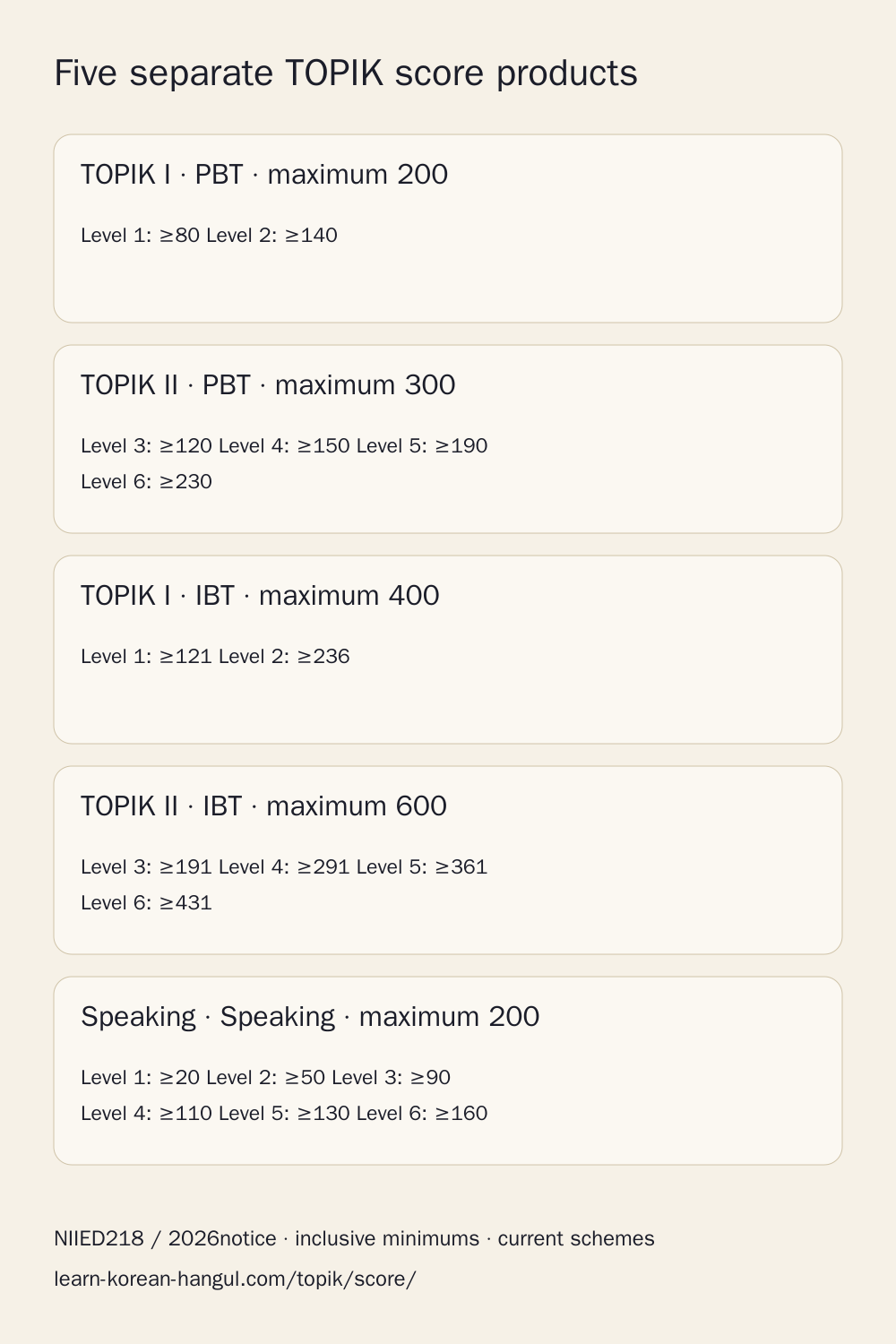
PBT I has listening and reading components, each with a 100-point maximum, for a total of 200. Under the current scheme, level 1 begins at 80 and level 2 at 140. A total below 80 receives no level on that product. PBT I does not award levels 3–6.
| PBT I total | Result |
|---|---|
| 0–79 | No level |
| 80–139 | Level 1 |
| 140–200 | Level 2 |
PBT II has listening, writing and reading, each with a 100-point maximum, for a total of 300. Its level range begins at 3. The current minima are 120, 150, 190 and 230 for levels 3–6. A low PBT II result is not automatically transferred into TOPIK I.
| PBT II total | Result |
|---|---|
| 0–119 | No level |
| 120–149 | Level 3 |
| 150–189 | Level 4 |
| 190–229 | Level 5 |
| 230–300 | Level 6 |
Why Does 150 Mean Different Things on Different Tests?
On PBT I, 150 is within level 2. On PBT II, it reaches level 4. The first result uses a 200-point product with two level bands; the second uses a 300-point product with four different bands. A percentage alone cannot resolve that difference. Always retain the product and format beside the number.
IBT Scores and the 2025 Rule Change
Current IBT I uses a 400-point maximum, with listening and reading capped at 200 each. Level 1 begins at 121 and level 2 at 236. Current IBT II uses a 600-point maximum, with listening, writing and reading capped at 200 each. Its minima are 191, 291, 361 and 431 for levels 3–6.
| Current IBT product | First band | Further minima | Maximum |
|---|---|---|---|
| IBT I | Level 1 at 121 | Level 2 at 236 | 400 |
| IBT II | Level 3 at 191 | Levels 4, 5, 6 at 291, 361, 431 | 600 |
Current and Historical IBT Bands
The historical IBT presets use the source scheme before the change effective from IBT session 5 on February 22, 2025. Historical IBT I minima were 132 and 208; historical IBT II minima were 204, 262, 331 and 412. The maxima were still 400 and 600. Those historical values are selectable for the reports to which they apply.
A historical IBT I total of 208 reaches level 2 under its historical scheme, while the same total reaches level 1 under the current scheme. Historical IBT II 262 reaches level 4, while the current scheme places it in level 3. Preserve the report’s scheme rather than silently applying whichever table was most recently published.
The larger IBT maximum does not supply a general PBT conversion formula. Doubling a PBT score or halving an IBT score is not an official equivalence. Compare each result within its own scale, using the skills and conditions associated with that attempt. The IBT format guide explains the product context.
What Does the Speaking Score Mean?
Speaking is a separate product with a 200-point maximum. Its six minimums are 20, 50, 90, 110, 130 and 160. A total of 159 reaches Speaking level 5; 160 reaches Speaking level 6. Below 20, no Speaking level is reached. The calculator labels these results as belonging to the Speaking product.
Do not add the Speaking result to a TOPIK II total or infer it from listening and reading. A report of receptive-language and writing performance cannot supply an unobserved speaking score. The Speaking product has its own tasks and reported result. Six tasks do not establish equal item weights or a simple correct-count conversion.
Continue with the separate TOPIK Speaking test when choosing practice materials or interpreting that report. This arithmetic tool does not grade a recording or issue a speaking assessment from a written total.
Worked Examples for Four Common Results
Example 1: PBT I 139 Becomes 140
Suppose a completed PBT I attempt has a total of 139. It lies in the level 1 interval and needs one additional point to reach the level 2 minimum. At 140, the result becomes level 2. The percentage changes from 69.5% to 70.0% of maximum, but the band change is determined by the inclusive minimum itself.
This example demonstrates a boundary rather than predicting how easy an extra point will be to gain. Actual improvement depends on the tasks, preparation and performance. The calculator can identify the arithmetic gap; it cannot forecast the next exam result from that gap.
Example 2: PBT II Totals 163
Enter listening 64, writing 38 and reading 61 from one PBT II attempt. The sum is 163 out of 300, or 54.3% of maximum when displayed to one decimal. It reaches level 4 because 163 is at least 150 and below 190. The gap to level 5 is 190 minus 163, giving 27 points.
The lower writing percentage is a descriptive observation. It does not prove writing is the quickest section to improve. Review the actual marking feedback and task demands before choosing a study priority. Keep the input provenance visible if writing was self-marked rather than officially reported.
Example 3: IBT II Totals 320
Listening 117, writing 105 and reading 98 sum to 320 out of 600. The displayed percentage is 53.3% of maximum. Current IBT II places 320 in level 4 because it lies between the minimums 291 and 361. The next gap is 41 points.
This percentage is close to the previous PBT example’s percentage, but the figures are not numerically interchangeable results. They belong to different products and marks. A same-format history comparison is useful for arithmetic tracking; a cross-format comparison needs the separate labels and broader assessment context.
Example 4: Speaking 159 Becomes 160
On the separate Speaking product, 159 is below the level 6 minimum of 160. It therefore reaches level 5 and needs one point to reach the next band. At 160, level 6 is reached. The result remains a Speaking result and is not appended to a PBT or IBT section total.
At the highest available band, the tool reports that the highest level has been reached rather than inventing a level 7 target. Scores above the band minimum can still differ numerically, but the selected product has no further awarded level to calculate.
How Many Points Do You Need for Your Target?
Choose a target that exists in the selected product. The basic gap is the target minimum minus your current complete total, with a floor of zero when the target has already been reached. A target calculation is exact arithmetic. It is not a probability estimate or a promise about your next result.
Section headroom gives another constraint. A PBT section cannot exceed 100; an IBT section cannot exceed 200 under these schemes. A what-if scenario should respect those caps rather than adding unlimited points to a convenient section. Mark scenarios separately from reported or practice results so that a planning figure is not mistaken for an actual attempt.
Section Headroom and Feasible Scenarios
For PBT II, lock listening 60 and reading 60, and target level 5 at 190. The remaining writing requirement is 70. Writing has a 100-point cap, so that arithmetic scenario is feasible. It does not predict that a person will obtain 70; it states what mark would meet the target while the locked marks stay fixed.
If listening and reading are both locked at 50 and the target is level 6 at 230, writing would need 130. That exceeds its cap of 100, so the target is impossible under those locks. The useful response is to reconsider which marks may change, not to round, rescale or hide the missing capacity.
Can Unknown Writing Marks Change Your Level?
Yes. If listening and reading total 120 on PBT II and writing is unknown from 0 to 100, the overall total spans 120–220. The compatible levels are 3, 4 and 5. Reporting one level would conceal the unresolved component. The calculator displays the interval and all crossed bands.
The interval is not a confidence interval or a statistical prediction. It is the complete arithmetic range permitted by the supplied known marks and the remaining section cap. Narrow it only with actual marking evidence or an explicitly documented range. A hopeful estimate is still a practice assumption and should remain labelled.
A 120–220 Result Interval
The low endpoint reaches level 3; a writing mark of 30 reaches level 4 at total 150; a writing mark of 70 reaches level 5 at total 190. The high endpoint of 220 is below level 6 at 230. These comparisons explain precisely which outcomes remain possible without assuming a writing score.
A blank field and an explicit awarded zero are different. Mark writing unknown when the work is not yet assessed. Enter zero when zero was genuinely awarded or deliberately selected as a scenario. That distinction survives copy, history and export so another reader can understand the result’s limits.
Can Correct-Answer Counts Predict an Official Score?
A correct count alone is insufficient when item weights or scaling are not documented. Reading, listening, writing and IBT tasks cannot all be treated as equal-weight interchangeable questions. A fraction such as 20 correct out of 26 describes count accuracy; it does not establish a general official IBT scaled score.
The Weighted answers workspace lets you supply each documented maximum and awarded mark. Correct, wrong, blank, partial and unknown states are distinct. A blank answer explicitly receives zero in that authored practice record. An unmarked answer keeps its possible maximum. Each weight needs a source identifier so the calculation remains traceable.
Weighted Practice Forms and Unresolved Scaling
For two authored items with maxima 4 and 3, awarding 4 and 0 gives 4 out of 7, or 57.1% practice accuracy. That small form does not produce a full-exam TOPIK level. If another unresolved item has a maximum of 6, known awarded marks of 4 can instead span 4–10. The result preserves the uncertainty.
A complete-form application requires documented scoring and a maximum matching the selected product. It still remains practice rather than an official certificate. Teacher-marked writing and speaking need actual rubric-based feedback. The full TOPIK mock test and the relevant marking guidance provide the next learning task; this calculator does not invent missing assessment evidence.
A Score Percentage, Percentile and CEFR Analogy
Percent of maximum divides your total by the selected product’s maximum. A score of 150 out of 300 is 50.0% of maximum. That says nothing about how many other candidates scored below you. A percentile requires an actual comparison cohort, the same scheme and a stated tie convention.
The local cohort workspace accepts user-owned scores with a name and date. Its midrank convention is 100 times the count below your score plus half the count equal to it, divided by cohort size. For the four scores 100, 150, 150 and 200, a score of 150 has percentile 50.0 within that particular cohort. It is not an official worldwide percentile.
What Evidence Would Validate a CEFR Comparison?
A third-party calculator publishes the rough analogy of levels 1–6 with A1, A2, B1, B2, C1 and C2. Here it is explicitly an unvalidated published convention, not an official NIIED equivalence or your achieved CEFR level. Different examinations sample skills and tasks differently; a neat six-row mapping does not validate itself.
The Council of Europe examination-linking methodology describes the kind of evidence needed for an examination relationship. Use a skill-by-skill self-assessment and the relevant institution’s requirements instead of treating the analogy as certification. The score export does not attach a claimed CEFR award.
How Do You Check the Official Result and Its Validity?
Obtain the official report through the TOPIK service. This page does not collect candidate numbers, passwords, birth dates or certificate identifiers. Read the product, section scores, total, awarded level and validity information on that report. Use the official result guide for the retrieval process.
The published validity reference begins from the announcement date and lasts two years. The date worksheet shows a two-year anniversary reference and asks for the expiry printed on the report. It does not invent an official day boundary when a leap date or inclusive endpoint is unresolved. The report’s actual printed expiry takes precedence.
Announcement Date and Recipient Deadline
An announcement date of May 29, 2026 has a two-year anniversary reference of May 29, 2028. That reference is not a substitute for reading the printed expiry. For a deadline check, enter that expiry and choose whether the recipient includes or excludes the expiry date. If the recipient’s policy is unknown, the comparison remains unresolved.
An institution can require a particular product, level, recency period or skill evidence beyond a numerical total. Ask the institution that owns the requirement. The announcement-date validity guide gives the broader context, while the calculator keeps the chosen source and endpoint assumptions visible.
Private History, Offline Use and Exports
Save an attempt only when you deliberately choose local history. A record contains the product, scheme, input provenance, attempt label, source version and calculated result. You can load, compare, delete or export records. Storage failure leaves the current session usable and provides a file-export alternative rather than blocking calculation.
JSON reopens complete records after schema validation and confirmation. CSV supports local audit and analysis with source fields retained. Print and authored PNG summaries are score references, not certificates. Clean page sharing omits scores by default; including a summary is a separate choice. External composers open only after a user action.
Saved Attempts Keep Their Original Scheme
A policy update should not silently reclassify an old report. Historical records keep their original source version, while a new interpretation is a separate calculation. Offline use retains the available snapshot. Explicit public caching saves tool assets, not a public score record or an account. A mode never loaded before may need its first download.
Frequently Asked Questions
Can I combine listening from one sitting with reading from another?
Keep scores from one report or one complete practice attempt together. Combining stronger sections from different sittings creates a scenario rather than the result of either exam. The calculator preserves an attempt label and rejects explicitly mixed attempts. Save separate records if you want to compare your progress across sittings.
Does a TOPIK II score below 120 give level 2?
No. Under the current PBT II scheme, a total below 120 receives no level in that product. TOPIK I and TOPIK II award different level ranges. The calculator does not transfer a low TOPIK II total into TOPIK I or infer a level 1 or 2 result from it.
Why did an older calculator say 165 is level 3?
Check which product and source version the older calculator used. Current PBT II has a level 4 minimum of 150, so 165 is in level 4. Some published calculator explanations use inconsistent cutoffs. Current IBT II is a different scale; 165 does not reach its first band. Always select the exact product.
Can I enter a total without my section scores?
Yes. Choose Total only, select the exact product and enter a reported whole score within its maximum. The calculator can identify the band and target gap from that total. It cannot infer section strengths, writing marks or a practice marking rubric when the component information was not supplied.
Will a rule update change my saved score?
Saved records retain their scheme, source version and original inputs. A newer rule should be selected deliberately for a separate interpretation rather than silently changing an earlier report. Historical IBT presets remain clearly labelled. Keep the source version in your export when comparing an older result with a newly published policy.
Is a practice summary a TOPIK certificate?
No. A practice summary records your supplied marks and an arithmetic interpretation. It is not an official score report, certificate or assessment of unmarked writing and speaking. Obtain official reports through the TOPIK service. Institutions decide which reports, dates and levels meet their own requirements.
Your Next Step with the TOPIK Score Calculator
Use the TOPIK score calculator with scores from one attempt and the exact exam format. Save the source date with your result, then choose a TOPIK study plan for the section you want to improve. Confirm your official report and any institution’s requirements through the channels that own them. For another task, continue with free Korean learning tools or what each TOPIK level describes.
A Final Check before You Compare Two TOPIK Results
Place the product, format and source version next to each total. Then check whether the figures describe reported scores, fully marked practice attempts or hypothetical changes. A PBT II listening improvement from 45 to 55 means ten more points on that section's published scale; it does not establish an equivalent improvement on an IBT listening scale. Comparing percentages can describe the fraction of each maximum, but it still cannot establish equivalent difficulty or ability.
Keep an unmarked section visible until its marks are available. If you replace an interval with a final writing score, save a new complete record with the same attempt label and explain the change in its note. This lets you distinguish progress between attempts from a change in information about one attempt. Finally, consult the receiving institution's actual report requirements rather than assuming that a calculator band, a practice estimate or a percentage satisfies an application rule. The TOPIK score calculator helps organize those checks while leaving the official decision with the published requirements.