Key facts
- Set A has 6 items in TOPIK I style; Set B has 4 items in TOPIK II style for levels 3-4.
TOPIK Listening Practice: the Essentials
TOPIK listening practice works best in short, timed sets with a careful review afterwards. The real test plays each recording on a fixed schedule, with no pausing or rewinding, so this page trains the same habit: listen once at normal speed, answer, and only then replay. Both sets use the four-option format (① to ④) of the real multiple-choice items.
| Set | Level | Items | Item types | Time |
|---|---|---|---|---|
| A | TOPIK I (levels 1-2) | 6 | reply choice, place, topic, next line, content match, number correction | about 8 minutes |
| B | TOPIK II (levels 3-4) | 4 | next action, announcement, main idea, reason | about 10 minutes |
Instructions on the real test are in Korean only. Learn the most common one before you start, so it costs you no time on the day:
다음을 듣고 알맞은 것을 고르십시오 (daeumeul deutgo almajeun geoseul goreusipsio) means "Listen to the following and choose the correct answer." The test format itself, with question counts and timing, is on the TOPIK exam format page. The next section explains how to work through a set.
How Do You Use a Listening Set?
Use each set in five steps: preview, listen once, answer, replay slowly, then log. The order matters, because answering before replaying is the only way to measure what you would score on the day.
- Preview the options (about 10 seconds per item). Read the four options before you press play. Underline what differs between them: a place, a time, a person or an action. You'll know it worked when you can say, before listening, what the item is testing.
- Listen once at normal speed. Do not pause. Keep your eyes on the options and mark a first answer as soon as you hear the deciding detail.
- Answer every item. Mark an answer even if you are unsure; a blank and a wrong answer score the same on TOPIK.
- Replay at 0.8x speed. Only now, use the slow setting and the transcript to find the exact words you missed.
- Log each miss. Use the self-check log below to record the item type and the cause of the error.
The common mistake at step 2 is pausing after every sentence. That turns listening into reading and hides your real speed problem. Tactics for each item type are on the TOPIK listening tips page. With the method set, start Set A.
Set a: TOPIK I Listening Practice
Set A copies six common TOPIK I item types. The speech is short, clear and polite. Play each item once, choose ①-④ in the quiz at the end of the set, and leave the answer key until you have finished all six.
Item A1: Choose the Right Reply
You hear a man ask a question. Choose the most natural reply.
커피 좋아해요?
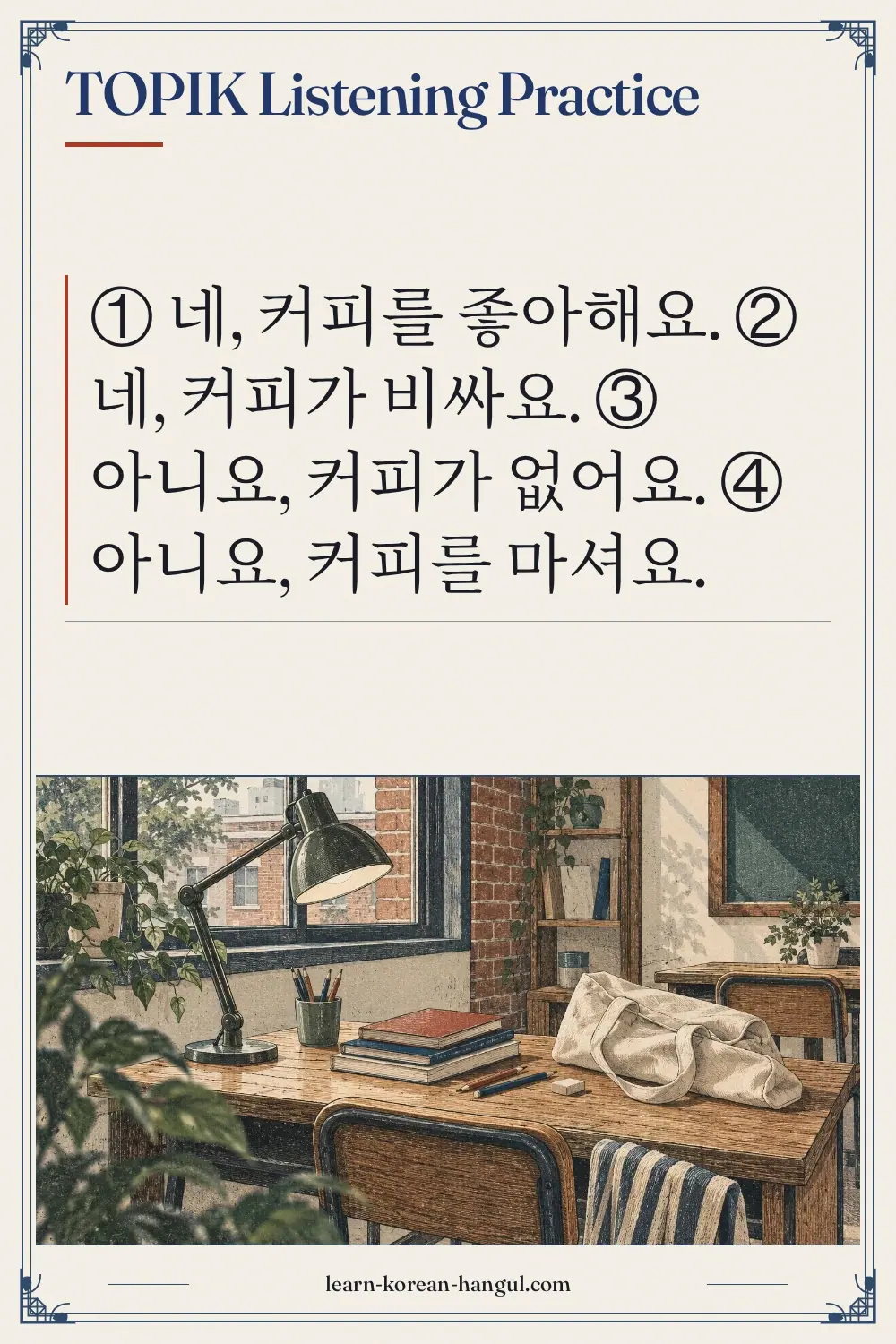
① 네, 커피를 좋아해요. ② 네, 커피가 비싸요. ③ 아니요, 커피가 없어요. ④ 아니요, 커피를 마셔요.
Item A2: Where Are They?
You hear a woman and a man. Choose the place where the conversation happens.
이 책을 빌리고 싶어요. 학생증 있으세요?
① 서점 (bookshop) ② 도서관 (library) ③ 은행 (bank) ④ 우체국 (post office)
Item A3: What Are They Talking About?
You hear two short statements. Choose the topic.
저는 봄을 좋아해요. 저는 눈이 와서 겨울이 좋아요.
① 날씨 (weather) ② 계절 (seasons) ③ 주말 (weekend) ④ 취미 (hobby)
Item A4: Choose the Next Line
You hear a woman make a suggestion. Choose what the man says next.
내일 같이 점심 먹을까요?
① 네, 맛있게 드세요. ② 좋아요. 몇 시에 만날까요? ③ 아니요, 점심이에요. ④ 네, 어제 먹었어요.
Item A5: Choose the Matching Statement
You hear a short conversation about the weekend. Choose the statement that matches it.
수미 씨, 주말에 뭐 했어요? 토요일에는 친구하고 쇼핑했어요. 일요일에는 집에서 쉬었어요. 저는 주말에 아르바이트를 했어요.
① 여자는 일요일에 쇼핑했어요. ② 남자는 주말에 일했어요. ③ 여자는 토요일에 혼자 있었어요. ④ 남자는 집에서 쉬었어요.
Item A6: Catch the Corrected Time
You hear a question and a correction. Choose the time of the meeting: 회의는 몇 시예요?
회의가 세 시예요? 아니요, 네 시로 바뀌었어요.
① 두 시 ② 세 시 ③ 네 시 ④ 다섯 시
Now mark your answers. The quiz gives feedback after each answer.
Practice · 6
Item A1: choose the right reply.
Show answer
① 네, 커피를 좋아해요.
The question 좋아해요? asks about liking, so the reply must use 좋아해요. Options 2 and 3 change the topic to price and having; option 4 says no but then describes drinking coffee.
Item A2: where are they?
Show answer
② 도서관
빌리다 (to borrow) and 학생증 (student ID) point to a library. A bookshop also has books, but you buy them there; that is the trap.
Item A3: what are they talking about?
Show answer
② 계절
봄 (spring) and 겨울 (winter) are seasons. 눈 (snow) tempts you towards weather, but both speakers name a favourite season.
Item A4: choose the next line.
Show answer
② 좋아요. 몇 시에 만날까요?
-(으)ㄹ까요? is a suggestion, so a natural reply accepts or refuses it. Option 2 accepts and asks a follow-up question. Option 1 is what you say to someone about to eat alone.
Item A5: choose the matching statement.
Show answer
② 남자는 주말에 일했어요.
The man did 아르바이트 (part-time work), which the option paraphrases as 일했어요. The woman shopped on Saturday with a friend and rested on Sunday, so options 1, 3 and 4 swap days or people.
Item A6: what time is the meeting?
Show answer
③ 네 시
The woman says 세 시 first, but the man corrects it: 네 시로 바뀌었어요 (it changed to four). The last number stated is the answer.
The answer key with transcripts is further down. If you scored 5 or 6, Set B is your next step; if you scored 4 or fewer, repeat Set A tomorrow before moving on.
Set B: TOPIK II Listening Practice (levels 3-4)
Set B copies four item types from the lower half of TOPIK II. The recordings are longer, include three turns, and use a wider range of endings. The options use the plain written style (-ㄴ/는다), as many TOPIK II options do.
Item B1: What Will the Man Do Next?
You hear a conversation at work. Choose what the man will do next.
민준 씨, 회의 자료 다 준비했어요? 네, 그런데 프린터가 고장 나서 아직 출력을 못 했어요. 그럼 제가 3층 사무실에서 출력해 올게요. 파일을 메일로 보내 주세요.
① 프린터를 고친다. ② 파일을 메일로 보낸다. ③ 3층 사무실에 간다. ④ 회의 자료를 만든다.
Item B2: Choose What Matches the Announcement
You hear an announcement in a building. Choose the statement that matches it.
안내 말씀 드리겠습니다. 오늘 오후 두 시부터 네 시까지 엘리베이터 점검이 있습니다. 점검 시간에는 계단을 이용해 주시기 바랍니다. 불편을 드려 죄송합니다.
① 엘리베이터는 오전에 점검한다. ② 점검은 두 시간 동안 한다. ③ 점검 시간에도 엘리베이터를 탈 수 있다. ④ 계단 공사가 있다.
Item B3: What Is the Man's Main Idea?
You hear a short discussion. Choose the man's central opinion.
요즘 아이들이 스마트폰을 너무 오래 사용하는 것 같아요. 그래도 스마트폰으로 공부도 할 수 있잖아요. 물론 그렇지만 사용 시간은 부모와 함께 정하는 게 좋다고 생각해요.
① 아이들은 스마트폰으로 공부해야 한다. ② 아이들의 스마트폰 사용 시간을 정할 필요가 있다. ③ 아이들에게 스마트폰을 사 주면 안 된다. ④ 부모가 스마트폰을 덜 사용해야 한다.
Item B4: Why Can't the Woman Go?
You hear a conversation between friends. Choose the reason the woman cannot join the group.
이번 주말 등산 모임에 못 갈 것 같아요. 왜요? 지난번에 꼭 가고 싶다고 했잖아요. 갑자기 회사에 일이 생겨서 토요일에도 출근해야 하거든요.
① 등산을 싫어해서 ② 몸이 아파서 ③ 회사에 일이 생겨서 ④ 다른 약속이 있어서
Practice · 4
Item B1: what will the man do next?
Show answer
② 파일을 메일로 보낸다.
The woman offers to print on the third floor and asks the man to email the file, so his next action is sending the file. Going to the third floor is her action, not his.
Item B2: which statement matches the announcement?
Show answer
② 점검은 두 시간 동안 한다.
오후 두 시부터 네 시까지 is two hours in the afternoon. Option 1 changes 오후 to 오전, option 3 reverses the instruction to use the stairs, and option 4 reuses the word 계단 with a new meaning.
Item B3: what is the man's main idea?
Show answer
② 아이들의 스마트폰 사용 시간을 정할 필요가 있다.
The man's last turn states his view: usage time should be set together with parents. Option 1 is the woman's point, and options 3 and 4 go further than anything he says.
Item B4: why can't the woman go?
Show answer
③ 회사에 일이 생겨서
She says 갑자기 회사에 일이 생겨서 토요일에도 출근해야 하거든요: something came up at work. The man's reminder that she wanted to go rules out option 1.
Answer Key and Transcripts
The answer key gives each transcript, the correct option and the trap. Speakers are labelled 남자 (man) and 여자 (woman), as on real TOPIK scripts.
| Item | Transcript | Answer | Trap in the wrong options |
|---|---|---|---|
| A1 | 남자: 커피 좋아해요? | ① | ② and ③ change the topic; ④ mixes 아니요 with a positive fact |
| A2 | 여자: 이 책을 빌리고 싶어요. 남자: 학생증 있으세요? | ② | ① shares the word 책 |
| A3 | 남자: 저는 봄을 좋아해요. 여자: 저는 눈이 와서 겨울이 좋아요. | ② | ① picks up 눈 (snow) |
| A4 | 여자: 내일 같이 점심 먹을까요? | ② | ④ answers a different question |
| A5 | 남자: 수미 씨, 주말에 뭐 했어요? 여자: 토요일에는 친구하고 쇼핑했어요. 일요일에는 집에서 쉬었어요. 남자: 저는 주말에 아르바이트를 했어요. | ② | ①, ③ and ④ swap days or speakers |
| A6 | 여자: 회의가 세 시예요? 남자: 아니요, 네 시로 바뀌었어요. | ③ | ② is the first number you hear |
| B1 | 여자: 민준 씨, 회의 자료 다 준비했어요? 남자: 네, 그런데 프린터가 고장 나서 아직 출력을 못 했어요. 여자: 그럼 제가 3층 사무실에서 출력해 올게요. 파일을 메일로 보내 주세요. | ② | ③ is the woman's action |
| B2 | 여자: 안내 말씀 드리겠습니다. 오늘 오후 두 시부터 네 시까지 엘리베이터 점검이 있습니다. 점검 시간에는 계단을 이용해 주시기 바랍니다. 불편을 드려 죄송합니다. | ② | ① changes afternoon to morning; ④ reuses 계단 |
| B3 | 남자: 요즘 아이들이 스마트폰을 너무 오래 사용하는 것 같아요. 여자: 그래도 스마트폰으로 공부도 할 수 있잖아요. 남자: 물론 그렇지만 사용 시간은 부모와 함께 정하는 게 좋다고 생각해요. | ② | ① is the woman's opinion |
| B4 | 여자: 이번 주말 등산 모임에 못 갈 것 같아요. 남자: 왜요? 지난번에 꼭 가고 싶다고 했잖아요. 여자: 갑자기 회사에 일이 생겨서 토요일에도 출근해야 하거든요. | ③ | ④ is a common reason, but not the one stated |
Three traps repeat across both sets: an option that reuses a word from the audio with a different meaning, an option that describes the other speaker, and an option built on a detail that is later corrected. The same three traps recur in many past-paper items, which is why the log below records the cause, not only the item.
How Do You Log Your Errors?
Log every wrong answer in one line: the item type, what you chose, what was correct, and the cause. After two or three sets, the pattern in the "cause" column tells you what to train.
| Date | Set and item | Item type | My answer | Correct | Cause | Fix for next time |
|---|---|---|---|---|---|---|
| example | A6 | number / time | ② | ③ | took the first number | wait for the last number stated |
| example | B3 | main idea | ① | ② | chose the other speaker's view | note who speaks last |
Use these five causes, so your log stays comparable from week to week:
- Word unknown: a key word was new to you. Fix: add it to your flashcards.
- Word missed by ear: you know the word in writing but did not catch it. Fix: dictation of the transcript.
- Trap option: you chose a word-match, wrong speaker or corrected detail. Fix: re-read the trap column above.
- Speed: you were still processing when the next line started. Fix: shadow the transcript at 0.8x, then 1x.
- Option misread: you misunderstood the answer text itself. Fix: slower preview, underline the differences.
For "missed by ear" errors, the Korean listening discrimination tool trains similar-sounding words with instant feedback. Once your log is running, the next decision is how much practice to do.
How Many Sets Should You Do per Week?
Two to four short sets a week, plus one full timed mock every two to four weeks, is a realistic rhythm for most learners. Short sets build the habit; full mocks build stamina and test pacing.
| Weeks before the test | Short sets per week | Full timed mock | Review time per set |
|---|---|---|---|
| 12-8 | 2 | every 4 weeks | 15 minutes |
| 8-4 | 3 | every 2-3 weeks | 15 minutes |
| 4-1 | 4 | every week or two | 10 minutes |
| test week | 1-2 light sets | none | 5 minutes |
When the two sets on this page are finished, the Korean audio dialogues collection gives more everyday listening at a similar level, and the TOPIK mock test page explains how to run and score a full timed paper. The last step is to train with the real recordings.
Where Can You Find Official TOPIK Audio?
Official TOPIK audio comes from the past papers that NIIED publishes on the official TOPIK website (topik.go.kr). This site links to them rather than copying them. The TOPIK past papers page explains how to find them and which papers to start with.
| Source | Best for | Limitation |
|---|---|---|
| This page (Sets A and B) | Learning the item types, logging errors | 10 items, AI-generated audio |
| Official past papers | Realistic voices, full-length timing | No explanations of the traps |
| Korean audio dialogues | Daily listening volume | Not in test format |
| Listening discrimination tool | Similar-sounding words | Single words, not dialogues |
Use this page first to learn the traps, then switch to past papers for timing. The paper-based and internet-based tests can differ in question counts and timing, so check the current official guide for the version you will sit.
What This TOPIK Listening Practice Does Not Cover
This TOPIK listening practice covers ten items, not a full paper. It does not include picture-choice items, because those need printed images, and it does not reach the long lectures and debates of the upper TOPIK II items. Treat a perfect score here as readiness to start past papers, not as a predicted test score. For more on the whole listening section, return to TOPIK listening.
Frequently Asked Questions
Are These Official TOPIK Questions?
No. Every item on this page is original practice written to copy the item types of TOPIK I and TOPIK II, not taken from a real paper. The official TOPIK website (topik.go.kr) publishes selected past papers with audio, and you should use those for full timed mocks once these sets feel comfortable.
Can I Slow down the Audio?
Yes. Each player has a slow setting at 0.8 times normal speed. Use it only on your second pass, after you have answered at normal speed, because the real test plays at normal speed. If you need the slow setting for every item, spend a week on easier dialogues before returning.
How Do I Check My Answers?
Each set has a built-in quiz that marks your answers and explains them, and the answer key on this page gives the transcript, the correct option and the trap in each wrong option. Check only after finishing the whole set, then log every miss by item type and cause.
Is the Audio Like the Real TOPIK?
It is clear and close to the pace of TOPIK I, but it is not the official recording. Use it to train item types and habits, then use official past-paper audio for realistic voices and timing.