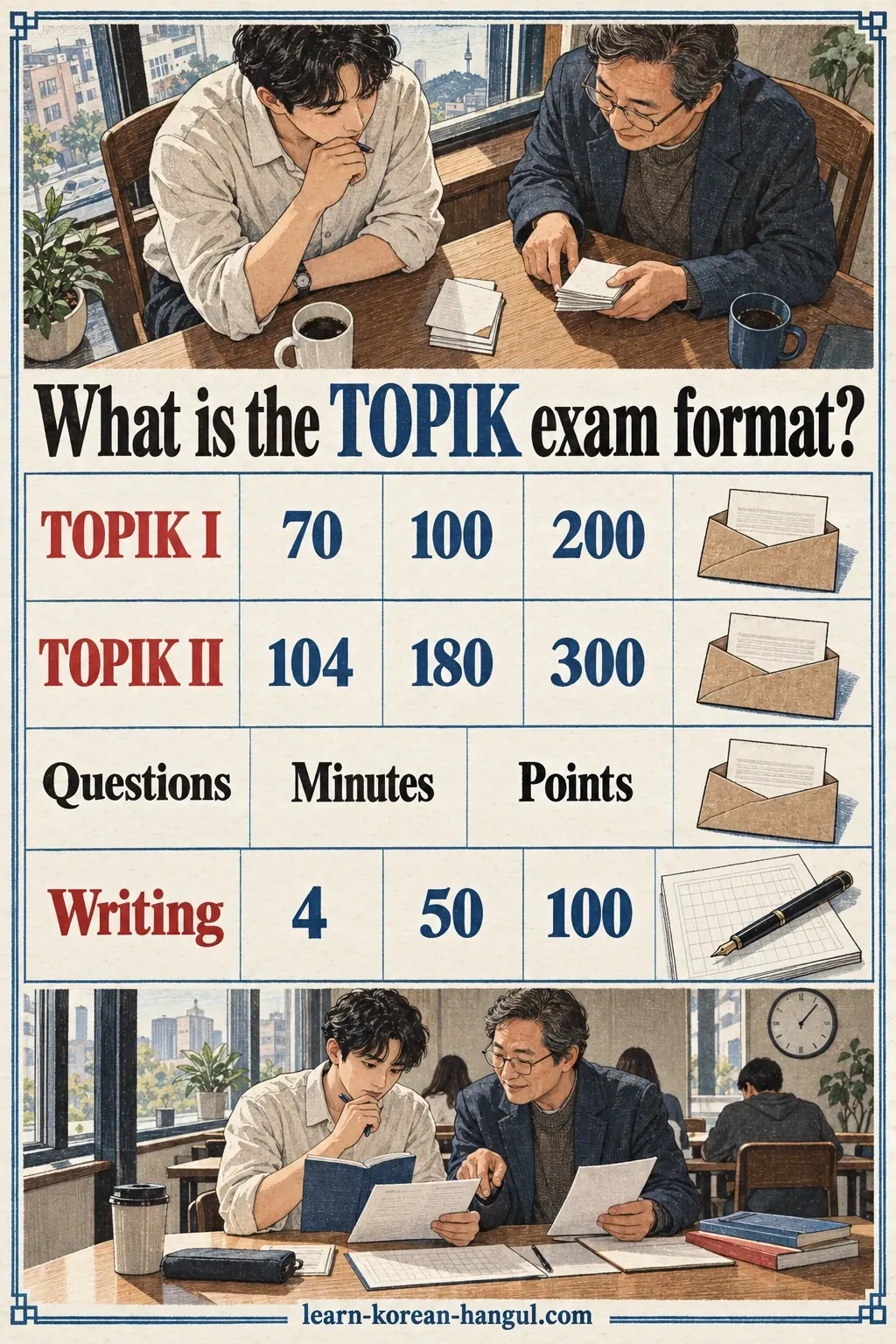
The TOPIK exam format has two separate papers: TOPIK I with listening (30 questions) and reading (40), and TOPIK II with listening (50), writing (4) and reading (50). TOPIK I takes 100 minutes and TOPIK II 180 minutes on paper. Every section is worth 100 points, and the total decides your level from 1 to 6.
What Is the TOPIK Exam Format?
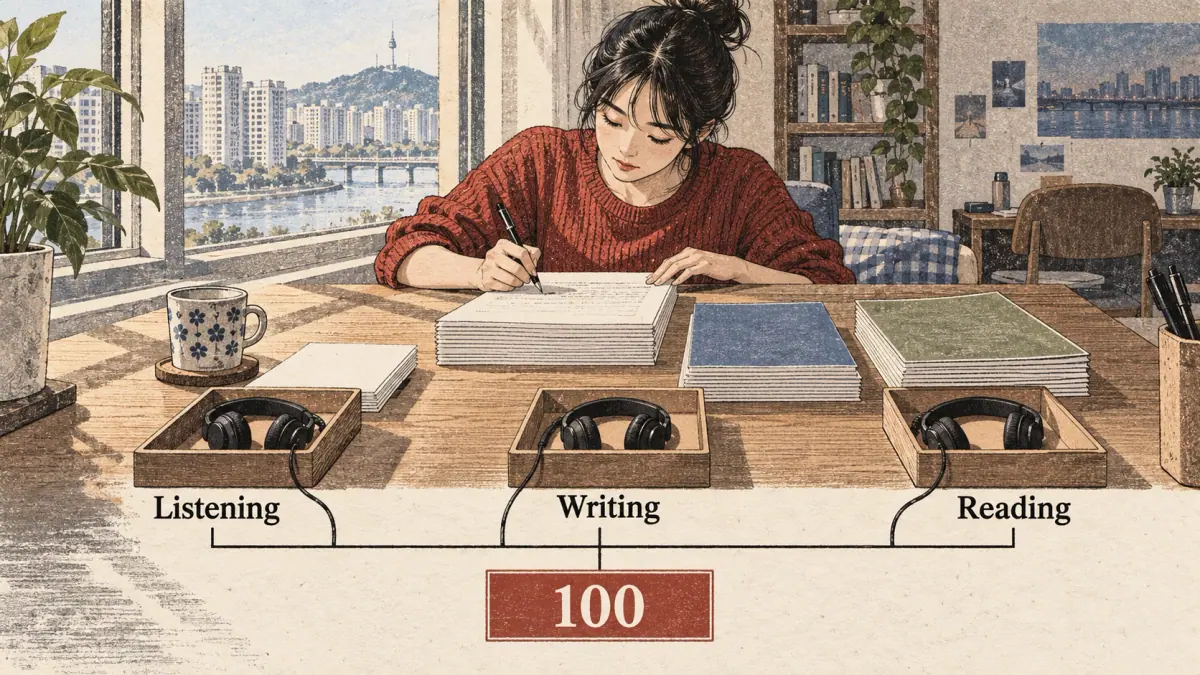
The TOPIK exam format is a fixed set of timed sections, each scored out of 100, with no speaking section. The table below is the master view of the paper-based test (PBT), as described in the official TOPIK guide published by the National Institute for International Education (NIIED) on topik.go.kr. Confirm it in the current guide before your test, because NIIED can change the format.
| Test | Period (교시) | Section | Questions | Minutes | Points | Answer type |
|---|---|---|---|---|---|---|
| TOPIK I | 1 | Listening (듣기) | 30 | 40 | 100 | 4-option multiple choice |
| TOPIK I | 1 | Reading (읽기) | 40 | 60 | 100 | 4-option multiple choice |
| TOPIK I total | 70 | 100 | 200 | |||
| TOPIK II | 1 | Listening (듣기) | 50 | 60 | 100 | 4-option multiple choice |
| TOPIK II | 1 | Writing (쓰기) | 4 | 50 | 100 | written answers |
| TOPIK II | 2 | Reading (읽기) | 50 | 70 | 100 | 4-option multiple choice |
| TOPIK II total | 104 | 180 | 300 |
The three section names appear on every answer sheet, so it helps to recognise them by sight and sound.
듣기 (deutgi) is listening, 읽기 (ilgi, said [일끼]) is reading and 쓰기 (sseugi) is writing. A period is a 교시 (gyosi): 1교시 is the first period and 2교시 the second.
Three points in the table matter more than they first appear:
- The two papers are separate tests. You register for TOPIK I or TOPIK II. They are not two halves of one exam, and a TOPIK I result can never reach level 3.
- Every section has the same weight. In TOPIK II, the 4 writing questions are worth as much as the 50 reading questions, so writing carries far more points per question.
- There is no section minimum. Under the current rules, your level comes from the total alone, so a strong section can make up for a weak one. Check the current guide, because older versions of the test worked differently.
The next two sections open each paper in turn, starting with the beginner test.
What Does TOPIK I Contain?
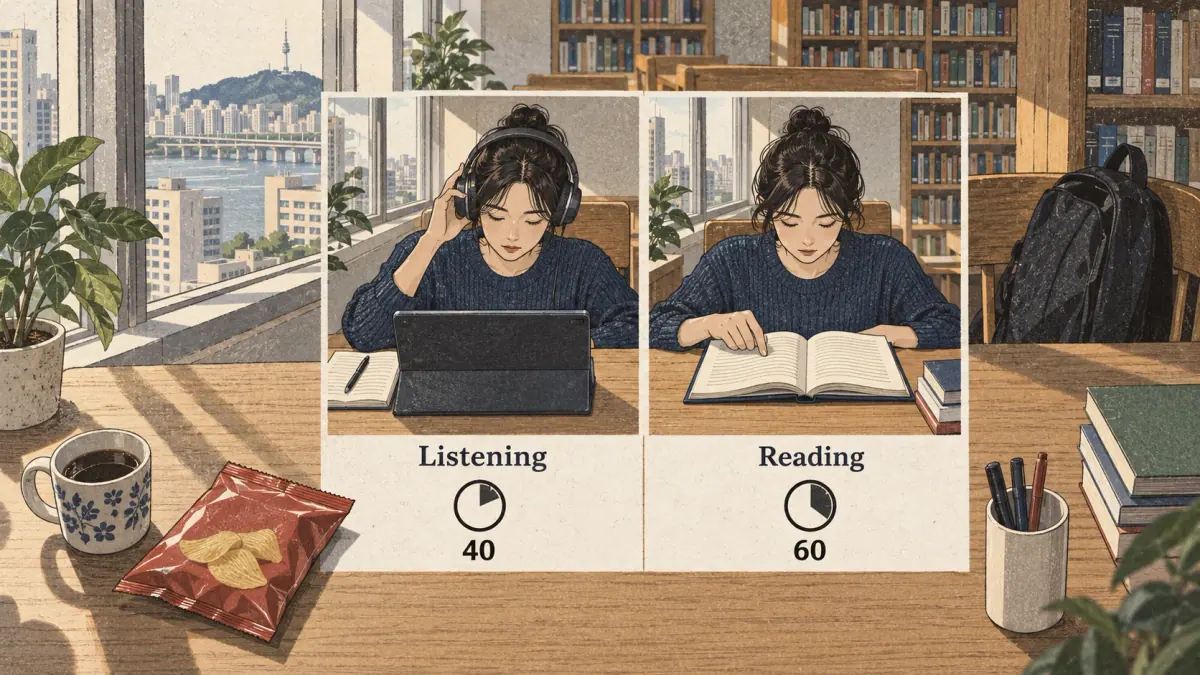
TOPIK I contains two multiple-choice sections, listening then reading, taken together in one 100-minute period. It is designed for beginners and awards level 1 at 80 points and level 2 at 140 points out of 200.
| Section | Question numbers | Questions | Minutes | Seconds per question (average) |
|---|---|---|---|---|
| Listening | 1-30 | 30 | 40 | about 80 (audio time included) |
| Reading | 31-70 | 40 | 60 | 90 |
Question numbering runs straight through: listening is questions 1 to 30, and reading continues from 31 to 70 on the same answer sheet. That single numbering is a quick way to tell a TOPIK I paper from a TOPIK II paper, where reading restarts at 1.
What TOPIK I listening sounds like. The recordings are short, everyday exchanges spoken at a clear, moderate speed: a question about where someone is going, a request in a shop, a short announcement. Early questions ask you to pick the natural reply or the place where a conversation happens. Later questions ask which picture matches, which statement agrees with the conversation, and what a speaker mainly means.
What TOPIK I reading looks like. Reading starts with very short items, such as identifying the topic of two sentences (for example, a sentence about apples and pears is about fruit), and filling a blank with the right word or particle. It moves on to notices, signs, simple advertisements and text messages, then to short paragraphs where you choose the main idea, put sentences in order or answer two questions about one text.
The full question-by-question guide is on TOPIK 1 exam format. The second paper is longer and adds the one section that is not multiple choice.
What Does TOPIK II Contain?
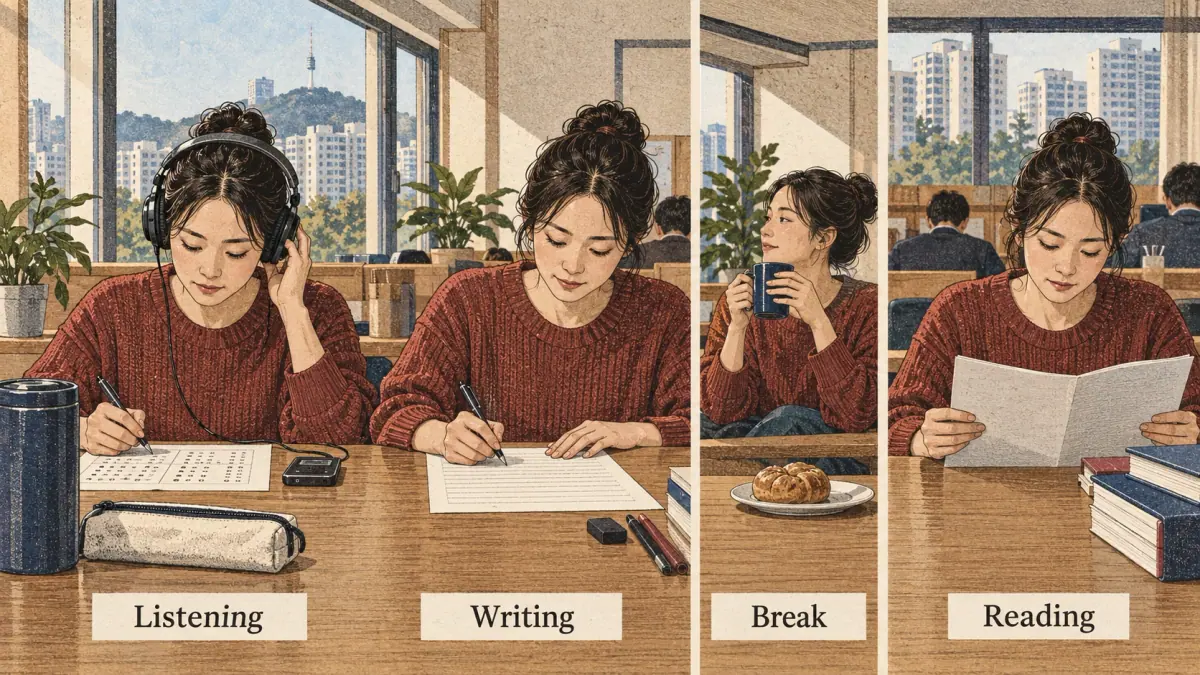
TOPIK II contains three sections, listening, writing and reading, split across two periods with a break in between. It awards level 3 at 120 points, level 4 at 150, level 5 at 190 and level 6 at 230, out of 300.
| Period | Section | Question numbers | Questions | Minutes | Seconds per question (average) |
|---|---|---|---|---|---|
| 1교시 | Listening | 1-50 | 50 | 60 | about 72 (audio time included) |
| 1교시 | Writing | 51-54 | 4 | 50 | not comparable |
| Break | |||||
| 2교시 | Reading | 1-50 | 50 | 70 | 84 |
The numbering explains a common confusion. In period 1, listening runs from 1 to 50 and writing continues as 51 to 54. Period 2 starts a new booklet, so reading is numbered 1 to 50 again. When teachers say "question 54", they always mean the essay.
Listening and writing share one 110-minute period. Once the listening audio ends, the rest of the period is for writing, so you need a plan for those 50 minutes before test day: for example, about 10 minutes for questions 51 and 52, 15 for question 53 and 25 for question 54.
What TOPIK II listening sounds like. Recordings grow from short dialogues to interviews, news reports, lectures, documentaries and debates. Speech is closer to natural speed, and many later items come in pairs: two questions about one longer recording.
What TOPIK II reading looks like. Reading begins with grammar-in-context items and short notices, then moves to newspaper headlines, explanatory articles, opinion pieces, literary extracts and academic passages. Questions ask for the main idea, the writer's attitude or purpose, the right place to insert a sentence, and details that match the text.
Writing deserves its own section, because it is scored differently from everything else.
The Four TOPIK II Writing Questions
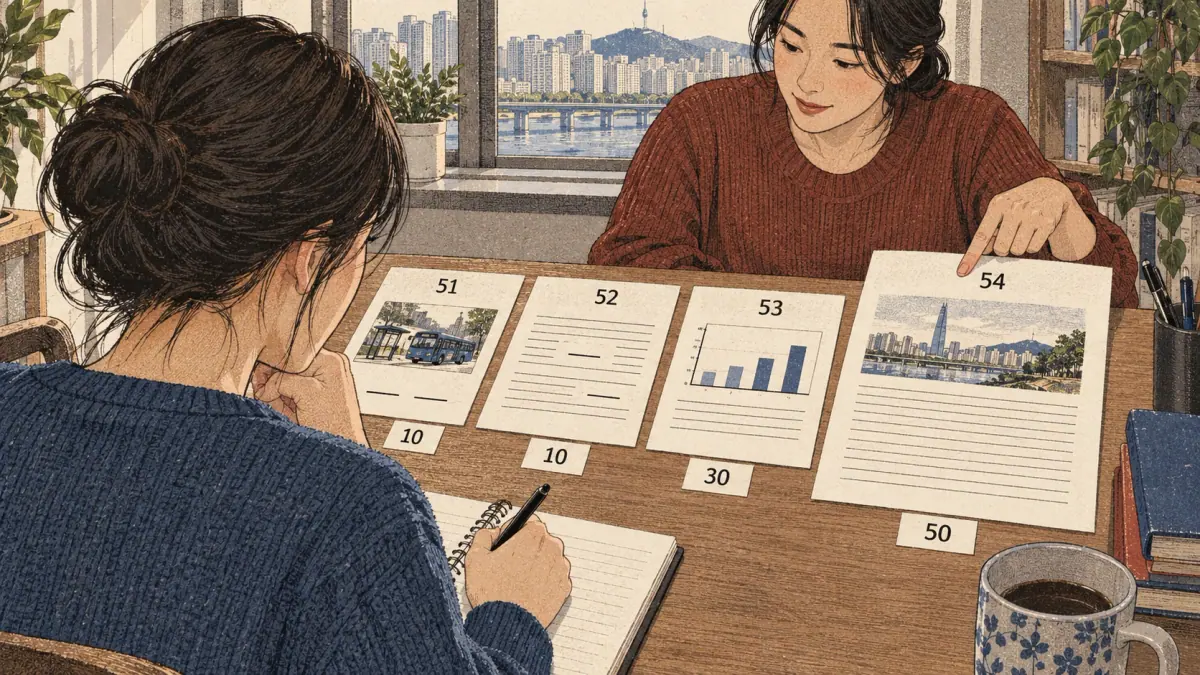
TOPIK II writing has exactly four questions, numbered 51 to 54, and together they are worth 100 points. They move from filling two blanks in a short text to writing a full argumentative essay. The point values below follow the commonly published breakdown; check the current official guide.
| Question | Task | Typical length | Points |
|---|---|---|---|
| 51 | Fill two blanks in a practical text (a notice, invitation or message) | one sentence per blank | 10 |
| 52 | Fill two blanks in a short explanatory paragraph | one sentence per blank | 10 |
| 53 | Describe information from a chart, graph or survey in one paragraph | 200-300 characters | 30 |
| 54 | Write an essay giving and supporting an opinion on a set topic | 600-700 characters | 50 |
Questions 53 and 54 are written on manuscript grid paper, 원고지 (wongoji), where each square holds one Hangul syllable or one punctuation mark, with special rules for numbers and Latin letters. A space between words also takes a square, which is why the lengths are given in characters, not words.
The style rule catches many learners. Questions 53 and 54 expect the written plain style (한다체), which ends sentences in -다, not the polite -요 endings of conversation. Compare 도서관은 9시에 문을 열어요 (spoken polite) with the written form below.
도서관은 9시에 문을 연다.
doseogwaneun ahop sie muneul yeonda.
The library opens at 9. (written plain style)
Writing in -요 does not make an answer wrong in meaning, but it is the wrong register for a report or an essay, and graders expect the written style. With all three sections described, the next step is to compare their question types side by side.
What Question Types Appear in Each Section?
Question types are the recurring tasks the test uses, such as "choose the picture" or "find the main idea". Knowing them in advance saves reading time on the day, because you recognise the instruction at a glance.
| Question type | TOPIK I listening | TOPIK I reading | TOPIK II listening | TOPIK II reading |
|---|---|---|---|---|
| Choose the natural reply or next line | yes | yes | ||
| Identify the place or topic | yes | yes | yes | yes |
| Choose the matching picture or graph | yes | yes | yes | |
| Fill a blank with a word, particle or grammar pattern | yes | yes | ||
| Match details to a notice, sign or advertisement | yes | yes | ||
| Put sentences in order | yes | yes | ||
| Insert a sentence in the right place | yes | |||
| Find the main idea or speaker's purpose | yes | yes | yes | yes |
| Infer the speaker's or writer's attitude | yes | yes | ||
| Two questions about one longer text or recording | yes | yes | yes | yes |
The table is a guide to the patterns that appear across recent papers, not an official list; NIIED can add or retire types. Three practical points follow from it:
- Instructions are in Korean only. A typical instruction is 다음을 듣고 알맞은 그림을 고르십시오 ("Listen and choose the correct picture"). Learn the instruction phrases before the test so they cost you no time.
- Reading always moves from short to long. Spend less time on early items and save minutes for the long passages at the end.
- Paired questions share one text. Read both questions before you read or hear the passage, so you know what to look for.
Section-by-section strategy is on TOPIK listening and TOPIK reading. Knowing the tasks is half the preparation; knowing how the day itself runs is the other half.
TOPIK Test Day, Step by Step

TOPIK test day runs in a fixed order: arrival and check-in, a document and device check, instructions, then the timed periods. The exact clock times are printed on your admission ticket (수험표) and differ between Korea and overseas centres, so use this as the order of events, not the timetable.
- Arrive before the entry deadline. Doors close at a set time before the test starts, and late arrivals are not admitted. Bring the admission ticket and an accepted photo ID; for 2027, press reports of the Ministry of Education's plan say accepted ID will be limited to physical passports and foreigner registration cards, so check the rule on topik.go.kr.
- Hand in or switch off devices. Phones, smartwatches, earphones and similar devices must be turned off and stored as instructed. Proctors may use detectors for electronic devices.
- Fill in the answer sheet details. Write your name and candidate number and mark the test type in the boxes. Errors here can delay or void a result.
- Sit the first period. For TOPIK I this is the whole test: listening, then reading, in 100 minutes. For TOPIK II it is listening followed by writing, in 110 minutes.
- Take the break (TOPIK II only). Follow the centre's rules on leaving the room and on what you may look at.
- Sit the second period (TOPIK II only). Reading, 70 minutes.
- Hand in all papers. You may not take the question booklets or notes out of the room unless the centre says otherwise.
On paper tests, listening and reading answers are marked on a machine-read answer sheet (often called an OMR sheet) with the pen specified in the official guide, usually supplied at the centre. Writing answers go on a separate written answer sheet. In Korea, TOPIK I and TOPIK II have been scheduled at different times of the same day, but whether you can sit both depends on the current rules and your registration; check before you plan to.
Your first full rehearsal of this order should be a timed TOPIK mock test, not the real exam. The day looks different again if you sit the computer version.
How Do PBT and IBT Differ in Format?
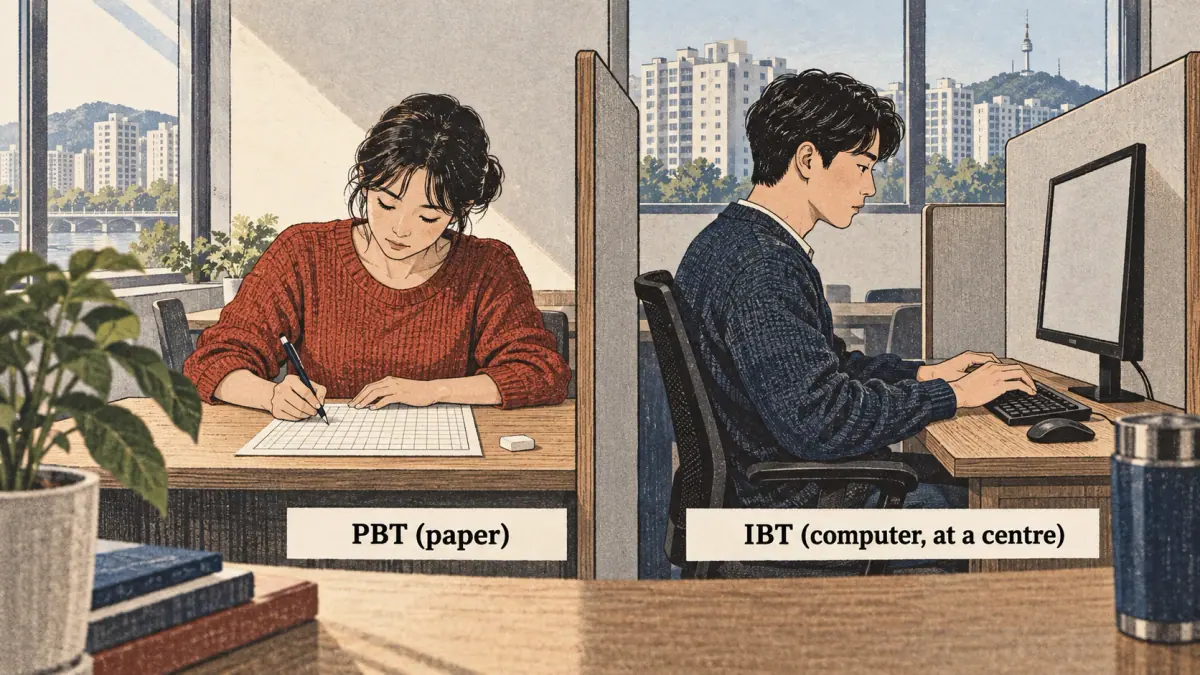
The paper-based test (PBT) and the internet-based test (IBT) measure the same levels, but the IBT is not a scanned copy of the paper. It is taken on a computer at an approved test centre, and its sections, question counts, timing and some question types differ from the paper test.
| Feature | PBT (paper) | IBT (computer, at a centre) |
|---|---|---|
| Levels | TOPIK I 1-2, TOPIK II 3-6 | same levels |
| Answering | pen on answer sheets | on screen |
| Writing | handwritten on 원고지 | typed with a Korean keyboard layout |
| Question counts and minutes | as in the master table above | different; check the IBT guide |
| Breaks | TOPIK II has a break between periods | per the IBT guide |
| Results | published on the official schedule | usually faster than the paper test |
The biggest practical change is typing. If you choose the IBT, practise typing Korean on the standard 2-beolsik keyboard until you can write a 600-character essay comfortably within the time. Handwriting practice matters only for the paper test.
IBT TOPIK explains the computer version in detail, and IBT vs PBT helps you choose one. Neither version includes speaking, which leads to the last part of the format.
Is There a Speaking Section in TOPIK?
No. TOPIK I and TOPIK II have no speaking section in either the paper or the computer version. Speaking is assessed by a separate exam, the TOPIK speaking test, which has its own registration, sessions and scale and is currently held in Korea only.
A TOPIK II level 6 certificate therefore says nothing official about how well you speak. If an employer or programme needs evidence of speaking, check whether it accepts the separate test. The details are on TOPIK speaking test. With the format covered, the practical question is how to pace each section.
Pacing Each TOPIK Section

Pace the multiple-choice sections by question blocks, not by the clock alone, and give the long items at the end the most time. Listening is paced for you by the audio, so pacing decisions really matter in reading and writing. The budgets below are editorial suggestions built from the official timings, not official rules.
| Section | Total time | Suggested split | Why |
|---|---|---|---|
| TOPIK I reading | 60 minutes | about 15 minutes for questions 31-48, 40 for 49-70, 5 to check the answer sheet | early items are one or two lines; later items are full paragraphs with paired questions |
| TOPIK II writing | 50 minutes | about 10 for 51-52, 15 for 53, 25 for 54 | question 54 carries half the writing points |
| TOPIK II reading | 70 minutes | about 20 for questions 1-20, 45 for 21-50, 5 to check | the last 20 questions are long academic and literary texts |
Worked example. A TOPIK II candidate reaches reading question 30 after 40 minutes. That leaves 30 minutes for 20 questions, or 90 seconds each, which is workable. If the same candidate reached question 30 after 55 minutes, 15 minutes would remain for 20 questions, or 45 seconds each, which is not enough to read the final passages. The fix is to set a checkpoint before the test, for example "question 20 by minute 20", and to guess and move on when you miss it.
Three habits make pacing easier:
- Transfer answers as you go. On paper tests, marking the answer sheet only at the end risks running out of time with a full booklet and an empty sheet.
- Never leave a multiple-choice item blank. If time is short, mark a guess; a blank and a wrong answer both score zero.
- Draft question 54 in outline first. Two minutes spent listing an introduction, two body points and a conclusion saves rewriting on grid paper, where corrections are slow.
Practise these budgets under timed conditions at least twice before the real test, so the checkpoints feel normal. Even with good pacing, some candidates lose points by misreading the format itself.
Common Misreadings of the TOPIK Format
Learners often assume TOPIK I and II are one exam with two parts. Actually, they are separate tests with separate registration and fees, because each targets a different range of levels. A beginner who sits TOPIK II hoping to "start at the bottom" may score below 120 and receive no level at all.
Learners also assume writing is a small section because it has only four questions. Actually, it is worth 100 points, the same as 50 reading questions, because each section carries equal weight. Skipping question 54 gives away up to 50 points, more than many candidates lose in all of reading.
A third assumption is that unanswered questions are safer than guesses. Actually, TOPIK has no negative marking, so a blank answer and a wrong answer both score zero. Mark every multiple-choice question before time runs out.
A fourth misreading is that the IBT is the paper test on a screen. Actually, the IBT has its own structure, so preparing only with paper-test timings can leave you surprised on the day.
What This Page Covers and Does Not
This page describes the structure of TOPIK: its papers, sections, question counts, timing, points and test-day order. It does not cover the score-to-level details (see TOPIK levels), registration, fees or dates, which change every year. Figures here follow the official guide published by NIIED on topik.go.kr; if the official guide differs from this page, the official guide is right.
Frequently Asked Questions
How long is the TOPIK exam? The paper-based TOPIK I lasts 100 minutes in one sitting, 40 for listening and 60 for reading. The paper-based TOPIK II lasts 180 minutes of test time in two periods, 110 minutes for listening and writing and 70 for reading, with a break between them. Arrival, check-in and instructions add time on the day, so plan for longer.
Is there a break during TOPIK? In the paper-based TOPIK II, yes. The first period (listening and writing) and the second period (reading) are separated by a break, during which you may leave the room under the centre's rules. Paper-based TOPIK I runs as one 100-minute period with no break. Check the admission ticket and the current official guide for the exact schedule.
Can I use a dictionary in TOPIK? No. Dictionaries, phones, translation apps, smartwatches and other electronic devices are not allowed in the test room, and devices must be switched off and handed in or stored as the proctor instructs. Using a banned item can cancel your result and, under rules reported for 2027, lead to a ban from future tests.
How many answer options does each TOPIK question have? Every multiple-choice question in TOPIK listening and reading has four options, numbered ① to ④. You mark one answer per question on the answer sheet. Only the TOPIK II writing section has no options, because you write your own sentences and essays. A wrong answer simply scores zero; there is no extra deduction.
Does TOPIK have negative marking? No. TOPIK does not subtract points for wrong answers in listening or reading. A wrong or blank answer simply earns zero for that question, so you should always mark an answer, even a guess, before time runs out. With four options, a blind guess still has a one-in-four chance of scoring.
What to Read Next
Now that you know the TOPIK exam format, the next step is turning section scores into a level: continue with TOPIK score: points, passing scores and section weights. Every other exam page is listed in the TOPIK section.