
What you will be able to do after this page
- Look up the polite present, past, future, formal or casual form of 50 common words.
- Read down one column and see the same change repeat in every verb of a pattern.
- Recognise which irregular class a verb belongs to from its forms.
- Check your own forms against a list and then against the Korean verb conjugator.
Before you start: read how to read a conjugation chart, because this list uses the same rows, class labels and conventions. Time: about 30 minutes to read, longer to practise. Level: A1.
What Is in the Korean Verbs Conjugation List?
The list holds 50 verbs and adjectives, each in five forms, and it is arranged by pattern and not by alphabet or topic. Grouping by pattern lets you read down a column and watch one rule repeat, which is how conjugation becomes automatic.
How the 50 words were chosen: they cover every stem type (vowel, consonant, contracting and 하다) and all seven irregular classes (ㅂ, ㄷ, ㅅ, 르, ㅎ, ㅡ and ㄹ), with at least two words for each class. Levels come from the site's verb lexicon: 45 words are A1, 3 are A2 and 2 are B1. 15 of the 50 are adjectives, which conjugate with the same endings as verbs. The selection is editorial, aimed at pattern coverage, and it is not a ranking by how often a word appears in Korean.
The five forms are the ones the conjugation cheat sheet summarises:
| Form | Recipe | Example with 먹다 |
|---|---|---|
| Polite present | stem + 아요/어요 | 먹어요 |
| Past | stem + 았/었/했 + 어요 | 먹었어요 |
| Future | stem + (으)ㄹ 거예요 | 먹을 거예요 |
| Formal | stem + ㅂ니다 / 습니다 | 먹습니다 |
| Casual | polite form without 요 | 먹어 |
Spellings are shown as written, without pronunciation brackets, to keep the rows readable. Where a pronunciation differs from the spelling, the dictionary page gives it. A sample of three words shows the layout before the full tables.
가다
| Form | Korean | Romanization | Rule |
|---|---|---|---|
| Polite present | 가요 | gayo | 가 + 아요 = 가요 |
| Past | 갔어요 | gasseoyo | 가 + 았 + 어요 = 갔어요 |
| Future | 갈 거예요 | gal geoyeyo | 가 + ㄹ 거예요 = 갈 거예요 |
| Formal | 갑니다 | gamnida | 가 + ㅂ니다 = 갑니다 |
| Casual | 가 | ga | 가 + 아 = 가 |
모르다
| Form | Korean | Romanization | Rule |
|---|---|---|---|
| Polite present | 몰라요 | mollayo | 모르 → 몰ㄹ + 아요 = 몰라요 |
| Past | 몰랐어요 | mollasseoyo | 모르 → 몰ㄹ + 았 + 어요 = 몰랐어요 |
| Future | 모를 거예요 | moreul geoyeyo | 모르 + ㄹ 거예요 = 모를 거예요 |
| Formal | 모릅니다 | moreumnida | 모르 + ㅂ니다 = 모릅니다 |
| Casual | 몰라 | molla | 모르 → 몰ㄹ + 아 = 몰라 |
돕다
| Form | Korean | Romanization | Rule |
|---|---|---|---|
| Polite present | 도와요 | dowayo | 돕 → 도오 + 아요 = 도와요 |
| Past | 도왔어요 | dowasseoyo | 돕 → 도오 + 았 + 어요 = 도왔어요 |
| Future | 도울 거예요 | doul geoyeyo | 돕 → 도우 + ㄹ 거예요 = 도울 거예요 |
| Formal | 돕습니다 | dopseumnida | 돕 + 습니다 = 돕습니다 |
| Casual | 도와 | dowa | 돕 → 도오 + 아 = 도와 |
Every row in the tables below follows this layout. The first group is the simplest, so begin there.
Which Regular Verbs Have Vowel Stems?
Regular verbs with vowel stems end their stem in a vowel, and they show the simplest pattern: the stem and the ending merge or drop one vowel. Read down the Formal column and the Future column. The formal ending is always ㅂ니다, and the future ending is always ㄹ 거예요.
| Stem | Dictionary form | Meaning | Level | Polite present | Past | Future | Formal | Casual |
|---|---|---|---|---|---|---|---|---|
| 가 | 가다 | go | A1 | 가요 | 갔어요 | 갈 거예요 | 갑니다 | 가 |
| 서 | 서다 | stand | A1 | 서요 | 섰어요 | 설 거예요 | 섭니다 | 서 |
| 자 | 자다 | sleep | A1 | 자요 | 잤어요 | 잘 거예요 | 잡니다 | 자 |
| 사 | 사다 | buy | A1 | 사요 | 샀어요 | 살 거예요 | 삽니다 | 사 |
| 만나 | 만나다 | meet | A1 | 만나요 | 만났어요 | 만날 거예요 | 만납니다 | 만나 |
| 보내 | 보내다 | send | A1 | 보내요 | 보냈어요 | 보낼 거예요 | 보냅니다 | 보내 |
| 일어나 | 일어나다 | get up | A1 | 일어나요 | 일어났어요 | 일어날 거예요 | 일어납니다 | 일어나 |
| 비싸 | 비싸다 | be expensive | A1 | 비싸요 | 비쌌어요 | 비쌀 거예요 | 비쌉니다 | 비싸 |
Three things to notice:
- Same vowel, one drops. 가 + 아요 is 가요, and 서 + 어요 is 서요.
- A vowel stem takes the short endings. 갑니다 and 잘 거예요 (from 자다) need no extra syllable.
- The 아/어 choice still applies. 사다 takes 아 (사요), and 만나다 takes 아 because of the ㅏ in 나 (만나요).
For the rule behind these merges, see vowel dropping. Consonant stems behave differently, so they have their own group.
Which Regular Verbs Have Consonant Stems?
Regular verbs with consonant stems end their stem in a consonant, so the ending needs a linking vowel or a longer form. The Formal column shows 습니다 here, and the Future column shows 을 거예요.
| Stem | Dictionary form | Meaning | Level | Polite present | Past | Future | Formal | Casual |
|---|---|---|---|---|---|---|---|---|
| 먹 | 먹다 | eat | A1 | 먹어요 | 먹었어요 | 먹을 거예요 | 먹습니다 | 먹어 |
| 읽 | 읽다 | read | A1 | 읽어요 | 읽었어요 | 읽을 거예요 | 읽습니다 | 읽어 |
| 앉 | 앉다 | sit | A1 | 앉아요 | 앉았어요 | 앉을 거예요 | 앉습니다 | 앉아 |
| 받 | 받다 | receive | A1 | 받아요 | 받았어요 | 받을 거예요 | 받습니다 | 받아 |
| 찾 | 찾다 | find | A1 | 찾아요 | 찾았어요 | 찾을 거예요 | 찾습니다 | 찾아 |
| 입 | 입다 | wear | A1 | 입어요 | 입었어요 | 입을 거예요 | 입습니다 | 입어 |
| 웃 | 웃다 | laugh | A1 | 웃어요 | 웃었어요 | 웃을 거예요 | 웃습니다 | 웃어 |
| 좋 | 좋다 | be good | A1 | 좋아요 | 좋았어요 | 좋을 거예요 | 좋습니다 | 좋아 |
| 많 | 많다 | be many | A1 | 많아요 | 많았어요 | 많을 거예요 | 많습니다 | 많아 |
| 작 | 작다 | be small | A1 | 작아요 | 작았어요 | 작을 거예요 | 작습니다 | 작아 |
Read down the Polite present column and the 아/어 choice appears in a clean row. 좋다 and 앉다 take 아 (좋아요, 앉아요) because their last vowel is ㅗ or ㅏ. 먹다, 읽다 and 입다 take 어. The adjectives 좋다, 많다 and 작다 follow the same pattern as the verbs, which shows that adjectives and verbs share endings.
One caution: 입다 (to wear) and 좁다 (to be narrow) end in ㅂ but are regular. They give 입어요 and 좁아요, not 이워요. The next group is the one where you need to watch the vowels.
Which Verbs Are Contraction Cases?
Contraction cases are vowel-stem verbs whose stem vowel merges with 아 or 어 into a new syllable, so the polite present looks different from the stem. This is the group that surprises beginners, because 오 + 아요 does not look like 와요 until you have seen it.
| Stem | Dictionary form | Meaning | Level | Polite present | Past | Future | Formal | Casual |
|---|---|---|---|---|---|---|---|---|
| 오 | 오다 | come | A1 | 와요 | 왔어요 | 올 거예요 | 옵니다 | 와 |
| 보 | 보다 | see, watch | A1 | 봐요 | 봤어요 | 볼 거예요 | 봅니다 | 봐 |
| 배우 | 배우다 | learn | A1 | 배워요 | 배웠어요 | 배울 거예요 | 배웁니다 | 배워 |
| 주 | 주다 | give | A1 | 줘요 | 줬어요 | 줄 거예요 | 줍니다 | 줘 |
| 마시 | 마시다 | drink | A1 | 마셔요 | 마셨어요 | 마실 거예요 | 마십니다 | 마셔 |
| 되 | 되다 | become | A1 | 돼요 | 됐어요 | 될 거예요 | 됩니다 | 돼 |
| 기다리 | 기다리다 | wait | A1 | 기다려요 | 기다렸어요 | 기다릴 거예요 | 기다립니다 | 기다려 |
| 하 | 하다 | do | A1 | 해요 | 했어요 | 할 거예요 | 합니다 | 해 |
| 공부하 | 공부하다 | study | A1 | 공부해요 | 공부했어요 | 공부할 거예요 | 공부합니다 | 공부해 |
| 피곤하 | 피곤하다 | be tired | A1 | 피곤해요 | 피곤했어요 | 피곤할 거예요 | 피곤합니다 | 피곤해 |
The pattern behind each row:
- 오 + 아 → 와, 보 + 아 → 봐. The vowel ㅗ turns into a glide before ㅏ.
- 배우 + 어 → 배워, 주 + 어 → 줘. The vowel ㅜ turns into a glide before ㅓ.
- 마시 + 어 → 마셔, 기다리 + 어 → 기다려. The vowel ㅣ merges with ㅓ into ㅕ.
- 되 + 어 → 돼. The vowel ㅚ merges with ㅓ into ㅙ. Write 돼요 and not 되요.
- 하 + 여 → 해. The 하다 pattern covers every verb and adjective ending in 하다: 공부해요, 피곤해요.
These merges apply in the past too, so 보다 gives 봤어요 and 마시다 gives 마셨어요. The full set of contraction lessons begins with ㅘ contraction. The other half of the list deals with verbs that break the regular rules.
Which Irregular Verbs Are in the List?
The list includes 22 irregular verbs that cover all seven classes: ㅂ (5 words), ㄷ (3), 르 (3), ㅡ (4), ㄹ (3), ㅎ (2) and ㅅ (2). The Class column names the group, so a row tells you both the forms and the reason for them.
| Stem | Dictionary form | Meaning | Level | Class | Polite present | Past | Future | Formal | Casual |
|---|---|---|---|---|---|---|---|---|---|
| 돕 | 돕다 | help | A2 | ㅂ | 도와요 | 도왔어요 | 도울 거예요 | 돕습니다 | 도와 |
| 덥 | 덥다 | be hot (weather) | A1 | ㅂ | 더워요 | 더웠어요 | 더울 거예요 | 덥습니다 | 더워 |
| 춥 | 춥다 | be cold (weather) | A1 | ㅂ | 추워요 | 추웠어요 | 추울 거예요 | 춥습니다 | 추워 |
| 어렵 | 어렵다 | be difficult | A1 | ㅂ | 어려워요 | 어려웠어요 | 어려울 거예요 | 어렵습니다 | 어려워 |
| 쉽 | 쉽다 | be easy | A1 | ㅂ | 쉬워요 | 쉬웠어요 | 쉬울 거예요 | 쉽습니다 | 쉬워 |
| 듣 | 듣다 | listen | A1 | ㄷ | 들어요 | 들었어요 | 들을 거예요 | 듣습니다 | 들어 |
| 걷 | 걷다 | walk | A1 | ㄷ | 걸어요 | 걸었어요 | 걸을 거예요 | 걷습니다 | 걸어 |
| 묻 | 묻다 | ask | A2 | ㄷ | 물어요 | 물었어요 | 물을 거예요 | 묻습니다 | 물어 |
| 모르 | 모르다 | not know | A1 | 르 | 몰라요 | 몰랐어요 | 모를 거예요 | 모릅니다 | 몰라 |
| 빠르 | 빠르다 | be fast | A1 | 르 | 빨라요 | 빨랐어요 | 빠를 거예요 | 빠릅니다 | 빨라 |
| 부르 | 부르다 | call, sing | A2 | 르 | 불러요 | 불렀어요 | 부를 거예요 | 부릅니다 | 불러 |
| 쓰 | 쓰다 | write | A1 | ㅡ | 써요 | 썼어요 | 쓸 거예요 | 씁니다 | 써 |
| 바쁘 | 바쁘다 | be busy | A1 | ㅡ | 바빠요 | 바빴어요 | 바쁠 거예요 | 바쁩니다 | 바빠 |
| 아프 | 아프다 | be sick | A1 | ㅡ | 아파요 | 아팠어요 | 아플 거예요 | 아픕니다 | 아파 |
| 크 | 크다 | be big | A1 | ㅡ | 커요 | 컸어요 | 클 거예요 | 큽니다 | 커 |
| 살 | 살다 | live | A1 | ㄹ | 살아요 | 살았어요 | 살 거예요 | 삽니다 | 살아 |
| 만들 | 만들다 | make | A1 | ㄹ | 만들어요 | 만들었어요 | 만들 거예요 | 만듭니다 | 만들어 |
| 알 | 알다 | know | A1 | ㄹ | 알아요 | 알았어요 | 알 거예요 | 압니다 | 알아 |
| 그렇 | 그렇다 | be so | A1 | ㅎ | 그래요 | 그랬어요 | 그럴 거예요 | 그렇습니다 | 그래 |
| 빨갛 | 빨갛다 | be red | A1 | ㅎ | 빨개요 | 빨갰어요 | 빨갈 거예요 | 빨갛습니다 | 빨개 |
| 낫 | 낫다 | get better | B1 | ㅅ | 나아요 | 나았어요 | 나을 거예요 | 낫습니다 | 나아 |
| 짓 | 짓다 | build, make (a name) | B1 | ㅅ | 지어요 | 지었어요 | 지을 거예요 | 짓습니다 | 지어 |
Read down each class and the shared change appears:
- ㅂ. The ㅂ turns into 우 before a vowel (더워요, 추워요, 어려워요, 쉬워요), or into 오 for 돕다 (도와요). Before a consonant such as 습, it stays (덥습니다).
- ㄷ. The ㄷ turns into ㄹ before a vowel (들어요, 걸어요, 물어요) and stays before a consonant (듣습니다).
- 르. The 르 splits: 모르 gives 몰라, 빠르 gives 빨라, and 부르 gives 불러. A ㄹ is added to the previous syllable.
- ㅡ. The ㅡ drops. 쓰다 gives 써요, 바쁘다 gives 바빠요 (the vowel before ㅡ was ㅏ), and 크다 gives 커요.
- ㄹ. Before ㄴ, ㅂ and ㅅ, the ㄹ drops (삽니다, 압니다, 만듭니다). Before 아/어 it stays (살아요, 알아요).
- ㅎ. The ㅎ drops and the vowel changes to ㅐ (그래요, 빨개요).
- ㅅ. The ㅅ drops before a vowel (나아요, 지어요) and stays before a consonant (낫습니다, 짓습니다).
The same change appears in the past (도왔어요, 들었어요, 몰랐어요) and in the future. Each class has its own lesson, collected in Korean irregular verbs, and the compact strip is in the irregular verbs chart. With the 50 rows in hand, the next question is how to practise them.
How Can You Use the List for Practice?
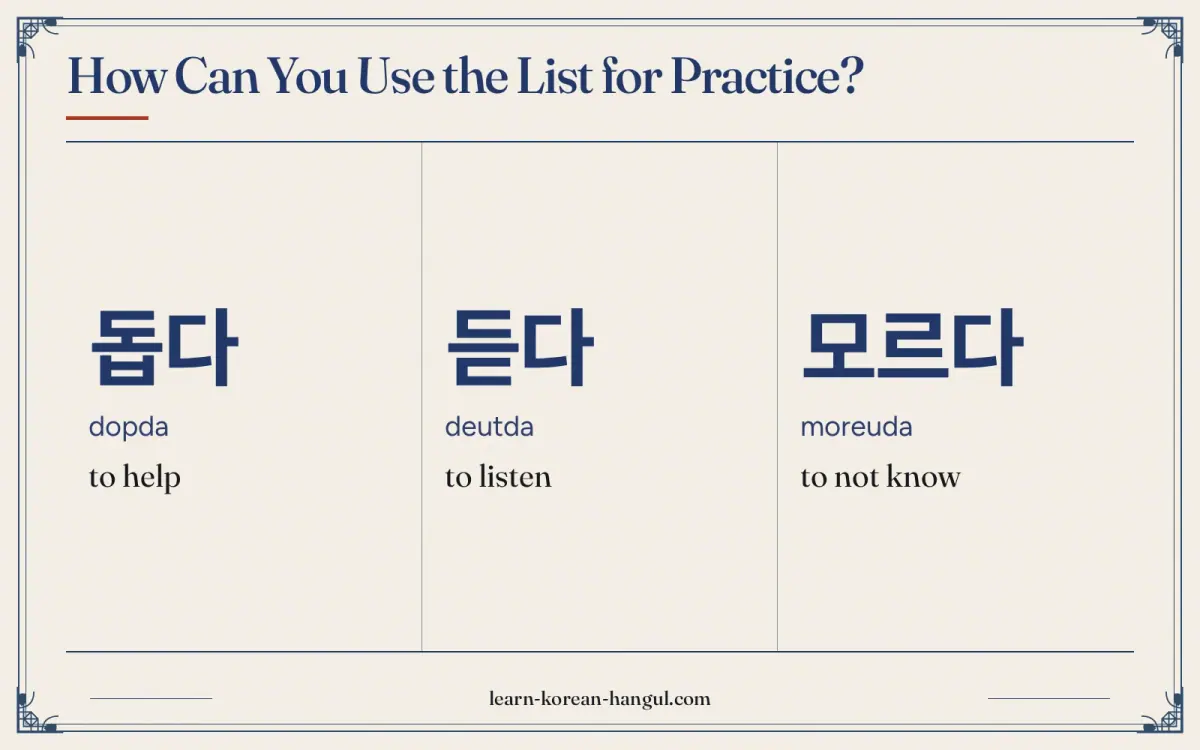
You can use the list as a drill set, and five methods work well with it. Pick one per session so that the practice stays focused.
- Cover and recall. Hide every column except the stem and the dictionary form. Say the polite present aloud, then reveal the column and check it.
- Read down a column. Read the Formal column from top to bottom in each group. Notice the 습니다 rows and the ㅂ니다 rows.
- Sort by class. Cover the Class column in the irregular table and name the class from the forms alone.
- One verb, three sentences. Pick a row, then write a polite present, past and future sentence with it.
- Check against the conjugator. Type a verb that is not on the list into the Korean verb conjugator and compare it to the closest pattern here.
For method 1, the flashcard deck below holds ten of the trickiest words. Each card shows the dictionary form, and the back shows all five forms.
Practice · 10
- 01돕다
Show answer
dopda
to help
- 02듣다
Show answer
deutda
to listen
- 03모르다
Show answer
moreuda
to not know
- 04쓰다
Show answer
sseuda
to write
- 05살다
Show answer
salda
to live
- 06그렇다
Show answer
geureota
to be so
- 07가다
Show answer
gada
to go
- 08오다
Show answer
oda
to come
- 09하다
Show answer
hada
to do
- 10마시다
Show answer
masida
to drink
For paper practice, use the grammar worksheets. If you want the words in themed groups with example sentences, the next step is 100 Korean verbs.
What Does the List Not Cover?
The list covers five forms of 50 words, and it leaves out three things you may need. First, it does not include honorific forms (such as 드세요 for 먹다), connectives (-아서/-어서) or other endings, which have their own lessons. Second, it does not rank words by frequency, so a word's absence says nothing about how common it is. Third, it has only three words of the 하다 type (하다, 공부하다 and 피곤하다), because every 하다 word follows the same pattern: 해요, 했어요, 할 거예요, 합니다 and 해.
The formal future, such as 먹을 겁니다, is not in the tables, so that the five columns match on every page. The forms were generated with a rule-based conjugation engine and are checked by a Korean teacher before publication.
Where Can You Download the List?
CSV and PDF versions of the list are available. The card below shows their status, and this page shows the version date and review status.
Korean Verbs Conjugation List, 50 Verbs in 5 Forms (CSV and PDF)
What to Learn Next
Now that you have the Korean verbs conjugation list, the best next step is to apply it to words you meet. Type any other verb or adjective into the Korean verb conjugator, which shows the rule for each form. To meet the same verbs in context, open the Korean verb dictionary, where each row above links to its own page. For the section overview, return to Conjugation Charts.
Frequently Asked Questions
Which verbs are on the Korean verbs conjugation list? The list has 50 common verbs and adjectives: 8 with vowel stems such as 가다, 10 with consonant stems such as 먹다, 10 contraction cases such as 오다 and 하다, and 22 irregular words. They were chosen to cover every stem type and all seven irregular classes, not to rank the most frequent words.
How many forms does each verb have on the list? Each verb has five forms: the polite present, past, future, formal and casual. For 가다 those are 가요, 갔어요, 갈 거예요, 갑니다 and 가. The conjugator tool shows many more forms, such as the honorific and the reason form, for any word you type in.
Are irregular verbs marked on the conjugation list? Yes. The irregular table has a Class column that names ㅂ, ㄷ, ㅅ, 르, ㅎ, ㅡ or ㄹ for each word. For example, 돕다 is marked ㅂ, and its forms 도와요 and 도왔어요 show the change. The regular tables carry no class badge, because nothing changes.
Can I download the Korean verbs conjugation list? CSV and PDF versions are available from the download card on this page. Consult this page for the version date and review status when using a downloaded copy. For practice, the tables on this page are written as plain tables that you can copy or print.
Why are the verbs grouped by pattern and not alphabetically? Grouping by pattern lets you read down a column and see one rule repeat. In the contraction group, 오다, 보다 and 배우다 show the same vowel merge. An alphabetical list would scatter those words, and you would have to find the pattern yourself.