What you will be able to do after this lesson
- Recognise the meaning and the polite present of 100 verbs.
- Use 20 of them in original sentences with the right particle.
- Spot the 30 하다 verbs and the 18 irregular verbs in the list and know their rule.
- Practise with audio and a flashcard deck.
Before you start: read how Korean conjugation works. Time: about 10 weeks at 10 verbs a week (editorial estimate). Level: A1 to B1.
What Are the 100 Korean Verbs That Matter Most?
The 100 most useful Korean verbs here are everyday verbs for moving, living, eating, talking, thinking, buying, working, caring for the body, relating to people and describing change. They come from the site verb lexicon and are ranked by learner need and level, from A1 to B1. They are not a frequency list from a text corpus, and you should not read the order as "most used first".
The basis, stated plainly:
- Chosen from the site verb lexicon by how often a learner needs the verb for survival, study and daily talk.
- Levels are the lexicon's editorial labels: 54 verbs at A1, 43 at A2 and 3 at B1.
- Not a frequency ranking. This page does not use a corpus frequency source. For exam preparation, compare the list with a TOPIK I word list as well.
- Example sentences are short, use the polite present, and include the object particle so you learn each verb's pattern. 65 of the 100 examples take an object marked with 을/를.
Because 100 verbs is a lot, begin with the 20 that open the most sentences.
Which 20 Verbs Should You Learn First?
Learn 가다, 오다, 하다, 되다, 있다, 없다, 보다, 먹다, 마시다, 자다, 사다, 주다, 받다, 알다, 모르다, 좋아하다, 만나다, 말하다, 읽다 and 쓰다 first. They appear in the most basic sentences: where you go, what you do, what you have, what you know and whom you meet. The number in the last column points to the row in the full list.
| Order | Verb | Meaning | Polite present | Row in the list |
|---|---|---|---|---|
| 1 | 가다 | to go | 가요 | 1 |
| 2 | 오다 | to come | 와요 | 2 |
| 3 | 하다 | to do | 해요 | 91 |
| 4 | 되다 | to become | 돼요 | 92 |
| 5 | 있다 | to exist/have | 있어요 | 93 |
| 6 | 없다 | to not exist/not have | 없어요 | 94 |
| 7 | 보다 | to see/watch | 봐요 | 71 |
| 8 | 먹다 | to eat | 먹어요 | 21 |
| 9 | 마시다 | to drink | 마셔요 | 22 |
| 10 | 자다 | to sleep | 자요 | 12 |
| 11 | 사다 | to buy | 사요 | 51 |
| 12 | 주다 | to give | 줘요 | 53 |
| 13 | 받다 | to receive | 받아요 | 54 |
| 14 | 알다 | to know | 알아요 | 41 |
| 15 | 모르다 | to not know | 몰라요 | 42 |
| 16 | 좋아하다 | to like | 좋아해요 | 82 |
| 17 | 만나다 | to meet | 만나요 | 81 |
| 18 | 말하다 | to speak | 말해요 | 31 |
| 19 | 읽다 | to read | 읽어요 | 63 |
| 20 | 쓰다 | to write; to use; to wear (hat); to spend (money) | 써요 | 64 |
Two points about this strip. 하다 and 되다 are special: 하다 builds the whole 하다 family, and 되다 means "become" and is the base of many fixed expressions. 있다 and 없다 are existence verbs, used for "have" as well as "be there". Once the first twenty feel natural, the themed tables take you from movement to health.
Which Verbs Cover Movement and Daily Life (1 to 20)?
Movement verbs say where you go, and daily-life verbs say how you live. Most are regular. 걷다 is a ㄷ-irregular verb (걸어요), 눕다 is ㅂ-irregular (누워요) and 살다 is an ㄹ-stem (살아요).
Movement Verbs (1 to 10)
| # | Verb | Meaning | Polite present | Class | Example | Meaning of the example |
|---|---|---|---|---|---|---|
| 1 | 가다 | to go | 가요 | regular | 학교에 가요. | I go to school. |
| 2 | 오다 | to come | 와요 | regular | 집에 와요. | I come home. |
| 3 | 들어가다 | to enter | 들어가요 | regular | 방에 들어가요. | I go into the room. |
| 4 | 나가다 | to go out | 나가요 | regular | 밖에 나가요. | I go outside. |
| 5 | 돌아가다 | to go back | 돌아가요 | regular | 고향에 돌아가요. | I go back to my hometown. |
| 6 | 올라가다 | to go up | 올라가요 | regular | 계단을 올라가요. | I go up the stairs. |
| 7 | 걷다 | to walk | 걸어요 | ㄷ irregular | 공원에서 걸어요. | I walk in the park. |
| 8 | 뛰다 | to run/jump | 뛰어요 | regular | 아침에 뛰어요. | I run in the morning. |
| 9 | 타다 | to ride | 타요 | regular | 버스를 타요. | I ride the bus. |
| 10 | 도착하다 | to arrive | 도착해요 | 하다 type | 일곱 시에 도착해요. | I arrive at seven. |
Daily Life Verbs (11 to 20)
| # | Verb | Meaning | Polite present | Class | Example | Meaning of the example |
|---|---|---|---|---|---|---|
| 11 | 일어나다 | to wake up/get up | 일어나요 | regular | 일곱 시에 일어나요. | I get up at seven. |
| 12 | 자다 | to sleep | 자요 | regular | 열한 시에 자요. | I go to sleep at eleven. |
| 13 | 씻다 | to wash | 씻어요 | regular | 손을 씻어요. | I wash my hands. |
| 14 | 입다 | to wear (clothes) | 입어요 | regular | 코트를 입어요. | I wear a coat. |
| 15 | 신다 | to wear (shoes) | 신어요 | regular | 운동화를 신어요. | I wear sneakers. |
| 16 | 쉬다 | to rest | 쉬어요 | regular | 주말에 쉬어요. | I rest on the weekend. |
| 17 | 살다 | to live | 살아요 | ㄹ-drop | 서울에 살아요. | I live in Seoul. |
| 18 | 앉다 | to sit | 앉아요 | regular | 의자에 앉아요. | I sit on the chair. |
| 19 | 서다 | to stand | 서요 | regular | 줄을 서요. | I stand in line. |
| 20 | 눕다 | to lie down | 누워요 | ㅂ irregular | 침대에 누워요. | I lie on the bed. |
The movement set is expanded in Korean motion verbs, and the daily-life set in Korean daily verbs. Next are food, communication and thinking.
Which Verbs Cover Food, Communication and Thinking (21 to 50)?
These three groups give you the verbs for meals, conversation and the mind. Five irregular classes appear: 굽다 is ㅂ-irregular (구워요), 붓다 is ㅅ-irregular (부어요), 묻다 is ㄷ-irregular (물어요), 자르다, 부르다 and 모르다 are 르-irregular (잘라요, 불러요, 몰라요), and 알다 is an ㄹ-stem (알아요).
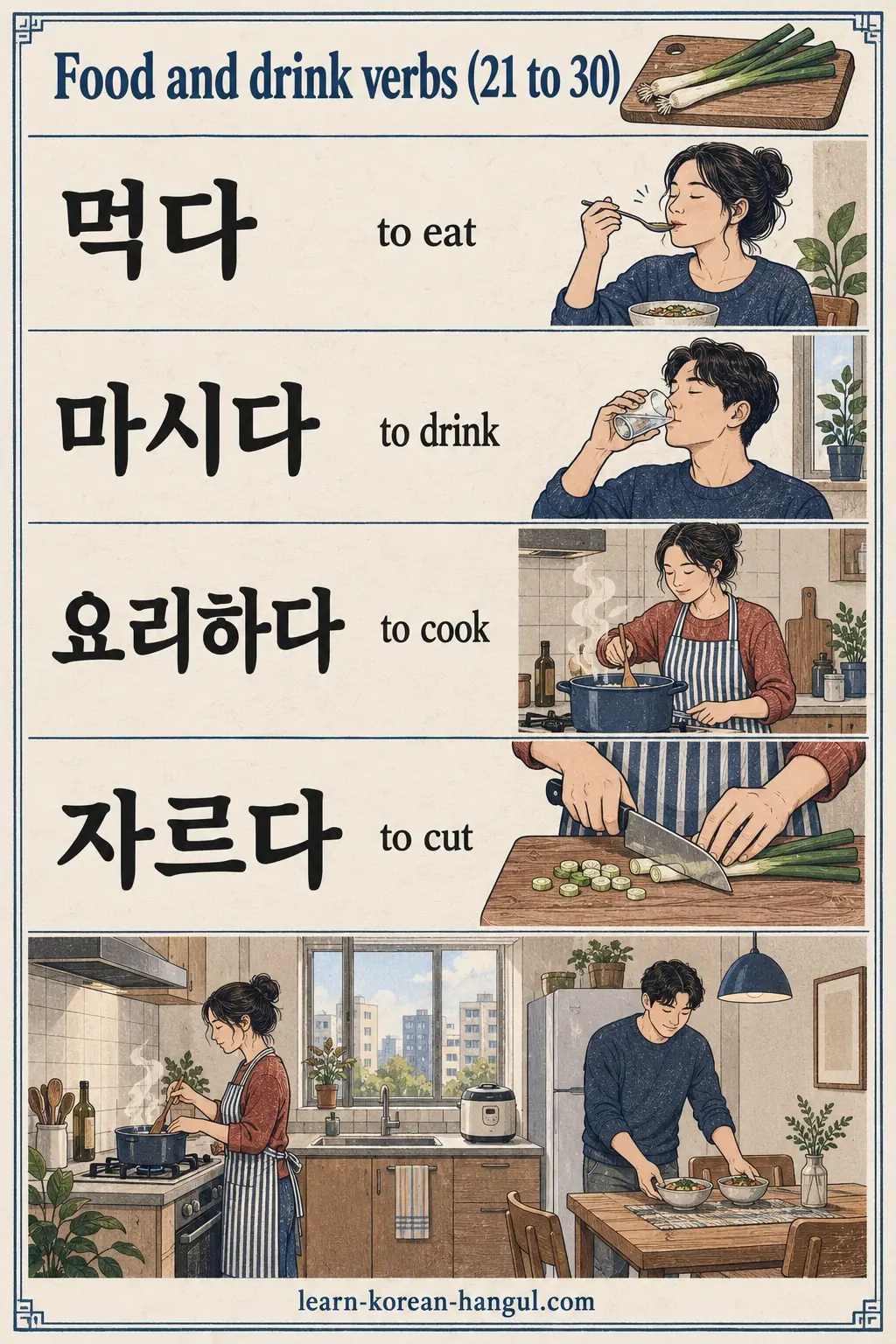
Food and Drink Verbs (21 to 30)
| # | Verb | Meaning | Polite present | Class | Example | Meaning of the example |
|---|---|---|---|---|---|---|
| 21 | 먹다 | to eat | 먹어요 | regular | 아침을 먹어요. | I eat breakfast. |
| 22 | 마시다 | to drink | 마셔요 | regular | 물을 마셔요. | I drink water. |
| 23 | 요리하다 | to cook | 요리해요 | 하다 type | 집에서 요리해요. | I cook at home. |
| 24 | 끓이다 | to boil | 끓여요 | regular | 라면을 끓여요. | I boil ramyeon. |
| 25 | 굽다 | to grill; to roast | 구워요 | ㅂ irregular | 고기를 구워요. | I grill meat. |
| 26 | 볶다 | to stir-fry | 볶아요 | regular | 야채를 볶아요. | I stir-fry vegetables. |
| 27 | 자르다 | to cut | 잘라요 | 르 irregular | 파를 잘라요. | I cut the green onion. |
| 28 | 주문하다 | to order | 주문해요 | 하다 type | 커피를 주문해요. | I order coffee. |
| 29 | 시키다 | to order; to make (someone) do | 시켜요 | regular | 피자를 시켜요. | I order pizza. |
| 30 | 붓다 | to pour; to swell | 부어요 | ㅅ irregular | 컵에 물을 부어요. | I pour water into a cup. |
Communication Verbs (31 to 40)
| # | Verb | Meaning | Polite present | Class | Example | Meaning of the example |
|---|---|---|---|---|---|---|
| 31 | 말하다 | to speak | 말해요 | 하다 type | 천천히 말해요. | I speak slowly. |
| 32 | 이야기하다 | to talk; to chat (also 얘기하다) | 이야기해요 | 하다 type | 친구와 이야기해요. | I talk with a friend. |
| 33 | 전화하다 | to phone | 전화해요 | 하다 type | 엄마한테 전화해요. | I call my mom. |
| 34 | 묻다 | to ask | 물어요 | ㄷ irregular | 길을 물어요. | I ask for directions. |
| 35 | 대답하다 | to answer | 대답해요 | 하다 type | 질문에 대답해요. | I answer the question. |
| 36 | 부르다 | to call/sing | 불러요 | 르 irregular | 노래를 불러요. | I sing a song. |
| 37 | 설명하다 | to explain | 설명해요 | 하다 type | 규칙을 설명해요. | I explain the rules. |
| 38 | 알려주다 | to let know; to tell | 알려줘요 | regular | 시간을 알려줘요. | I tell (you) the time. |
| 39 | 소개하다 | to introduce | 소개해요 | 하다 type | 친구를 소개해요. | I introduce a friend. |
| 40 | 인사하다 | to greet | 인사해요 | 하다 type | 선생님께 인사해요. | I greet the teacher. |
Thinking and Knowing Verbs (41 to 50)
| # | Verb | Meaning | Polite present | Class | Example | Meaning of the example |
|---|---|---|---|---|---|---|
| 41 | 알다 | to know | 알아요 | ㄹ-drop | 그 사람을 알아요. | I know that person. |
| 42 | 모르다 | to not know | 몰라요 | 르 irregular | 답을 몰라요. | I do not know the answer. |
| 43 | 생각하다 | to think | 생각해요 | 하다 type | 가족을 생각해요. | I think about my family. |
| 44 | 믿다 | to believe | 믿어요 | regular | 친구를 믿어요. | I trust my friend. |
| 45 | 기억하다 | to remember | 기억해요 | 하다 type | 이름을 기억해요. | I remember the name. |
| 46 | 잊다 | to forget | 잊어요 | regular | 약속을 잊어요. | I forget the appointment. |
| 47 | 이해하다 | to understand | 이해해요 | 하다 type | 문법을 이해해요. | I understand the grammar. |
| 48 | 배우다 | to learn | 배워요 | regular | 한국어를 배워요. | I learn Korean. |
| 49 | 외우다 | to memorize | 외워요 | regular | 단어를 외워요. | I memorize words. |
| 50 | 느끼다 | to feel | 느껴요 | regular | 행복을 느껴요. | I feel happiness. |
A pair worth noting is 알다 and 모르다: 알아요 is "I know" and 몰라요 is "I do not know". 알다 is an ㄹ-stem and 모르다 is 르-irregular. The group on buying, work and the body comes next.
Which Verbs Cover Buying, Work, Body and Health (51 to 80)?

These groups cover money, school and office life, and the body. Verbs here introduce transitive patterns: 사과를 사요, 영어를 가르쳐요, 영화를 봐요. 쓰다 is ㅡ-drop (써요), and 듣다 is ㄷ-irregular (들어요).
Buying and Money Verbs (51 to 60)
| # | Verb | Meaning | Polite present | Class | Example | Meaning of the example |
|---|---|---|---|---|---|---|
| 51 | 사다 | to buy | 사요 | regular | 사과를 사요. | I buy apples. |
| 52 | 팔다 | to sell | 팔아요 | ㄹ-drop | 중고차를 팔아요. | I sell a used car. |
| 53 | 주다 | to give | 줘요 | regular | 친구에게 선물을 줘요. | I give a friend a gift. |
| 54 | 받다 | to receive | 받아요 | regular | 선물을 받아요. | I receive a gift. |
| 55 | 내다 | to pay/put out | 내요 | regular | 돈을 내요. | I pay money. |
| 56 | 빌리다 | to borrow | 빌려요 | regular | 책을 빌려요. | I borrow a book. |
| 57 | 빌려주다 | to lend | 빌려줘요 | regular | 우산을 빌려줘요. | I lend an umbrella. |
| 58 | 쇼핑하다 | to shop | 쇼핑해요 | 하다 type | 시장에서 쇼핑해요. | I shop at the market. |
| 59 | 계산하다 | to calculate/pay | 계산해요 | 하다 type | 카드로 계산해요. | I pay by card. |
| 60 | 보내다 | to send; to spend (time) | 보내요 | regular | 편지를 보내요. | I send a letter. |
Work and Study Verbs (61 to 70)
| # | Verb | Meaning | Polite present | Class | Example | Meaning of the example |
|---|---|---|---|---|---|---|
| 61 | 일하다 | to work | 일해요 | 하다 type | 은행에서 일해요. | I work at a bank. |
| 62 | 공부하다 | to study | 공부해요 | 하다 type | 한국어를 공부해요. | I study Korean. |
| 63 | 읽다 | to read | 읽어요 | regular | 신문을 읽어요. | I read the newspaper. |
| 64 | 쓰다 | to write; to use; to wear (hat); to spend (money) | 써요 | ㅡ-drop | 이메일을 써요. | I write an email. |
| 65 | 가르치다 | to teach | 가르쳐요 | regular | 영어를 가르쳐요. | I teach English. |
| 66 | 연습하다 | to practice | 연습해요 | 하다 type | 발음을 연습해요. | I practice pronunciation. |
| 67 | 준비하다 | to prepare | 준비해요 | 하다 type | 시험을 준비해요. | I prepare for the exam. |
| 68 | 시작하다 | to start | 시작해요 | 하다 type | 수업을 시작해요. | I start the class. |
| 69 | 끝나다 | to end | 끝나요 | regular | 수업이 끝나요. | The class ends. |
| 70 | 사용하다 | to use | 사용해요 | 하다 type | 컴퓨터를 사용해요. | I use a computer. |
Body and Health Verbs (71 to 80)
| # | Verb | Meaning | Polite present | Class | Example | Meaning of the example |
|---|---|---|---|---|---|---|
| 71 | 보다 | to see/watch | 봐요 | regular | 영화를 봐요. | I watch a movie. |
| 72 | 듣다 | to listen/hear | 들어요 | ㄷ irregular | 음악을 들어요. | I listen to music. |
| 73 | 웃다 | to laugh/smile | 웃어요 | regular | 크게 웃어요. | I laugh loudly. |
| 74 | 울다 | to cry | 울어요 | ㄹ-drop | 슬픈 영화를 보고 울어요. | I cry watching a sad movie. |
| 75 | 운동하다 | to exercise | 운동해요 | 하다 type | 매일 운동해요. | I exercise every day. |
| 76 | 수영하다 | to swim | 수영해요 | 하다 type | 바다에서 수영해요. | I swim in the sea. |
| 77 | 다치다 | to get hurt | 다쳐요 | regular | 다리를 다쳐요. | I hurt my leg. |
| 78 | 낫다 | to recover | 나아요 | ㅅ irregular | 감기가 나아요. | The cold gets better. |
| 79 | 만지다 | to touch | 만져요 | regular | 강아지를 만져요. | I touch the puppy. |
| 80 | 안다 | to hug | 안아요 | regular | 아기를 안아요. | I hold the baby. |
Single entries for most of these have their own page in the Korean verb dictionary, and 낫다 is ㅅ-irregular (나아요). The last two groups cover people and change.
Which Verbs Cover Relationships, Change and State (81 to 100)?
The last twenty verbs describe how people relate and how things change or stay. 돕다 is ㅂ-irregular (도와요), and 켜다 and 끄다 are a pair, with 끄다 dropping ㅡ (꺼요).
Relationships Verbs (81 to 90)
| # | Verb | Meaning | Polite present | Class | Example | Meaning of the example |
|---|---|---|---|---|---|---|
| 81 | 만나다 | to meet | 만나요 | regular | 친구를 만나요. | I meet a friend. |
| 82 | 좋아하다 | to like | 좋아해요 | 하다 type | 커피를 좋아해요. | I like coffee. |
| 83 | 싫어하다 | to dislike | 싫어해요 | 하다 type | 벌레를 싫어해요. | I dislike bugs. |
| 84 | 사랑하다 | to love | 사랑해요 | 하다 type | 가족을 사랑해요. | I love my family. |
| 85 | 돕다 | to help | 도와요 | ㅂ irregular | 부모님을 도와요. | I help my parents. |
| 86 | 초대하다 | to invite | 초대해요 | 하다 type | 친구를 초대해요. | I invite a friend. |
| 87 | 약속하다 | to promise | 약속해요 | 하다 type | 친구와 약속해요. | I make plans with a friend. |
| 88 | 결혼하다 | to marry | 결혼해요 | 하다 type | 내년에 결혼해요. | I get married next year. |
| 89 | 헤어지다 | to part/break up | 헤어져요 | regular | 역에서 헤어져요. | We part at the station. |
| 90 | 싸우다 | to fight | 싸워요 | regular | 동생과 싸워요. | I fight with my younger sibling. |
Change and State Verbs (91 to 100)
| # | Verb | Meaning | Polite present | Class | Example | Meaning of the example |
|---|---|---|---|---|---|---|
| 91 | 하다 | to do | 해요 | 하다 type | 숙제를 해요. | I do homework. |
| 92 | 되다 | to become | 돼요 | regular | 의사가 돼요. | I become a doctor. |
| 93 | 있다 | to exist/have | 있어요 | existence verb | 집에 있어요. | I am at home. |
| 94 | 없다 | to not exist/not have | 없어요 | existence verb | 시간이 없어요. | I have no time. |
| 95 | 열다 | to open | 열어요 | ㄹ-drop | 창문을 열어요. | I open the window. |
| 96 | 닫다 | to close | 닫아요 | regular | 문을 닫아요. | I close the door. |
| 97 | 켜다 | to turn on | 켜요 | regular | 불을 켜요. | I turn on the light. |
| 98 | 끄다 | to turn off | 꺼요 | ㅡ-drop | 텔레비전을 꺼요. | I turn off the TV. |
| 99 | 바꾸다 | to change | 바꿔요 | regular | 자리를 바꿔요. | I change seats. |
| 100 | 찾다 | to find/look for | 찾아요 | regular | 열쇠를 찾아요. | I look for my key. |
Each verb in the list has a matching conjugation chart in the verbs conjugation list. With all 100 in view, a tally shows which patterns repeat.
How Many of the 100 Verbs Are 하다 Verbs or Irregular?
Of the 100 verbs, 30 are 하다 verbs, 50 are regular, 18 are irregular, and 2 (있다 and 없다) are existence verbs with their own forms. The class labels come from the site's conjugation engine and were reviewed by Min-ji Park on 15 October 2026; treat them as a guide. The counts show that most of the list uses a small set of patterns.
| Class | Verbs in the 100 | Examples |
|---|---|---|
| regular | 50 | 먹다, 만나다, 읽다 |
| 하다 type | 30 | 공부하다, 운동하다, 전화하다 |
| ㄹ-drop | 5 | 살다, 알다, 팔다, 울다, 열다 |
| ㄷ irregular | 3 | 걷다, 묻다, 듣다 |
| ㅂ irregular | 3 | 눕다, 굽다, 돕다 |
| 르 irregular | 3 | 자르다, 부르다, 모르다 |
| ㅅ irregular | 2 | 붓다, 낫다 |
| ㅡ-drop | 2 | 쓰다, 끄다 |
| existence verbs (not irregular) | 2 | 있다, 없다 |
| Total | 100 |
The 하다 verbs all follow one rule (해요), and the regular verbs follow the ordinary 아요 or 어요 rule. Each irregular class has a short rule and its own lesson in the Korean irregular verbs section. The ㄹ-stem verbs are the largest irregular group in this list, with five verbs, and they are also the mildest, because only the ㄹ drops before ㄴ, ㅂ and ㅅ. Knowing the tally tells you where to spend practice time.
How Do You Practise the 100 Verbs?
Practise in four steps: listen, say the example aloud, make one sentence of your own, and review on a schedule. The method is in how to learn Korean verbs, and the deck below applies it.
- Listen to the example sentence once, then say it aloud with the audio.
- Change one word in the example: 학교에 가요 becomes 회사에 가요.
- Write one sentence with a noun from your own life and the same verb.
- Review on days 1, 3, 7, 14 and 30, using the flashcard deck.
Practice · 120
- 01가요
Show answer
polite present of the learn-first verb 가다
- 02와요
Show answer
polite present of the learn-first verb 오다
- 03해요
Show answer
polite present of the learn-first verb 하다
- 04돼요
Show answer
polite present of the learn-first verb 되다
- 05있어요
Show answer
polite present of the learn-first verb 있다
- 06없어요
Show answer
polite present of the learn-first verb 없다
- 07봐요
Show answer
polite present of the learn-first verb 보다
- 08먹어요
Show answer
polite present of the learn-first verb 먹다
- 09마셔요
Show answer
polite present of the learn-first verb 마시다
- 10자요
Show answer
polite present of the learn-first verb 자다
- 11사요
Show answer
polite present of the learn-first verb 사다
- 12줘요
Show answer
polite present of the learn-first verb 주다
- 13받아요
Show answer
polite present of the learn-first verb 받다
- 14알아요
Show answer
polite present of the learn-first verb 알다
- 15몰라요
Show answer
polite present of the learn-first verb 모르다
- 16좋아해요
Show answer
polite present of the learn-first verb 좋아하다
- 17만나요
Show answer
polite present of the learn-first verb 만나다
- 18말해요
Show answer
polite present of the learn-first verb 말하다
- 19읽어요
Show answer
polite present of the learn-first verb 읽다
- 20써요
Show answer
polite present of the learn-first verb 쓰다
- 21학교에 가요.
Show answer
example sentence with 가다
- 22집에 와요.
Show answer
example sentence with 오다
- 23방에 들어가요.
Show answer
example sentence with 들어가다
- 24밖에 나가요.
Show answer
example sentence with 나가다
- 25고향에 돌아가요.
Show answer
example sentence with 돌아가다
- 26계단을 올라가요.
Show answer
example sentence with 올라가다
- 27공원에서 걸어요.
Show answer
example sentence with 걷다
- 28아침에 뛰어요.
Show answer
example sentence with 뛰다
- 29버스를 타요.
Show answer
example sentence with 타다
- 30일곱 시에 도착해요.
Show answer
example sentence with 도착하다
- 31일곱 시에 일어나요.
Show answer
example sentence with 일어나다
- 32열한 시에 자요.
Show answer
example sentence with 자다
- 33손을 씻어요.
Show answer
example sentence with 씻다
- 34코트를 입어요.
Show answer
example sentence with 입다
- 35운동화를 신어요.
Show answer
example sentence with 신다
- 36주말에 쉬어요.
Show answer
example sentence with 쉬다
- 37서울에 살아요.
Show answer
example sentence with 살다
- 38의자에 앉아요.
Show answer
example sentence with 앉다
- 39줄을 서요.
Show answer
example sentence with 서다
- 40침대에 누워요.
Show answer
example sentence with 눕다
- 41아침을 먹어요.
Show answer
example sentence with 먹다
- 42물을 마셔요.
Show answer
example sentence with 마시다
- 43집에서 요리해요.
Show answer
example sentence with 요리하다
- 44라면을 끓여요.
Show answer
example sentence with 끓이다
- 45고기를 구워요.
Show answer
example sentence with 굽다
- 46야채를 볶아요.
Show answer
example sentence with 볶다
- 47파를 잘라요.
Show answer
example sentence with 자르다
- 48커피를 주문해요.
Show answer
example sentence with 주문하다
- 49피자를 시켜요.
Show answer
example sentence with 시키다
- 50컵에 물을 부어요.
Show answer
example sentence with 붓다
- 51천천히 말해요.
Show answer
example sentence with 말하다
- 52친구와 이야기해요.
Show answer
example sentence with 이야기하다
- 53엄마한테 전화해요.
Show answer
example sentence with 전화하다
- 54길을 물어요.
Show answer
example sentence with 묻다
- 55질문에 대답해요.
Show answer
example sentence with 대답하다
- 56노래를 불러요.
Show answer
example sentence with 부르다
- 57규칙을 설명해요.
Show answer
example sentence with 설명하다
- 58시간을 알려줘요.
Show answer
example sentence with 알려주다
- 59친구를 소개해요.
Show answer
example sentence with 소개하다
- 60선생님께 인사해요.
Show answer
example sentence with 인사하다
- 61그 사람을 알아요.
Show answer
example sentence with 알다
- 62답을 몰라요.
Show answer
example sentence with 모르다
- 63가족을 생각해요.
Show answer
example sentence with 생각하다
- 64친구를 믿어요.
Show answer
example sentence with 믿다
- 65이름을 기억해요.
Show answer
example sentence with 기억하다
- 66약속을 잊어요.
Show answer
example sentence with 잊다
- 67문법을 이해해요.
Show answer
example sentence with 이해하다
- 68한국어를 배워요.
Show answer
example sentence with 배우다
- 69단어를 외워요.
Show answer
example sentence with 외우다
- 70행복을 느껴요.
Show answer
example sentence with 느끼다
- 71사과를 사요.
Show answer
example sentence with 사다
- 72중고차를 팔아요.
Show answer
example sentence with 팔다
- 73친구에게 선물을 줘요.
Show answer
example sentence with 주다
- 74선물을 받아요.
Show answer
example sentence with 받다
- 75돈을 내요.
Show answer
example sentence with 내다
- 76책을 빌려요.
Show answer
example sentence with 빌리다
- 77우산을 빌려줘요.
Show answer
example sentence with 빌려주다
- 78시장에서 쇼핑해요.
Show answer
example sentence with 쇼핑하다
- 79카드로 계산해요.
Show answer
example sentence with 계산하다
- 80편지를 보내요.
Show answer
example sentence with 보내다
- 81은행에서 일해요.
Show answer
example sentence with 일하다
- 82한국어를 공부해요.
Show answer
example sentence with 공부하다
- 83신문을 읽어요.
Show answer
example sentence with 읽다
- 84이메일을 써요.
Show answer
example sentence with 쓰다
- 85영어를 가르쳐요.
Show answer
example sentence with 가르치다
- 86발음을 연습해요.
Show answer
example sentence with 연습하다
- 87시험을 준비해요.
Show answer
example sentence with 준비하다
- 88수업을 시작해요.
Show answer
example sentence with 시작하다
- 89수업이 끝나요.
Show answer
example sentence with 끝나다
- 90컴퓨터를 사용해요.
Show answer
example sentence with 사용하다
- 91영화를 봐요.
Show answer
example sentence with 보다
- 92음악을 들어요.
Show answer
example sentence with 듣다
- 93크게 웃어요.
Show answer
example sentence with 웃다
- 94슬픈 영화를 보고 울어요.
Show answer
example sentence with 울다
- 95매일 운동해요.
Show answer
example sentence with 운동하다
- 96바다에서 수영해요.
Show answer
example sentence with 수영하다
- 97다리를 다쳐요.
Show answer
example sentence with 다치다
- 98감기가 나아요.
Show answer
example sentence with 낫다
- 99강아지를 만져요.
Show answer
example sentence with 만지다
- 100아기를 안아요.
Show answer
example sentence with 안다
- 101친구를 만나요.
Show answer
example sentence with 만나다
- 102커피를 좋아해요.
Show answer
example sentence with 좋아하다
- 103벌레를 싫어해요.
Show answer
example sentence with 싫어하다
- 104가족을 사랑해요.
Show answer
example sentence with 사랑하다
- 105부모님을 도와요.
Show answer
example sentence with 돕다
- 106친구를 초대해요.
Show answer
example sentence with 초대하다
- 107친구와 약속해요.
Show answer
example sentence with 약속하다
- 108내년에 결혼해요.
Show answer
example sentence with 결혼하다
- 109역에서 헤어져요.
Show answer
example sentence with 헤어지다
- 110동생과 싸워요.
Show answer
example sentence with 싸우다
- 111숙제를 해요.
Show answer
example sentence with 하다
- 112의사가 돼요.
Show answer
example sentence with 되다
- 113집에 있어요.
Show answer
example sentence with 있다
- 114시간이 없어요.
Show answer
example sentence with 없다
- 115창문을 열어요.
Show answer
example sentence with 열다
- 116문을 닫아요.
Show answer
example sentence with 닫다
- 117불을 켜요.
Show answer
example sentence with 켜다
- 118텔레비전을 꺼요.
Show answer
example sentence with 끄다
- 119자리를 바꿔요.
Show answer
example sentence with 바꾸다
- 120열쇠를 찾아요.
Show answer
example sentence with 찾다
More decks are in the vocabulary flashcards hub. For nouns to combine with these verbs, use the 100 Korean words list, and when you are ready for adjectives, continue with common Korean adjectives.
Download the List
The CSV and PDF versions carry the same 100 rows: verb, meaning, polite present, class, example, meaning of the example. They are not available yet; for practice, use the flashcard deck above.
100 Korean Verbs (CSV, PDF)
What to Learn Next
These 100 Korean verbs give you a working core: the 20 first verbs for basic sentences, ten themed groups for daily life, and a tally that shows how few patterns you need (the 하다 rule, the regular rule and a handful of irregular classes). Keep each verb with its particle, review it on a schedule, and add the adjectives next. The page on common Korean verbs shows the other lists, and the verbs conjugation list gives the full forms.
This list does not cover honorific verbs, passive and causative pairs, or verbs beyond B1. It does not claim to be a frequency ranking. The forms follow the standard written language of the National Institute of Korean Language (국립국어원), and the bracketed pronunciations in other lessons are standard Seoul approximations.
Frequently Asked Questions
What are the most common Korean verbs? The most common Korean verbs include 가다 (go), 오다 (come), 하다 (do), 되다 (become), 있다 (exist), 보다 (see), 먹다 (eat), 마시다 (drink), 알다 (know), 만나다 (meet), 말하다 (speak), 읽다 (read) and 쓰다 (write). This list ranks verbs by learner need and level, not by a corpus frequency count.
Which Korean verbs should I learn first? Learn the 20 in the first table: 가다, 오다, 하다, 되다, 있다, 없다, 보다, 먹다, 마시다, 자다, 사다, 주다, 받다, 알다, 모르다, 좋아하다, 만나다, 말하다, 읽다 and 쓰다. They appear in the most basic sentences, and learning them with their particles gives you a working base in a few weeks.
How many Korean verbs are there? There is no single fixed count, because 하다 builds new verbs from nouns all the time and dictionaries differ in what they list. This page gives a working core of 100. The site verb lexicon holds 474 verbs and adjectives, and the 100 verbs here are chosen from it.
Are all of these verbs regular? No. 30 of the 100 are 하다 verbs, 50 are regular, and 18 are irregular in six classes (ㄹ, ㄷ, ㅂ, 르, ㅅ, ㅡ). The last two, 있다 and 없다, are existence verbs with their own pattern. The class label in each row tells you which rule applies, and 80 of the 100 follow the simple 하다 or regular rule.
Is there a flashcard deck for these verbs? Yes. The deck embedded above holds the 100 verbs in recognition mode, and you can switch to active recall to practise producing the Korean from the English cue. CSV and PDF downloads are available. Use the deck together with the review schedule in the learning guide.