
Basic Korean Words at a Glance
This page holds 60 words in six groups of ten, each tied to something you do in your first two days: arrive, ask, order, pay and find your way. The list is part of Most Common Korean Words, but it is chosen by situation, not by rank.
| Group | Words | Use |
|---|---|---|
| First-day survival words | 10 | Asking for water, the restroom, help and prices |
| People and titles | 10 | Saying who you are and addressing people |
| Yes, no and politeness | 10 | Answering, thanking and apologising |
| Food and drink basics | 10 | Reading a menu and ordering |
| Money and numbers | 10 | Paying and asking about prices |
| Directions and places | 10 | Finding places and reading signs |
The words come with example sentences, so you can use the page as a ready deck. Learners often ask which of them to learn first.
Which Basic Korean Words Should You Learn First?
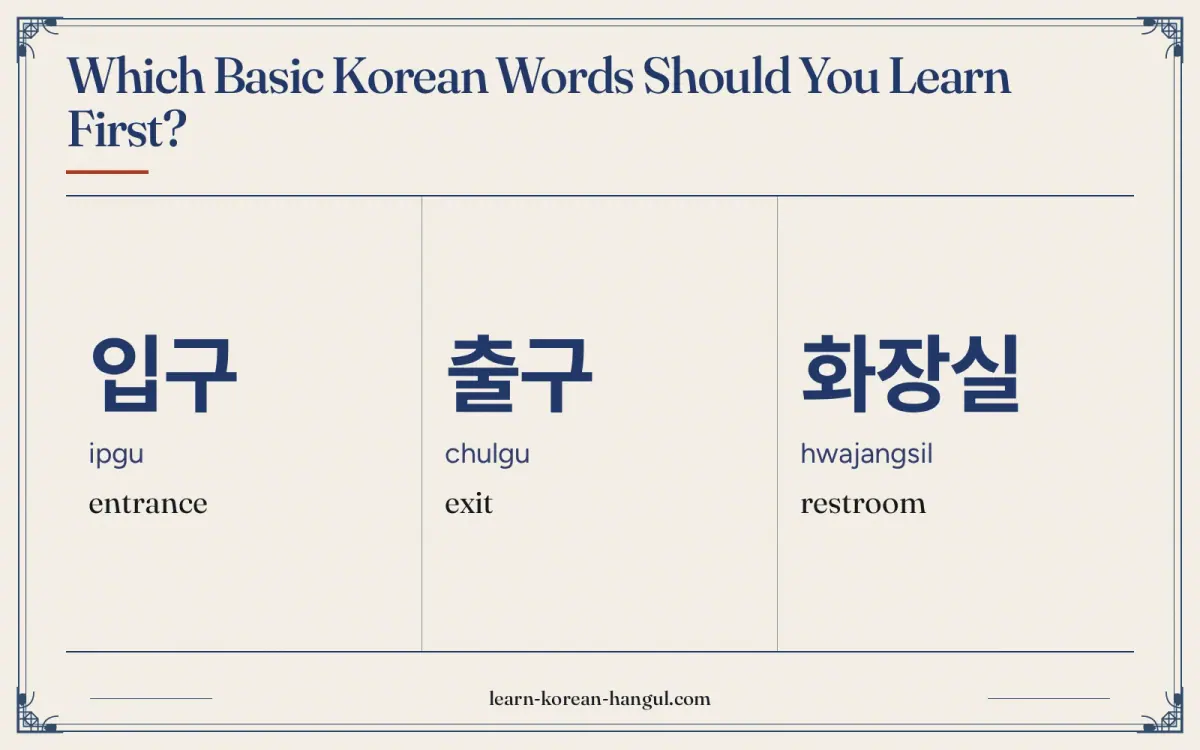
Learn the first-day survival words and the politeness words first, since they solve the most urgent problems. Then add the food, money and direction groups.
The list splits into two kinds of word, and each needs a different drill:
- Words to recognise. You see these on signs, menus and screens: 입구, 출구, 화장실, 약국, 메뉴, 현금. Drill them by reading, with the romanization covered.
- Words to say. You speak these: 물 주세요, 얼마예요, 감사합니다, 죄송합니다. Drill them aloud, with the audio, until you can say them without looking.
The signs strip below shows the four words you will meet on doors and shop fronts.
| Sign | Hangul | Romanization | Meaning |
|---|---|---|---|
| Door of a building | 입구 | ipgu | entrance |
| Door of a building | 출구 | chulgu | exit |
| Door of a room | 화장실 | hwajangsil | restroom |
| Shop front with a green cross | 약국 | yakguk | pharmacy |
First-Day Survival Words
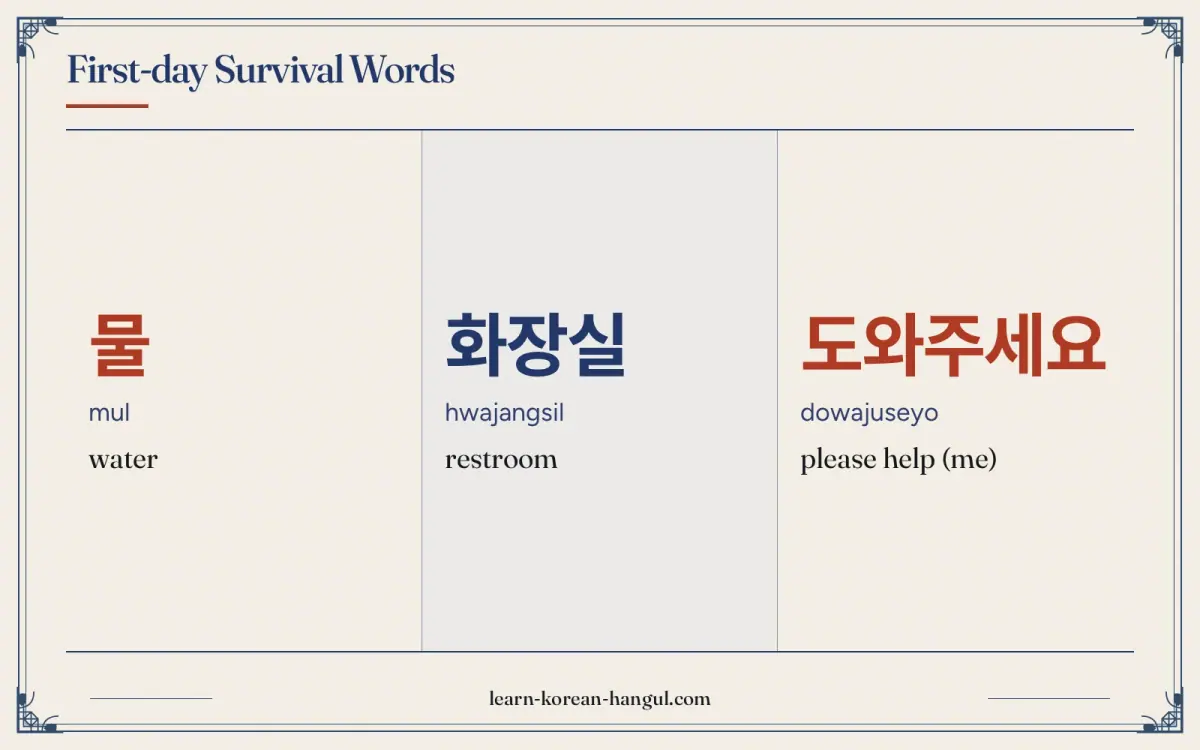
These ten words get you through arrival: water, the restroom, a request for help, prices, places and transport. Combine them with 주세요 (please give me) and 어디예요 (where is it?). The polite ending 예요 follows a noun, so 화장실이 어디예요? means where is the restroom.
| No. | Hangul | Revised Romanization | Meaning | Example sentence | Audio assetId |
|---|---|---|---|---|---|
| 1 | 물 | mul | water | 물 주세요. (Water, please.) | au-pg-vocabulary-core-words-basic-1; example: au-pg-vocabulary-core-words-basic-61 |
| 2 | 화장실 | hwajangsil | restroom | 화장실이 어디예요? (Where is the restroom?) | au-pg-vocabulary-core-words-basic-2; example: au-pg-vocabulary-core-words-basic-62 |
| 3 | 도와주세요 | dowajuseyo | please help (me) | 도와주세요! (Please help me!) | au-pg-vocabulary-core-words-basic-3; example: au-pg-vocabulary-core-words-basic-63 |
| 4 | 얼마 | eolma | how much | 이거 얼마예요? (How much is this?) | au-pg-vocabulary-core-words-basic-4; example: au-pg-vocabulary-core-words-basic-64 |
| 5 | 여기 | yeogi | here | 여기 있어요. (It is here.) | au-pg-vocabulary-core-words-basic-5; example: au-pg-vocabulary-core-words-basic-65 |
| 6 | 어디 | eodi | where | 지하철역이 어디예요? (Where is the subway station?) | au-pg-vocabulary-core-words-basic-6; example: au-pg-vocabulary-core-words-basic-66 |
| 7 | 지하철 | jihacheol | subway | 지하철을 타요. (I take the subway.) | au-pg-vocabulary-core-words-basic-7; example: au-pg-vocabulary-core-words-basic-67 |
| 8 | 택시 | taeksi | taxi | 택시를 타요. (I take a taxi.) | au-pg-vocabulary-core-words-basic-8; example: au-pg-vocabulary-core-words-basic-68 |
| 9 | 입구 | ipgu | entrance | 입구는 저기예요. (The entrance is over there.) | au-pg-vocabulary-core-words-basic-9; example: au-pg-vocabulary-core-words-basic-69 |
| 10 | 출구 | chulgu | exit | 출구는 어디예요? (Where is the exit?) | au-pg-vocabulary-core-words-basic-10; example: au-pg-vocabulary-core-words-basic-70 |
Note that 도와주세요 is a phrase, not a single noun, but it is on this list because it is the sentence you most need in an emergency. The next group covers the people you will speak to.
Example Sentences
Say each example aloud and compare it with the audio. The sentences are short and polite, so you can reuse them with new nouns. Replace 물 with 커피 and 물 주세요 becomes 커피 주세요.
People and Titles
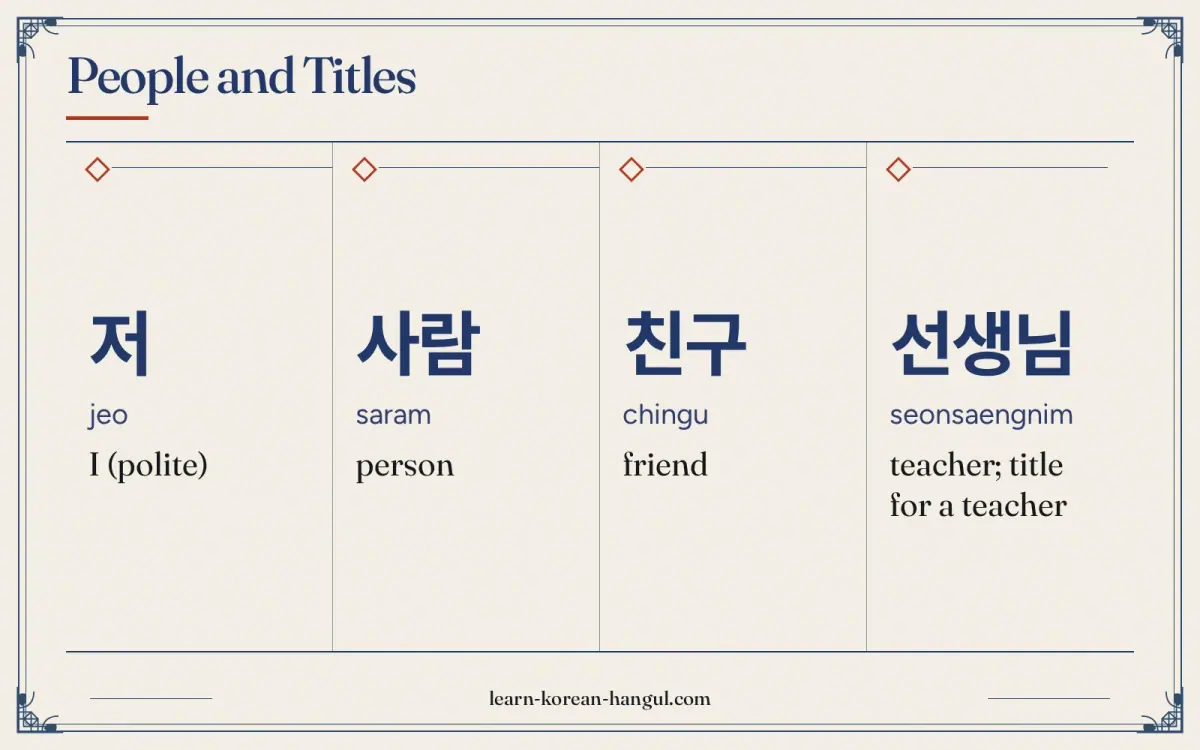
Use 저 for I when you speak to strangers and elders, and call a teacher 선생님. In Korean you often add 님 to a title as a mark of respect, and 선생님 can address any teacher, not only the person who teaches you.
| No. | Hangul | Revised Romanization | Meaning | Example sentence | Audio assetId |
|---|---|---|---|---|---|
| 11 | 저 | jeo | I (polite) | 저는 미국 사람이에요. (I am American.) | au-pg-vocabulary-core-words-basic-11; example: au-pg-vocabulary-core-words-basic-71 |
| 12 | 사람 | saram | person | 한국 사람이에요. (I am a Korean person.) | au-pg-vocabulary-core-words-basic-12; example: au-pg-vocabulary-core-words-basic-72 |
| 13 | 친구 | chingu | friend | 친구를 만나요. (I meet a friend.) | au-pg-vocabulary-core-words-basic-13; example: au-pg-vocabulary-core-words-basic-73 |
| 14 | 선생님 | seonsaengnim | teacher; title for a teacher | 선생님, 안녕하세요. (Hello, teacher.) | au-pg-vocabulary-core-words-basic-14; example: au-pg-vocabulary-core-words-basic-74 |
| 15 | 학생 | haksaeng | student | 저는 학생이에요. (I am a student.) | au-pg-vocabulary-core-words-basic-15; example: au-pg-vocabulary-core-words-basic-75 |
| 16 | 아이 | ai | child | 아이가 웃어요. (The child laughs.) | au-pg-vocabulary-core-words-basic-16; example: au-pg-vocabulary-core-words-basic-76 |
| 17 | 어머니 | eomeoni | mother | 어머니는 집에 계세요. (My mother is at home.) | au-pg-vocabulary-core-words-basic-17; example: au-pg-vocabulary-core-words-basic-77 |
| 18 | 아버지 | abeoji | father | 아버지는 회사에 가요. (My father goes to the office.) | au-pg-vocabulary-core-words-basic-18; example: au-pg-vocabulary-core-words-basic-78 |
| 19 | 남자 | namja | man | 남자 화장실은 저기예요. (The men's restroom is over there.) | au-pg-vocabulary-core-words-basic-19; example: au-pg-vocabulary-core-words-basic-79 |
| 20 | 여자 | yeoja | woman | 여자 화장실은 여기예요. (The women's restroom is here.) | au-pg-vocabulary-core-words-basic-20; example: au-pg-vocabulary-core-words-basic-80 |
The words 남자 and 여자 also appear on restroom signs, as in 남자 화장실 (men's restroom). Politeness words are next.
Yes, No and Politeness
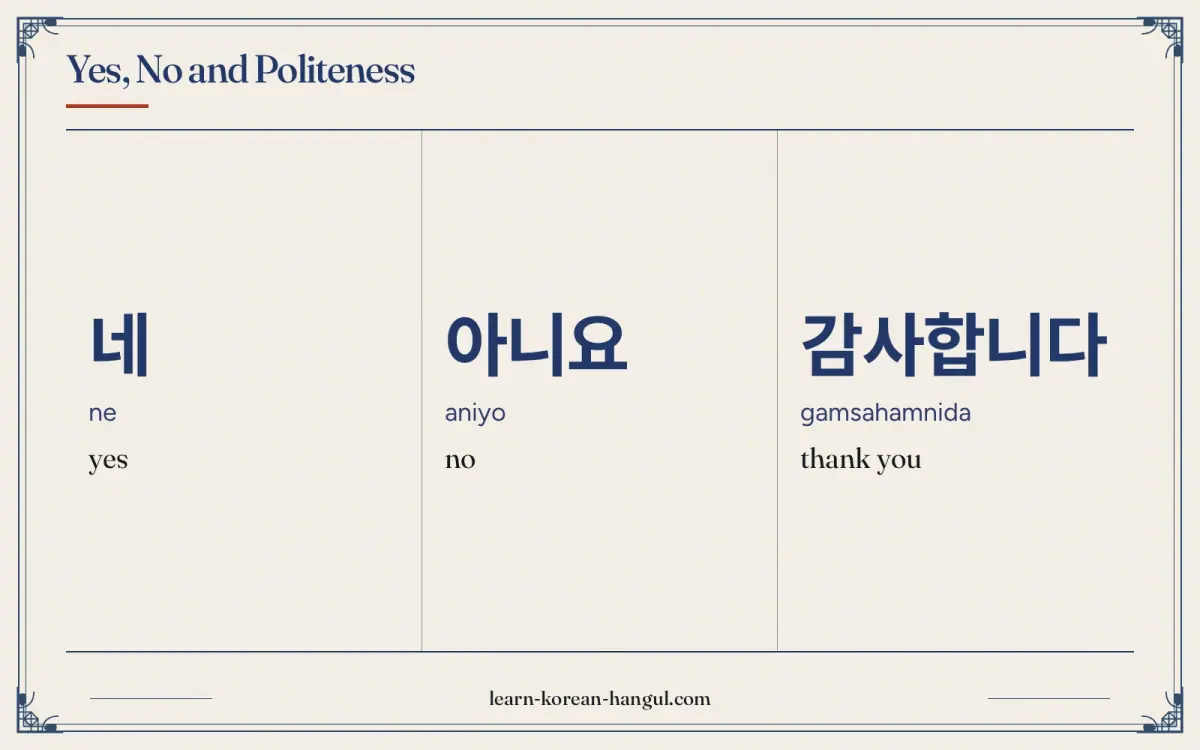
Politeness words shape how you sound, so learn a few early. 감사합니다 and 죄송합니다 use the formal polite ending 합니다, and 주세요 and 괜찮아요 use the softer 요 ending of everyday speech. These words are already in a polite form: 주세요, for example, is the polite request form of 주다 (to give), so 물 주세요 needs no extra ending.
| No. | Hangul | Revised Romanization | Meaning | Example sentence | Audio assetId |
|---|---|---|---|---|---|
| 21 | 네 | ne | yes | 네, 맞아요. (Yes, that is right.) | au-pg-vocabulary-core-words-basic-21; example: au-pg-vocabulary-core-words-basic-81 |
| 22 | 아니요 | aniyo | no | 아니요, 괜찮아요. (No, I am fine.) | au-pg-vocabulary-core-words-basic-22; example: au-pg-vocabulary-core-words-basic-82 |
| 23 | 감사합니다 | gamsahamnida | thank you | 감사합니다, 선생님. (Thank you, teacher.) | au-pg-vocabulary-core-words-basic-23; example: au-pg-vocabulary-core-words-basic-83 |
| 24 | 죄송합니다 | joesonghamnida | I am sorry | 늦어서 죄송합니다. (I am sorry I am late.) | au-pg-vocabulary-core-words-basic-24; example: au-pg-vocabulary-core-words-basic-84 |
| 25 | 주세요 | juseyo | please give me | 커피 주세요. (Coffee, please.) | au-pg-vocabulary-core-words-basic-25; example: au-pg-vocabulary-core-words-basic-85 |
| 26 | 괜찮아요 | gwaenchanayo | it is okay | 저는 괜찮아요. (I am okay.) | au-pg-vocabulary-core-words-basic-26; example: au-pg-vocabulary-core-words-basic-86 |
| 27 | 안녕하세요 | annyeonghaseyo | hello | 안녕하세요, 만나서 반갑습니다. (Hello, nice to meet you.) | au-pg-vocabulary-core-words-basic-27; example: au-pg-vocabulary-core-words-basic-87 |
| 28 | 안녕히 가세요 | annyeonghi gaseyo | goodbye (to someone leaving) | 안녕히 가세요, 선생님. (Goodbye, teacher.) | au-pg-vocabulary-core-words-basic-28; example: au-pg-vocabulary-core-words-basic-88 |
| 29 | 실례합니다 | sillyehamnida | excuse me | 실례합니다, 화장실이 어디예요? (Excuse me, where is the restroom?) | au-pg-vocabulary-core-words-basic-29; example: au-pg-vocabulary-core-words-basic-89 |
| 30 | 잠깐만요 | jamkkanmanyo | just a moment | 잠깐만요, 곧 가요. (Just a moment, I am coming soon.) | au-pg-vocabulary-core-words-basic-30; example: au-pg-vocabulary-core-words-basic-90 |
Greetings are covered in full on the Korean greetings page, and travel sentences on the travel phrases page. The next group moves to the table.
Food and Drink Basics
Food words are among the first you will read, because menus use short nouns. Pair a noun with a number and 주세요 to order: 커피 한 잔 주세요 (one cup of coffee, please).
| No. | Hangul | Revised Romanization | Meaning | Example sentence | Audio assetId |
|---|---|---|---|---|---|
| 31 | 밥 | bap | cooked rice; meal | 밥 먹었어요? (Have you eaten?) | au-pg-vocabulary-core-words-basic-31; example: au-pg-vocabulary-core-words-basic-91 |
| 32 | 커피 | keopi | coffee | 커피 한 잔 주세요. (One cup of coffee, please.) | au-pg-vocabulary-core-words-basic-32; example: au-pg-vocabulary-core-words-basic-92 |
| 33 | 차 | cha | tea | 차 한 잔 주세요. (One cup of tea, please.) | au-pg-vocabulary-core-words-basic-33; example: au-pg-vocabulary-core-words-basic-93 |
| 34 | 맥주 | maekju | beer | 맥주 두 병 주세요. (Two bottles of beer, please.) | au-pg-vocabulary-core-words-basic-34; example: au-pg-vocabulary-core-words-basic-94 |
| 35 | 우유 | uyu | milk | 우유 있어요? (Do you have milk?) | au-pg-vocabulary-core-words-basic-35; example: au-pg-vocabulary-core-words-basic-95 |
| 36 | 빵 | ppang | bread | 빵을 먹어요. (I eat bread.) | au-pg-vocabulary-core-words-basic-36; example: au-pg-vocabulary-core-words-basic-96 |
| 37 | 고기 | gogi | meat | 고기를 좋아해요. (I like meat.) | au-pg-vocabulary-core-words-basic-37; example: au-pg-vocabulary-core-words-basic-97 |
| 38 | 김치 | gimchi | kimchi | 김치가 매워요. (The kimchi is spicy.) | au-pg-vocabulary-core-words-basic-38; example: au-pg-vocabulary-core-words-basic-98 |
| 39 | 맛있어요 | masisseoyo | it is delicious | 이 음식 맛있어요. (This food is delicious.) | au-pg-vocabulary-core-words-basic-39; example: au-pg-vocabulary-core-words-basic-99 |
| 40 | 메뉴 | menyu | menu | 메뉴 주세요. (A menu, please.) | au-pg-vocabulary-core-words-basic-40; example: au-pg-vocabulary-core-words-basic-100 |
Note that 밥 means cooked rice and also a meal, so 밥 먹었어요? (Have you eaten?) is a common way to ask how someone is. Next comes the words for paying.
Money and Numbers
Paying needs only a few words: 얼마예요 for the price, 원 for the unit and a native number for how many you want. Use the native numbers 하나, 둘 and 셋 when you ask for items, and Sino-Korean numbers for prices. Read more in the Sino-Korean numbers lesson.
| No. | Hangul | Revised Romanization | Meaning | Example sentence | Audio assetId |
|---|---|---|---|---|---|
| 41 | 돈 | don | money | 돈이 없어요. (I have no money.) | au-pg-vocabulary-core-words-basic-41; example: au-pg-vocabulary-core-words-basic-101 |
| 42 | 원 | won | won (Korean currency) | 오천 원이에요. (It is 5,000 won.) | au-pg-vocabulary-core-words-basic-42; example: au-pg-vocabulary-core-words-basic-102 |
| 43 | 카드 | kadeu | card | 카드로 계산해요. (I pay by card.) | au-pg-vocabulary-core-words-basic-43; example: au-pg-vocabulary-core-words-basic-103 |
| 44 | 현금 | hyeongeum | cash | 현금만 돼요. (Cash only.) | au-pg-vocabulary-core-words-basic-44; example: au-pg-vocabulary-core-words-basic-104 |
| 45 | 영수증 | yeongsujeung | receipt | 영수증 주세요. (A receipt, please.) | au-pg-vocabulary-core-words-basic-45; example: au-pg-vocabulary-core-words-basic-105 |
| 46 | 하나 | hana | one | 사과 하나 주세요. (One apple, please.) | au-pg-vocabulary-core-words-basic-46; example: au-pg-vocabulary-core-words-basic-106 |
| 47 | 둘 | dul | two | 물 둘 주세요. (Two waters, please.) | au-pg-vocabulary-core-words-basic-47; example: au-pg-vocabulary-core-words-basic-107 |
| 48 | 셋 | set | three | 커피 셋 주세요. (Three coffees, please.) | au-pg-vocabulary-core-words-basic-48; example: au-pg-vocabulary-core-words-basic-108 |
| 49 | 비싸요 | bissayo | it is expensive | 너무 비싸요. (It is too expensive.) | au-pg-vocabulary-core-words-basic-49; example: au-pg-vocabulary-core-words-basic-109 |
| 50 | 싸요 | ssayo | it is cheap | 여기는 싸요. (It is cheap here.) | au-pg-vocabulary-core-words-basic-50; example: au-pg-vocabulary-core-words-basic-110 |
A price such as 5,000 won is 오천 원, using a Sino-Korean number, while the quantity 두 개 uses a native number. The last group helps you find places.
How Do You Say Directions and Places in Korean?
Directions need place words and direction words. Combine a place with 어디예요 to ask where it is, then listen for 왼쪽, 오른쪽, 앞 or 뒤 in the answer.
| No. | Hangul | Revised Romanization | Meaning | Example sentence | Audio assetId |
|---|---|---|---|---|---|
| 51 | 왼쪽 | oenjjok | left | 왼쪽으로 가세요. (Please go to the left.) | au-pg-vocabulary-core-words-basic-51; example: au-pg-vocabulary-core-words-basic-111 |
| 52 | 오른쪽 | oreunjjok | right | 오른쪽에 있어요. (It is on the right.) | au-pg-vocabulary-core-words-basic-52; example: au-pg-vocabulary-core-words-basic-112 |
| 53 | 앞 | ap | front | 앞으로 가세요. (Please go forward.) | au-pg-vocabulary-core-words-basic-53; example: au-pg-vocabulary-core-words-basic-113 |
| 54 | 뒤 | dwi | back, behind | 뒤에 있어요. (It is behind.) | au-pg-vocabulary-core-words-basic-54; example: au-pg-vocabulary-core-words-basic-114 |
| 55 | 약국 | yakguk | pharmacy | 약국은 저기예요. (The pharmacy is over there.) | au-pg-vocabulary-core-words-basic-55; example: au-pg-vocabulary-core-words-basic-115 |
| 56 | 병원 | byeongwon | hospital | 병원에 가요. (I go to the hospital.) | au-pg-vocabulary-core-words-basic-56; example: au-pg-vocabulary-core-words-basic-116 |
| 57 | 호텔 | hotel | hotel | 호텔은 가까워요. (The hotel is close.) | au-pg-vocabulary-core-words-basic-57; example: au-pg-vocabulary-core-words-basic-117 |
| 58 | 공항 | gonghang | airport | 공항에 가요. (I go to the airport.) | au-pg-vocabulary-core-words-basic-58; example: au-pg-vocabulary-core-words-basic-118 |
| 59 | 역 | yeok | station | 역이 어디예요? (Where is the station?) | au-pg-vocabulary-core-words-basic-59; example: au-pg-vocabulary-core-words-basic-119 |
| 60 | 편의점 | pyeonuijeom | convenience store | 편의점은 여기 있어요. (The convenience store is here.) | au-pg-vocabulary-core-words-basic-60; example: au-pg-vocabulary-core-words-basic-120 |
Note that 호텔 is a loanword from English, and the Hangul spelling follows the Korean sound. The audio shows how the words sound.
How Do You Pronounce These Words?
Press the play button to hear a word, and repeat it before you read the romanization. Some of these words change sound when they sit in a sentence. The table shows the forms that learners often miss.
| Word | Romanization | Said | Rule |
|---|---|---|---|
| 감사합니다 | gamsahamnida | [감사함니다] | ㅂ becomes ㅁ before ㄴ |
| 죄송합니다 | joesonghamnida | [죄송함니다] | ㅂ becomes ㅁ before ㄴ |
| 입구 | ipgu | [입꾸] | ㄱ after ㅂ becomes tense |
| 약국 | yakguk | [약꾹] | ㄱ after ㄱ becomes tense |
| 맛있어요 | masisseoyo | [마시써요] | final ㅅ and ㅆ move onto the next vowel (liaison) |
| 괜찮아요 | gwaenchanayo | [괜차나요] | ㅎ is not heard before a vowel |
The rules come from the Standard Pronunciation rules (표준 발음법) of the 국립국어원, and a Korean reviewer should confirm each form.
Audio and Slow Playback
Each word has a normal clip, and five key words also have a slow clip at 0.8 times the speed: 물, 화장실, 얼마, 감사합니다 and 약국. Nothing plays until you press a button. Try the five slow clips here.
The clips are generated and were approved by Min-ji Park on 15 October 2026.
What Mistakes Do Learners Make with Basic Korean Words?
- Dropping the polite ending. 물 alone is a noun; 물 주세요 is a request.
- Confusing 네 and 아니요 in answers to negative questions. 네 agrees with the question, so to 안 가요? (Aren't you going?) 네 means right, I am not going.
- Stressing syllables like English. Say 화장실 with three even beats.
- Using Sino-Korean numbers for quantities. Say 커피 둘 (two coffees), not 커피 이.
- Reading romanization instead of Hangul, so signs stay unreadable.
Practice: Flashcards and Worksheet
Drill these words with the vocabulary flashcard decks, starting with the 100 Korean words flashcards. The vocabulary worksheets page lists available printable sheets. Progress in the decks is saved only in your browser.
Where to Go Next
This list sits inside Most Common Korean Words. After it, move on to Top 100 Korean Words, which adds the sentence-building words, and later to Top 1000 Korean Words once the top 500 feel familiar.
Frequently Asked Questions
How Do You Say Water in Korean?
Water is 물 (mul). Close your lips for ㅁ, say a short oo vowel, and end with a light ㄹ, with the tongue tip touching the roof of the mouth. To ask politely, say 물 주세요 (mul juseyo), which means water, please.
How Do You Pronounce 화장실 (hwajangsil)?
화장실 is said hwa-jang-sil, in three even beats. The first syllable 화 glides from w to a, the middle 장 ends in the ng sound, and the final 실 ends in a light l. Stress all three beats equally, and press the audio button to hear it.
How Many Basic Korean Words Should I Learn First?
Learn these 60 words first. At 10 new words a day, that takes six days plus review, and it covers asking where something is, ordering, paying and being polite. After the 60, move to the top 100 list, which builds sentences, and then the top 500.
Where Can I Practise Basic Korean Words with Flashcards?
Use the vocabulary flashcard decks. The 100 Korean words flashcards hold the 100 words of the Top 100 list, including the pronouns and question words that go with this list, and the numbers decks cover the counting words in the money group. Each deck has audio, and progress stays in your browser.
Is the Romanization on This Page Official?
It follows the Revised Romanization of Korean, which South Korea officially adopted on 7 July 2000 and whose rules are published by the National Institute of Korean Language (국립국어원). It is a learning aid and does not mark every sound change. Learn the Hangul, and use the audio to hear the real sound.
Is There a Printable Worksheet for Basic Korean Words?
The vocabulary worksheets page lists the printable sheets for vocabulary themes, and the 100 Korean words worksheet matches the top 100 list. Use the tables on this page for paper practice. Until it appears, copy the entries in the tables above by hand.