Korean Words 101 to 200 at a Glance
This page holds 100 words in five groups of 20. The numbers 101 to 200 show a suggested study order. The order is an editorial judgement of what a beginner needs next, and it is not a count from a text corpus. The first 100 words are on the top 100 Korean words page, and this list does not repeat any of them or any word from the later units. That is why 책 (book) and 돈 (money), which many learners expect here, are not on the list: they are already words 73 and 74.
| Group | Words | Examples |
|---|---|---|
| Everyday objects | 20 | 가방, 시계, 안경, 모자 |
| People and places | 20 | 의사, 간호사, 손님, 이웃 |
| Food and shopping | 20 | 과일, 사과, 커피, 우유 |
| Time and weather | 20 | 장마, 미세먼지, 온도, 화요일 |
| Useful adverbs | 20 | 절대, 천천히, 방금, 특히 |
The origin column shows how each word was built. Of the 100 words, 50 are Sino-Korean (built from Chinese-derived syllables), 30 are native Korean, 14 are loanwords (mostly from English) and 6 mix two sources. In the top 100 only 28 words were Sino-Korean and 71 were native. From word 101 onwards, nouns for objects and places overtake the pronouns, and Sino-Korean words take a much larger share, because most building, shop and time words come from Chinese roots. That also helps you: once you know that 관 ends many buildings (미술관, 박물관, 영화관), you can guess more words.
This page lists nouns and adverbs. Verbs and adjectives are on the 100 Korean verbs page, and you need to read Hangul to use the tables, so start with reading Hangul if the letters still feel new. The next question is which words to learn first.
Which Words Ranked 101 to 200 Should You Learn First?
If you study ten words, start with these. Each one opens a topic you will meet in the first week of travel or study.
| Word | Why it comes first |
|---|---|
| 가방 | you carry one every day, and people ask about it when you travel |
| 사진 | taking and sharing photos is the most common reason to talk to a stranger |
| 카페 | the first place most learners order in Korean |
| 커피 | the most common order in any café |
| 계산서 | you ask for the bill at the end of every meal |
| 주말 | plans for the weekend are the standard question between friends |
| 어떻게 | asks how to do or reach something |
| 왜 | asks why, the other question word beginners need |
| 천천히 | lets you ask someone to speak slowly |
| 미리 | lets you book or prepare in advance |
Everyday Objects: Words 101 to 120
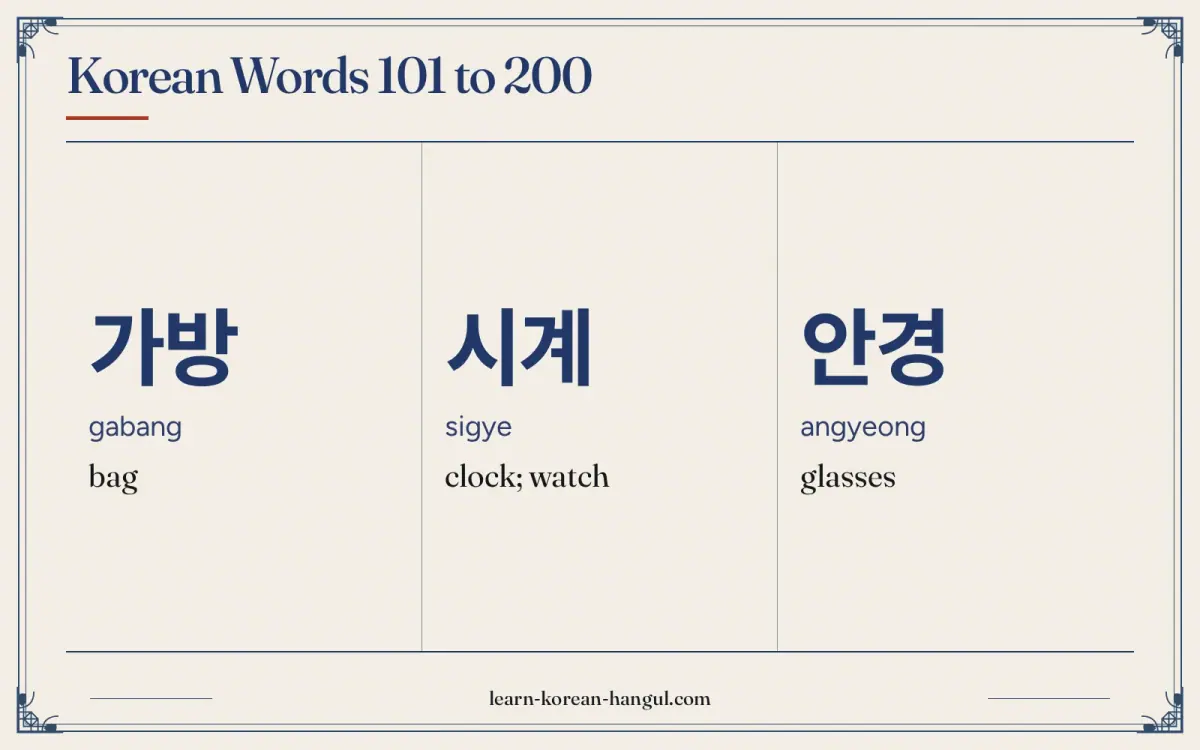
These are the things on your desk, on your table and in your bag. 10 are Sino-Korean words made of two syllables, such as 시계, 의자 and 연필. 5 are loanwords: 가방, 컴퓨터, 텔레비전, 컵 and 소파. The pronunciation of 책상 is [책쌍], and Revised Romanization writes it chaeksang, not chaekssang. The native words in the group are 젓가락 (chopsticks), 거울, 가위 and 접시.
| No. | Hangul | Revised Romanization | Meaning | Origin | Example sentence |
|---|---|---|---|---|---|
| 101 | 가방 | gabang | bag | loanword | 가방이 무거워요. (The bag is heavy.) |
| 102 | 시계 | sigye | clock; watch | Sino-Korean | 시계가 비싸요. (The watch is expensive.) |
| 103 | 안경 | angyeong | glasses | Sino-Korean | 안경이 없어요. (I do not have my glasses.) |
| 104 | 모자 | moja | hat; cap | Sino-Korean | 모자가 예뻐요. (The hat is pretty.) |
| 105 | 젓가락 | jeotgarak | chopsticks | native | 젓가락으로 먹어요. (I eat with chopsticks.) |
| 106 | 지갑 | jigap | wallet | Sino-Korean | 지갑에 돈이 있어요. (There is money in the wallet.) |
| 107 | 휴대폰 | hyudaepon | mobile phone | mixed | 휴대폰이 작아요. (The phone is small.) |
| 108 | 컴퓨터 | keompyuteo | computer | loanword | 컴퓨터를 켜요. (I turn on the computer.) |
| 109 | 텔레비전 | tellebijeon | television | loanword | 텔레비전을 봐요. (I watch television.) |
| 110 | 의자 | uija | chair | Sino-Korean | 의자에 앉아요. (I sit on the chair.) |
| 111 | 책상 | chaeksang | desk | Sino-Korean | 책상이 커요. (The desk is big.) |
| 112 | 소파 | sopa | sofa; couch | loanword | 소파에서 쉬어요. (I rest on the sofa.) |
| 113 | 거울 | geoul | mirror | native | 거울을 봐요. (I look in the mirror.) |
| 114 | 창문 | changmun | window | Sino-Korean | 창문을 열어요. (I open the window.) |
| 115 | 가위 | gawi | scissors | native | 가위가 필요해요. (I need scissors.) |
| 116 | 컵 | keop | cup; glass | loanword | 컵에 물을 따라요. (I pour water into the cup.) |
| 117 | 접시 | jeopsi | plate; dish | native | 접시를 닦아요. (I wipe the plate.) |
| 118 | 연필 | yeonpil | pencil | Sino-Korean | 연필로 써요. (I write with a pencil.) |
| 119 | 편지 | pyeonji | letter (a written message) | Sino-Korean | 편지를 보내요. (I send a letter.) |
| 120 | 사진 | sajin | photo; picture | Sino-Korean | 사진을 찍어요. (I take a photo.) |
Hear the words:
Hear the example sentences:
Example Sentences
Listen to these four sentences at normal speed, then say them yourself. The subject particle 이/가, the object particle 을/를 and the location particle 에 appear in them, and the verb is in the polite -요 style.
가방이 무거워요.
gabangi mugeowoyo.
The bag is heavy.
창문을 열어요.
changmuneul yeoreoyo.
I open the window.
사진을 찍어요.
sajineul jjigeoyo.
I take a photo.
컵에 물을 따라요.
keobe mureul ttarayo.
I pour water into the cup.
How Do You Say People and Places in Korean?
The first six words are people, and the next fourteen are places that appear on a map of any Korean town. Many place names end in 관 (a hall), 점 (a shop) or 국 (an office): 박물관, 미술관, 영화관, 백화점, 서점, 편의점, 우체국. Learn the ending and you can guess the kind of place. 노래방 (karaoke room) ends in 방, which means room.
| No. | Hangul | Revised Romanization | Meaning | Origin | Example sentence |
|---|---|---|---|---|---|
| 121 | 의사 | uisa | doctor | Sino-Korean | 의사가 병원에 있어요. (The doctor is at the hospital.) |
| 122 | 간호사 | ganhosa | nurse | Sino-Korean | 간호사가 친절해요. (The nurse is kind.) |
| 123 | 손님 | sonnim | guest; customer | native | 손님이 와요. (A customer is coming.) |
| 124 | 이웃 | iut | neighbor | native | 이웃이 친절해요. (My neighbour is kind.) |
| 125 | 어른 | eoreun | adult; elder | native | 어른께 인사해요. (I greet an adult.) |
| 126 | 아기 | agi | baby | native | 아기가 자요. (The baby is sleeping.) |
| 127 | 미술관 | misulgwan | art museum; art gallery | Sino-Korean | 미술관에서 그림을 봐요. (I look at paintings at the art museum.) |
| 128 | 미용실 | miyongsil | hair salon; beauty salon | Sino-Korean | 미용실에서 머리를 잘라요. (I get a haircut at the salon.) |
| 129 | 우체국 | ucheguk | post office | Sino-Korean | 우체국에 가요. (I go to the post office.) |
| 130 | 슈퍼마켓 | syupeomaket | supermarket | loanword | 슈퍼마켓에서 우유를 사요. (I buy milk at the supermarket.) |
| 131 | 노래방 | noraebang | karaoke room; karaoke | mixed | 노래방에서 노래를 불러요. (I sing at the karaoke room.) |
| 132 | 카페 | kape | cafe; coffee shop | loanword | 카페에서 커피를 마셔요. (I drink coffee at the café.) |
| 133 | 편의점 | pyeonuijeom | convenience store | Sino-Korean | 편의점에서 물을 사요. (I buy water at the convenience store.) |
| 134 | 백화점 | baekhwajeom | department store | Sino-Korean | 백화점이 커요. (The department store is big.) |
| 135 | 영화관 | yeonghwagwan | movie theater; cinema | Sino-Korean | 영화관에서 영화를 봐요. (I watch a movie at the cinema.) |
| 136 | 서점 | seojeom | bookstore | Sino-Korean | 서점에서 책을 사요. (I buy a book at the bookstore.) |
| 137 | 화장실 | hwajangsil | bathroom; restroom | Sino-Korean | 화장실이 어디예요? (Where is the restroom?) |
| 138 | 박물관 | bangmulgwan | museum | Sino-Korean | 박물관은 월요일에 문을 닫아요. (The museum is closed on Mondays.) |
| 139 | 시청 | sicheong | city hall | Sino-Korean | 시청 앞에서 만나요. (We meet in front of City Hall.) |
| 140 | 놀이터 | noriteo | playground | native | 아이가 놀이터에서 놀아요. (The child plays at the playground.) |
Hear the words:
Hear the example sentences:
Food and Shopping: Words 141 to 160
Food words are a mix of native words (김치, 고기, 비빔밥), Sino-Korean words (우유, 맥주) and loanwords (커피, 빵), while the shopping words 카드, 쇼핑 and 메뉴 are loanwords. Several will be on every menu you read: 김밥, 라면, 비빔밥, 불고기 and 주스. Two words help at the end of a meal: 계산서 (the bill) and 포장 (takeout).
| No. | Hangul | Revised Romanization | Meaning | Origin | Example sentence |
|---|---|---|---|---|---|
| 141 | 과일 | gwail | fruit | native | 과일을 좋아해요. (I like fruit.) |
| 142 | 사과 | sagwa | apple (also "apology") | Sino-Korean | 사과를 먹어요. (I eat an apple.) |
| 143 | 커피 | keopi | coffee | loanword | 아침에 커피를 마셔요. (I drink coffee in the morning.) |
| 144 | 우유 | uyu | milk | Sino-Korean | 우유가 맛있어요. (The milk is tasty.) |
| 145 | 빵 | ppang | bread; pastry | loanword | 아침에 빵을 먹어요. (I eat bread in the morning.) |
| 146 | 고기 | gogi | meat | native | 고기를 구워요. (I grill meat.) |
| 147 | 김치 | gimchi | kimchi | native | 김치가 매워요. (The kimchi is spicy.) |
| 148 | 김밥 | gimbap | gimbap (seaweed rice roll) | native | 김밥을 만들어요. (I make gimbap.) |
| 149 | 라면 | ramyeon | instant noodles | loanword | 라면을 끓여요. (I boil ramyeon.) |
| 150 | 계란 | gyeran | egg | Sino-Korean | 계란을 삶아요. (I boil an egg.) |
| 151 | 과자 | gwaja | snack; cookie | Sino-Korean | 아이가 과자를 좋아해요. (The child likes snacks.) |
| 152 | 맥주 | maekju | beer | Sino-Korean | 저는 맥주를 안 마셔요. (I do not drink beer.) |
| 153 | 주스 | juseu | juice | loanword | 주스 한 잔 주세요. (Please give me a glass of juice.) |
| 154 | 비빔밥 | bibimbap | bibimbap | native | 비빔밥을 좋아해요. (I like bibimbap.) |
| 155 | 불고기 | bulgogi | bulgogi; marinated grilled beef | native | 불고기가 맛있어요. (The bulgogi is tasty.) |
| 156 | 카드 | kadeu | card; credit card | loanword | 카드로 내요. (I pay by card.) |
| 157 | 계산서 | gyesanseo | bill (at a restaurant); check | Sino-Korean | 계산서를 주세요. (Please give me the bill.) |
| 158 | 쇼핑 | syoping | shopping | loanword | 주말에 쇼핑해요. (I go shopping on the weekend.) |
| 159 | 메뉴 | menyu | menu | loanword | 메뉴가 많아요. (The menu has many items.) |
| 160 | 포장 | pojang | takeout; packaging, wrapping | Sino-Korean | 포장해 주세요. (Takeout, please.) |
Hear the words:
Hear the example sentences:
How Do You Say Time and Weather in Korean?
The names of the seven days all end in 요일 (day of the week). Learn 월요일 (Monday) first, and then add the other six: 화요일, 수요일, 목요일, 금요일, 토요일, 일요일. The rest of the group is time of day (오전, 오후, 점심), the calendar (주말, 평일, 올해, 작년, 내년, 생일, 휴일) and three weather words that matter in Korea: 장마 (the rainy season), 미세먼지 (fine dust) and 온도 (temperature). The seasons and everyday weather words such as 날씨 and 비 are in Korean words 301 to 400.
| No. | Hangul | Revised Romanization | Meaning | Origin | Example sentence |
|---|---|---|---|---|---|
| 161 | 장마 | jangma | rainy season (monsoon) | native | 장마가 시작돼요. (The rainy season begins.) |
| 162 | 미세먼지 | misemeonji | fine dust; particulate matter | mixed | 오늘은 미세먼지가 많아요. (There is a lot of fine dust today.) |
| 163 | 온도 | ondo | temperature | Sino-Korean | 방 온도가 높아요. (The room temperature is high.) |
| 164 | 화요일 | hwayoil | Tuesday | Sino-Korean | 화요일에 수업이 있어요. (I have class on Tuesday.) |
| 165 | 수요일 | suyoil | Wednesday | Sino-Korean | 수요일에 친구를 만나요. (I meet a friend on Wednesday.) |
| 166 | 목요일 | mogyoil | Thursday | Sino-Korean | 목요일에 쉬어요. (I rest on Thursday.) |
| 167 | 금요일 | geumyoil | Friday | Sino-Korean | 금요일 저녁에 영화를 봐요. (I watch a movie on Friday evening.) |
| 168 | 토요일 | toyoil | Saturday | Sino-Korean | 토요일에 친구 집에 가요. (I go to my friend's house on Saturday.) |
| 169 | 일요일 | iryoil | Sunday | Sino-Korean | 일요일에는 늦게 일어나요. (I get up late on Sundays.) |
| 170 | 오전 | ojeon | morning (a.m.) | Sino-Korean | 오전에 운동해요. (I exercise in the morning.) |
| 171 | 오후 | ohu | afternoon (p.m.) | Sino-Korean | 오후에 친구를 만나요. (I meet a friend in the afternoon.) |
| 172 | 점심 | jeomsim | lunch; midday | Sino-Korean | 점심에 뭐 먹어요? (What will you eat for lunch?) |
| 173 | 주말 | jumal | weekend | Sino-Korean | 주말에 쉬어요. (I rest on the weekend.) |
| 174 | 평일 | pyeongil | weekday | Sino-Korean | 평일에는 일해요. (I work on weekdays.) |
| 175 | 올해 | olhae | this year | native | 올해 한국에 가요. (I go to Korea this year.) |
| 176 | 작년 | jangnyeon | last year | Sino-Korean | 작년에 한국에 갔어요. (I went to Korea last year.) |
| 177 | 내년 | naenyeon | next year | Sino-Korean | 내년에 졸업해요. (I graduate next year.) |
| 178 | 월요일 | woryoil | Monday | Sino-Korean | 월요일에 학교에 가요. (I go to school on Monday.) |
| 179 | 생일 | saengil | birthday | Sino-Korean | 내일은 제 생일이에요. (Tomorrow is my birthday.) |
| 180 | 휴일 | hyuil | holiday; day off | Sino-Korean | 휴일에는 집에 있어요. (I stay home on holidays.) |
Hear the words:
Hear the example sentences:
Useful Adverbs: Words 181 to 200
An adverb goes before the verb or adjective it describes. These 20 add manner (이렇게, 그렇게, 직접, 일부러, 천천히), degree (훨씬, 약간, 점점, 완전히, 충분히), time (방금, 미리, 드디어, 겨우), attitude (반드시, 오히려, 특히, 절대) and two question words, 어떻게 (how) and 왜 (why), which complete the question words of the top 100. Frequency and degree adverbs such as 항상 and 정말 are in the next units.
| No. | Hangul | Revised Romanization | Meaning | Origin | Example sentence |
|---|---|---|---|---|---|
| 181 | 절대 | jeoldae | never (with a negative); absolutely | Sino-Korean | 절대 늦지 않아요. (I am never late.) |
| 182 | 천천히 | cheoncheonhi | slowly | native | 천천히 말해 주세요. (Please speak slowly.) |
| 183 | 방금 | banggeum | just now | Sino-Korean | 방금 도착했어요. (I just arrived.) |
| 184 | 특히 | teuki | especially | mixed | 특히 김치를 좋아해요. (I especially like kimchi.) |
| 185 | 점점 | jeomjeom | gradually; more and more | native | 점점 좋아져요. (It is getting better and better.) |
| 186 | 훨씬 | hwolssin | much more; far | native | 이 가방이 훨씬 비싸요. (This bag is much more expensive.) |
| 187 | 약간 | yakgan | slightly; a little | Sino-Korean | 약간 피곤해요. (I am slightly tired.) |
| 188 | 완전히 | wanjeonhi | completely | mixed | 완전히 잊었어요. (I completely forgot.) |
| 189 | 충분히 | chungbunhi | enough; sufficiently | mixed | 충분히 잤어요. (I slept enough.) |
| 190 | 직접 | jikjeop | directly; in person | Sino-Korean | 직접 만들어요. (I make it myself.) |
| 191 | 미리 | miri | in advance | native | 미리 예약해요. (I book in advance.) |
| 192 | 일부러 | ilbureo | on purpose | native | 일부러 찾아왔어요. (I came here on purpose.) |
| 193 | 드디어 | deudieo | finally | native | 드디어 도착했어요. (We finally arrived.) |
| 194 | 반드시 | bandeusi | without fail; must | native | 반드시 오세요. (Please come without fail.) |
| 195 | 오히려 | ohiryeo | rather; on the contrary | native | 오히려 쉬워요. (It is rather easy.) |
| 196 | 겨우 | gyeou | barely; only just | native | 겨우 끝냈어요. (I only just managed to finish.) |
| 197 | 이렇게 | ireoke | like this; this way | native | 이렇게 해요. (I do it like this.) |
| 198 | 그렇게 | geureoke | like that; so | native | 그렇게 생각해요. (I think so.) |
| 199 | 어떻게 | eotteoke | how; in what way | native | 어떻게 가요? (How do I get there?) |
| 200 | 왜 | wae | why; how come | native | 왜 울어요? (Why are you crying?) |
Hear the words:
Hear the example sentences:
Place an adverb before the word it modifies, as in 직접 만들어요. 절대 needs a negative: 절대 늦지 않아요. The two question words come right before the verb, and in a question that uses them the voice does not end in a sharp rise, because the question word already carries the meaning.
How Do You Pronounce These Words?
Press the play button on any entry to hear the word, and repeat it before you read the romanization. Revised Romanization is a learning aid. It follows the sound of a word and writes a tense consonant only when the spelling has one, so 책상 stays chaeksang although it is said [책쌍]. The table shows the changes that learners miss most in this list.
| Word | Romanization | Said | Rule |
|---|---|---|---|
| 책상 | chaeksang | [책쌍] | ㄱ before ㅅ makes the ㅅ tense |
| 박물관 | bangmulgwan | [방물관] | ㄱ before ㅁ sounds like ㅇ |
| 맥주 | maekju | [맥쭈] | ㄱ before ㅈ makes the ㅈ tense |
| 김밥 | gimbap | [김밥] or [김빱] | both are standard; the tense [김빱] is a word-specific change, not a rule for ㅁ + ㅂ |
| 일요일 | iryoil | [이료일] | final ㄹ links to the vowel that follows |
| 월요일 | woryoil | [워료일] | final ㄹ links to the next syllable |
| 젓가락 | jeotgarak | [젇까락] | final ㅅ closes as ㄷ and makes the ㄱ tense |
| 편의점 | pyeonuijeom | [펴늬점] or [펴니점] | 의 in a later syllable may be said as 이 |
These rules come from the standard pronunciation rules (표준 발음법) of the 국립국어원, the National Institute of Korean Language. For more on sound changes, see reading Hangul.
Audio and Slow Playback
Each headword and each example sentence has its own clip. Nothing plays until you press a button. Use the headword clip first, then the sentence clip, and try to match the rhythm of the sentence.
What Mistakes Do Learners Make with Words Ranked 101 to 200?
- Treating 사과 as only "apple". 사과 also means "apology", and the two words sound the same. The verb tells you which: 사과를 먹어요 means I eat an apple, and 사과해요 means I apologise.
- Confusing 어떻게 and 왜. 어떻게 means how (in what way) and 왜 means why (for what reason). Both come right before the verb: 어떻게 가요? (How do I get there?) and 왜 울어요? (Why are you crying?).
- Spelling 이렇게 and 그렇게 as they sound. They are said [이러케] and [그러케], but the spelling keeps ㅎ: 이렇게, 그렇게. Revised Romanization writes ireoke and geureoke.
- Dropping the comparison with 훨씬. 훨씬 means "much more" and goes with an adjective that compares: 이 가방이 훨씬 비싸요 (This bag is much more expensive).
- Putting 오전 or 오후 after the hour. Korean puts it first: 오후 세 시, not 세 시 오후.
- Using 입다 for a watch. 시계 takes its own verb: 시계를 차요. The verb for each item is explained in Korean verb phrases.
The next section gives you tools to fix these.
Practice: Flashcards and Worksheet
Start with a deck of 20 cards, then move to the full list. The cards are the 20 words that cover the most situations, one or two from each group. The table and the deck contain the same cards.
| # | Word | Revised Romanization | Meaning | Note |
|---|---|---|---|---|
| 1 | 가방 | gabang | bag | A loanword; 책가방 is a school bag. |
| 2 | 시계 | sigye | clock; watch | Clock and watch; wear a watch with 차다. |
| 3 | 지갑 | jigap | wallet | Wallet. |
| 4 | 사진 | sajin | photo; picture | Photo; 사진을 찍다 means to take one. |
| 5 | 카페 | kape | cafe; coffee shop | Café. |
| 6 | 손님 | sonnim | guest; customer | Guest or customer. |
| 7 | 화장실 | hwajangsil | bathroom; restroom | Restroom; 화장실이 어디예요? is a key question. |
| 8 | 커피 | keopi | coffee | Coffee. |
| 9 | 비빔밥 | bibimbap | bibimbap | Rice mixed with vegetables. |
| 10 | 계산서 | gyesanseo | bill (at a restaurant); check | The bill at a restaurant. |
| 11 | 포장 | pojang | takeout; packaging, wrapping | Takeout; 포장해 주세요 means takeout, please. |
| 12 | 주말 | jumal | weekend | Weekend. |
| 13 | 생일 | saengil | birthday | Birthday. |
| 14 | 토요일 | toyoil | Saturday | Saturday. |
| 15 | 어떻게 | eotteoke | how; in what way | How; said [어떠케]. |
| 16 | 왜 | wae | why; how come | Why. |
| 17 | 천천히 | cheoncheonhi | slowly | Slowly; 천천히 말해 주세요. |
| 18 | 이렇게 | ireoke | like this; this way | Like this; said [이러케]. |
| 19 | 미리 | miri | in advance | In advance. |
| 20 | 드디어 | deudieo | finally | Finally. |
Practice · 20
- 01가방
Show answer
gabang
bag
- 02시계
Show answer
sigye
clock; watch
- 03지갑
Show answer
jigap
wallet
- 04사진
Show answer
sajin
photo; picture
- 05카페
Show answer
kape
cafe; coffee shop
- 06손님
Show answer
sonnim
guest; customer
- 07화장실
Show answer
hwajangsil
bathroom; restroom
- 08커피
Show answer
keopi
coffee
- 09비빔밥
Show answer
bibimbap
bibimbap
- 10계산서
Show answer
gyesanseo
bill (at a restaurant); check
- 11포장
Show answer
pojang
takeout; packaging, wrapping
- 12주말
Show answer
jumal
weekend
- 13생일
Show answer
saengil
birthday
- 14토요일
Show answer
toyoil
Saturday
- 15어떻게
Show answer
eotteoke
how; in what way
- 16왜
Show answer
wae
why; how come
- 17천천히
Show answer
cheoncheonhi
slowly
- 18이렇게
Show answer
ireoke
like this; this way
- 19미리
Show answer
miri
in advance
- 20드디어
Show answer
deudieo
finally
Review the deck ten cards at a time. Find themed decks in the vocabulary flashcard decks. For writing practice, the vocabulary worksheets page lists printable sheets, and the worksheet for this unit reuses the same scene as a blank labelling task.
Korean Words 101 to 200 Worksheet (PDF)
Now test yourself with eight questions.
Practice · 8
What does 가방 (gabang) mean?
Show answer
bag
가방 means bag. Example: 가방이 무거워요. (The bag is heavy.)
Which word means "the bill" at a restaurant?
Show answer
계산서
계산서 is the bill; 메뉴 is the menu.
Which word means "Saturday"?
Show answer
토요일
토요일 (toyoil) is Saturday; all day names end in 요일.
Which word means "why"?
Show answer
왜
왜 means why; 어떻게 means how.
Which adverb needs a negative verb?
Show answer
절대
절대 is used with a negative: 절대 늦지 않아요.
What does 사과 mean?
Show answer
apple or apology
사과 is a homophone: apple and apology. The verb decides.
Which expression is right?
Show answer
오후 세 시
오전 and 오후 come before the hour.
Which word means "chopsticks"?
Show answer
젓가락
젓가락 is chopsticks; 숟가락 is a spoon.
Where to Go Next
This list sits inside Top 500 Korean Words. The previous unit is the top 100 Korean words. When these 100 words feel easy, move on to Korean words 201 to 300, then Korean words 301 to 400. To use the nouns in sentences, pair this list with the verbs in 100 Korean verbs.
What this page does not cover. It does not list verbs or adjectives, the counters for objects, or the honorific forms of these words. It does not give a frequency count from a corpus.
About this page. Last updated 2026-10-09. The Korean text and example sentences were drafted with AI assistance and cross-checked with the site's rule-based conjugation engine; a Korean reviewer checks every lesson before it is marked as reviewed.
Frequently Asked Questions
What Are Korean Words 101 to 200?
They are the second set of 100 core words in the Top 500 Korean Words series. After the first 100 (pronouns, family, time and numbers, places and basic adverbs), this set adds everyday objects, people and places, food and shopping, time and weather, and useful adverbs.
Why Are 책 and 돈 Not in This List?
책 (book) and 돈 (money) are already words 73 and 74 in the top 100 Korean words, and this list does not repeat a word from the top 100 or from words 201 to 500. A new object word to learn first is 가방 (bag).
How Do You Say Bag in Korean?
Say 가방 (gabang). It is a loanword and takes the usual particles: 가방이 무거워요 means the bag is heavy. For a school bag, say 책가방. To carry it, you "hold" or "carry" it: 가방을 들어요 (I carry the bag).
How Many of These Words Are Sino-Korean?
50 of the 100 words are Sino-Korean, 30 are native Korean, 14 are loanwords and 6 mix two sources. In the top 100 the Sino-Korean share was 28. The share rises because building, shop and time words come from Chinese roots.
Is the Order of the Words a Frequency Ranking?
No. The numbers show a suggested study order, which is an editorial judgement of what a beginner needs next. It is not a count from a corpus, so do not read 150 as less common than 140.
How Long Does It Take to Learn 100 Korean Words?
At 10 new words a day, the list takes about 10 days plus review. At 5 a day it takes about 20 days. Recognising a word is easier than producing it, so say each word and its example sentence aloud before you mark it as known.