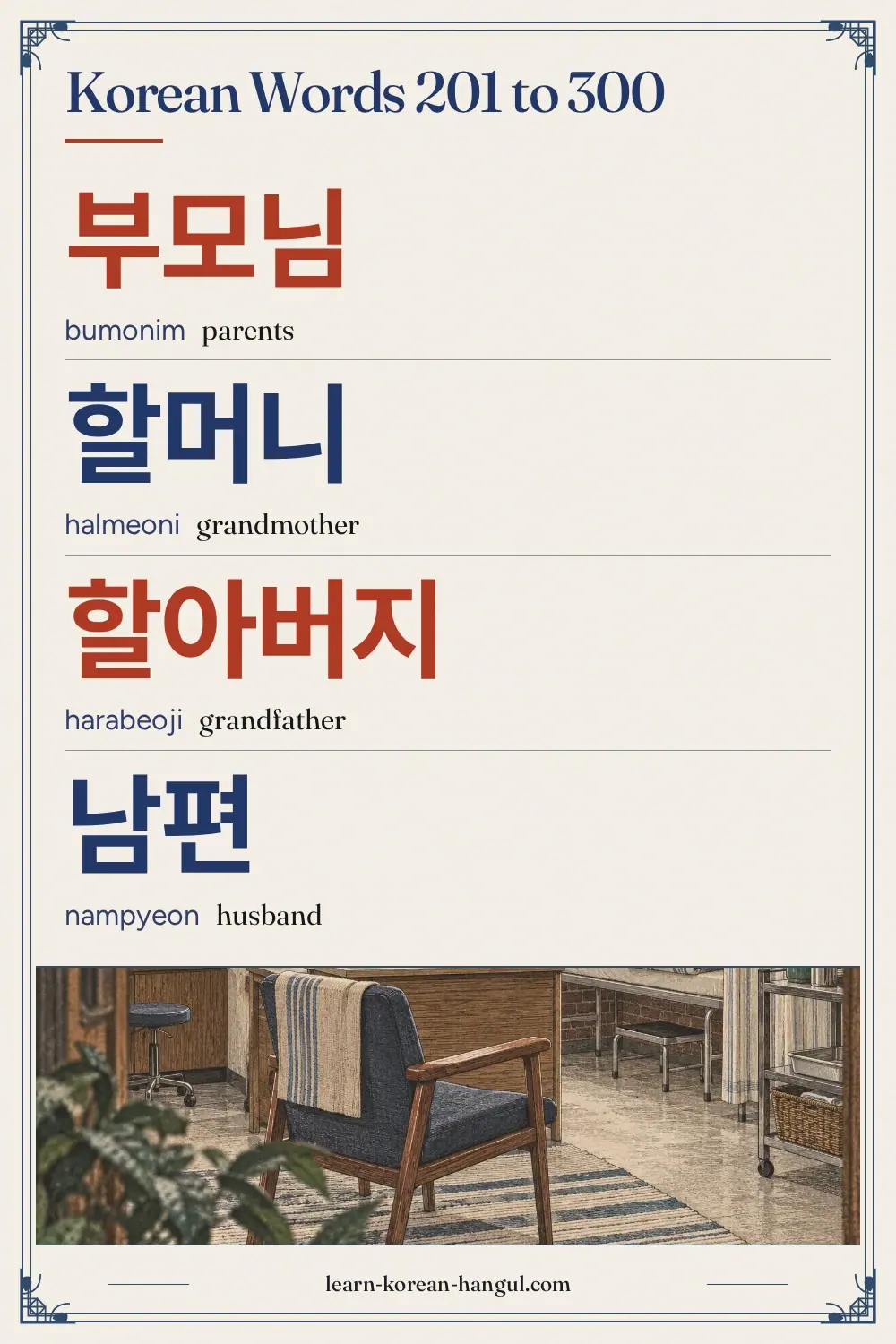
Korean Words 201 to 300 at a Glance
This page holds 100 words in five groups of 20. The numbers show a suggested study order, which is an editorial judgement and not a corpus count. The words build on Korean words 101 to 200 and do not repeat a word from the top 100, from that list or from the later units. Two nouns learners often expect here, 방 (room) and 돈 (money), are not on the page because they are already words 61 and 74 of the top 100.
| Group | Words | Examples |
|---|---|---|
| Home and family | 20 | 부모님, 할머니, 할아버지, 남편 |
| Work and money | 20 | 회사원, 승진, 세금, 수입 |
| Transport and places | 20 | 버스, 택시, 자전거, 자동차 |
| Body and health | 20 | 머리, 얼굴, 귀, 코 |
| Connectors and adverbs | 20 | 그러니까, 그럼, 또는, 왜냐하면 |
Of the 100 words, 58 are Sino-Korean, 36 are native Korean, 4 are loanwords and 2 mix two sources. That is a bigger Sino-Korean share than in the previous 100 words (50) and in the top 100 (28). The reason is the Work and money group: 19 of its 20 words are Sino-Korean, because bank and office terms are built from Chinese-derived syllables. The reverse is true for the body: 15 of its 20 words are native. A native word is one that existed in Korean before the Chinese-derived vocabulary arrived, and body parts, homes and small daily jobs are where such words survive.
The list covers nouns, with a set of connecting words at the end. Verbs are on the 100 Korean verbs page, and if Hangul still feels slow, practise first with reading Hangul. Next comes the question of order.
Which Words Ranked 201 to 300 Should You Learn First?
Start with the words that unlock the most everyday conversation. These ten each belong to a different group, so after one session you can already talk about family, work, travel and health.
| Word | What it lets you say |
|---|---|
| 부모님 | talk about your parents: 부모님은 서울에 계세요 |
| 아파트 | say where you live: 아파트에 살아요 |
| 회사원 | say what you do: 아버지는 회사원이에요 |
| 월세 | talk about rent, the biggest monthly cost |
| 버스 | name the most common vehicle |
| 교통카드 | pay for every bus and subway ride |
| 정류장 | find your stop |
| 머리 | say 머리가 아파요 at the pharmacy |
| 건강 | wish someone good health |
| 그렇지만 | join two ideas that contrast |
Home and Family: Words 201 to 220
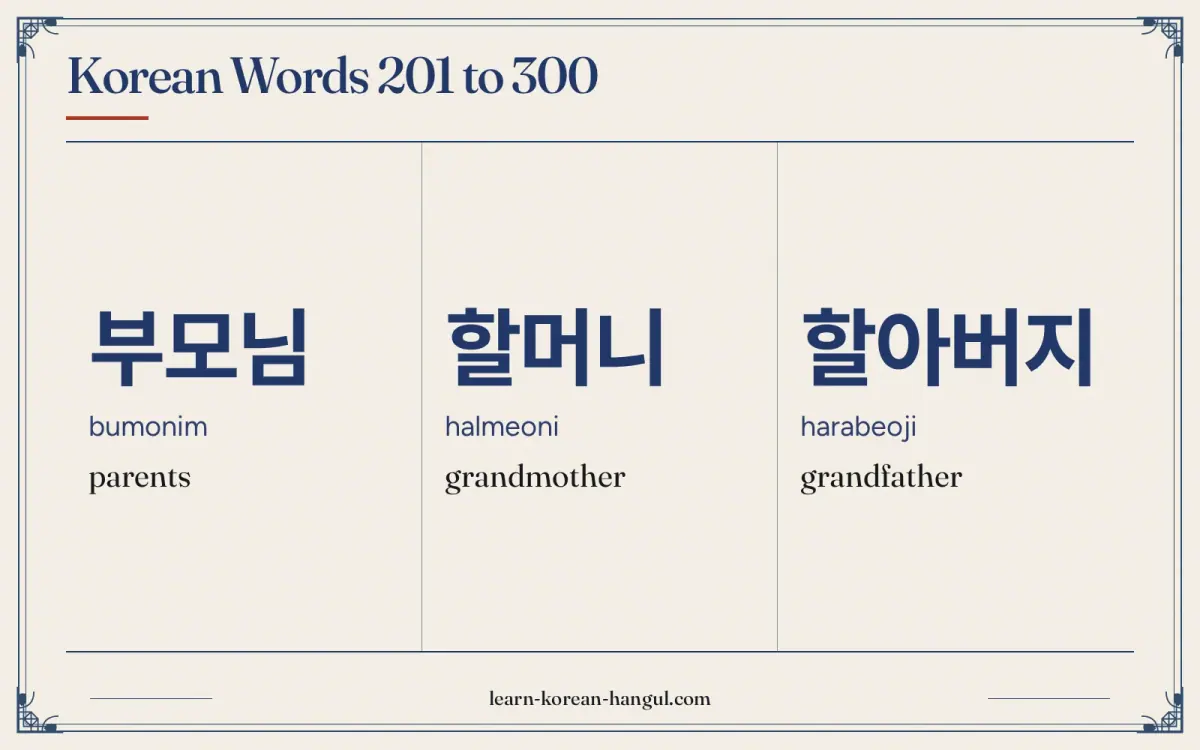
This group mixes family members with rooms and chores. Family words depend on who is speaking and on which side of the family the person is on, so learn them in pairs: 남동생 and 여동생 (younger brother and younger sister) are the same for everyone, and 이모 (mother's sister) and 삼촌 (father's younger brother) name the family side. 할머니 and 할아버지 are also what you call any older person with respect.
| No. | Hangul | Revised Romanization | Meaning | Origin | Example sentence |
|---|---|---|---|---|---|
| 201 | 부모님 | bumonim | parents | mixed | 부모님은 서울에 계세요. (My parents are in Seoul.) |
| 202 | 할머니 | halmeoni | grandmother | native | 할머니는 시골에 사세요. (My grandmother lives in the countryside.) |
| 203 | 할아버지 | harabeoji | grandfather | native | 할아버지는 매일 산책하세요. (My grandfather takes a walk every day.) |
| 204 | 남편 | nampyeon | husband | Sino-Korean | 남편은 회사에 가요. (My husband goes to the office.) |
| 205 | 아내 | anae | wife | native | 아내는 요리를 잘해요. (My wife cooks well.) |
| 206 | 남동생 | namdongsaeng | younger brother | Sino-Korean | 남동생은 대학생이에요. (My younger brother is a university student.) |
| 207 | 여동생 | yeodongsaeng | younger sister | Sino-Korean | 여동생은 노래를 좋아해요. (My younger sister likes singing.) |
| 208 | 사촌 | sachon | cousin | Sino-Korean | 사촌이 부산에 살아요. (My cousin lives in Busan.) |
| 209 | 이모 | imo | aunt (mother's sister) | Sino-Korean | 이모가 우리 집에 와요. (My aunt comes to our house.) |
| 210 | 삼촌 | samchon | uncle (father's unmarried younger brother) | Sino-Korean | 삼촌은 운전을 해요. (My uncle drives.) |
| 211 | 아파트 | apateu | apartment | loanword | 우리는 아파트에 살아요. (We live in an apartment.) |
| 212 | 거실 | geosil | living room | Sino-Korean | 거실에서 텔레비전을 봐요. (We watch television in the living room.) |
| 213 | 부엌 | bueok | kitchen | native | 엄마가 부엌에서 요리해요. (Mom cooks in the kitchen.) |
| 214 | 침실 | chimsil | bedroom | Sino-Korean | 침실이 조용해요. (The bedroom is quiet.) |
| 215 | 냉장고 | naengjanggo | refrigerator | Sino-Korean | 냉장고에 우유가 있어요. (There is milk in the refrigerator.) |
| 216 | 세탁기 | setakgi | washing machine | Sino-Korean | 세탁기를 사용해요. (I use the washing machine.) |
| 217 | 이불 | ibul | blanket; quilt | native | 이불이 따뜻해요. (The blanket is warm.) |
| 218 | 청소 | cheongso | cleaning | Sino-Korean | 토요일에 청소해요. (I clean on Saturday.) |
| 219 | 빨래 | ppallae | laundry | native | 빨래를 널어요. (I hang out the laundry.) |
| 220 | 설거지 | seolgeoji | washing the dishes | native | 저녁 후에 설거지를 해요. (I do the dishes after dinner.) |
Hear the words:
Hear the example sentences:
Example Sentences
Listen to these four sentences, then say them yourself. They show the honorific verbs 계세요 (is) and 사세요 (lives) for respected people, and plain polite verbs for living and cooking.
부모님은 서울에 계세요.
bumonimeun seoure gyeseyo.
My parents are in Seoul.
할머니는 시골에 사세요.
halmeonineun sigore saseyo.
My grandmother lives in the countryside.
우리는 아파트에 살아요.
urineun apateue sarayo.
We live in an apartment.
엄마가 부엌에서 요리해요.
eommaga bueokeseo yorihaeyo.
Mom cooks in the kitchen.
How Do You Say Work and Money in Korean?
19 of the 20 words here are Sino-Korean; the exception is the loanword 보너스. Bank words come in a trio you should learn together: 입금 (money in), 출금 (money out) and 송금 (money sent to someone). The table below the list sorts them out. The work words (회사원, 승진, 출장, 동료, 야근) cover a normal working week, and the money words (세금, 수입, 지출, 월세) cover a monthly budget.
| No. | Hangul | Revised Romanization | Meaning | Origin | Example sentence |
|---|---|---|---|---|---|
| 221 | 회사원 | hoesawon | office worker; company employee | Sino-Korean | 아버지는 회사원이에요. (My father is an office worker.) |
| 222 | 승진 | seungjin | promotion | Sino-Korean | 올해 승진해요. (I get promoted this year.) |
| 223 | 세금 | segeum | tax | Sino-Korean | 세금이 많아요. (The taxes are high.) |
| 224 | 수입 | suip | income | Sino-Korean | 수입이 적어요. (The income is small.) |
| 225 | 지출 | jichul | spending; expenses | Sino-Korean | 지출이 늘어요. (Spending increases.) |
| 226 | 월세 | wolse | monthly rent | Sino-Korean | 월세를 내요. (I pay the monthly rent.) |
| 227 | 보너스 | boneoseu | bonus | loanword | 보너스를 받아요. (I receive a bonus.) |
| 228 | 출장 | chuljang | business trip | Sino-Korean | 다음 주에 출장을 가요. (I go on a business trip next week.) |
| 229 | 동료 | dongnyo | colleague; coworker | Sino-Korean | 동료와 점심을 먹어요. (I have lunch with a colleague.) |
| 230 | 야근 | yageun | overtime work | Sino-Korean | 오늘은 야근해요. (I work late tonight.) |
| 231 | 계좌 | gyejwa | bank account | Sino-Korean | 은행에서 계좌를 만들어요. (I open an account at the bank.) |
| 232 | 통장 | tongjang | bankbook | Sino-Korean | 통장이 필요해요. (I need a bankbook.) |
| 233 | 현금 | hyeongeum | cash | Sino-Korean | 현금으로 내요. (I pay in cash.) |
| 234 | 입금 | ipgeum | deposit (paying money in) | Sino-Korean | 오늘 입금해요. (I will deposit the money today.) |
| 235 | 출금 | chulgeum | withdrawal (taking money out) | Sino-Korean | 은행에서 출금해요. (I withdraw money at the bank.) |
| 236 | 송금 | songgeum | money transfer | Sino-Korean | 친구에게 송금해요. (I send money to a friend.) |
| 237 | 저축 | jeochuk | savings | Sino-Korean | 매달 저축해요. (I save every month.) |
| 238 | 이자 | ija | interest (on money) | Sino-Korean | 이자가 높아요. (The interest is high.) |
| 239 | 대출 | daechul | loan | Sino-Korean | 은행에서 대출을 받아요. (I get a loan from the bank.) |
| 240 | 수수료 | susuryo | fee; commission | Sino-Korean | 수수료가 있어요. (There is a fee.) |
Hear the words:
Hear the example sentences:
| Word | Meaning | Direction of the money | Example |
|---|---|---|---|
| 입금 | deposit | into an account | 오늘 입금해요. |
| 출금 | withdrawal | out of an account | 은행에서 출금해요. |
| 송금 | transfer | from you to another person | 친구에게 송금해요. |
All three are Sino-Korean nouns that take 하다 to make a verb, so the polite present of each is the noun plus 해요: 입금해요, 출금해요, 송금해요. For more on that pattern, see Korean hada verbs explained.
Transport and Places: Words 241 to 260
Most of these are Sino-Korean nouns for the street and the transit system: 정류장 (stop), 신호등 (traffic light), 횡단보도 (crosswalk), 주차장 (parking lot), 출구 (exit). 교통카드 (transit card) and 환승 (transfer) appear on every trip, and 택배, 소포 and 우표 are the nouns for sending things by post. For the verbs that go with these nouns, such as 타다 and 내리다, read Korean transport verbs, and for more nouns see Korean transportation vocabulary.
| No. | Hangul | Revised Romanization | Meaning | Origin | Example sentence |
|---|---|---|---|---|---|
| 241 | 버스 | beoseu | bus | loanword | 버스가 와요. (The bus is coming.) |
| 242 | 택시 | taeksi | taxi | loanword | 택시를 불러요. (I call a taxi.) |
| 243 | 자전거 | jajeongeo | bicycle; bike | Sino-Korean | 공원에서 자전거를 타요. (I ride a bicycle in the park.) |
| 244 | 자동차 | jadongcha | car; automobile | Sino-Korean | 자동차가 많아요. (There are many cars.) |
| 245 | 교통 | gyotong | transport; traffic | Sino-Korean | 교통이 편리해요. (Transport is convenient.) |
| 246 | 근처 | geuncheo | nearby; vicinity | Sino-Korean | 근처에 은행이 있어요. (There is a bank nearby.) |
| 247 | 거리 | geori | street; distance | native | 집에서 학교까지 거리가 멀어요. (The distance from home to school is far.) |
| 248 | 건물 | geonmul | building | Sino-Korean | 저 건물이 높아요. (That building is tall.) |
| 249 | 환승 | hwanseung | transfer; change (of trains/buses) | Sino-Korean | 다음 역에서 환승해요. (I transfer at the next station.) |
| 250 | 교통카드 | gyotongkadeu | transit card | mixed | 교통카드를 충전해요. (I top up my transit card.) |
| 251 | 대중교통 | daejunggyotong | public transportation | Sino-Korean | 대중교통을 이용해요. (I use public transport.) |
| 252 | 환전 | hwanjeon | currency exchange; money exchange | Sino-Korean | 공항에서 환전해요. (I exchange money at the airport.) |
| 253 | 택배 | taekbae | parcel delivery; delivered parcel | Sino-Korean | 택배가 와요. (A parcel is arriving.) |
| 254 | 소포 | sopo | package; parcel (mailed) | Sino-Korean | 소포를 보내요. (I send a parcel.) |
| 255 | 우표 | upyo | stamp; postage stamp | Sino-Korean | 우표를 붙여요. (I stick on a stamp.) |
| 256 | 정류장 | jeongnyujang | stop (bus or taxi) | Sino-Korean | 정류장에서 버스를 기다려요. (I wait for the bus at the stop.) |
| 257 | 신호등 | sinhodeung | traffic light | Sino-Korean | 신호등이 빨개요. (The traffic light is red.) |
| 258 | 횡단보도 | hoengdanbodo | crosswalk | Sino-Korean | 횡단보도를 건너요. (I cross at the crosswalk.) |
| 259 | 주차장 | juchajang | parking lot | Sino-Korean | 주차장이 넓어요. (The parking lot is spacious.) |
| 260 | 출구 | chulgu | exit | Sino-Korean | 출구는 저쪽에 있어요. (The exit is over there.) |
Hear the words:
Hear the example sentences:
How Do You Say Body and Health in Korean?
Body words are mostly native Korean and short: 귀, 코, 입, 목, 팔, 발, 몸. Health words are Sino-Korean: 건강, 약국, 감기, 두통. To say that a part hurts, use the pattern body part + 이/가 + 아파요: 머리가 아파요 (my head hurts), 목이 아파요 (my throat hurts).
| No. | Hangul | Revised Romanization | Meaning | Origin | Example sentence |
|---|---|---|---|---|---|
| 261 | 머리 | meori | head; hair (on the head) | native | 머리가 아파요. (My head hurts.) |
| 262 | 얼굴 | eolgul | face | native | 얼굴이 작아요. (His face is small.) |
| 263 | 귀 | gwi | ear | native | 귀가 아파요. (My ear hurts.) |
| 264 | 코 | ko | nose | native | 코가 막혀요. (My nose is blocked.) |
| 265 | 입 | ip | mouth | native | 입을 닦아요. (I wipe my mouth.) |
| 266 | 목 | mok | neck; throat | native | 목이 아파요. (My throat hurts.) |
| 267 | 어깨 | eokkae | shoulder | native | 어깨가 넓어요. (He has broad shoulders.) |
| 268 | 팔 | pal | arm | native | 팔이 길어요. (Her arms are long.) |
| 269 | 다리 | dari | leg; bridge | native | 다리를 다쳤어요. (I hurt my leg.) |
| 270 | 발 | bal | foot | native | 발이 커요. (My feet are big.) |
| 271 | 손가락 | songarak | finger | native | 손가락이 열 개 있어요. (There are ten fingers.) |
| 272 | 등 | deung | back (of the body) | native | 등을 펴세요. (Please straighten your back.) |
| 273 | 무릎 | mureup | knee | native | 무릎을 굽혀요. (I bend my knees.) |
| 274 | 몸 | mom | body | native | 몸이 건강해요. (My body is healthy.) |
| 275 | 건강 | geongang | health | Sino-Korean | 건강이 제일 중요해요. (Health is the most important thing.) |
| 276 | 약 | yak | medicine | Sino-Korean | 하루에 두 번 약을 먹어요. (I take medicine twice a day.) |
| 277 | 약국 | yakguk | pharmacy; drugstore | Sino-Korean | 약국에서 약을 사요. (I buy medicine at the pharmacy.) |
| 278 | 감기 | gamgi | a cold (illness) | Sino-Korean | 감기에 걸렸어요. (I caught a cold.) |
| 279 | 기침 | gichim | cough | native | 기침이 나요. (I have a cough.) |
| 280 | 두통 | dutong | headache | Sino-Korean | 두통이 있어요. (I have a headache.) |
Hear the words:
Hear the example sentences:
The nouns for eye (눈), hand (손) and belly (배) are already in the top 100, so they are not repeated here. Together with this group they cover the whole body. The phrase for catching a cold, 감기에 걸리다, is explained in Korean verb phrases.
Connectors and Adverbs: Words 281 to 300
A connector joins two sentences or two ideas. The list holds a contrast word (그렇지만), result and reason words (그러니까, 그럼, 왜냐하면, 따라서), addition and restating words (게다가, 또한, 즉), a choice word (또는), attitude words (물론, 사실, 혹시) and time words (이제, 아까, 잠시, 이따가, 한참, 금방, 오래, 계속). The common contrast words 하지만 and 그러나 are in Korean words 401 to 500.
| No. | Hangul | Revised Romanization | Meaning | Origin | Example sentence |
|---|---|---|---|---|---|
| 281 | 그러니까 | geureonikka | so; that is why | native | 비가 와요. 그러니까 우산을 가져가세요. (It is raining. So take an umbrella.) |
| 282 | 그럼 | geureom | then; of course (casual) | native | 그럼 내일 봐요. (Then see you tomorrow.) |
| 283 | 또는 | ttoneun | or | native | 커피 또는 차를 마셔요. (I drink coffee or tea.) |
| 284 | 왜냐하면 | waenyahamyeon | because | native | 늦었어요. 왜냐하면 길이 막혔어요. (I was late. Because the road was jammed.) |
| 285 | 물론 | mullon | of course | Sino-Korean | 물론 괜찮아요. (Of course, it is fine.) |
| 286 | 사실 | sasil | in fact; fact | Sino-Korean | 사실 조금 피곤해요. (In fact, I am a little tired.) |
| 287 | 혹시 | hoksi | by any chance | Sino-Korean | 혹시 한국 사람이에요? (Are you Korean, by any chance?) |
| 288 | 이제 | ije | now; from now on | native | 이제 집에 가요. (Now I go home.) |
| 289 | 아까 | akka | a while ago | native | 아까 전화했어요. (I called a while ago.) |
| 290 | 오래 | orae | for a long time | native | 오래 기다렸어요. (I waited a long time.) |
| 291 | 계속 | gyesok | continuously; keep doing | Sino-Korean | 계속 공부해요. (I keep studying.) |
| 292 | 그렇지만 | geureochiman | but; however | native | 어려워요. 그렇지만 재미있어요. (It is hard. However, it is fun.) |
| 293 | 게다가 | gedaga | besides; on top of that | native | 맛있어요. 게다가 싸요. (It is tasty. Besides, it is cheap.) |
| 294 | 따라서 | ttaraseo | therefore (formal) | native | 비가 와요. 따라서 경기는 취소돼요. (It is raining. Therefore the game is cancelled.) |
| 295 | 또한 | ttohan | also; in addition (formal) | native | 그는 의사예요. 또한 선생님이에요. (He is a doctor. He is also a teacher.) |
| 296 | 즉 | jeuk | that is; in other words | Sino-Korean | 일 년, 즉 열두 달이에요. (A year, that is, twelve months.) |
| 297 | 잠시 | jamsi | for a moment | Sino-Korean | 잠시 기다리세요. (Please wait a moment.) |
| 298 | 이따가 | ittaga | later (today) | native | 이따가 만나요. (See you later.) |
| 299 | 한참 | hancham | for quite a while | native | 한참 걸었어요. (I walked for quite a while.) |
| 300 | 금방 | geumbang | right away; in a moment | Sino-Korean | 금방 와요. (I will be right back.) |
Hear the words:
Hear the example sentences:
| Connector | Use | Register |
|---|---|---|
| 그렇지만 | but, however (contrast) | everyday and written |
| 그러니까 | so, therefore; leads to a request or a suggestion | everyday |
| 그럼 | then, of course | casual short form of 그러면 |
| 또는 | or | neutral, often written |
| 왜냐하면 | because (opens an explanation) | neutral, often written |
| 따라서 | therefore | formal and written |
| 게다가 | besides, on top of that | everyday |
| 또한 | also, in addition | formal and written |
| 즉 | that is, in other words | written |
The connectors usually start a sentence, and they stay in front of the sentence they introduce. 왜냐하면 opens an explanation. In careful writing the explanation ends with -기 때문이에요, which is beyond this list; in speech, a plain polite sentence follows, as in the example above, and people often use 그래서 or the ending -어서 instead.
How Do You Pronounce These Words?
Press the play button to hear each word, then repeat it before you read the romanization. Revised Romanization follows the sound of a word and writes tense consonants only where the spelling has them, so it does not show the tensing caused by a neighbouring sound. The words below change when spoken. They are the ones to hear first.
| Word | Romanization | Said | Rule |
|---|---|---|---|
| 월세 | wolse | [월쎄] | in Sino-Korean words ㄹ tenses a following ㅅ |
| 입금 | ipgeum | [입끔] | ㅂ before ㄱ makes the ㄱ tense |
| 출금 | chulgeum | [출금] | in this Sino-Korean word ㄹ does not tense ㄱ |
| 출장 | chuljang | [출짱] | in Sino-Korean words ㄹ tenses a following ㅈ |
| 약국 | yakguk | [약꾹] | ㄱ before ㄱ makes the second sound tense |
| 부엌 | bueok | [부억] | final ㅋ closes as ㄱ |
| 무릎 | mureup | [무릅] | final ㅍ closes as ㅂ |
| 물론 | mullon | [물론] | ㄹ + ㄹ is said as a long double ㄹ |
Notice that 출금 and 출장 look alike but behave differently: 출금 keeps a plain ㄱ, and 출장 tenses the ㅈ. The tensing rule for Sino-Korean words with a final ㄹ only applies before ㄷ, ㅅ and ㅈ. The standard pronunciation rules (표준 발음법) of the 국립국어원 set this out in Article 26.
Audio and Slow Playback
Each headword and each example sentence has its own clip. Nothing plays until you press a button. For the sound-change words in the table, listen twice: once to hear the word, and once while reading the Said column.
What Mistakes Do Learners Make with Words Ranked 201 to 300?
- Hearing 다리 as one word. 다리 means leg and bridge, and both are the same sound. The verb tells you which: 다리를 다쳤어요 (I hurt my leg) and 다리를 건너요 (I cross the bridge).
- Treating 거리 and 약 as single-meaning words. 거리 is a street and a distance, and 약 is medicine and, before a number, "about" (약 열 명, about ten people).
- Mixing up 세금 and 수수료. 세금 is a tax that the state collects, and 수수료 is a fee that a bank or a shop charges.
- Mixing 입금, 출금 and 송금. 입금 is money in, 출금 is money out, and 송금 is money sent to someone else. Check the direction of the money before you pick.
- Using 따라서 and 즉 in speech. Both are formal and written. In conversation, say 그래서 for "so" and 그러니까 for "I mean".
- Swapping 그러니까 and 그래서. 그래서 reports a result: 비가 와요. 그래서 집에 있어요. 그러니까 gives a reason that leads to a request or suggestion: 비가 와요. 그러니까 우산을 가져가세요.
Practice: Flashcards and Worksheet
A deck of 20 cards covers the words that matter most. The table and the deck hold the same cards, so you can drill on screen or on paper.
| # | Word | Revised Romanization | Meaning | Note |
|---|---|---|---|---|
| 1 | 부모님 | bumonim | parents | Parents; 님 makes it respectful. |
| 2 | 할머니 | halmeoni | grandmother | Grandmother; also a polite word for an older woman. |
| 3 | 남편 | nampyeon | husband | Husband. |
| 4 | 아파트 | apateu | apartment | Apartment; a loanword. |
| 5 | 냉장고 | naengjanggo | refrigerator | Refrigerator. |
| 6 | 회사원 | hoesawon | office worker; company employee | Office worker; 저는 회사원이에요. |
| 7 | 월세 | wolse | monthly rent | Monthly rent; said [월쎄]. |
| 8 | 현금 | hyeongeum | cash | Cash. |
| 9 | 계좌 | gyejwa | bank account | Bank account. |
| 10 | 버스 | beoseu | bus | Bus; a loanword. |
| 11 | 택시 | taeksi | taxi | Taxi; a loanword. |
| 12 | 교통카드 | gyotongkadeu | transit card | Transit card. |
| 13 | 정류장 | jeongnyujang | stop (bus or taxi) | Bus or taxi stop. |
| 14 | 머리 | meori | head; hair (on the head) | Head and hair. |
| 15 | 건강 | geongang | health | Health. |
| 16 | 약국 | yakguk | pharmacy; drugstore | Pharmacy; said [약꾹]. |
| 17 | 그렇지만 | geureochiman | but; however | But; however. |
| 18 | 그러니까 | geureonikka | so; that is why | So; leads to a request. |
| 19 | 이제 | ije | now; from now on | Now; from now on. |
| 20 | 잠시 | jamsi | for a moment | For a moment. |
Practice · 20
- 01부모님
Show answer
bumonim
parents
- 02할머니
Show answer
halmeoni
grandmother
- 03남편
Show answer
nampyeon
husband
- 04아파트
Show answer
apateu
apartment
- 05냉장고
Show answer
naengjanggo
refrigerator
- 06회사원
Show answer
hoesawon
office worker; company employee
- 07월세
Show answer
wolse
monthly rent
- 08현금
Show answer
hyeongeum
cash
- 09계좌
Show answer
gyejwa
bank account
- 10버스
Show answer
beoseu
bus
- 11택시
Show answer
taeksi
taxi
- 12교통카드
Show answer
gyotongkadeu
transit card
- 13정류장
Show answer
jeongnyujang
stop (bus or taxi)
- 14머리
Show answer
meori
head; hair (on the head)
- 15건강
Show answer
geongang
health
- 16약국
Show answer
yakguk
pharmacy; drugstore
- 17그렇지만
Show answer
geureochiman
but; however
- 18그러니까
Show answer
geureonikka
so; that is why
- 19이제
Show answer
ije
now; from now on
- 20잠시
Show answer
jamsi
for a moment
Find more decks in the vocabulary flashcard decks. For writing practice, the vocabulary worksheets page lists the printable sheets. The sheet for this unit asks you to label a blank scene with the words from the Home and family and Transport groups.
Korean Words 201 to 300 Worksheet (PDF)
Test yourself with eight questions.
Practice · 8
What does 부모님 mean?
Show answer
parents
부모님 means parents, with the respectful 님.
Which word means "bank account"?
Show answer
계좌
계좌 is the account; 통장 is the bankbook.
Which word means "money sent to someone"?
Show answer
송금
송금 is a transfer to another person.
Which word means "stop" (bus stop)?
Show answer
정류장
정류장 (jeongnyujang) is a stop; 출구 is an exit.
다리 can mean:
Show answer
leg or bridge
다리 is a homophone: leg and bridge.
Which word means "headache"?
Show answer
두통
두통 is a headache; 기침 is a cough.
Which connector gives a reason that leads to a request?
Show answer
그러니까
그러니까 introduces a reason before a request: 그러니까 우산을 가져가세요.
Which word means "monthly rent"?
Show answer
월세
월세 is monthly rent; 세금 is tax.
Where to Go Next
This list sits inside Top 500 Korean Words. The previous unit is Korean words 101 to 200. When these 100 words feel easy, continue with Korean words 301 to 400. The verbs that belong with these nouns are on 100 Korean verbs.
What this page does not cover. It does not list verbs, the counters for people and objects, or the full set of kinship terms. It does not give a frequency count from a corpus.
About this page. Last updated 2026-10-09. The Korean text and example sentences were drafted with AI assistance and cross-checked with the site's rule-based conjugation engine; a Korean reviewer checks every lesson before it is marked as reviewed.
Frequently Asked Questions
What Are Korean Words 201 to 300?
They are the third set of 100 core words in the Top 500 Korean Words series. This set covers home and family, work and money, transport and places, body and health, and connectors with time adverbs, and it builds on words 101 to 200.
Why Are 방 and 돈 Not in This List?
방 (room) and 돈 (money) are words 61 and 74 in the top 100 Korean words, and this list does not repeat a word from the top 100 or from words 301 to 500. A new home word to learn first is 부모님, and a new money word is 월세.
How Do You Say Bus in Korean?
Say 버스 (beoseu). It is a loanword, and you ride it with 타다: 버스를 타요. For the verbs that go with transport nouns, see the transport verbs lesson.
What Is the Difference between 입금, 출금 and 송금?
입금 is paying money into an account (a deposit), 출금 is taking money out (a withdrawal), and 송금 is sending money to another person (a transfer). All three are Sino-Korean nouns and take 하다 to make a verb.
How Many of These Words Are Sino-Korean?
58 of the 100 words are Sino-Korean, 36 are native Korean, 4 are loanwords and 2 mix two sources. 19 of the 20 Work and money words are Sino-Korean, while 15 of the 20 body words are native.
Is 다리 a Leg or a Bridge?
Both. 다리 is one sound with two meanings, and the verb or the situation decides: 다리를 다쳤어요. means I hurt my leg, and 다리를 건너요 means I cross the bridge. The word pages show each meaning separately.