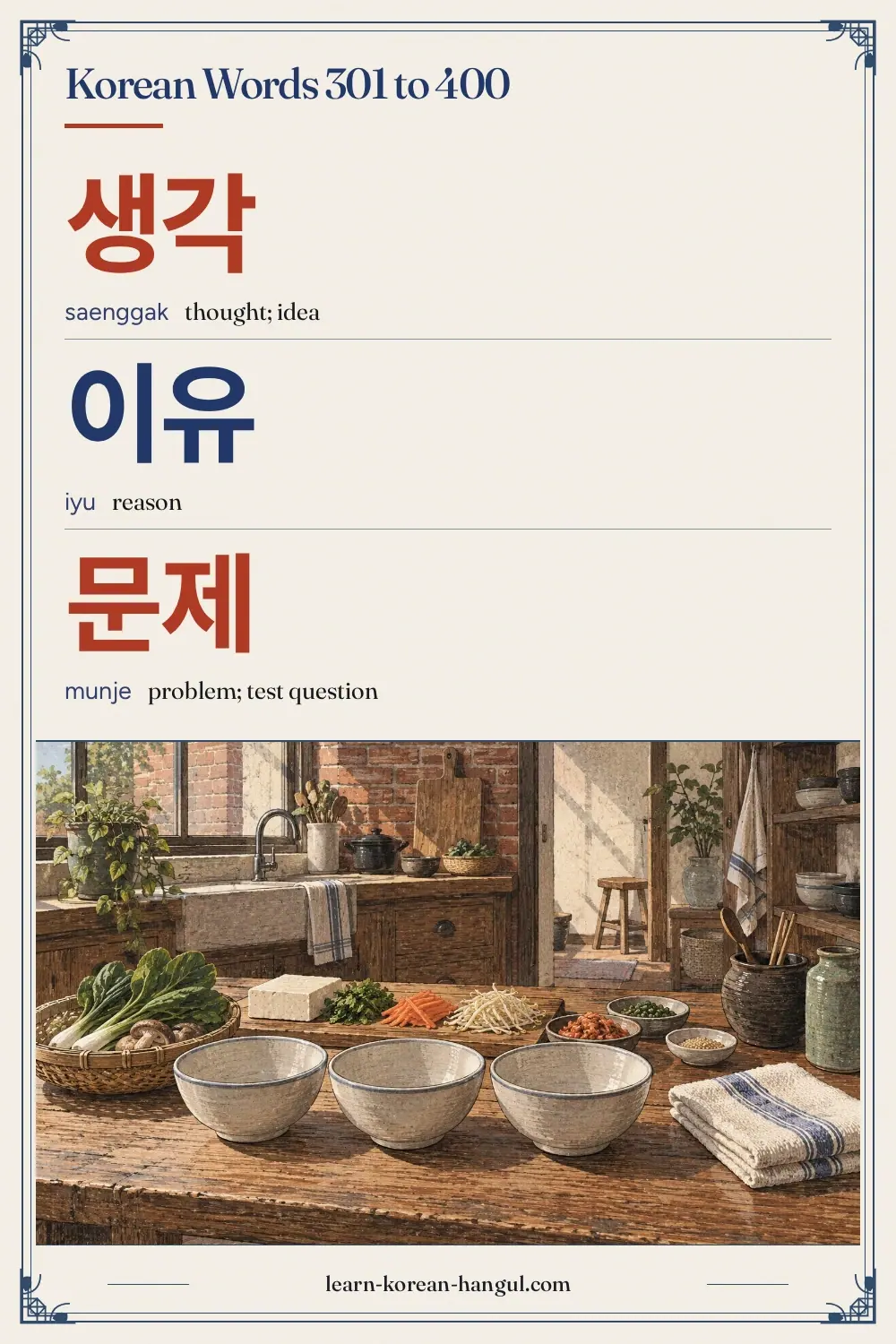
Korean Words 301 to 400 at a Glance
Korean words 301 to 400 are the third block of the Top 500 Korean Words list. The earlier blocks of the list cover the most basic people, objects and places. This block adds the words you need to explain yourself: a reason (이유), an opinion (의견), a problem (문제) and a plan (약속). It also adds the words of space, school and the seasons.
The list holds nouns and adverbs only. Of the 100 words, 47 are Sino-Korean (built from Chinese-derived syllables), 45 are native Korean and 8 are mixed, joining a Sino-Korean syllable to a native one, as in 동쪽 (east: 동 "east" + native 쪽 "side"). The origin column in every table marks each word. The number in the first column is a suggested study order for an A2 learner, and it is an editorial judgement, not a frequency count.
| Group | Words | What it lets you say |
|---|---|---|
| Feelings and opinions | 20 | Say what you think, why, and how you feel |
| Places and directions | 20 | Say where things are and which way to go |
| School and study | 20 | Talk about classes, exams and subjects |
| Nature and seasons | 20 | Describe the weather, the seasons and the outdoors |
| Frequency and degree words | 20 | Say how often, how much and how early or late |
You can read the tables once Hangul feels familiar. If the letters are still new, start with reading Hangul. The next section says where to begin.
Which Words Ranked 301 to 400 Should You Learn First?
Learn 생각, 이유, 문제, 의견 and 질문 first. These five words let you answer the question 왜요? (why?) and say what you think, which is the first thing that separates a basic speaker from an intermediate one. Then add the position words in the second group, because 위, 아래, 앞, 뒤 and 옆 come up in almost every direction you are given.
- Day one. 생각, 이유, 문제, 질문, 대답 and 의견.
- Day two. 위, 아래, 앞, 뒤, 옆, 안, 밖 and the left and right words.
- Day three. 공부, 수업, 시험, 숙제 and the school subjects.
- Day four. The four seasons, 날씨, 비 and 바람.
- Day five. 항상, 보통, 거의, 전혀, 별로, 아직 and 벌써.
At 20 words a day the list takes five days, and at 10 words a day it takes ten. Add one review day after each group. Many of these words also appear in TOPIK I study materials, but the order here is not taken from the exam. For official exam information, use topik.go.kr and the TOPIK guide.
Feelings and Opinions
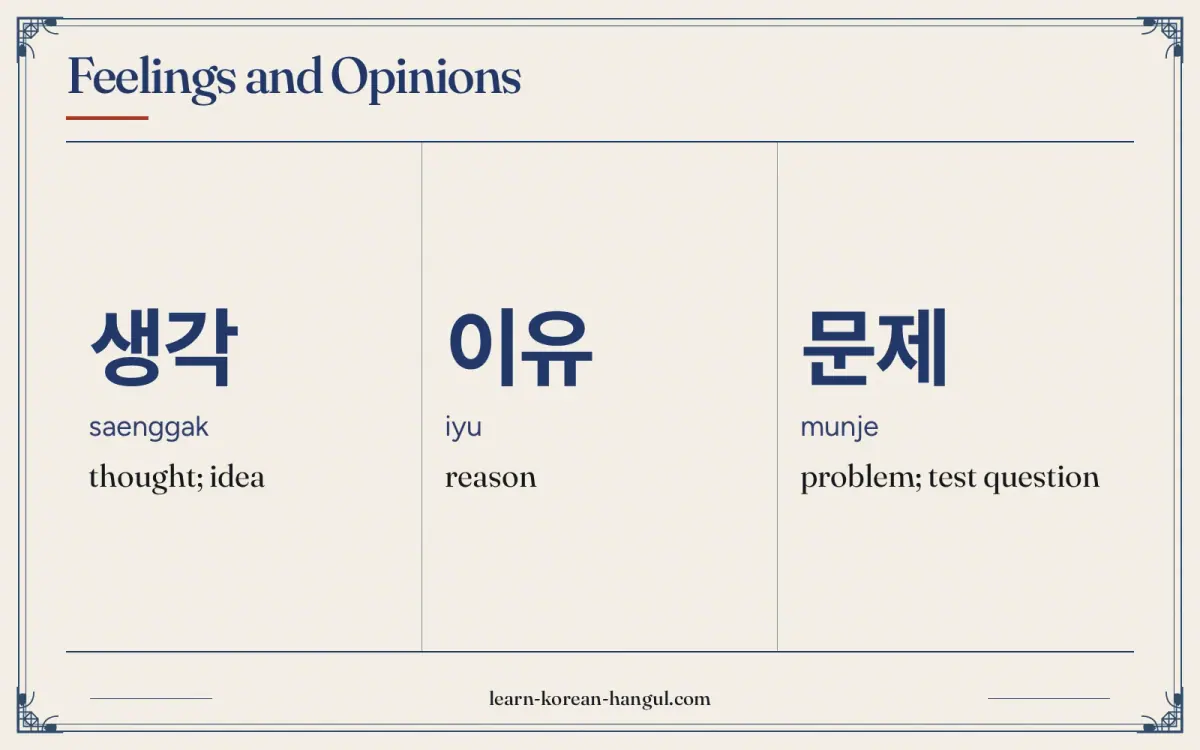
This group holds the words for thinking and feeling. 생각 is the key word. It is a noun meaning thought or idea, and it also works inside the verb 생각하다 (to think). 의견 is a more formal opinion, and 마음 and 기분 both mean something close to feeling, with 마음 for the heart and 기분 for the mood.
| No. | Hangul | Revised Romanization | Origin | Meaning | Example sentence | Audio assetId |
|---|---|---|---|---|---|---|
| 301 | 생각 | saenggak | native | thought; idea | 좋은 생각이에요. (That is a good idea.) | au-pg-vocabulary-core-words-top-500-301-400-1; example: au-pg-vocabulary-core-words-top-500-301-400-101 |
| 302 | 이유 | iyu | Sino-Korean | reason | 이유가 뭐예요? (What is the reason?) | au-pg-vocabulary-core-words-top-500-301-400-2; example: au-pg-vocabulary-core-words-top-500-301-400-102 |
| 303 | 문제 | munje | Sino-Korean | problem; test question | 문제가 있어요. (There is a problem.) | au-pg-vocabulary-core-words-top-500-301-400-3; example: au-pg-vocabulary-core-words-top-500-301-400-103 |
| 304 | 질문 | jilmun | Sino-Korean | question | 질문이 있어요. (I have a question.) | au-pg-vocabulary-core-words-top-500-301-400-4; example: au-pg-vocabulary-core-words-top-500-301-400-104 |
| 305 | 대답 | daedap | Sino-Korean | answer; reply | 대답을 기다려요. (I wait for an answer.) | au-pg-vocabulary-core-words-top-500-301-400-5; example: au-pg-vocabulary-core-words-top-500-301-400-105 |
| 306 | 의견 | uigyeon | Sino-Korean | opinion | 제 의견은 달라요. (My opinion is different.) | au-pg-vocabulary-core-words-top-500-301-400-6; example: au-pg-vocabulary-core-words-top-500-301-400-106 |
| 307 | 마음 | maeum | native | heart; mind | 마음이 편해요. (My mind is at ease.) | au-pg-vocabulary-core-words-top-500-301-400-7; example: au-pg-vocabulary-core-words-top-500-301-400-107 |
| 308 | 기분 | gibun | Sino-Korean | mood; feeling | 오늘 기분이 좋아요. (I am in a good mood today.) | au-pg-vocabulary-core-words-top-500-301-400-8; example: au-pg-vocabulary-core-words-top-500-301-400-108 |
| 309 | 느낌 | neukkim | native | feeling; impression | 느낌이 좋아요. (I have a good feeling about it.) | au-pg-vocabulary-core-words-top-500-301-400-9; example: au-pg-vocabulary-core-words-top-500-301-400-109 |
| 310 | 걱정 | geokjeong | Sino-Korean | worry | 걱정이 많아요. (I have many worries.) | au-pg-vocabulary-core-words-top-500-301-400-10; example: au-pg-vocabulary-core-words-top-500-301-400-110 |
| 311 | 사랑 | sarang | native | love | 부모님의 사랑이 커요. (My parents' love is great.) | au-pg-vocabulary-core-words-top-500-301-400-11; example: au-pg-vocabulary-core-words-top-500-301-400-111 |
| 312 | 행복 | haengbok | Sino-Korean | happiness | 행복은 가까이에 있어요. (Happiness is close by.) | au-pg-vocabulary-core-words-top-500-301-400-12; example: au-pg-vocabulary-core-words-top-500-301-400-112 |
| 313 | 희망 | huimang | Sino-Korean | hope | 희망이 있어요. (There is hope.) | au-pg-vocabulary-core-words-top-500-301-400-13; example: au-pg-vocabulary-core-words-top-500-301-400-113 |
| 314 | 꿈 | kkum | native | dream | 제 꿈은 의사예요. (My dream is to be a doctor.) | au-pg-vocabulary-core-words-top-500-301-400-14; example: au-pg-vocabulary-core-words-top-500-301-400-114 |
| 315 | 기억 | gieok | Sino-Korean | memory | 좋은 기억이 많아요. (I have many good memories.) | au-pg-vocabulary-core-words-top-500-301-400-15; example: au-pg-vocabulary-core-words-top-500-301-400-115 |
| 316 | 약속 | yaksok | Sino-Korean | promise; appointment | 내일 약속이 있어요. (I have plans tomorrow.) | au-pg-vocabulary-core-words-top-500-301-400-16; example: au-pg-vocabulary-core-words-top-500-301-400-116 |
| 317 | 비밀 | bimil | Sino-Korean | secret | 이건 비밀이에요. (This is a secret.) | au-pg-vocabulary-core-words-top-500-301-400-17; example: au-pg-vocabulary-core-words-top-500-301-400-117 |
| 318 | 거짓말 | geojinmal | native | lie | 그건 거짓말이에요. (That is a lie.) | au-pg-vocabulary-core-words-top-500-301-400-18; example: au-pg-vocabulary-core-words-top-500-301-400-118 |
| 319 | 실수 | silsu | Sino-Korean | mistake | 실수는 괜찮아요. (A mistake is okay.) | au-pg-vocabulary-core-words-top-500-301-400-19; example: au-pg-vocabulary-core-words-top-500-301-400-119 |
| 320 | 성격 | seonggyeok | Sino-Korean | personality; character | 그 친구는 성격이 좋아요. (That friend has a good personality.) | au-pg-vocabulary-core-words-top-500-301-400-20; example: au-pg-vocabulary-core-words-top-500-301-400-120 |
Three pairs need a note. 질문 is the question you ask, and 대답 is the reply you give. 문제 means a problem, but it also means a question on a test, so 시험 문제 is an exam question. 마음 is the heart as the place of feeling, while 기분 is the mood of today, so say 기분이 좋아요 for a good mood. The word 거짓말 is said [거진말]: the final ㅅ is said as ㄷ, and ㄷ before ㅁ becomes ㄴ.
To say what you think, use 생각 with 하다: 저는 그렇게 생각해요 means I think so. The 왜 (why) page shows how 이유 and 왜 work together. The next group covers where things are.
Example Sentences
Each example is a short polite sentence. Most follow two patterns. The first is noun + 이/가 + 있어요 (there is), as in 질문이 있어요. The second is noun + 에 + place word, as in 집 뒤에 산이 있어요. Say each sentence aloud, then swap the first noun. Replace 질문 with 문제 and you get 문제가 있어요, which is also natural. Particles such as 이/가 and 은/는 are not on this list, so see the Korean particles guide when the endings feel unclear.
How Do You Say Places and Directions in Korean?
Places and directions are said with position nouns. In Korean the position word comes after the thing it relates to: 책상 위 (on the desk, literally desk top), 의자 아래 (under the chair). Add the particle 에 to mark the place, as in 책상 위에. The group also has the four compass points, two ways to turn and the words for an address, a park and the countryside.
| No. | Hangul | Revised Romanization | Origin | Meaning | Example sentence | Audio assetId |
|---|---|---|---|---|---|---|
| 321 | 위 | wi | native | above; top | 책이 책상 위에 있어요. (The book is on the desk.) | au-pg-vocabulary-core-words-top-500-301-400-21; example: au-pg-vocabulary-core-words-top-500-301-400-121 |
| 322 | 아래 | arae | native | below; under | 의자 아래에 가방이 있어요. (The bag is under the chair.) | au-pg-vocabulary-core-words-top-500-301-400-22; example: au-pg-vocabulary-core-words-top-500-301-400-122 |
| 323 | 앞 | ap | native | front | 학교 앞에서 만나요. (We meet in front of the school.) | au-pg-vocabulary-core-words-top-500-301-400-23; example: au-pg-vocabulary-core-words-top-500-301-400-123 |
| 324 | 뒤 | dwi | native | back; behind | 집 뒤에 산이 있어요. (There is a mountain behind the house.) | au-pg-vocabulary-core-words-top-500-301-400-24; example: au-pg-vocabulary-core-words-top-500-301-400-124 |
| 325 | 옆 | yeop | native | side; next to | 은행 옆에 식당이 있어요. (There is a restaurant next to the bank.) | au-pg-vocabulary-core-words-top-500-301-400-25; example: au-pg-vocabulary-core-words-top-500-301-400-125 |
| 326 | 안 | an | native | inside | 가방 안에 지갑이 있어요. (The wallet is inside the bag.) | au-pg-vocabulary-core-words-top-500-301-400-26; example: au-pg-vocabulary-core-words-top-500-301-400-126 |
| 327 | 밖 | bak | native | outside | 밖에 비가 와요. (It is raining outside.) | au-pg-vocabulary-core-words-top-500-301-400-27; example: au-pg-vocabulary-core-words-top-500-301-400-127 |
| 328 | 가운데 | gaunde | native | middle; centre | 방 가운데에 책상이 있어요. (There is a desk in the middle of the room.) | au-pg-vocabulary-core-words-top-500-301-400-28; example: au-pg-vocabulary-core-words-top-500-301-400-128 |
| 329 | 오른쪽 | oreunjjok | native | right side | 오른쪽으로 가세요. (Please go to the right.) | au-pg-vocabulary-core-words-top-500-301-400-29; example: au-pg-vocabulary-core-words-top-500-301-400-129 |
| 330 | 왼쪽 | oenjjok | native | left side | 은행은 왼쪽에 있어요. (The bank is on the left.) | au-pg-vocabulary-core-words-top-500-301-400-30; example: au-pg-vocabulary-core-words-top-500-301-400-130 |
| 331 | 동쪽 | dongjjok | mixed | east | 해는 동쪽에서 떠요. (The sun rises in the east.) | au-pg-vocabulary-core-words-top-500-301-400-31; example: au-pg-vocabulary-core-words-top-500-301-400-131 |
| 332 | 서쪽 | seojjok | mixed | west | 서쪽에 바다가 있어요. (There is a sea in the west.) | au-pg-vocabulary-core-words-top-500-301-400-32; example: au-pg-vocabulary-core-words-top-500-301-400-132 |
| 333 | 남쪽 | namjjok | mixed | south | 남쪽은 따뜻해요. (The south is warm.) | au-pg-vocabulary-core-words-top-500-301-400-33; example: au-pg-vocabulary-core-words-top-500-301-400-133 |
| 334 | 북쪽 | bukjjok | mixed | north | 북쪽은 추워요. (The north is cold.) | au-pg-vocabulary-core-words-top-500-301-400-34; example: au-pg-vocabulary-core-words-top-500-301-400-134 |
| 335 | 방향 | banghyang | Sino-Korean | direction | 방향이 맞아요. (The direction is right.) | au-pg-vocabulary-core-words-top-500-301-400-35; example: au-pg-vocabulary-core-words-top-500-301-400-135 |
| 336 | 주소 | juso | Sino-Korean | address | 주소를 알려 주세요. (Please tell me the address.) | au-pg-vocabulary-core-words-top-500-301-400-36; example: au-pg-vocabulary-core-words-top-500-301-400-136 |
| 337 | 공항 | gonghang | Sino-Korean | airport | 공항에 가요. (I am going to the airport.) | au-pg-vocabulary-core-words-top-500-301-400-37; example: au-pg-vocabulary-core-words-top-500-301-400-137 |
| 338 | 공원 | gongwon | Sino-Korean | park | 공원에서 산책해요. (I take a walk in the park.) | au-pg-vocabulary-core-words-top-500-301-400-38; example: au-pg-vocabulary-core-words-top-500-301-400-138 |
| 339 | 도시 | dosi | Sino-Korean | city | 서울은 큰 도시예요. (Seoul is a big city.) | au-pg-vocabulary-core-words-top-500-301-400-39; example: au-pg-vocabulary-core-words-top-500-301-400-139 |
| 340 | 시골 | sigol | native | countryside | 할머니는 시골에 사세요. (My grandmother lives in the countryside.) | au-pg-vocabulary-core-words-top-500-301-400-40; example: au-pg-vocabulary-core-words-top-500-301-400-140 |
Position words are nouns, not prepositions, so they follow the thing they locate. English says on the desk, and Korean says desk-top-at. The words 왼쪽 and 오른쪽 end in 쪽 (side), and the compass points use the same ending: 동쪽, 서쪽, 남쪽 and 북쪽. Do not mix up 안 (inside) with the negative adverb 안 (not). Context and word order tell them apart: 가방 안에 is inside the bag, and 안 가요 is I do not go.
The Korean directions vocabulary page has more position and direction words, and the places hub covers buildings and shops. The next group moves from places to the classroom.
School and Study
School and study words are mostly Sino-Korean, built from the same syllables again and again. 학 (study) appears in 대학교, 대학생, 입학, 수학, 과학 and 역사 is built on 사 (history). Knowing these building blocks lets you guess new words. The group also holds the first languages and subject you meet: 영어, 한국어 and 수학.
| No. | Hangul | Revised Romanization | Origin | Meaning | Example sentence | Audio assetId |
|---|---|---|---|---|---|---|
| 341 | 공부 | gongbu | Sino-Korean | study | 매일 공부해요. (I study every day.) | au-pg-vocabulary-core-words-top-500-301-400-41; example: au-pg-vocabulary-core-words-top-500-301-400-141 |
| 342 | 수업 | sueop | Sino-Korean | class; lesson | 수업이 아홉 시에 시작해요. (Class starts at nine.) | au-pg-vocabulary-core-words-top-500-301-400-42; example: au-pg-vocabulary-core-words-top-500-301-400-142 |
| 343 | 교실 | gyosil | Sino-Korean | classroom | 교실에 학생이 많아요. (There are many students in the classroom.) | au-pg-vocabulary-core-words-top-500-301-400-43; example: au-pg-vocabulary-core-words-top-500-301-400-143 |
| 344 | 숙제 | sukje | Sino-Korean | homework | 숙제가 많아요. (There is a lot of homework.) | au-pg-vocabulary-core-words-top-500-301-400-44; example: au-pg-vocabulary-core-words-top-500-301-400-144 |
| 345 | 시험 | siheom | Sino-Korean | exam | 내일 시험이 있어요. (There is an exam tomorrow.) | au-pg-vocabulary-core-words-top-500-301-400-45; example: au-pg-vocabulary-core-words-top-500-301-400-145 |
| 346 | 성적 | seongjeok | Sino-Korean | grades; results | 성적이 좋아요. (My grades are good.) | au-pg-vocabulary-core-words-top-500-301-400-46; example: au-pg-vocabulary-core-words-top-500-301-400-146 |
| 347 | 도서관 | doseogwan | Sino-Korean | library | 도서관에서 책을 읽어요. (I read a book in the library.) | au-pg-vocabulary-core-words-top-500-301-400-47; example: au-pg-vocabulary-core-words-top-500-301-400-147 |
| 348 | 대학교 | daehakgyo | Sino-Korean | university | 우리 형은 대학교에 다녀요. (My older brother goes to university.) | au-pg-vocabulary-core-words-top-500-301-400-48; example: au-pg-vocabulary-core-words-top-500-301-400-148 |
| 349 | 대학생 | daehaksaeng | Sino-Korean | university student | 저는 대학생이에요. (I am a university student.) | au-pg-vocabulary-core-words-top-500-301-400-49; example: au-pg-vocabulary-core-words-top-500-301-400-149 |
| 350 | 졸업 | joreop | Sino-Korean | graduation | 내년에 졸업해요. (I graduate next year.) | au-pg-vocabulary-core-words-top-500-301-400-50; example: au-pg-vocabulary-core-words-top-500-301-400-150 |
| 351 | 입학 | iphak | Sino-Korean | entering a school | 입학은 삼월에 해요. (Entering school happens in March.) | au-pg-vocabulary-core-words-top-500-301-400-51; example: au-pg-vocabulary-core-words-top-500-301-400-151 |
| 352 | 과목 | gwamok | Sino-Korean | school subject | 좋아하는 과목이 뭐예요? (What is your favourite subject?) | au-pg-vocabulary-core-words-top-500-301-400-52; example: au-pg-vocabulary-core-words-top-500-301-400-152 |
| 353 | 영어 | yeongeo | Sino-Korean | English (language) | 영어를 배워요. (I am learning English.) | au-pg-vocabulary-core-words-top-500-301-400-53; example: au-pg-vocabulary-core-words-top-500-301-400-153 |
| 354 | 한국어 | hangugeo | Sino-Korean | Korean (language) | 한국어는 재미있어요. (Korean is fun.) | au-pg-vocabulary-core-words-top-500-301-400-54; example: au-pg-vocabulary-core-words-top-500-301-400-154 |
| 355 | 수학 | suhak | Sino-Korean | mathematics | 수학이 어려워요. (Math is difficult.) | au-pg-vocabulary-core-words-top-500-301-400-55; example: au-pg-vocabulary-core-words-top-500-301-400-155 |
| 356 | 과학 | gwahak | Sino-Korean | science | 과학 수업이 재미있어요. (Science class is fun.) | au-pg-vocabulary-core-words-top-500-301-400-56; example: au-pg-vocabulary-core-words-top-500-301-400-156 |
| 357 | 역사 | yeoksa | Sino-Korean | history | 역사를 좋아해요. (I like history.) | au-pg-vocabulary-core-words-top-500-301-400-57; example: au-pg-vocabulary-core-words-top-500-301-400-157 |
| 358 | 음악 | eumak | Sino-Korean | music | 음악을 들어요. (I listen to music.) | au-pg-vocabulary-core-words-top-500-301-400-58; example: au-pg-vocabulary-core-words-top-500-301-400-158 |
| 359 | 미술 | misul | Sino-Korean | art (school subject) | 미술 시간에 그림을 그려요. (In art class I draw a picture.) | au-pg-vocabulary-core-words-top-500-301-400-59; example: au-pg-vocabulary-core-words-top-500-301-400-159 |
| 360 | 시간표 | siganpyo | Sino-Korean | timetable; schedule | 시간표를 봐요. (I look at the timetable.) | au-pg-vocabulary-core-words-top-500-301-400-60; example: au-pg-vocabulary-core-words-top-500-301-400-160 |
Notice the pattern in 대학교 (university) and 대학생 (university student). Add 생 (student) to 대학 and you get the person who studies there. Notice the pair 입학 (entering school) and 졸업 (graduating). In Korea the school year begins in March, which is why 입학 is linked to 삼월 in the example.
The verb 공부하다 is formed from the noun 공부 and 하다, so 공부해요 means I study. You can also say 공부를 해요 with the particle 를. Both are natural. The school subjects page lists more subjects, and the school and work hub covers classroom items. The next group goes outside.
How Do You Say Nature and Seasons in Korean?
Nature words are mostly native Korean and short. The four seasons are 봄, 여름, 가을 and 겨울, and 계절 is the general word for season. 날씨 is the weather, and the weather words 비, 바람 and 구름 follow it. The list also has landscape words such as 산, 강, 바다 and 숲.
| No. | Hangul | Revised Romanization | Origin | Meaning | Example sentence | Audio assetId |
|---|---|---|---|---|---|---|
| 361 | 계절 | gyejeol | Sino-Korean | season | 한국은 계절이 네 개예요. (Korea has four seasons.) | au-pg-vocabulary-core-words-top-500-301-400-61; example: au-pg-vocabulary-core-words-top-500-301-400-161 |
| 362 | 봄 | bom | native | spring | 봄에 꽃이 피어요. (Flowers bloom in spring.) | au-pg-vocabulary-core-words-top-500-301-400-62; example: au-pg-vocabulary-core-words-top-500-301-400-162 |
| 363 | 여름 | yeoreum | native | summer | 여름은 더워요. (Summer is hot.) | au-pg-vocabulary-core-words-top-500-301-400-63; example: au-pg-vocabulary-core-words-top-500-301-400-163 |
| 364 | 가을 | gaeul | native | autumn | 가을 하늘이 높아요. (The autumn sky is high.) | au-pg-vocabulary-core-words-top-500-301-400-64; example: au-pg-vocabulary-core-words-top-500-301-400-164 |
| 365 | 겨울 | gyeoul | native | winter | 겨울에는 눈이 와요. (It snows in winter.) | au-pg-vocabulary-core-words-top-500-301-400-65; example: au-pg-vocabulary-core-words-top-500-301-400-165 |
| 366 | 날씨 | nalssi | native | weather | 오늘 날씨가 좋아요. (The weather is good today.) | au-pg-vocabulary-core-words-top-500-301-400-66; example: au-pg-vocabulary-core-words-top-500-301-400-166 |
| 367 | 비 | bi | native | rain | 비가 와요. (It is raining.) | au-pg-vocabulary-core-words-top-500-301-400-67; example: au-pg-vocabulary-core-words-top-500-301-400-167 |
| 368 | 바람 | baram | native | wind | 바람이 불어요. (The wind is blowing.) | au-pg-vocabulary-core-words-top-500-301-400-68; example: au-pg-vocabulary-core-words-top-500-301-400-168 |
| 369 | 구름 | gureum | native | cloud | 구름이 많아요. (There are many clouds.) | au-pg-vocabulary-core-words-top-500-301-400-69; example: au-pg-vocabulary-core-words-top-500-301-400-169 |
| 370 | 하늘 | haneul | native | sky | 하늘이 맑아요. (The sky is clear.) | au-pg-vocabulary-core-words-top-500-301-400-70; example: au-pg-vocabulary-core-words-top-500-301-400-170 |
| 371 | 별 | byeol | native | star | 밤하늘에 별이 많아요. (There are many stars in the night sky.) | au-pg-vocabulary-core-words-top-500-301-400-71; example: au-pg-vocabulary-core-words-top-500-301-400-171 |
| 372 | 산 | san | Sino-Korean | mountain | 주말에 산에 가요. (I go to the mountain on weekends.) | au-pg-vocabulary-core-words-top-500-301-400-72; example: au-pg-vocabulary-core-words-top-500-301-400-172 |
| 373 | 강 | gang | Sino-Korean | river | 강이 넓어요. (The river is wide.) | au-pg-vocabulary-core-words-top-500-301-400-73; example: au-pg-vocabulary-core-words-top-500-301-400-173 |
| 374 | 바다 | bada | native | sea | 여름에 바다에 가요. (I go to the sea in summer.) | au-pg-vocabulary-core-words-top-500-301-400-74; example: au-pg-vocabulary-core-words-top-500-301-400-174 |
| 375 | 꽃 | kkot | native | flower | 꽃이 예뻐요. (The flowers are pretty.) | au-pg-vocabulary-core-words-top-500-301-400-75; example: au-pg-vocabulary-core-words-top-500-301-400-175 |
| 376 | 나무 | namu | native | tree; wood | 나무가 커요. (The tree is big.) | au-pg-vocabulary-core-words-top-500-301-400-76; example: au-pg-vocabulary-core-words-top-500-301-400-176 |
| 377 | 풀 | pul | native | grass | 풀 위에 앉아요. (I sit on the grass.) | au-pg-vocabulary-core-words-top-500-301-400-77; example: au-pg-vocabulary-core-words-top-500-301-400-177 |
| 378 | 숲 | sup | native | forest | 숲에서 걸어요. (I walk in the forest.) | au-pg-vocabulary-core-words-top-500-301-400-78; example: au-pg-vocabulary-core-words-top-500-301-400-178 |
| 379 | 동물 | dongmul | Sino-Korean | animal | 동물을 좋아해요. (I like animals.) | au-pg-vocabulary-core-words-top-500-301-400-79; example: au-pg-vocabulary-core-words-top-500-301-400-179 |
| 380 | 공기 | gonggi | Sino-Korean | air | 공기가 맑아요. (The air is clean.) | au-pg-vocabulary-core-words-top-500-301-400-80; example: au-pg-vocabulary-core-words-top-500-301-400-180 |
The weather verbs are paired with the noun. Rain uses 오다 (to come): 비가 와요 means it is raining. Wind uses 불다 (to blow): 바람이 불어요. Snow is 눈, which is already in the first 100 words, and it also uses 오다. This pairing of noun and verb is worth learning as a unit.
Two notes help here. 나무 means both tree and wood, and 별 (star) pairs with 달 (moon, month), which is in the first 100 words. The seasons page and the weather page go deeper on the first two groups of words here. The last group is the smallest words on the page and often the hardest to use.
Frequency and Degree Words
Frequency and degree words are adverbs. An adverb says how often, how much or when. They usually come right before the verb or adjective they describe: 항상 일찍 일어나요 (I always get up early). This group sits at the end because these short words are the hardest to place in a sentence.
| No. | Hangul | Revised Romanization | Origin | Meaning | Example sentence | Audio assetId |
|---|---|---|---|---|---|---|
| 381 | 항상 | hangsang | Sino-Korean | always | 항상 일찍 일어나요. (I always get up early.) | au-pg-vocabulary-core-words-top-500-301-400-81; example: au-pg-vocabulary-core-words-top-500-301-400-181 |
| 382 | 보통 | botong | Sino-Korean | usually | 보통 여섯 시에 일어나요. (I usually get up at six.) | au-pg-vocabulary-core-words-top-500-301-400-82; example: au-pg-vocabulary-core-words-top-500-301-400-182 |
| 383 | 거의 | geoui | native | almost; hardly (with a negative) | 거의 다 왔어요. (We have almost arrived.) | au-pg-vocabulary-core-words-top-500-301-400-83; example: au-pg-vocabulary-core-words-top-500-301-400-183 |
| 384 | 전혀 | jeonhyeo | mixed | not at all (with a negative) | 전혀 몰라요. (I do not know at all.) | au-pg-vocabulary-core-words-top-500-301-400-84; example: au-pg-vocabulary-core-words-top-500-301-400-184 |
| 385 | 별로 | byeollo | mixed | not very (with a negative) | 별로 안 매워요. (It is not very spicy.) | au-pg-vocabulary-core-words-top-500-301-400-85; example: au-pg-vocabulary-core-words-top-500-301-400-185 |
| 386 | 아직 | ajik | native | still; not yet | 아직 안 먹었어요. (I have not eaten yet.) | au-pg-vocabulary-core-words-top-500-301-400-86; example: au-pg-vocabulary-core-words-top-500-301-400-186 |
| 387 | 이미 | imi | native | already | 이미 끝났어요. (It is already over.) | au-pg-vocabulary-core-words-top-500-301-400-87; example: au-pg-vocabulary-core-words-top-500-301-400-187 |
| 388 | 벌써 | beolsseo | native | already (with surprise) | 벌써 열두 시예요. (It is already twelve o'clock.) | au-pg-vocabulary-core-words-top-500-301-400-88; example: au-pg-vocabulary-core-words-top-500-301-400-188 |
| 389 | 일찍 | iljjik | native | early | 내일 일찍 와요. (Come early tomorrow.) | au-pg-vocabulary-core-words-top-500-301-400-89; example: au-pg-vocabulary-core-words-top-500-301-400-189 |
| 390 | 늦게 | neutge | native | late (adverb) | 어제 늦게 잤어요. (I went to bed late yesterday.) | au-pg-vocabulary-core-words-top-500-301-400-90; example: au-pg-vocabulary-core-words-top-500-301-400-190 |
| 391 | 다 | da | native | all; everything | 다 먹었어요. (I ate it all.) | au-pg-vocabulary-core-words-top-500-301-400-91; example: au-pg-vocabulary-core-words-top-500-301-400-191 |
| 392 | 모두 | modu | native | everyone; all | 모두 와요. (Everyone is coming.) | au-pg-vocabulary-core-words-top-500-301-400-92; example: au-pg-vocabulary-core-words-top-500-301-400-192 |
| 393 | 정말 | jeongmal | mixed | really | 정말 맛있어요. (It is really delicious.) | au-pg-vocabulary-core-words-top-500-301-400-93; example: au-pg-vocabulary-core-words-top-500-301-400-193 |
| 394 | 진짜 | jinjja | mixed | really; real | 진짜 예뻐요. (It is really pretty.) | au-pg-vocabulary-core-words-top-500-301-400-94; example: au-pg-vocabulary-core-words-top-500-301-400-194 |
| 395 | 매우 | maeu | native | very | 매우 중요해요. (It is very important.) | au-pg-vocabulary-core-words-top-500-301-400-95; example: au-pg-vocabulary-core-words-top-500-301-400-195 |
| 396 | 제일 | jeil | Sino-Korean | most; best | 봄이 제일 좋아요. (I like spring the most.) | au-pg-vocabulary-core-words-top-500-301-400-96; example: au-pg-vocabulary-core-words-top-500-301-400-196 |
| 397 | 가장 | gajang | native | most (superlative) | 서울은 가장 큰 도시예요. (Seoul is the biggest city.) | au-pg-vocabulary-core-words-top-500-301-400-97; example: au-pg-vocabulary-core-words-top-500-301-400-197 |
| 398 | 꼭 | kkok | native | without fail; definitely | 내일 꼭 오세요. (Please be sure to come tomorrow.) | au-pg-vocabulary-core-words-top-500-301-400-98; example: au-pg-vocabulary-core-words-top-500-301-400-198 |
| 399 | 바로 | baro | native | right away; exactly | 바로 여기예요. (It is right here.) | au-pg-vocabulary-core-words-top-500-301-400-99; example: au-pg-vocabulary-core-words-top-500-301-400-199 |
| 400 | 아마 | ama | native | probably | 아마 내일 비가 올 거예요. (It will probably rain tomorrow.) | au-pg-vocabulary-core-words-top-500-301-400-100; example: au-pg-vocabulary-core-words-top-500-301-400-200 |
Compare the frequency words you already know. 자주 (often) and 가끔 (sometimes) are in the first 100 words, and they sit on a scale with the words of this group: 항상 (always), 보통 (usually), 자주 (often), 가끔 (sometimes), 거의 (hardly) and 전혀 (not at all). All of them go before the verb. For example, 자주 가요 (I go often), 가끔 가요 (I go sometimes) and 항상 가요 (I always go). 전혀 always needs a negative verb, and 거의 means hardly only with a negative: 거의 안 가요 means I hardly go, and 전혀 안 가요 means I do not go at all. With a positive verb, 거의 means almost, as in 거의 다 왔어요 (We have almost arrived).
Three words are easy to confuse. 아직 (still, not yet) and 벌써 (already, with surprise) are near opposites: 아직 안 왔어요 means he has not come yet, and 벌써 왔어요 means he has already come. 이미 also means already, but it states a plain fact. 정말 and 진짜 both mean really. 정말 suits any situation, and 진짜 sounds a little more casual. 제일 and 가장 both mean most, and you can swap them.
How Do You Pronounce These Words?
Most of these words follow the spelling, but several undergo sound changes between consonants. The table shows eight that learners often get wrong.
| Spelling | Pronunciation | What happens |
|---|---|---|
| 거짓말 | [거진말] | Final ㅅ is said as ㄷ, and ㄷ before ㅁ becomes ㄴ |
| 입학 | [이팍] | ㅂ and ㅎ merge into an aspirated ㅍ |
| 졸업 | [조럽] | The final ㄹ of 졸 links to the vowel of the next syllable |
| 대학교 | [대학꾜] | ㄱ after a final ㄱ is said as a tense sound |
| 대학생 | [대학쌩] | ㅅ after a final ㄱ is said as a tense sound |
| 성격 | [성껵] | The second ㄱ is tense in the standard dictionary pronunciation, although the spelling shows a plain ㄱ |
| 숲에서 | [수페서] | The final ㅍ links to the vowel of the next syllable |
| 거의 | [거의] or [거이] | ㅢ in a later syllable may be said [이] |
The rules come from the Standard Pronunciation rules (표준 발음법) of the 국립국어원. Revised Romanization does not show tensing caused by a neighbouring sound, so it writes 성격 as seonggyeok and 대학교 as daehakgyo even though they are said [성껵] and [대학꾜].
Audio and Slow Playback
Each word has a normal clip, and 5 key words also have a slow clip at 0.8 times the speed: 생각, 이유, 입학, 성격 and 벌써. Nothing plays until you press a button.
Listen to 입학 first. You should hear a single puff of air on the ㅍ, as if the word were spelled 이팍. Then listen to 벌써. The first vowel, ㅓ, is said with relaxed, unrounded lips. It is not the same as the ㅗ in 오늘.
What Mistakes Do Learners Make with Words Ranked 301 to 400?
- Treating 안 as only a negative. 안 also means inside, as in 가방 안에 (inside the bag). Position and word order show which meaning is meant.
- Putting the position word before the thing, as in English. Say 책상 위, never 위 책상. The location comes first and the position word second.
- Saying 전혀 with a positive verb. 전혀 needs a negative, so use 전혀 몰라요 (I do not know at all), not 전혀 알아요. 거의 works both ways: 거의 다 왔어요 is almost there, and 거의 안 와요 is hardly comes.
- Mixing up 아직 and 벌써. 아직 is still or not yet, and 벌써 is already, usually with a note of surprise.
- Reading 거짓말 as geojit-mal. It is said [거진말], and the Revised Romanization is geojinmal.
- Using 문제 only for problem. 시험 문제 is an exam question, so context decides.
Of these, the position-word order is the one most learners get wrong in their first week. The next section turns the list into practice.
Practice: Flashcards and Worksheet
Drill these words with the vocabulary flashcard decks. A printable worksheet for these words (word list, matching, writing practice, fill-in-the-blank exercises and answer key) is available in A4 and US Letter from the download card on this page. Progress in the decks is saved only in your browser. A simple method is to take the five groups one at a time, cover the English column and say each Hangul word aloud with its meaning.
Korean Words 301 to 400 Worksheet
Try this five-question check, then say all 100 words aloud once more.
Practice · 5
What does 사랑 mean?
Show answer
love
사랑 (sarang) means love.
What does 동쪽 mean?
Show answer
east
동쪽 (dongjjok) means east.
What does 입학 mean?
Show answer
entering a school
입학 (iphak) means entering a school.
What does 별 mean?
Show answer
star
별 (byeol) means star.
What does 다 mean?
Show answer
all; everything
다 (da) means all; everything.
Where to Go Next
This block sits inside Top 500 Korean Words. Go back to Korean words 201 to 300 if the first groups feel too hard, or move on to Korean words 401 to 500, which adds society, work and travel words and closes the list. After the full 500, the Top 1000 Korean Words page continues the order.
Frequently Asked Questions
How Do You Say Thought in Korean?
Thought is 생각 (saenggak). It is a noun meaning thought or idea, as in 좋은 생각이에요 (That is a good idea). It also forms the verb 생각하다, to think. Say it as written, [생각]. The ㄱ at the start of the second syllable is a soft, plain sound, and the final ㄱ is held without a puff of air.
How Do You Pronounce 이유 (iyu)?
이유 is said i-yu, with two short syllables. The first, 이, is a bright, tight vowel like the ee in see. The second, 유, begins with a y glide into ㅜ. Nothing changes between the syllables. Press the audio button, say the two syllables together and listen for even stress.
How Many Words Ranked 301 to 400 Should I Learn First?
Learn about 25 first: the 10 thinking and feeling words (생각, 이유, 문제, 질문, 대답, 의견, 마음, 기분, 걱정, 약속), the 8 position words and the 7 frequency words 항상, 보통, 거의, 전혀, 별로, 아직 and 벌써. Add the school and nature groups as you need them.
Where Can I Practise Words Ranked 301 to 400 with Flashcards?
Use the vocabulary flashcard decks, which list every deck with audio. A deck for this block is planned. Progress stays in your browser. Until then, copy the five tables above onto cards: Hangul on one side, English on the other.
Is the Romanization on This Page Official?
It follows the Revised Romanization of Korean, which South Korea officially adopted on 7 July 2000 and whose rules the National Institute of Korean Language (국립국어원) publishes. It is a learning aid that does not show tensing caused by a neighbouring sound, so learn the Hangul and use the audio.
Is There a Printable Worksheet for Words Ranked 301 to 400?
A printable worksheet for these words (word list, matching, writing practice, fill-in-the-blank exercises and answer key) is available in A4 and US Letter from the download card on this page. For practice, write the Hangul from memory, cover the English column and check your answers against the tables.