What you will be able to do after this page
- Say 30 common phrases with the correct noun, particle and verb.
- Choose between 을/를, 이/가 and 에 for the noun in a phrase.
- Explain three cases where Korean uses a different verb than English: take, weather and illness, and light-verb 하다.
- Build a new sentence from any phrase with the polite present or past.
Before you start: read daily Korean verbs, because this page expands the collocations introduced there. Time: about 40 minutes. Level: A2.
What Are Korean Verb Phrases?
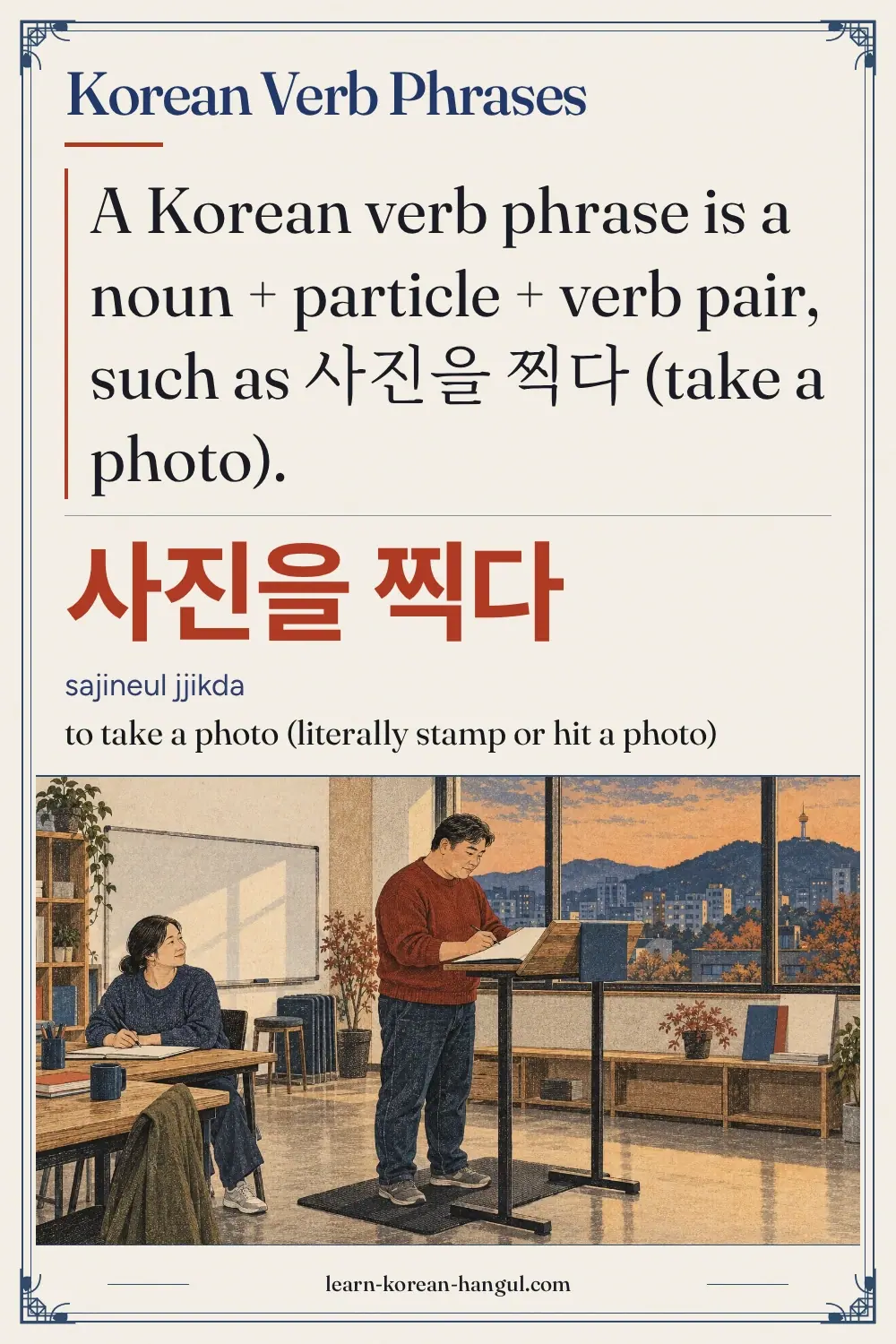
A verb phrase in this lesson is a noun with its particle plus the verb that normally goes with it. Linguists call such a pair a collocation: words that sit together by habit and not by logic. In English you "take" a photo, "catch" a cold and "make" a call. In Korean you "stamp" a photo (사진을 찍다), "get hooked by" a cold (감기에 걸리다) and "hang" a call (전화를 걸다). Nothing in the meaning forces these choices, so you learn each pair as one chunk.
The chunk always includes the particle. A particle is a short word that attaches to a noun and marks its job. In most phrases the noun is the thing the verb acts on, so it takes the object particle: the Korean object particle 을/를. In a few the noun is the one doing or undergoing the event, so it takes the subject particle, as explained in the Korean topic and subject particles.
Which Particle Goes with Each Phrase?
Of the 30 phrases on this page, 23 take 을/를, 6 take 이/가 and 1 takes 에. The pattern follows what the noun is in the event.
| Particle | Job of the noun | Example from this page | Typical verbs |
|---|---|---|---|
| 을/를 | The thing the action is done to | 약을 먹어요 | 먹다, 찍다, 보다, 듣다, 내다, 하다 |
| 이/가 | The thing that happens or arrives | 비가 와요 | 오다, 불다, 나다, 막히다, 걸리다 |
| 에 | The thing that catches or affects you | 감기에 걸려요 | 걸리다 (illness) |
The choice between 을/를 and 이/가 is the same as in the 이/가 lesson: ask whether the noun is acted on (object) or is the subject. A common slip is to put 을/를 on weather: 비를 와요 is wrong. Rain does not receive the action. Rain is the thing that comes. The second slip is to drop the particle. In speech, Koreans often drop 을/를 (약 먹었어요), but a learner should keep it until the full form feels natural, as omitting particles explains.
Verbs follow the noun, and every verb here is shown in the polite present (-요 ending), which is the form you use with strangers and in shops. The table in each group below gives the dictionary form of the phrase, its Revised Romanization, the meaning, and a full example sentence. The sentence verbs come from the site's conjugation engine.
Body and Health: Phrases 1 to 5
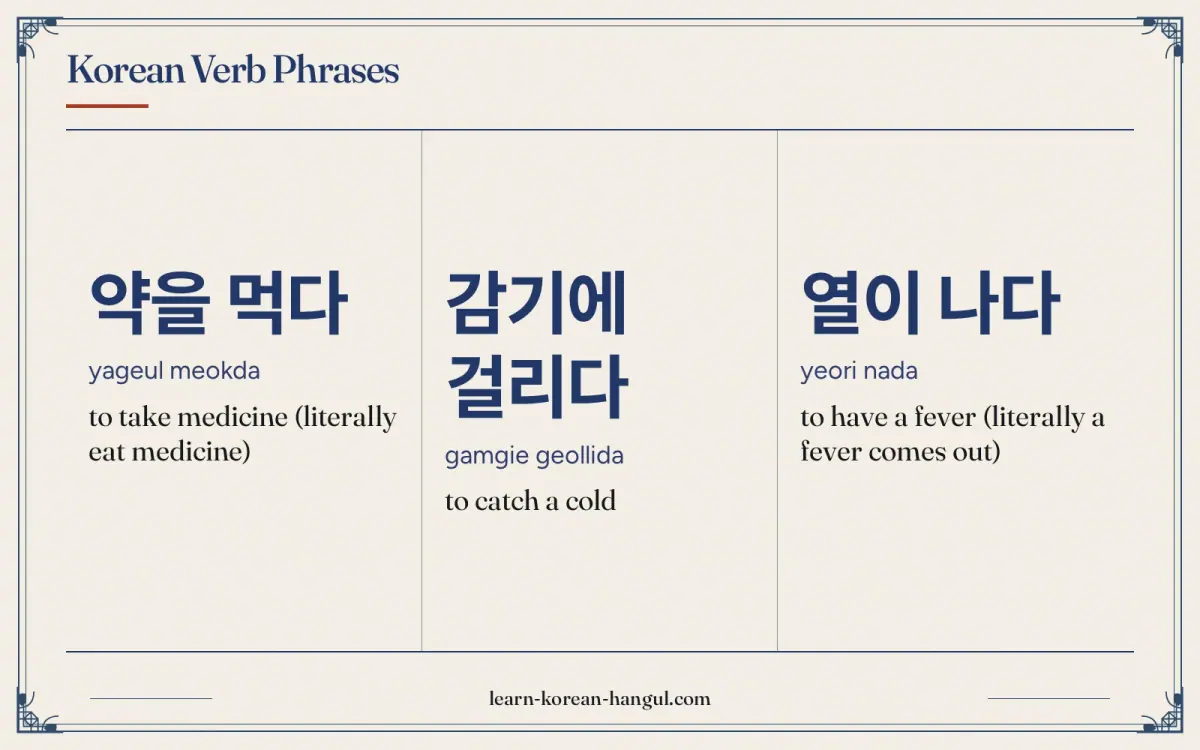
These phrases appear at the pharmacy, the clinic and in the bathroom. Three of the five take 을/를 as expected. The other two, 감기에 걸리다 and 열이 나다, put the illness or the symptom in a different slot, and you will see why below.
| # | Phrase | Revised Romanization | Meaning | Example sentence |
|---|---|---|---|---|
| 1 | 약을 먹다 | yageul meokda | to take medicine (literally eat medicine) | 하루에 세 번 약을 먹어요. (I take medicine three times a day.) |
| 2 | 감기에 걸리다 | gamgie geollida | to catch a cold | 어제 감기에 걸렸어요. (I caught a cold yesterday.) |
| 3 | 열이 나다 | yeori nada | to have a fever (literally a fever comes out) | 아이가 열이 나요. (The child has a fever.) |
| 4 | 주사를 맞다 | jusareul matda | to get a shot | 병원에서 주사를 맞아요. (I get a shot at the hospital.) |
| 5 | 이를 닦다 | ireul dakda | to brush your teeth (literally wipe your teeth) | 식사 후에 이를 닦아요. (I brush my teeth after meals.) |
The sound of 약을 is [야글]: the final ㄱ of 약 moves onto the vowel of 을. The phrase 열이 is said [여리] for the same reason, and 닦아요 is said [다까요]. Revised Romanization follows the linked sound: yageul, yeori, dakkayo. The next group is phones and media.
Phones, Photos and Media: Phrases 6 to 10
Technology phrases use verbs that picture an older action: you "hang" a call, "receive" it, "shoot" a photo and "see" a film.
| # | Phrase | Revised Romanization | Meaning | Example sentence |
|---|---|---|---|---|
| 6 | 전화를 걸다 | jeonhwareul geolda | to make a phone call (literally hang a call) | 친구에게 전화를 걸어요. (I call a friend.) |
| 7 | 전화를 받다 | jeonhwareul batda | to answer a phone call | 엄마 전화를 받아요. (I answer Mom's call.) |
| 8 | 사진을 찍다 | sajineul jjikda | to take a photo (literally stamp or hit a photo) | 여기에서 사진을 찍어요. (I take a photo here.) |
| 9 | 영화를 보다 | yeonghwareul boda | to watch a movie | 주말에 영화를 봐요. (I watch a movie on the weekend.) |
| 10 | 음악을 듣다 | eumageul deutda | to listen to music | 저는 매일 음악을 들어요. (I listen to music every day.) |
Weather and Traffic: Phrases 11 to 15
In this group the weather or the event is the subject, so the noun takes 이/가, not 을/를. Korean does not use a dummy subject like English "it" in "it rains".
| # | Phrase | Revised Romanization | Meaning | Example sentence |
|---|---|---|---|---|
| 11 | 비가 오다 | biga oda | to rain (literally rain comes) | 오늘은 비가 와요. (It is raining today.) |
| 12 | 눈이 오다 | nuni oda | to snow (literally snow comes) | 겨울에 눈이 와요. (It snows in winter.) |
| 13 | 바람이 불다 | barami bulda | for the wind to blow | 오늘은 바람이 불어요. (The wind is blowing today.) |
| 14 | 길이 막히다 | giri makida | for the road to be jammed | 퇴근 시간에는 길이 막혀요. (The roads are jammed at rush hour.) |
| 15 | 시간이 걸리다 | sigani geollida | for something to take time | 숙제는 시간이 많이 걸려요. (Homework takes a lot of time.) |
The ending of 막혀요 is said [마켜요]: ㄱ and ㅎ blend into ㅋ. 불어요 is [부러요], with the ㄹ moving to the next syllable. The ㄹ in 불다 and 걸다 drops before ㄴ, ㅂ and ㅅ: 바람이 부는 날 (a day when the wind blows) and 전화를 겁니다 (formal, I make a call).
Money, Time and Plans: Phrases 16 to 20
Here 내다, 쓰다, 잡다 and 보내다 are the verbs. 내다 means to put out, so you "put out" money and leave. 쓰다 here means to spend.
| # | Phrase | Revised Romanization | Meaning | Example sentence |
|---|---|---|---|---|
| 16 | 돈을 내다 | doneul naeda | to pay money | 카드로 돈을 내요. (I pay with a card.) |
| 17 | 돈을 쓰다 | doneul sseuda | to spend money | 쇼핑에 돈을 많이 써요. (I spend a lot of money on shopping.) |
| 18 | 휴가를 내다 | hyugareul naeda | to take time off (literally put out leave) | 다음 주에 휴가를 내요. (I take leave next week.) |
| 19 | 약속을 잡다 | yaksogeul japda | to make an appointment (literally grab a promise) | 친구와 약속을 잡아요. (I make plans with a friend.) |
| 20 | 시간을 보내다 | siganeul bonaeda | to spend time (with someone) | 가족과 시간을 보내요. (I spend time with my family.) |
Study and Work: Phrases 21 to 25
This group mixes 보다 with 하다 phrases. 하다 is a light verb in these phrases: it carries little meaning, and the noun carries the content. English picks "ask", "tell" or "have" here, and Korean uses 하다 for all of them.
| # | Phrase | Revised Romanization | Meaning | Example sentence |
|---|---|---|---|---|
| 21 | 시험을 보다 | siheomeul boda | to take an exam (literally see an exam) | 내일 한국어 시험을 봐요. (I take a Korean exam tomorrow.) |
| 22 | 질문을 하다 | jilmuneul hada | to ask a question | 선생님께 질문을 해요. (I ask the teacher a question.) |
| 23 | 회의를 하다 | hoeuireul hada | to have a meeting | 월요일에 회의를 해요. (We have a meeting on Monday.) |
| 24 | 아르바이트를 하다 | areubaiteureul hada | to work part-time | 저는 카페에서 아르바이트를 해요. (I work part-time at a café.) |
| 25 | 거짓말을 하다 | geojinmareul hada | to tell a lie | 저는 거짓말을 안 해요. (I don't tell lies.) |
Most 하다 phrases here can also be written without the particle, as one word: 질문하다, 회의하다, 거짓말하다. Both forms exist. The spaced form with 을/를 lets you add a word between noun and verb, as in 질문을 많이 해요 (I ask many questions). See Korean hada verbs explained for the attached form.
Everyday Actions: Phrases 26 to 30
These five phrases do not fit a theme, but each has a verb that English does not predict.
| # | Phrase | Revised Romanization | Meaning | Example sentence |
|---|---|---|---|---|
| 26 | 노래를 부르다 | noraereul bureuda | to sing a song (literally call a song) | 노래방에서 노래를 불러요. (I sing songs at the karaoke room.) |
| 27 | 꿈을 꾸다 | kkumeul kkuda | to have a dream (literally dream a dream) | 어젯밤에 이상한 꿈을 꿨어요. (Last night I had a strange dream.) |
| 28 | 우산을 쓰다 | usaneul sseuda | to use an umbrella (literally wear one over your head) | 비가 와서 우산을 써요. (It is raining, so I use an umbrella.) |
| 29 | 시계를 차다 | sigyereul chada | to wear a watch | 그는 매일 시계를 차요. (He wears a watch every day.) |
| 30 | 담배를 피우다 | dambaereul piuda | to smoke | 아버지는 담배를 안 피워요. (My father doesn't smoke.) |
Where Does Korean Use a Different Verb than English?
Three cases account for most of the surprises. Each one is a pattern, so you can predict new phrases once you see it.
Case 1: English "Take" Becomes Seven Different Verbs
English uses "take" for medicine, photos, exams, buses, time, showers and leave. Korean uses a different verb for each. The verb belongs to the noun, not to the idea of taking.
| English | Korean | Verb | Why |
|---|---|---|---|
| take medicine | 약을 먹어요 | 먹다 (eat) | Pills are "eaten" even though they are swallowed. |
| take a photo | 사진을 찍어요 | 찍다 (stamp) | The camera "stamps" the picture. |
| take an exam | 시험을 봐요 | 보다 (see) | You "see" the exam. |
| take a bus | 버스를 타요 | 타다 (ride) | See Korean transport verbs. |
| take time | 시간이 걸려요 | 걸리다 (hang, get caught) | Time is the subject, so it takes 이/가. |
| take a shower | 샤워를 해요 | 하다 (do) | A light verb with the noun 샤워. |
| take a day off | 휴가를 내요 | 내다 (put out) | You "put out" a request for leave. |
Case 2: Weather and Illness Make the Event the Subject
English says "It rains" with a dummy "it" and "I caught a cold" with "I" as the subject. Korean has no dummy subject and puts the weather, or a symptom such as a fever, in the subject slot with 이/가. Weather phrases are the cleanest: 비가 와요, 눈이 와요, 바람이 불어요. Illness phrases differ by symptom. A cold uses 에 with 걸리다, as if the cold were a hook that catches you: 감기에 걸렸어요. A fever uses 열이 나요, "the heat comes out". A headache and a stomach ache use the adjective 아프다: 머리가 아파요, 배가 아파요. The last two are adjectives, and they belong to another lesson.
감기에 걸렸어요.
gamgie geollyeosseoyo.
I caught a cold.
오늘은 비가 와요.
oneureun biga wayo.
It is raining today.
Case 3: 하다 Carries the Sentence and the Noun Carries the Meaning
English chooses "ask a question", "tell a lie", "have a meeting" and "work part-time". Korean uses 하다 with all four nouns: 질문을 해요, 거짓말을 해요, 회의를 해요, 아르바이트를 해요. 하다 is called a light verb in these phrases because it adds little meaning of its own. If you know the noun, you can often guess the phrase: a new noun such as 연락 (contact) or 전화 (call) will usually take 하다 too.
선생님께 질문을 해요.
seonsaengnimkke jilmuneul haeyo.
I ask the teacher a question.
저는 거짓말을 안 해요.
jeoneun geojinmareul an haeyo.
I don't tell lies.
Which of These Verbs Are Irregular?
Five verbs in the list change their stem. They are shown below with the polite present and the formal present, so you can see the change. Compare each with a regular verb such as 먹다 (먹어요, 먹습니다).
| Verb | Class | Polite present | Past | Formal present | Phrase |
|---|---|---|---|---|---|
| 쓰다 | ㅡ | 써요 | 썼어요 | 씁니다 | 우산을 쓰다 |
| 부르다 | 르 | 불러요 | 불렀어요 | 부릅니다 | 노래를 부르다 |
| 듣다 | ㄷ | 들어요 | 들었어요 | 듣습니다 | 음악을 듣다 |
| 걸다 | ㄹ | 걸어요 | 걸었어요 | 겁니다 | 전화를 걸다 |
| 불다 | ㄹ | 불어요 | 불었어요 | 붑니다 | 바람이 불다 |
쓰다 drops the ㅡ before -어 (써요, 썼어요). 부르다 doubles the ㄹ (불러요, 불렀어요). 듣다 changes ㄷ to ㄹ before a vowel (들어요). 걸다 and 불다 drop their ㄹ before ㄴ, ㅂ and ㅅ (겁니다, 붑니다). Read how to recognize irregular verbs for the pattern. The verbs in all the other phrases follow regular rules.
How Do You Learn Verb Phrases Fast?
Study the phrase, not the verb. A list of verbs gives you a meaning, and a list of phrases gives you a sentence. Use these four steps.
- Cover the verb. Read 약을 ___ and say 먹다. The noun and particle should call up the verb.
- Say the polite present aloud. Use the example sentences above and the audio buttons.
- Change one part. Replace the noun: 약을 먹어요 becomes 밥을 먹어요, and 전화를 받아요 becomes 문자를 받아요. Replace the tense: 먹었어요.
- Group by verb. 내다 gives 돈을 내다 and 휴가를 내다. 하다 gives 질문, 회의, 거짓말. A verb that appears twice is easier to remember.
A good target is five new phrases a day for six days. Each day, review the phrases from the day before. To practise the nouns, use the vocabulary flashcard decks.
What Mistakes Do Learners Make with Verb Phrases?
| Wrong | Right | Why |
|---|---|---|
| 약을 가져요 | 약을 먹어요 | "Take" is not 가지다 (to have). Medicine is eaten, 먹다. |
| 비를 와요 | 비가 와요 | Rain is the subject, so it takes 이/가. |
| 사진을 해요 | 사진을 찍어요 | English "take a photo" is not a 하다 phrase. |
| 감기를 걸려요 | 감기에 걸려요 | A cold uses 에, not 을/를. |
| 시험을 해요 | 시험을 봐요 | You take an exam with 보다, and 시험을 하다 is not the everyday phrase. |
The most common phrase errors are verb choices that come from English. Each fix in the table matches one of the three cases above. If an error does not match, check the dictionary page of the verb: 먹다, 보다, 걸리다 and 내다 all list the nouns they pair with.
Practice: Fill in the Blank
Fill each blank with the right verb from this lesson. Say the full sentence aloud when you have it. The answers follow the list.
- 저는 매일 아침에 이를 ___. (I brush my teeth every morning.)
- 주말에 친구하고 영화를 ___. (I watch a movie with a friend on the weekend.)
- 오늘은 비가 ___. (It is raining today.)
- 어제부터 열이 ___. (I have had a fever since yesterday.)
- 카페에서 사진을 ___. (I take a photo at the café.)
- 쇼핑에 돈을 많이 ___. (I spend a lot of money on shopping.)
- 선생님께 질문을 ___. (I ask the teacher a question.)
- 저는 노래방에서 노래를 ___. (I sing songs at the karaoke room.)
Answers: 1. 닦아요; 2. 봐요; 3. 와요; 4. 나요; 5. 찍어요; 6. 써요; 7. 해요; 8. 불러요.
Practice · 6
Which phrase means "to take medicine"?
Show answer
약을 먹어요
Pills are eaten, so the verb is 먹다.
Which sentence means "It is snowing"?
Show answer
눈이 와요
Snow is the subject, so it takes 이.
Which verb goes with 감기 (cold)?
Show answer
걸려요
A cold uses 감기에 걸리다.
Which phrase means "to take an exam"?
Show answer
시험을 봐요
You see (보다) an exam.
Which verb means "to make a phone call"?
Show answer
걸어요
전화를 걸다 means to make a call; 전화를 받다 means to answer one.
What is the polite present of 쓰다 in 우산을 쓰다?
Show answer
써요
쓰다 drops its ㅡ before -어: 써요.
What Should You Learn after Verb Phrases?
The next page is Korean hada verbs explained, which shows how a noun and 하다 combine into one verb, the largest group of Korean verbs. To check that you can use these phrases in a sentence, practise with the 100 most useful verbs in 100 Korean verbs, and review the set of wearing verbs in Korean wearing verbs, which has its own five-verb split.
What this page does not cover. It does not cover idioms such as 눈이 높다 (to have high standards), the adjective phrases for pain, or phrases with -고 있다. It also does not give the formal-speech forms for every phrase.
About this page. Last updated 2026-10-09. The Korean text and example sentences were drafted with AI assistance and cross-checked with the site's rule-based conjugation engine; a Korean reviewer checks every lesson before it is marked as reviewed.
Frequently Asked Questions
What Are Korean Verb Phrases?
Korean verb phrases are noun + particle + verb pairs that go together by habit, such as 사진을 찍다 (take a photo) and 비가 오다 (it rains). The verb is often different from the English one, so learn the whole phrase with its particle.
How Do You Say Take a Photo in Korean?
Say 사진을 찍다, and in the polite present 사진을 찍어요. 찍다 is the verb for taking a photo, stamping or printing. Do not use 하다 or 가지다 for this meaning.
Why Is It 감기에 걸리다 and Not 감기를 걸리다?
걸리다 is the verb for being caught or hooked, so the illness is the thing that catches you and takes 에. Korean says 감기에 걸렸어요 for "I caught a cold". It does not mark the cold as an object.
Does "It Rains" in Korean Use 비를 or 비가?
Use 비가. Rain is the thing that comes, so it takes the subject particle 이/가: 비가 와요. 비를 is used only when someone does something to the rain, as in 비를 맞다 (to get rained on).
Can I Drop the Particle in a Verb Phrase?
약 먹었어요 and 사진 찍었어요 are normal in casual speech, where 을/를 is often dropped. Keep the particle in writing and while you are learning, because it shows the noun's job. Never drop 이/가 or 에 in 비가 오다 or 감기에 걸리다 when you write.