Hanbok Vocabulary at a Glance
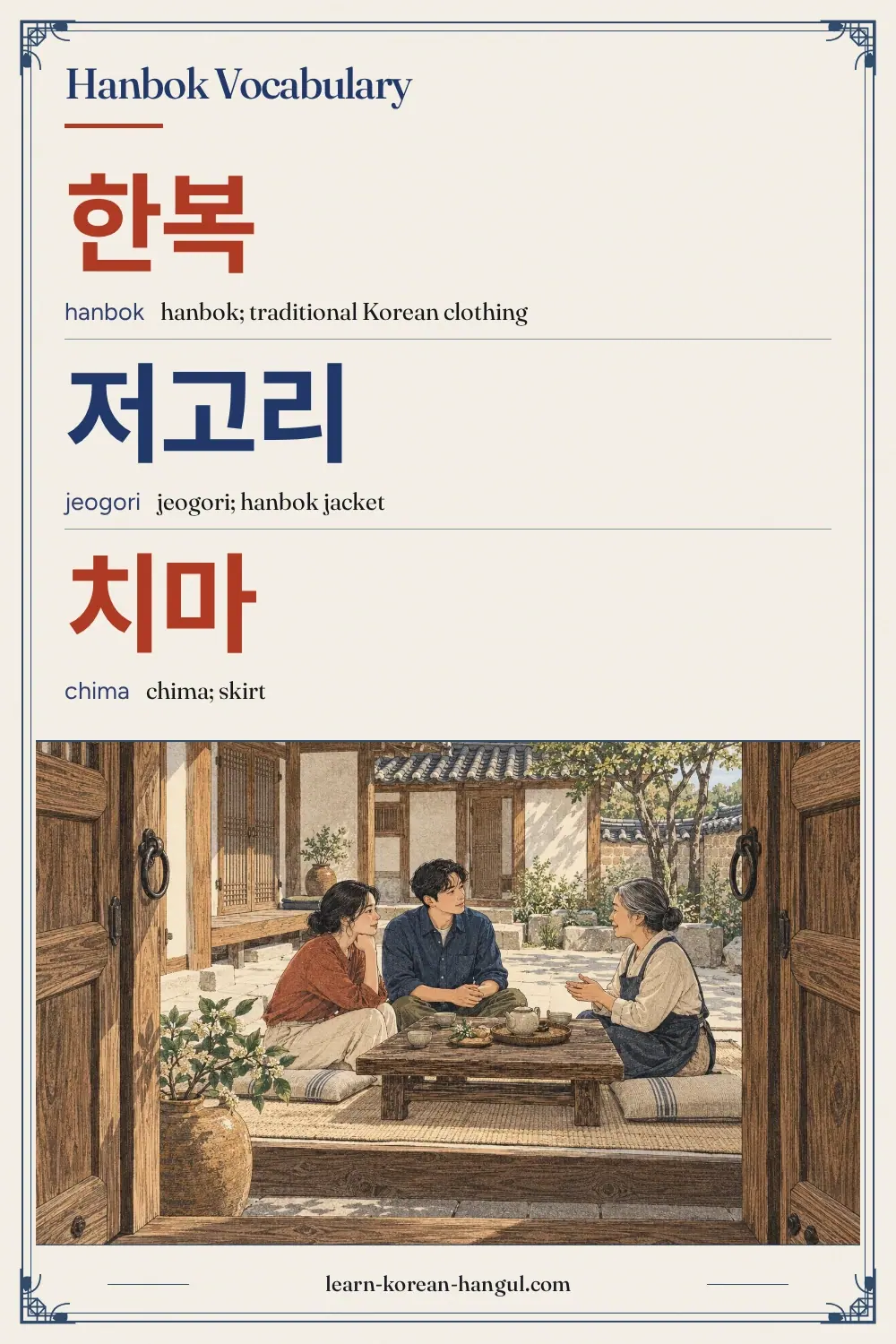
Hanbok vocabulary helps you name what you see at a palace, a wedding or a holiday dinner. A hanbok is made of separate pieces: a short jacket called 저고리 on top, and a skirt called 치마 for women or trousers called 바지 for men. Most piece names are native Korean words, which means they come from old Korean roots and not from Chinese characters. This page holds 30 words in five groups.
| Group | Words | Use |
|---|---|---|
| Women's hanbok | 7 | Naming the jacket, skirt and ties |
| Men's hanbok | 5 | Naming the trousers and overcoat |
| Accessories | 7 | Naming hats, shoes and hair ornaments |
| Fabrics and colors | 6 | Describing cloth and colors |
| Occasions and rental | 5 | Talking about when and where to wear hanbok |
The list belongs to Traditional Culture. If you want clothes for daily life, such as shirts and coats, see the clothing vocabulary list instead. The next section says where to start.
Which Hanbok Words Should You Learn First?
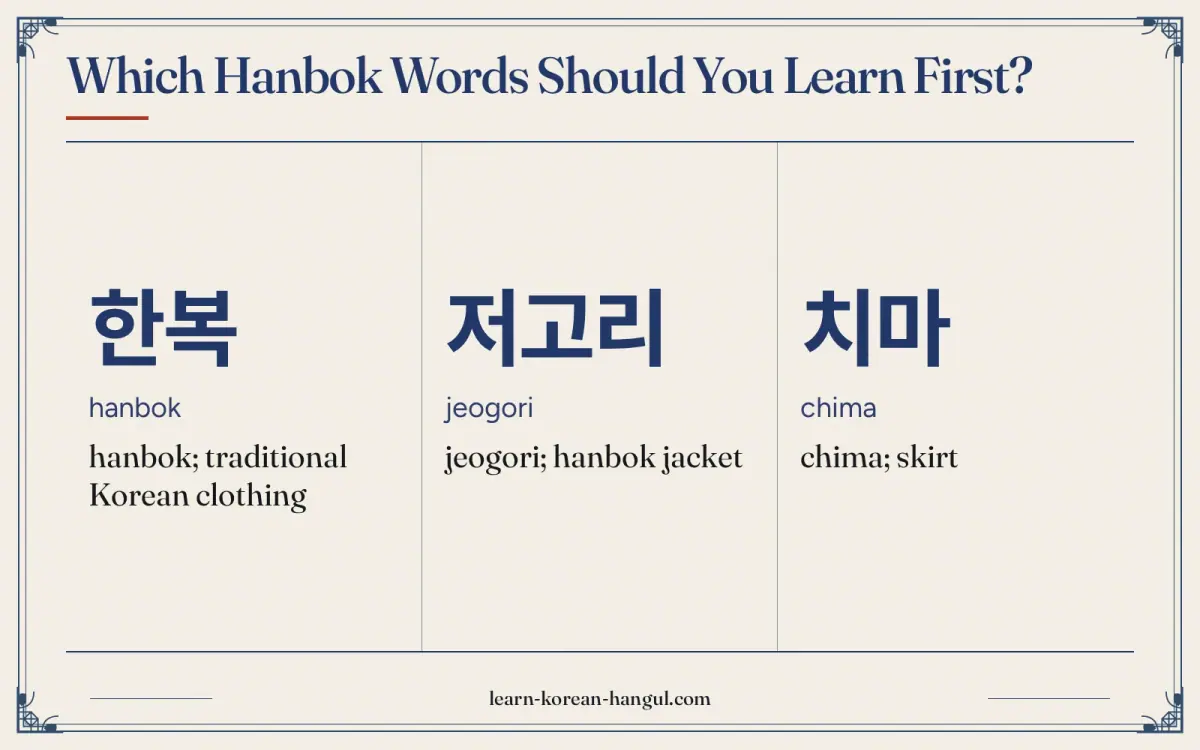
Learn 한복, 저고리, 치마 and 바지 first. They name the basic pieces and appear in almost every sentence about hanbok. After that, add the verbs you use with clothes and the words for the occasions.
- Day one. 한복, 저고리, 치마, 바지 and 고름.
- Day two. The men's pieces and the overcoat: 두루마기, 마고자 and 조끼.
- Day three. The accessories: 갓, 버선, 꽃신, 댕기, 비녀, 노리개 and 족두리.
- Day four. The fabrics, colors and occasion words, including 한복 대여.
At 8 to 10 words a day, the list takes three to four days plus review. This scene puts eight of the words on one picture.
Word · 8
- 1
한복
hanbok
hanbok; traditional Korean clothing
- 2
저고리
jeogori
jeogori; hanbok jacket
- 3
치마
chima
chima; skirt
- 4
바지
baji
baji; trousers
- 5
두루마기
durumagi
durumagi; long overcoat
- 6
갓
gat
gat; traditional horsehair hat
- 7
버선
beoseon
beoseon; padded traditional socks
- 8
노리개
norigae
norigae; hanging ornament for hanbok
By origin, the list has 6 Sino-Korean words, 20 native words, 1 loanword, 1 mixed word and 2 phrases. Native words such as 저고리, 치마 and 버선 name the pieces, and Sino-Korean words such as 비단 and 추석 come from Chinese-based vocabulary. The origin column in each table marks them. The first group is the one you use most.
Women's Hanbok
A woman's hanbok has a short 저고리 and a full 치마 that starts above the waist. The jacket closes with a ribbon-like tie called 고름, and under the skirt a woman wears an underskirt called 속치마. Modern designers also make 생활한복, an everyday style that is easier to wear on a normal day.
| No. | Hangul | Revised Romanization | Origin | Meaning | Example sentence | Audio assetId |
|---|---|---|---|---|---|---|
| 1 | 한복 | hanbok | Sino-Korean | hanbok; traditional Korean clothing | 설날에 한복을 입어요. (I wear hanbok at Seollal.) | au-pg-vocabulary-culture-traditional-hanbok-1; example: au-pg-vocabulary-culture-traditional-hanbok-31 |
| 2 | 저고리 | jeogori | native | jeogori; hanbok jacket | 저고리가 예뻐요. (The jeogori is pretty.) | au-pg-vocabulary-culture-traditional-hanbok-2; example: au-pg-vocabulary-culture-traditional-hanbok-32 |
| 3 | 치마 | chima | native | chima; skirt | 치마가 넓어요. (The skirt is wide.) | au-pg-vocabulary-culture-traditional-hanbok-3; example: au-pg-vocabulary-culture-traditional-hanbok-33 |
| 4 | 고름 | goreum | native | goreum; the ribbon ties of a jeogori | 고름을 예쁘게 매요. (I tie the goreum neatly.) | au-pg-vocabulary-culture-traditional-hanbok-4; example: au-pg-vocabulary-culture-traditional-hanbok-34 |
| 5 | 깃 | git | native | collar of a jacket | 깃이 목을 감싸요. (The collar wraps around the neck.) | au-pg-vocabulary-culture-traditional-hanbok-5; example: au-pg-vocabulary-culture-traditional-hanbok-35 |
| 6 | 속치마 | sokchima | native | underskirt; petticoat | 속치마를 먼저 입어요. (I put on the underskirt first.) | au-pg-vocabulary-culture-traditional-hanbok-6; example: au-pg-vocabulary-culture-traditional-hanbok-36 |
| 7 | 생활한복 | saenghwalhanbok | Sino-Korean | everyday hanbok; modern daily-wear hanbok | 생활한복은 편해요. (Everyday hanbok is comfortable.) | au-pg-vocabulary-culture-traditional-hanbok-7; example: au-pg-vocabulary-culture-traditional-hanbok-37 |
The word 한복 is a Sino-Korean compound: 한 (Korean) and 복 (clothing). Say 한복을 입어요 for put on hanbok, with the verb 입다 (wear on the body). Do not say 한복을 써요, because 쓰다 is for things on the head or face, such as a hat or glasses.
Example Sentences
Each example is a short polite sentence in the 해요 style. Most use the pattern object + 을/를 + verb, for example 한복을 입어요 (I wear hanbok). Use 을 after a final consonant and 를 after a vowel, so 저고리를 입어요 but 갓을 써요. Swap the noun to make your own sentence: 치마를 입어요 means I wear a skirt.
The group on accessories has the most verbs, because each item takes a different one. Read it with care. Fabrics and colors come next.
How Do You Say Men's Hanbok in Korean?
A man's hanbok has the same 저고리 on top and wide 바지 below. On special days he adds a 마고자 or a 조끼 over the jacket, and in the old days he wore a long coat called 두루마기 when going outside. The trousers are tied at the ankle with a band called 대님.
| No. | Hangul | Revised Romanization | Origin | Meaning | Example sentence | Audio assetId |
|---|---|---|---|---|---|---|
| 8 | 바지 | baji | native | baji; trousers | 바지가 헐렁해요. (The trousers are loose.) | au-pg-vocabulary-culture-traditional-hanbok-8; example: au-pg-vocabulary-culture-traditional-hanbok-38 |
| 9 | 두루마기 | durumagi | native | durumagi; long overcoat | 겨울에 두루마기를 입어요. (I wear a durumagi in winter.) | au-pg-vocabulary-culture-traditional-hanbok-9; example: au-pg-vocabulary-culture-traditional-hanbok-39 |
| 10 | 마고자 | magoja | Sino-Korean | magoja; jacket worn over the jeogori | 마고자는 저고리 위에 입어요. (A magoja is worn over the jeogori.) | au-pg-vocabulary-culture-traditional-hanbok-10; example: au-pg-vocabulary-culture-traditional-hanbok-40 |
| 11 | 조끼 | jokki | loanword | vest | 조끼는 소매가 없어요. (A vest has no sleeves.) | au-pg-vocabulary-culture-traditional-hanbok-11; example: au-pg-vocabulary-culture-traditional-hanbok-41 |
| 12 | 대님 | daenim | native | daenim; ties for the bottom of the trousers | 바지 아래에 대님을 매요. (I tie daenim around the bottom of the trousers.) | au-pg-vocabulary-culture-traditional-hanbok-12; example: au-pg-vocabulary-culture-traditional-hanbok-42 |
The word 바지 is the everyday word for trousers, not only for hanbok. In shops it is the same word you use for jeans, so 청바지 means jeans. The other words in this group are used almost only for hanbok.
Accessories
Accessories complete the outfit. Men wore a horsehair hat called 갓 with their robes, and both men and women wore padded socks called 버선. Women decorated their hair with a 댕기 or a 비녀, hung a 노리개 from the skirt string, and a bride wore a 족두리.
| No. | Hangul | Revised Romanization | Origin | Meaning | Example sentence | Audio assetId |
|---|---|---|---|---|---|---|
| 13 | 갓 | gat | native | gat; traditional horsehair hat | 갓을 써요. (I wear a gat.) | au-pg-vocabulary-culture-traditional-hanbok-13; example: au-pg-vocabulary-culture-traditional-hanbok-43 |
| 14 | 버선 | beoseon | native | beoseon; padded traditional socks | 버선을 신어요. (I put on beoseon.) | au-pg-vocabulary-culture-traditional-hanbok-14; example: au-pg-vocabulary-culture-traditional-hanbok-44 |
| 15 | 꽃신 | kkotsin | native | kkotsin; embroidered flower shoes | 꽃신이 예뻐요. (The flower shoes are pretty.) | au-pg-vocabulary-culture-traditional-hanbok-15; example: au-pg-vocabulary-culture-traditional-hanbok-45 |
| 16 | 댕기 | daenggi | native | daenggi; hair ribbon | 댕기를 머리에 달아요. (I tie a daenggi in my hair.) | au-pg-vocabulary-culture-traditional-hanbok-16; example: au-pg-vocabulary-culture-traditional-hanbok-46 |
| 17 | 비녀 | binyeo | native | binyeo; long hairpin | 비녀를 머리에 꽂아요. (I put a binyeo in my hair.) | au-pg-vocabulary-culture-traditional-hanbok-17; example: au-pg-vocabulary-culture-traditional-hanbok-47 |
| 18 | 노리개 | norigae | native | norigae; hanging ornament for hanbok | 노리개를 치마에 달아요. (I attach a norigae to the skirt.) | au-pg-vocabulary-culture-traditional-hanbok-18; example: au-pg-vocabulary-culture-traditional-hanbok-48 |
| 19 | 족두리 | jokduri | native | jokduri; small bridal crown | 신부가 족두리를 써요. (The bride wears a jokduri.) | au-pg-vocabulary-culture-traditional-hanbok-19; example: au-pg-vocabulary-culture-traditional-hanbok-49 |
Notice the verbs. You wear a hat with 쓰다 (갓을 써요), put on socks and shoes with 신다 (버선을 신어요), and attach a hanging ornament with 달다 (노리개를 달아요). Korean uses a different verb for each part of the body, and this is a good place to practise them.
How Do You Say Fabrics and Colors in Korean?
Traditional hanbok used natural fabrics chosen for the season. 비단 (silk) was for formal wear, 모시 (ramie) and 삼베 (hemp cloth) were for summer because they are thin and cool. For children, a jacket with 색동 sleeves added bright stripes. The general word for cloth is 옷감.
| No. | Hangul | Revised Romanization | Origin | Meaning | Example sentence | Audio assetId |
|---|---|---|---|---|---|---|
| 20 | 비단 | bidan | Sino-Korean | bidan; silk | 비단은 부드러워요. (Silk is soft.) | au-pg-vocabulary-culture-traditional-hanbok-20; example: au-pg-vocabulary-culture-traditional-hanbok-50 |
| 21 | 모시 | mosi | native | mosi; ramie, a light summer cloth | 여름에는 모시 한복을 입어요. (In summer people wear ramie hanbok.) | au-pg-vocabulary-culture-traditional-hanbok-21; example: au-pg-vocabulary-culture-traditional-hanbok-51 |
| 22 | 삼베 | sambe | native | sambe; hemp cloth | 삼베는 시원해요. (Hemp cloth is cool.) | au-pg-vocabulary-culture-traditional-hanbok-22; example: au-pg-vocabulary-culture-traditional-hanbok-52 |
| 23 | 색동 | saekdong | mixed | saekdong; rainbow stripes on sleeves | 아이 한복에는 색동 소매가 있어요. (A child's hanbok has rainbow-striped sleeves.) | au-pg-vocabulary-culture-traditional-hanbok-23; example: au-pg-vocabulary-culture-traditional-hanbok-53 |
| 24 | 옷감 | otgam | native | fabric; cloth | 옷감을 시장에서 사요. (I buy fabric at the market.) | au-pg-vocabulary-culture-traditional-hanbok-24; example: au-pg-vocabulary-culture-traditional-hanbok-54 |
| 25 | 분홍색 | bunhongsaek | Sino-Korean | pink | 분홍색 치마가 예뻐요. (The pink skirt is pretty.) | au-pg-vocabulary-culture-traditional-hanbok-25; example: au-pg-vocabulary-culture-traditional-hanbok-55 |
Hanbok colors often have meaning. Bright red and pink skirts are common for young women, and the five-color 색동 stripes are traditionally used on children's clothes. The word for color is 색, and it is added to the name of the color, as in 분홍색. For more color words, see the color list in the daily-life section.
Occasions and Rental
Koreans wear hanbok on big family days, such as 설날 and 추석, at a 돌잔치 for a baby's first birthday, and at weddings. Visitors to Seoul often rent hanbok for a day. The phrase for renting is 한복 대여, and many palaces have offered free entry to visitors in hanbok, which is called 무료 입장.
| No. | Hangul | Revised Romanization | Origin | Meaning | Example sentence | Audio assetId |
|---|---|---|---|---|---|---|
| 26 | 설날 | seollal | native | Seollal; Lunar New Year's Day | 설날에 가족이 모여요. (The family gathers at Seollal.) | au-pg-vocabulary-culture-traditional-hanbok-26; example: au-pg-vocabulary-culture-traditional-hanbok-56 |
| 27 | 추석 | chuseok | Sino-Korean | Chuseok; the autumn harvest holiday | 추석에 한복을 입는 사람도 있어요. (Some people wear hanbok at Chuseok.) | au-pg-vocabulary-culture-traditional-hanbok-27; example: au-pg-vocabulary-culture-traditional-hanbok-57 |
| 28 | 돌잔치 | doljanchi | native | doljanchi; first-birthday party | 아기의 돌잔치에서 한복을 입어요. (At the baby's doljanchi, people wear hanbok.) | au-pg-vocabulary-culture-traditional-hanbok-28; example: au-pg-vocabulary-culture-traditional-hanbok-58 |
| 29 | 한복 대여 | hanbok daeyeo | phrase | hanbok rental | 경복궁 앞에 한복 대여 가게가 있어요. (There is a hanbok rental shop in front of Gyeongbokgung.) | au-pg-vocabulary-culture-traditional-hanbok-29; example: au-pg-vocabulary-culture-traditional-hanbok-59 |
| 30 | 무료 입장 | muryo ipjang | phrase | free admission | 오늘은 무료 입장이에요. (Admission is free today.) | au-pg-vocabulary-culture-traditional-hanbok-30; example: au-pg-vocabulary-culture-traditional-hanbok-60 |
Rental shops near the Seoul palaces often have signs with 한복 대여, and the palaces post their current rules for visitors in hanbok. Free entry rules can change, so check the official website of each palace before you go.
How Do You Pronounce These Words?
Most of these words are said as they are spelled, but several change in speech. The table lists the ones that learners most often miss.
| Spelling | Pronunciation | What happens |
|---|---|---|
| 꽃신 | [꼳씬] | The final ㅊ is said as ㄷ, and the ㅅ that follows becomes tense |
| 옷감 | [옫깜] | The final ㅅ is said as ㄷ, and ㄱ after it becomes tense |
| 분홍색 | [분홍색] | Each syllable is said clearly, with the final ㅇ as ng |
| 색동 | [색똥] | The ㄷ after a final ㄱ becomes a tense ㄸ |
| 설날 | [설랄] | ㄴ after ㄹ is said as ㄹ, so the middle sounds like ll |
| 족두리 | [족뚜리] | The ㄷ after a final ㄱ becomes a tense ㄸ |
| 무료 입장 | [무료 입짱] | The ㅈ after a final ㅂ becomes tense; the two words are said one after the other |
The rules come from the Standard Pronunciation rules (표준 발음법) of the 국립국어원.
Audio and Slow Playback
Each word has a normal clip, and 5 key words also have a slow clip at 0.8 times the speed: 저고리, 두루마기, 꽃신, 노리개 and 색동. Nothing plays until you press a button.
Listen to 꽃신 first. You should hear the first syllable end in a short, closed t, and then a sharp, tense s at the start of the second syllable.
What Mistakes Do Learners Make with Hanbok Words?
- Using 쓰다 for the whole outfit. Say 한복을 입어요 for wearing hanbok, and keep 쓰다 for the 갓 and 족두리.
- Calling the jacket 한복. 한복 is the whole outfit, while the jacket is the 저고리.
- Calling the skirt 바지, or the trousers 치마. A woman's hanbok has a 치마, and a man's has a 바지.
- Writing 한복 대여 without a space. It is two words, a noun plus a noun.
- Reading 꽃신 as kko-chi-sin. The spoken form is [꼳씬], with a stop sound at the end of the first syllable.
The first two mistakes change the meaning, and the others only change how natural you sound. The next section turns the list into practice.
Practice: Flashcards and Worksheet
Drill these words with the vocabulary flashcard decks. A printable worksheet for these words (word list, matching, writing practice, fill-in-the-blank exercises and answer key) is available in A4 and US Letter from the download card on this page. Progress in the decks is saved only in your browser.
Hanbok Vocabulary Worksheet
Try this five-question check, then say the 30 words aloud once more.
Practice · 5
What does 한복 mean?
Show answer
hanbok; traditional Korean clothing
한복 (hanbok) means hanbok; traditional Korean clothing.
What does 저고리 mean?
Show answer
jeogori; hanbok jacket
저고리 (jeogori) means jeogori; hanbok jacket.
What does 버선 mean?
Show answer
beoseon; padded traditional socks
버선 (beoseon) means beoseon; padded traditional socks.
What does 비단 mean?
Show answer
bidan; silk
비단 (bidan) means bidan; silk.
What does 한복 대여 mean?
Show answer
hanbok rental
한복 대여 (hanbok daeyeo) means hanbok rental.
For a plain-clothes list, use the clothing vocabulary page. For one word at a time, see hanbok in Korean and traditional clothing in Korean.
Where to Go Next
This list sits inside Traditional Culture. After Hanbok vocabulary, many learners move on to Hanok and Ondol Vocabulary for the traditional house, or to Korean Palaces and History Vocabulary, where many visitors wear hanbok.
Frequently Asked Questions
How Do You Say Hanbok in Korean?
Hanbok is 한복 (hanbok), and it means traditional Korean clothing. The word is the same in Korean and English. To say you wear it, use 한복을 입어요 (hanbogeul ibeoyo), which means I wear hanbok. The jacket is 저고리, and the skirt is 치마. Press the audio button to hear the word.
How Do You Pronounce 저고리 (jeogori)?
저고리 is said jeo-go-ri, in three even beats. The first vowel ㅓ is made with unrounded lips, and the second syllable 고 has a rounded ㅗ. The ㄱ in the middle is soft, between two vowels. The ㄹ is a light tap of the tongue. Use the slow clip to match the rhythm.
How Many Hanbok Words Should I Learn First?
Learn five first: 한복, 저고리, 치마, 바지 and 입다. That takes one day. Next add the accessories, the fabrics and the occasion words. The whole list of 30 takes three to four days at 8 to 10 words a day, with review on the fifth day.
Where Can I Practise Hanbok Words with Flashcards?
Use the traditional Korean culture words flashcards, a 29-card deck with audio that includes 한복, 저고리 and 갓. A deck for the full hanbok list is not available yet. Progress stays in your browser. The clothing vocabulary list covers everyday clothes, so review it together with this page to keep traditional and modern clothing words apart.
Is the Romanization on This Page Official?
It follows the Revised Romanization of Korean, which South Korea officially adopted on 7 July 2000 and whose rules the National Institute of Korean Language (국립국어원) publishes. It is a learning aid that does not mark every sound change, so learn the Hangul and use the audio to hear the real sound.
Is There a Printable Worksheet for Hanbok Words?
A printable worksheet for these words (word list, matching, writing practice, fill-in-the-blank exercises and answer key) is available in A4 and US Letter from the download card on this page. For practice, copy the tables above by hand: write the Hangul, cover the English column, and check your answers against the page.