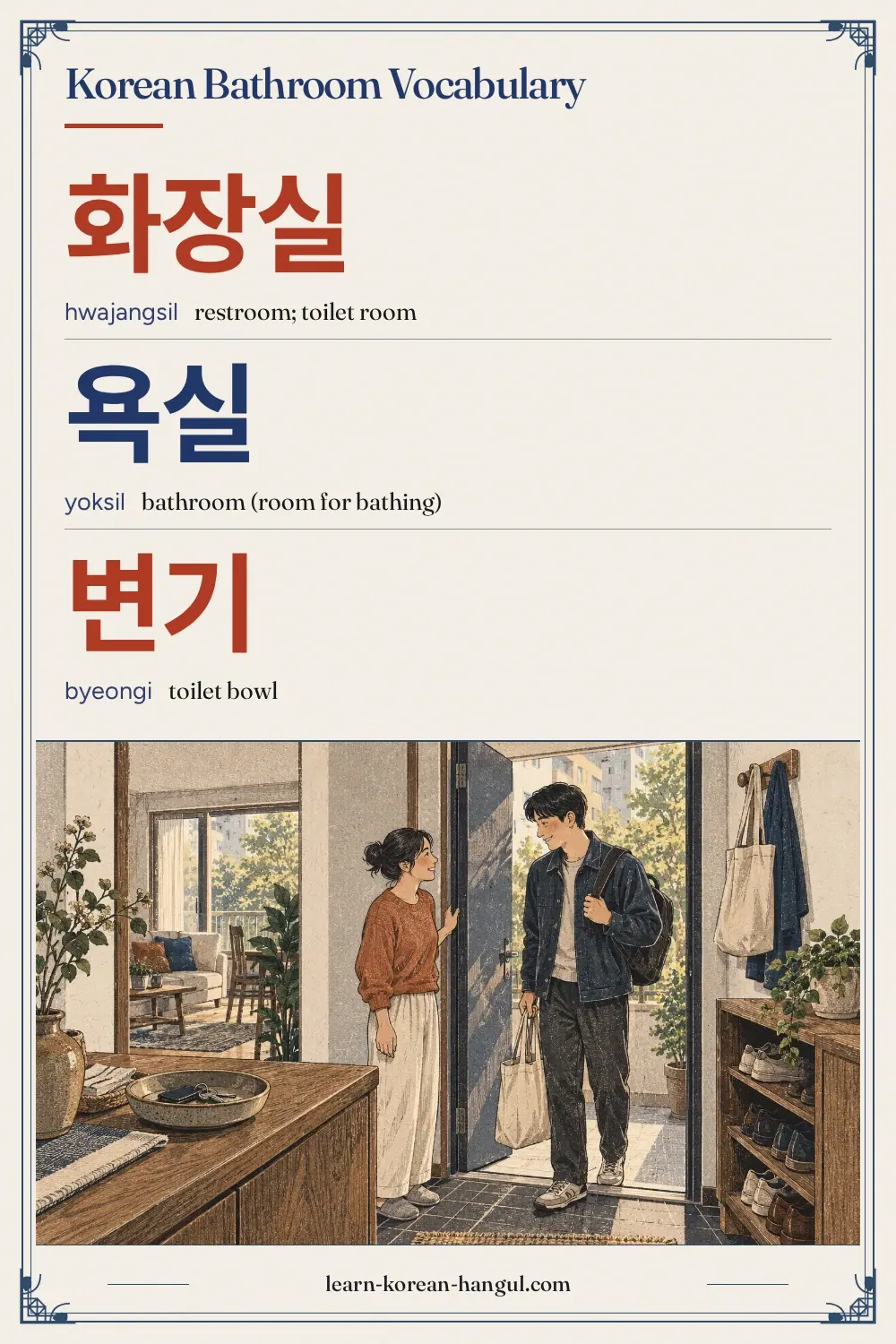
Korean Bathroom Vocabulary at a Glance
This list has 30 words in five groups of six. It covers the fixtures in a bathroom, the toiletries on the shelf, the cloths and bins, the polite sentences for asking where a restroom is and the words for public restrooms. It belongs to House and Home. Many words are loanwords, so you can read most toiletry labels the day you learn Hangul.
| Group | Words | Use |
|---|---|---|
| Bathroom fixtures | 6 | Naming the things in a bathroom |
| Toiletries | 6 | Naming washing and grooming products |
| Cleaning and laundry items | 6 | Cloths, bins and baskets in the bathroom |
| Polite ways to ask | 6 | Asking for and finding a restroom |
| Public restrooms | 6 | Understanding features in public restrooms |
The group on polite requests is the one that helps travellers most. The next section ranks all 30 words by how soon you will need them.
Which Bathroom Words Should You Learn First?
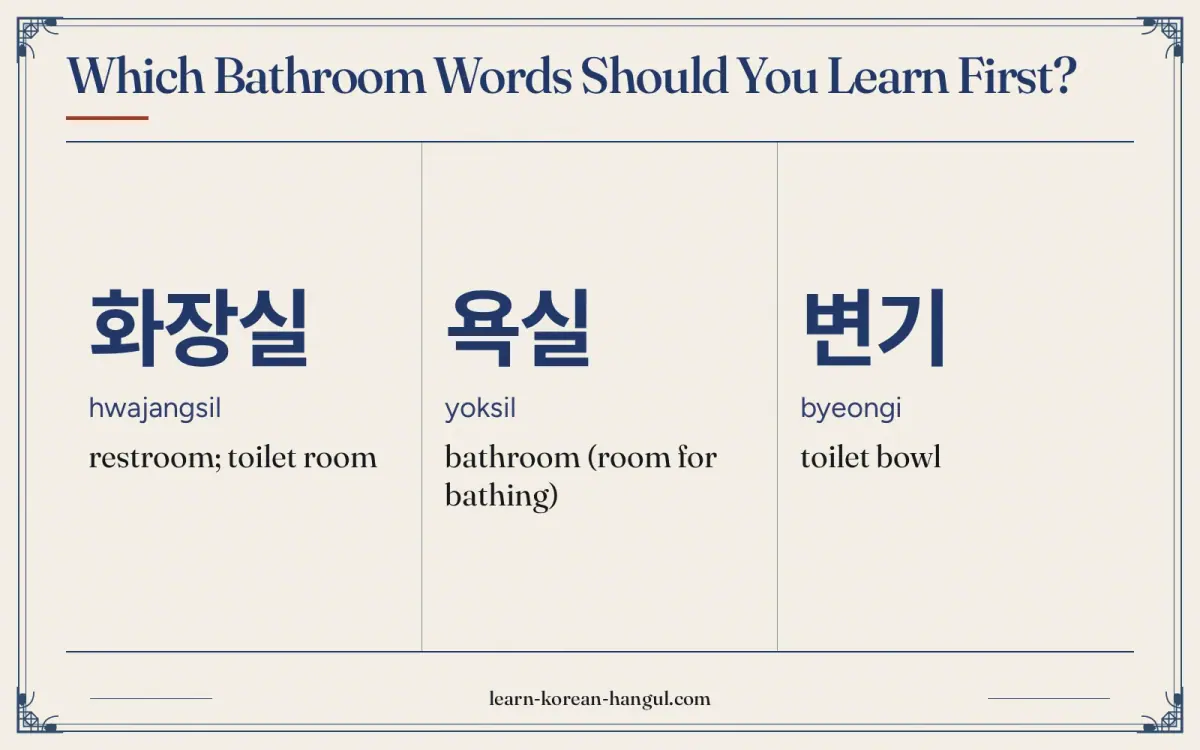
Learn 화장실 (restroom), 어디예요 (where is it), 휴지 (toilet paper), 수건 (towel) and 비누 (soap) first. They let you find a restroom, notice that the paper is missing and ask for a towel or soap. Then add the fixtures you see in a guesthouse bathroom, such as 샤워기 and 세면대.
- Words to say. 화장실, 휴지, 수건, 비누, 칫솔. Use these to ask and to request.
- Words to recognise. 사용 중, 비어 있어요, 남자, 여자, 휴지통. These appear on doors and signs.
- Words to match to products. 샴푸, 린스, 바디워시, 치약. These are loanwords or short words on the labels.
Three words for the bathroom need a clear split. 화장실 is the restroom you ask for in public, and it is also the everyday word for the toilet room at home. 욕실 is the room for bathing, and it names the room in a house plan or a hotel listing. 세면대 is the washbasin. The scene below shows a bathroom with numbered objects that match the list.
Word · 10
- 1
화장실
hwajangsil
restroom; toilet room
- 2
욕실
yoksil
bathroom (room for bathing)
- 3
변기
byeongi
toilet bowl
- 4
세면대
semyeondae
washbasin
- 5
욕조
yokjo
bathtub
- 6
샤워기
syawogi
shower head
- 7
비누
binu
soap
- 8
샴푸
syampu
shampoo
- 9
수건
sugeon
towel
- 10
휴지
hyuji
toilet paper; tissue
Bathroom Fixtures
Fixtures are the permanent parts of a bathroom. 변기 is the toilet bowl, 세면대 is the washbasin, 욕조 is the bathtub and 샤워기 is the shower head. Many Korean homes have no separate bathtub, just a shower on the wall and a floor drain, so 욕조 is not always present. The Sino-Korean words end in 대 (stand), 조 (tub) or 기 (device).
| No. | Hangul | Revised Romanization | Meaning and note | Example sentence | Audio assetId |
|---|---|---|---|---|---|
| 1 | 화장실 | hwajangsil | restroom; toilet room. Use this in shops, cafes and stations. | 화장실은 어디예요? (Where is the restroom?) | au-pg-vocabulary-daily-life-home-bathroom-1; example: au-pg-vocabulary-daily-life-home-bathroom-31 |
| 2 | 욕실 | yoksil | bathroom (room for bathing). Said [욕씰]; used in house plans. | 욕실이 깨끗해요. (The bathroom is clean.) | au-pg-vocabulary-daily-life-home-bathroom-2; example: au-pg-vocabulary-daily-life-home-bathroom-32 |
| 3 | 변기 | byeongi | toilet bowl. 막히다 means to be blocked. | 변기가 막혔어요. (The toilet is blocked.) | au-pg-vocabulary-daily-life-home-bathroom-3; example: au-pg-vocabulary-daily-life-home-bathroom-33 |
| 4 | 세면대 | semyeondae | washbasin. 씻다 means to wash. | 세면대에서 손을 씻어요. (I wash my hands at the washbasin.) | au-pg-vocabulary-daily-life-home-bathroom-4; example: au-pg-vocabulary-daily-life-home-bathroom-34 |
| 5 | 욕조 | yokjo | bathtub. 받다 means to collect. | 욕조에 물을 받아요. (I fill the bathtub with water.) | au-pg-vocabulary-daily-life-home-bathroom-5; example: au-pg-vocabulary-daily-life-home-bathroom-35 |
| 6 | 샤워기 | syawogi | shower head. 샤워 is the act of showering. | 샤워기가 고장 났어요. (The shower head is broken.) | au-pg-vocabulary-daily-life-home-bathroom-6; example: au-pg-vocabulary-daily-life-home-bathroom-36 |
Notice that 막혔어요 is a past form used for a present state. The toilet was blocked and still is, so Korean uses the past tense to say it is blocked now. The same pattern appears in 고장 났어요, it broke down.
Example Sentences
Three frames carry the examples. The first is noun + 이/가 어디예요? (where is the noun?), as in 화장실이 어디예요?. The second is noun + 이/가 없어요 (there is no noun), as in 휴지가 없어요. The third is noun + 주세요 (please give me noun), as in 수건 주세요. Say each sentence aloud after the audio, then swap in another word. 이 follows a consonant (화장실이) and 가 follows a vowel (샴푸가).
How Do You Say Toiletries in Korean?
Most toiletry names are loanwords, which makes them easy to read. 샴푸 is shampoo, 린스 is conditioner and 바디워시 is body wash, all copied from English. Two native or Sino-Korean words stand out: 비누 is soap and 치약 is toothpaste. 칫솔 is the toothbrush. 치 (teeth) appears in both 치약 and 칫솔.
| No. | Hangul | Revised Romanization | Meaning and note | Example sentence | Audio assetId |
|---|---|---|---|---|---|
| 7 | 비누 | binu | soap. 로 marks the tool you use. | 비누로 손을 씻어요. (I wash my hands with soap.) | au-pg-vocabulary-daily-life-home-bathroom-7; example: au-pg-vocabulary-daily-life-home-bathroom-37 |
| 8 | 샴푸 | syampu | shampoo. Loanword. | 샴푸가 없어요. (There is no shampoo.) | au-pg-vocabulary-daily-life-home-bathroom-8; example: au-pg-vocabulary-daily-life-home-bathroom-38 |
| 9 | 린스 | rinseu | conditioner. 도 means also. | 린스도 주세요. (Please give me conditioner too.) | au-pg-vocabulary-daily-life-home-bathroom-9; example: au-pg-vocabulary-daily-life-home-bathroom-39 |
| 10 | 바디워시 | badiwosi | body wash. Loanword; the standard spelling is 보디워시, but labels use 바디워시. | 바디워시를 써요. (I use body wash.) | au-pg-vocabulary-daily-life-home-bathroom-10; example: au-pg-vocabulary-daily-life-home-bathroom-40 |
| 11 | 치약 | chiyak | toothpaste. 떨어지다 means to run out. | 치약이 떨어졌어요. (The toothpaste has run out.) | au-pg-vocabulary-daily-life-home-bathroom-11; example: au-pg-vocabulary-daily-life-home-bathroom-41 |
| 12 | 칫솔 | chitsol | toothbrush. Said [치쏠]. | 칫솔을 사요. (I buy a toothbrush.) | au-pg-vocabulary-daily-life-home-bathroom-12; example: au-pg-vocabulary-daily-life-home-bathroom-42 |
In Korea, guesthouses and cheap hotels often supply a small set of 칫솔 and 치약 only on request, and some offer them at the front desk. Ask 칫솔 있어요? (do you have a toothbrush?). Both words appear in the bathroom in Korean word page.
Cleaning and Laundry Items
This group covers the things that dry you, hold waste or help you clean. A 수건 is a towel, and a 걸레 is a cleaning cloth. A 휴지 is toilet paper, and a 휴지통 is the bin where used paper goes. A 슬리퍼 is the bathroom slipper, which Koreans often wear on a wet floor. A 빨래 바구니 is a laundry basket.
| No. | Hangul | Revised Romanization | Meaning and note | Example sentence | Audio assetId |
|---|---|---|---|---|---|
| 13 | 수건 | sugeon | towel. Ask for it at a guesthouse desk. | 수건 주세요. (A towel, please.) | au-pg-vocabulary-daily-life-home-bathroom-13; example: au-pg-vocabulary-daily-life-home-bathroom-43 |
| 14 | 휴지 | hyuji | toilet paper; tissue. Also the word for tissues. | 휴지가 없어요. (There is no toilet paper.) | au-pg-vocabulary-daily-life-home-bathroom-14; example: au-pg-vocabulary-daily-life-home-bathroom-44 |
| 15 | 휴지통 | hyujitong | wastebasket (for used paper). 버리다 means to throw away. | 휴지통에 버려요. (I throw it in the wastebasket.) | au-pg-vocabulary-daily-life-home-bathroom-15; example: au-pg-vocabulary-daily-life-home-bathroom-45 |
| 16 | 걸레 | geolle | cleaning cloth. 닦다 means to wipe. | 걸레로 닦아요. (I wipe with a cloth.) | au-pg-vocabulary-daily-life-home-bathroom-16; example: au-pg-vocabulary-daily-life-home-bathroom-46 |
| 17 | 빨래 바구니 | ppallae baguni | laundry basket. Written as two words. | 빨래 바구니에 넣어요. (I put it in the laundry basket.) | au-pg-vocabulary-daily-life-home-bathroom-17; example: au-pg-vocabulary-daily-life-home-bathroom-47 |
| 18 | 슬리퍼 | seullipeo | slippers. 신다 is for shoes and slippers. | 슬리퍼를 신어요. (I wear slippers.) | au-pg-vocabulary-daily-life-home-bathroom-18; example: au-pg-vocabulary-daily-life-home-bathroom-48 |
In some older buildings and some public restrooms a sign asks users to put used paper in the bin and not in the toilet. If you see a bin beside the toilet, follow the sign. The word 휴지통 is the one on that sign. Treat this as a local convention to check on the spot.
How Do You Say Polite Ways to Ask for the Bathroom in Korean?
To ask for a restroom, say 화장실이 어디예요? (where is the restroom?). To ask permission to use one in a shop, say 화장실 좀 써도 돼요?, which means may I use the restroom? The word 좀 softens a request, like please or a little. On the door itself, 사용 중 means in use and 비어 있어요 means it is vacant.
| No. | Hangul | Revised Romanization | Meaning and note | Example sentence | Audio assetId |
|---|---|---|---|---|---|
| 19 | 화장실 좀 써도 돼요? | hwajangsil jom sseodo dwaeyo? | may I use the restroom? A polite request in a shop. | 실례합니다, 화장실 좀 써도 돼요? (Excuse me, may I use the restroom?) | au-pg-vocabulary-daily-life-home-bathroom-19; example: au-pg-vocabulary-daily-life-home-bathroom-49 |
| 20 | 어디예요 | eodiyeyo | where is it. Noun + 이/가 어디예요. | 화장실이 어디예요? (Where is the restroom?) | au-pg-vocabulary-daily-life-home-bathroom-20; example: au-pg-vocabulary-daily-life-home-bathroom-50 |
| 21 | 사용 중 | sayong jung | in use. Seen on doors. | 사용 중이에요. (It is in use.) | au-pg-vocabulary-daily-life-home-bathroom-21; example: au-pg-vocabulary-daily-life-home-bathroom-51 |
| 22 | 비어 있어요 | bieo isseoyo | it is vacant. Said [비어 이써요]. | 화장실이 비어 있어요. (The restroom is vacant.) | au-pg-vocabulary-daily-life-home-bathroom-22; example: au-pg-vocabulary-daily-life-home-bathroom-52 |
| 23 | 남자 화장실 | namja hwajangsil | men’s restroom. 남자 means man. | 남자 화장실은 왼쪽이에요. (The men’s restroom is on the left.) | au-pg-vocabulary-daily-life-home-bathroom-23; example: au-pg-vocabulary-daily-life-home-bathroom-53 |
| 24 | 여자 화장실 | yeoja hwajangsil | women’s restroom. 여자 means woman. | 여자 화장실은 오른쪽이에요. (The women’s restroom is on the right.) | au-pg-vocabulary-daily-life-home-bathroom-24; example: au-pg-vocabulary-daily-life-home-bathroom-54 |
You can often get by with only the word 화장실? and a questioning tone, but the full sentence is more polite. For other travel sentences, see the travel phrases. Also learn the two signs 남자 and 여자 by sight, since pictures on doors are not always clear.
Public Restrooms
Public restrooms in Korean stations, parks and shopping centres are usually free and clean. A 공중화장실 is a public restroom, 장애인 화장실 is an accessible restroom and 수유실 is a nursing room. Newer restrooms often add a 비데 (bidet seat) and a 손 건조기 (hand dryer). 화장지 is the more formal word for toilet paper, used on packaging and signs.
| No. | Hangul | Revised Romanization | Meaning and note | Example sentence | Audio assetId |
|---|---|---|---|---|---|
| 25 | 공중화장실 | gongjunghwajangsil | public restroom. 공중 means the public. | 공중화장실이 근처에 있어요. (There is a public restroom nearby.) | au-pg-vocabulary-daily-life-home-bathroom-25; example: au-pg-vocabulary-daily-life-home-bathroom-55 |
| 26 | 비데 | bide | bidet seat. Common in newer buildings. | 비데가 있어요. (There is a bidet seat.) | au-pg-vocabulary-daily-life-home-bathroom-26; example: au-pg-vocabulary-daily-life-home-bathroom-56 |
| 27 | 장애인 화장실 | jangaein hwajangsil | accessible restroom. 장애인 means a person with a disability. | 장애인 화장실은 일 층에 있어요. (The accessible restroom is on the first floor.) | au-pg-vocabulary-daily-life-home-bathroom-27; example: au-pg-vocabulary-daily-life-home-bathroom-57 |
| 28 | 수유실 | suyusil | nursing room. 수유 means breastfeeding. | 수유실이 있어요. (There is a nursing room.) | au-pg-vocabulary-daily-life-home-bathroom-28; example: au-pg-vocabulary-daily-life-home-bathroom-58 |
| 29 | 손 건조기 | son geonjogi | hand dryer. 손 means hand. | 손 건조기가 있어요. (There is a hand dryer.) | au-pg-vocabulary-daily-life-home-bathroom-29; example: au-pg-vocabulary-daily-life-home-bathroom-59 |
| 30 | 화장지 | hwajangji | toilet paper (formal). Formal word, same as 휴지. | 화장지가 없어요. (There is no toilet paper.) | au-pg-vocabulary-daily-life-home-bathroom-30; example: au-pg-vocabulary-daily-life-home-bathroom-60 |
How Do You Pronounce These Words?
Bathroom words contain tense sounds and linking. Standard pronunciation follows the National Institute of Korean Language (국립국어원) rules, and the romanization follows the Revised Romanization of Korean, which does not mark every sound change.
| Spelling | Sounds like | What changes |
|---|---|---|
| 욕실 | [욕씰] | After a final ㄱ, the ㅅ is said as a tense [ㅆ]. |
| 칫솔 | [치쏠] | The ㅅ written between the two parts (사이시옷) makes the next ㅅ tense; [칟쏠] is also allowed. |
| 비어 있어요 | [비어 이써요] | The final ㅆ of 있 links to the vowel of 어. |
| 휴지통 | [휴지통] | No change; ㅌ stays aspirated. |
| 좀 써도 | [좀 써도] | No change; the ㅆ is already a tense sound. |
The tense ㅆ in 욕실 and 칫솔 is the sound to practise. Say it with a tight throat and no breath, then compare it with the plain ㅅ in 수건. The pronunciation pages of this site explain the difference in detail.
Audio and Slow Playback
Each word and sentence has its own clip. The five clips below replay the hardest words slowly. Play one, repeat it aloud, then play it again and compare.
What Mistakes Do Learners Make with Bathroom Words?
Five mistakes come up again and again.
- Asking for 욕실 in a shop. 욕실 is the bathing room. In a cafe or a store, ask for the 화장실.
- Dropping 좀 from the request. 화장실 써도 돼요? is understandable, but 좀 makes it softer and more polite.
- Confusing 휴지 and 휴지통. 휴지 is the paper and 휴지통 is the bin. A sign that says 휴지통에 버리세요 asks you to put paper in the bin.
- Assuming a bathtub. Many flats have only a shower, so 욕조 may not be in the room. Ask 샤워 가능해요? (can I shower?) if it matters.
- Guessing the door from the picture alone. Pictures on restroom doors are not always clear. Learn to read 남자 (man) and 여자 (woman), and pick the door that matches.
Knowing the 화장실 and 욕실 split solves most confusion. For the single query on its own, see bathroom in Korean. The practice section below turns the list into drills.
Practice: Flashcards and Worksheet
Study in three steps. First, run the flashcard deck in recognition mode until you recognise all 30 words. Second, switch to listening mode. Third, take the quiz. The deck holds all 30 words with audio, and your progress stays in your browser. The vocabulary flashcard decks page lists the other decks.
Practice · 65
- 01화장실
Show answer
headword 1: restroom; toilet room
- 02욕실
Show answer
headword 2: bathroom (room for bathing)
- 03변기
Show answer
headword 3: toilet bowl
- 04세면대
Show answer
headword 4: washbasin
- 05욕조
Show answer
headword 5: bathtub
- 06샤워기
Show answer
headword 6: shower head
- 07비누
Show answer
headword 7: soap
- 08샴푸
Show answer
headword 8: shampoo
- 09린스
Show answer
headword 9: conditioner
- 10바디워시
Show answer
headword 10: body wash
- 11치약
Show answer
headword 11: toothpaste
- 12칫솔
Show answer
headword 12: toothbrush
- 13수건
Show answer
headword 13: towel
- 14휴지
Show answer
headword 14: toilet paper; tissue
- 15휴지통
Show answer
headword 15: wastebasket (for used paper)
- 16걸레
Show answer
headword 16: cleaning cloth
- 17빨래 바구니
Show answer
headword 17: laundry basket
- 18슬리퍼
Show answer
headword 18: slippers
- 19화장실 좀 써도 돼요?
Show answer
headword 19: may I use the restroom?
- 20어디예요
Show answer
headword 20: where is it
- 21사용 중
Show answer
headword 21: in use
- 22비어 있어요
Show answer
headword 22: it is vacant
- 23남자 화장실
Show answer
headword 23: men’s restroom
- 24여자 화장실
Show answer
headword 24: women’s restroom
- 25공중화장실
Show answer
headword 25: public restroom
- 26비데
Show answer
headword 26: bidet seat
- 27장애인 화장실
Show answer
headword 27: accessible restroom
- 28수유실
Show answer
headword 28: nursing room
- 29손 건조기
Show answer
headword 29: hand dryer
- 30화장지
Show answer
headword 30: toilet paper (formal)
- 31화장실은 어디예요?
Show answer
example sentence for headword 1
- 32욕실이 깨끗해요.
Show answer
example sentence for headword 2
- 33변기가 막혔어요.
Show answer
example sentence for headword 3
- 34세면대에서 손을 씻어요.
Show answer
example sentence for headword 4
- 35욕조에 물을 받아요.
Show answer
example sentence for headword 5
- 36샤워기가 고장 났어요.
Show answer
example sentence for headword 6
- 37비누로 손을 씻어요.
Show answer
example sentence for headword 7
- 38샴푸가 없어요.
Show answer
example sentence for headword 8
- 39린스도 주세요.
Show answer
example sentence for headword 9
- 40바디워시를 써요.
Show answer
example sentence for headword 10
- 41치약이 떨어졌어요.
Show answer
example sentence for headword 11
- 42칫솔을 사요.
Show answer
example sentence for headword 12
- 43수건 주세요.
Show answer
example sentence for headword 13
- 44휴지가 없어요.
Show answer
example sentence for headword 14
- 45휴지통에 버려요.
Show answer
example sentence for headword 15
- 46걸레로 닦아요.
Show answer
example sentence for headword 16
- 47빨래 바구니에 넣어요.
Show answer
example sentence for headword 17
- 48슬리퍼를 신어요.
Show answer
example sentence for headword 18
- 49실례합니다, 화장실 좀 써도 돼요?
Show answer
example sentence for headword 19
- 50화장실이 어디예요?
Show answer
example sentence for headword 20
- 51사용 중이에요.
Show answer
example sentence for headword 21
- 52화장실이 비어 있어요.
Show answer
example sentence for headword 22
- 53남자 화장실은 왼쪽이에요.
Show answer
example sentence for headword 23
- 54여자 화장실은 오른쪽이에요.
Show answer
example sentence for headword 24
- 55공중화장실이 근처에 있어요.
Show answer
example sentence for headword 25
- 56비데가 있어요.
Show answer
example sentence for headword 26
- 57장애인 화장실은 일 층에 있어요.
Show answer
example sentence for headword 27
- 58수유실이 있어요.
Show answer
example sentence for headword 28
- 59손 건조기가 있어요.
Show answer
example sentence for headword 29
- 60화장지가 없어요.
Show answer
example sentence for headword 30
- 61욕실
Show answer
slow playback of headword 2: bathroom (room for bathing)
- 62칫솔
Show answer
slow playback of headword 12: toothbrush
- 63세면대
Show answer
slow playback of headword 4: washbasin
- 64샤워기
Show answer
slow playback of headword 6: shower head
- 65비어 있어요
Show answer
slow playback of headword 22: it is vacant
Practice · 5
What does 화장실 (hwajangsil) mean?
Show answer
restroom; toilet room
화장실 means restroom; toilet room. Example: 화장실은 어디예요? (Where is the restroom?)
What does 욕실 (yoksil) mean?
Show answer
bathroom (room for bathing)
욕실 means bathroom (room for bathing). Example: 욕실이 깨끗해요. (The bathroom is clean.)
What does 세면대 (semyeondae) mean?
Show answer
washbasin
세면대 means washbasin. Example: 세면대에서 손을 씻어요. (I wash my hands at the washbasin.)
What does 치약 (chiyak) mean?
Show answer
toothpaste
치약 means toothpaste. Example: 치약이 떨어졌어요. (The toothpaste has run out.)
What does 수건 (sugeon) mean?
Show answer
towel
수건 means towel. Example: 수건 주세요. (A towel, please.)
Korean Bathroom Vocabulary Worksheet (PDF)
A printable worksheet for these words (word list, matching, writing practice, fill-in-the-blank exercises and answer key) is available in A4 and US Letter from the download card on this page. For practice, label your own bathroom with sticky notes in Korean: 변기, 세면대, 수건, 비누. Seeing the word every day is the fastest way to fix it.
Where to Go Next
After this page, continue with Korean Kitchen Vocabulary or Korean Bedroom Vocabulary. For more asking sentences, see the travel phrases. For the single query on its own, see bathroom in Korean. To move up a level, return to House and Home.
Frequently Asked Questions
How Do You Say Restroom in Korean?
Restroom is 화장실 (hwajangsil). Ask 화장실이 어디예요? (Where is the restroom?) in a shop or station. It is the everyday word for a toilet room in public, and many people also use it at home for the whole bathroom. Say it in three even beats.
How Do You Pronounce 욕실 (yoksil)?
Say yok-sil, but make the second sound tense, as in [욕씰]. After a final ㄱ, the ㅅ is said tight, with no puff of air. The word means the room for bathing. Press the audio button on this page to hear it and the slow version.
How Many Bathroom Words Should I Learn First?
Five first: 화장실, 어디예요, 휴지, 수건 and 비누. At five new words a day the whole list of 30 takes six days plus review. Learn the polite request group before the fixtures if you are about to travel.
Where Can I Practise Bathroom Words with Flashcards?
Use the vocabulary flashcard decks. The deck for this page holds all 30 words with Hangul, romanization and audio, with recognition and listening modes. Your progress stays in your browser. Return daily and review the cards you missed.
Is the Romanization on This Page Official?
It follows the Revised Romanization of Korean, which South Korea adopted on 7 July 2000 and whose rules the National Institute of Korean Language (국립국어원) publishes. It is a learning aid and does not mark every sound change, so rely on the Hangul and the audio.
Is There a Printable Worksheet for Bathroom Words?
A printable worksheet for these words (word list, matching, writing practice, fill-in-the-blank exercises and answer key) is available in A4 and US Letter from the download card on this page. For practice, copy the tables on this page by hand or use the flashcard deck, which carries the same 30 words.