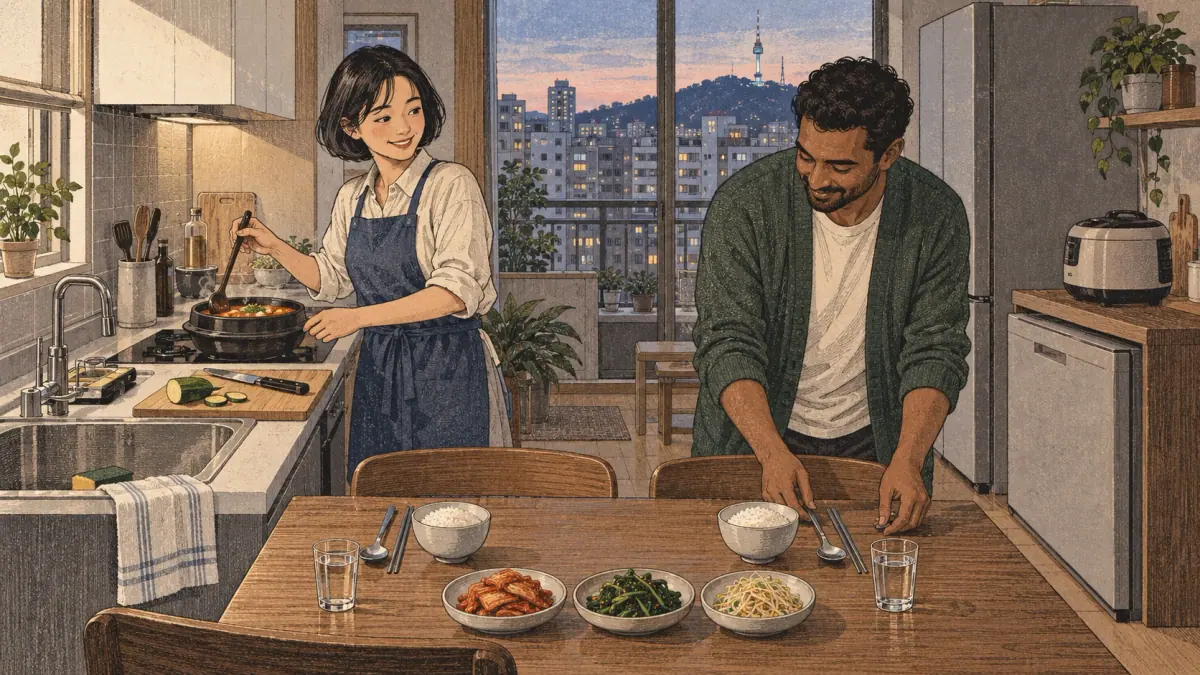
Korean Kitchen Vocabulary at a Glance
A Korean kitchen has the usual items, but also a few that surprise visitors: a metal spoon-and-chopsticks set, an earthenware pot for stews, a rice cooker that is almost always on the counter and a second refrigerator just for kimchi. Learning the words in groups, with the dish or job each tool is used for, makes them easier to remember than a flat list.
The list holds 40 words. By origin, the list has 18 native Korean, 7 Sino-Korean (built from Chinese-derived syllables), 6 loanwords and 9 mixed. Knowing the origin helps you guess how a new word will behave. The groups are:
| Group | Words | Examples |
|---|---|---|
| Cutlery and tableware | 11 | 수저, 숟가락, 젓가락, 포크 |
| Pots and pans | 8 | 냄비, 프라이팬, 뚝배기, 솥 |
| Appliances | 8 | 냉장고, 김치냉장고, 밥솥, 전자레인지 |
| Prep tools | 9 | 칼, 도마, 가위, 국자 |
| Sink and cleaning | 4 | 싱크대, 수세미, 행주, 부엌 |
Most utensil names are native Korean words and are short: 칼, 솥, 국자, 도마. Appliance names are usually Sino-Korean or loanwords, such as 냉장고 and 인덕션. The nouns on this page are the names only. Cooking verbs such as 끓이다 (boil) and 볶다 (stir-fry) belong in the verb lists, and the example sentences use them in simple polite forms. This list sits inside House and Home, where you can find the related topics.
Which Kitchen Words Should You Learn First?
Start with five words that you see on every Korean table and stove: 수저, 숟가락, 젓가락, 뚝배기 and 밥솥. Press play, then the slow button, and say each word aloud.
수저 (sujeo) means spoon and chopsticks (a set). At a restaurant, 수저 주세요 means "Please give me a spoon and chopsticks". It is usually explained as 술, an old native word for a spoon (still heard in 한 술, a spoonful), joined to 저, chopsticks, from Chinese. Example: 수저를 놓아요. (I set out the spoon and chopsticks.)
숟가락 (sutgarak) means spoon, the one used for rice and soup. Spell it with ㄷ in the first syllable (숟), not with ㅅ. It is said [숟까락], with a tense ㄱ in the middle. Example: 숟가락으로 국을 먹어요. (I eat soup with a spoon.)
젓가락 (jeotgarak) means chopsticks. In Korea they are usually thin metal, a feature that surprises many visitors. Spell it with ㅅ in the first syllable (젓), unlike 숟가락. Example: 젓가락을 사용해요. (I use chopsticks.)
뚝배기 (ttukbaegi) means earthenware pot. It is a heavy earthenware pot used for stews such as 된장찌개, and it keeps the stew boiling at the table. The word begins with a tense ㄸ, so the first sound is a firm tt. Example: 뚝배기에 된장찌개를 끓여요. (I boil soybean paste stew in an earthenware pot.)
밥솥 (bapsot) means rice cooker, a machine found in most Korean homes. The two parts are 밥 (cooked rice) and 솥 (cooking pot). Say it as [밥쏟]. Example: 밥솥으로 밥을 해요. (I make rice with the rice cooker.)
Cutlery and Tableware
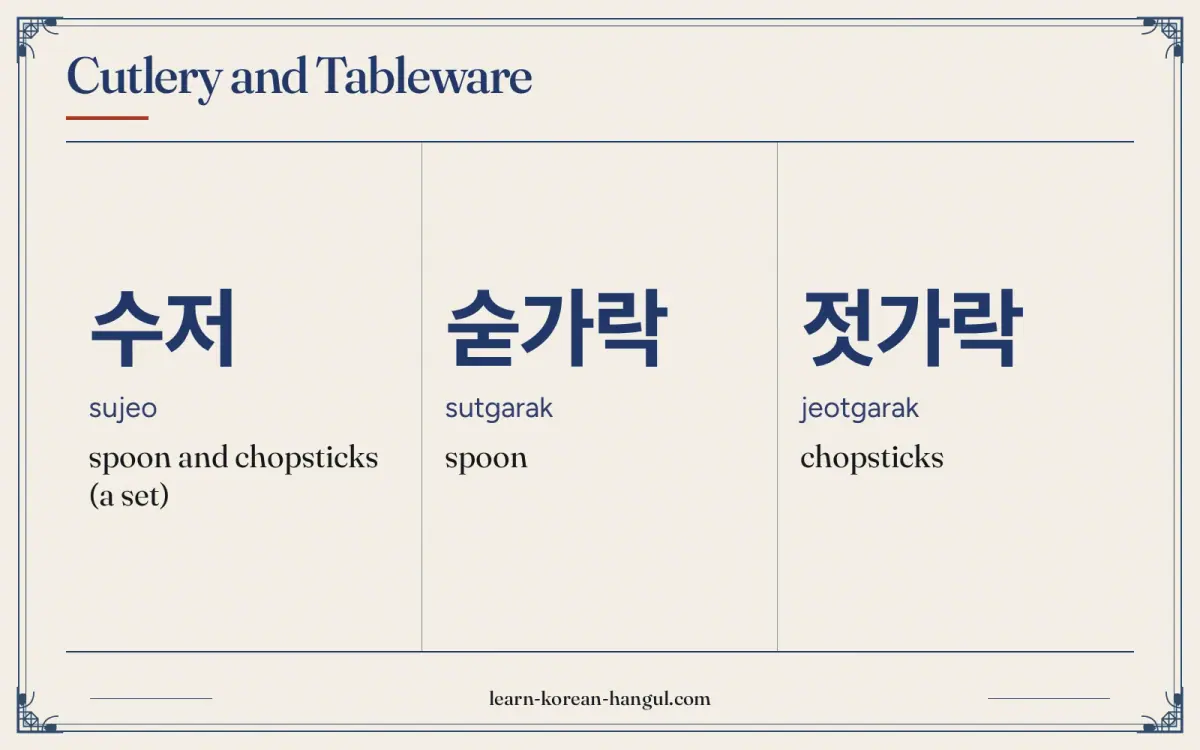
Eleven words cover what is on the table. In Korea soup and rice are eaten with a spoon, and side dishes with chopsticks.
| No. | Hangul | Revised Romanization | Meaning | Origin | Example sentence | Audio assetId |
|---|---|---|---|---|---|---|
| 1 | 수저 | sujeo | spoon and chopsticks (a set) | mixed | 수저를 놓아요. (sujeoreul noayo; I set out the spoon and chopsticks.) | au-pg-vocabulary-daily-life-home-kitchen-1; example: au-pg-vocabulary-daily-life-home-kitchen-101 |
| 2 | 숟가락 | sutgarak | spoon | native | 숟가락으로 국을 먹어요. (sutgarageuro gugeul meogeoyo; I eat soup with a spoon.) | au-pg-vocabulary-daily-life-home-kitchen-2; example: au-pg-vocabulary-daily-life-home-kitchen-102 |
| 3 | 젓가락 | jeotgarak | chopsticks | native | 젓가락을 사용해요. (jeotgarageul sayonghaeyo; I use chopsticks.) | au-pg-vocabulary-daily-life-home-kitchen-3; example: au-pg-vocabulary-daily-life-home-kitchen-103 |
| 4 | 포크 | pokeu | fork | loanword | 포크가 필요해요. (pokeuga piryohaeyo; I need a fork.) | au-pg-vocabulary-daily-life-home-kitchen-4; example: au-pg-vocabulary-daily-life-home-kitchen-104 |
| 5 | 접시 | jeopsi | plate | native | 접시에 반찬을 담아요. (jeopsie banchaneul damayo; I put side dishes on a plate.) | au-pg-vocabulary-daily-life-home-kitchen-5; example: au-pg-vocabulary-daily-life-home-kitchen-105 |
| 6 | 그릇 | geureut | bowl; dish | native | 그릇이 깨졌어요. (geureusi kkaejyeosseoyo; The bowl broke.) | au-pg-vocabulary-daily-life-home-kitchen-6; example: au-pg-vocabulary-daily-life-home-kitchen-106 |
| 7 | 공기 | gonggi | rice bowl | Sino-Korean | 공기에 밥을 담아요. (gonggie babeul damayo; I put rice in a rice bowl.) | au-pg-vocabulary-daily-life-home-kitchen-7; example: au-pg-vocabulary-daily-life-home-kitchen-107 |
| 8 | 컵 | keop | cup | loanword | 컵에 물을 따라요. (keobe mureul ttarayo; I pour water into a cup.) | au-pg-vocabulary-daily-life-home-kitchen-8; example: au-pg-vocabulary-daily-life-home-kitchen-108 |
| 9 | 물컵 | mulkeop | water glass | mixed | 물컵을 씻어요. (mulkeobeul ssiseoyo; I wash the water glass.) | au-pg-vocabulary-daily-life-home-kitchen-9; example: au-pg-vocabulary-daily-life-home-kitchen-109 |
| 10 | 쟁반 | jaengban | tray | Sino-Korean | 쟁반에 컵을 올려요. (jaengbane keobeul ollyeoyo; I put cups on the tray.) | au-pg-vocabulary-daily-life-home-kitchen-10; example: au-pg-vocabulary-daily-life-home-kitchen-110 |
| 11 | 반찬통 | banchantong | side-dish container | mixed | 반찬통에 김치가 있어요. (banchantonge gimchiga isseoyo; There is kimchi in the side-dish container.) | au-pg-vocabulary-daily-life-home-kitchen-11; example: au-pg-vocabulary-daily-life-home-kitchen-111 |
- 수저 is the full set and the word used when setting a table or asking for utensils. 숟가락 and 젓가락 are the two separate parts. The word 수저 is also used in idioms about family wealth, but that sense is for advanced learners.
- 그릇 is the general word for any dish, bowl or container. 공기 is the small bowl for rice, and 접시 is a flat plate.
- 반찬통 is a container for 반찬 (side dishes). Korean fridges usually hold many of these boxes, each with a different side dish.
Example Sentences
The tool frame is tool + (으)로 + food + verb. Use 으로 after a consonant and 로 after a vowel: 젓가락으로 먹어요 (I eat with chopsticks) and 숟가락으로 국을 먹어요 (I eat soup with a spoon). For a container or place, use 에: 냄비에 라면을 끓여요 (I boil ramen in a pot). To count utensils, use a thing counter such as 개: 숟가락 두 개 (two spoons). The counter is taught in counters for things. The single-word page kitchen in korean explains the word 부엌 on its own.
How Do You Say Pots and Pans in Korean?
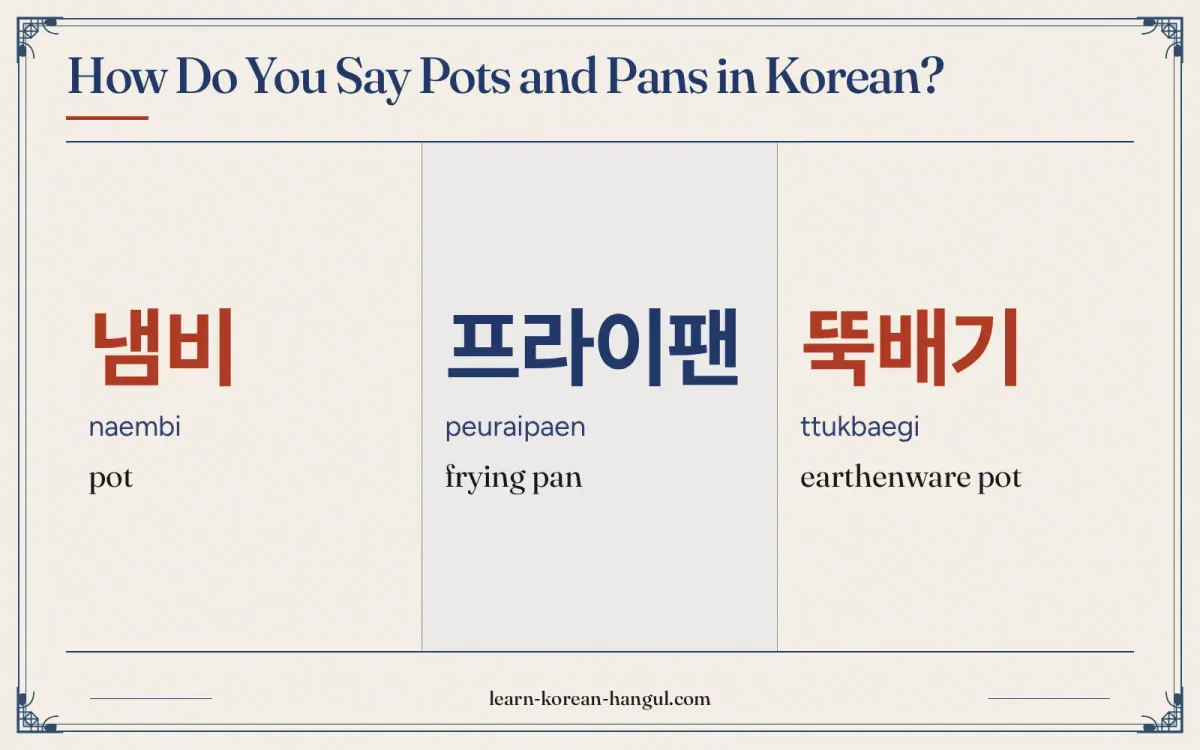
Pots and pans are the main place where Korean differs from English: each shape matches a dish. Learn the dish with the pot.
| No. | Hangul | Revised Romanization | Meaning | Origin | Example sentence | Audio assetId |
|---|---|---|---|---|---|---|
| 12 | 냄비 | naembi | pot | loanword | 냄비에 물을 끓여요. (naembie mureul kkeuryeoyo; I boil water in the pot.) | au-pg-vocabulary-daily-life-home-kitchen-12; example: au-pg-vocabulary-daily-life-home-kitchen-112 |
| 13 | 프라이팬 | peuraipaen | frying pan | loanword | 프라이팬에 계란을 부쳐요. (peuraipaene gyeraneul buchyeoyo; I fry an egg in the frying pan.) | au-pg-vocabulary-daily-life-home-kitchen-13; example: au-pg-vocabulary-daily-life-home-kitchen-113 |
| 14 | 뚝배기 | ttukbaegi | earthenware pot | native | 뚝배기에 된장찌개를 끓여요. (ttukbaegie doenjangjjigaereul kkeuryeoyo; I boil soybean paste stew in an earthenware pot.) | au-pg-vocabulary-daily-life-home-kitchen-14; example: au-pg-vocabulary-daily-life-home-kitchen-114 |
| 15 | 솥 | sot | cooking pot (large, heavy) | native | 솥에 밥을 지어요. (sote babeul jieoyo; I cook rice in a pot.) | au-pg-vocabulary-daily-life-home-kitchen-15; example: au-pg-vocabulary-daily-life-home-kitchen-115 |
| 16 | 주전자 | jujeonja | kettle | Sino-Korean | 주전자에 물이 있어요. (jujeonjae muri isseoyo; There is water in the kettle.) | au-pg-vocabulary-daily-life-home-kitchen-16; example: au-pg-vocabulary-daily-life-home-kitchen-116 |
| 17 | 찜기 | jjimgi | steamer | mixed | 찜기로 만두를 쪄요. (jjimgiro mandureul jjyeoyo; I steam dumplings with a steamer.) | au-pg-vocabulary-daily-life-home-kitchen-17; example: au-pg-vocabulary-daily-life-home-kitchen-117 |
| 18 | 압력솥 | amnyeoksot | pressure cooker | mixed | 압력솥으로 밥을 해요. (amnyeoksoteuro babeul haeyo; I make rice with a pressure cooker.) | au-pg-vocabulary-daily-life-home-kitchen-18; example: au-pg-vocabulary-daily-life-home-kitchen-118 |
| 19 | 불판 | bulpan | grill plate | mixed | 불판에 고기를 구워요. (bulpane gogireul guwoyo; I grill meat on the grill plate.) | au-pg-vocabulary-daily-life-home-kitchen-19; example: au-pg-vocabulary-daily-life-home-kitchen-119 |
- 냄비 is the everyday pot for ramen, soup and boiling. The word itself came into Korean from Japanese (nabe). 솥 is deeper and heavier, and is the word for the large pot used for rice or for a 가마솥 (gamasot, a traditional iron pot).
- 뚝배기 is paired with 찌개 (stew) and 국밥 (soup with rice). For stew words, see stews.
- 불판 is the grill plate in a Korean barbecue restaurant. It may be flat or round, and a 가위 (scissors) cuts the meat on it.
Appliances
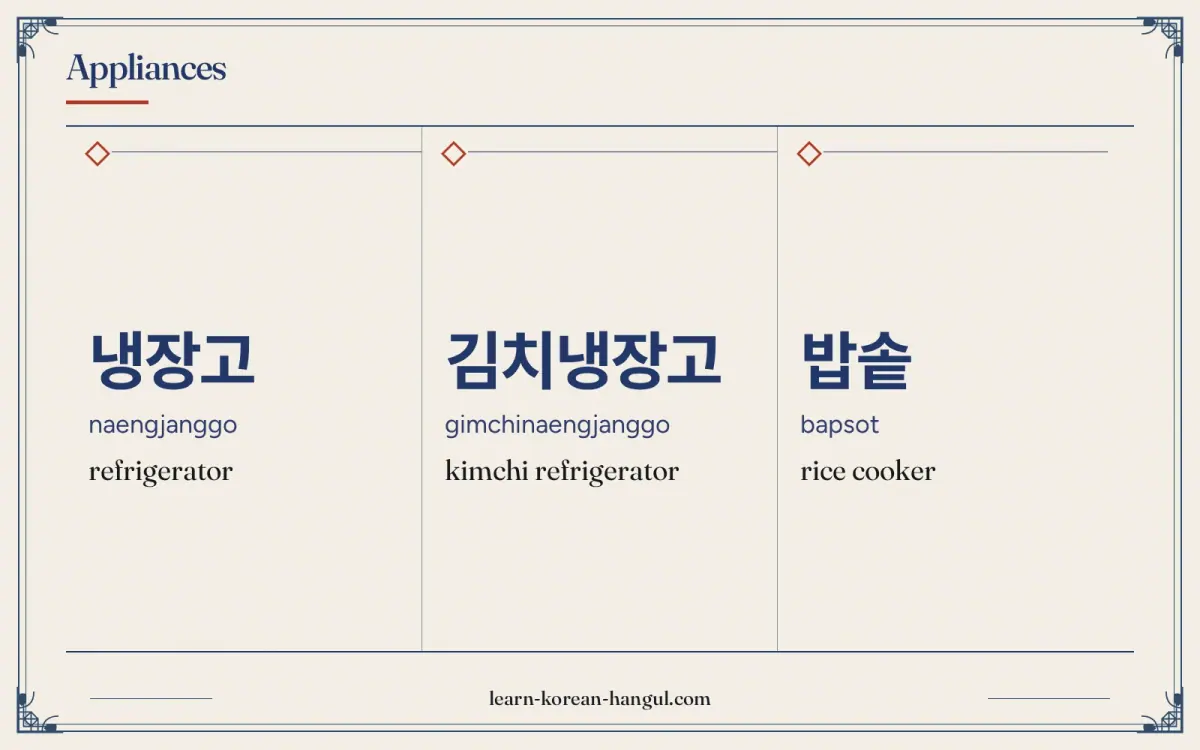
Appliance words show how Korean homes use technology. Two items, the rice cooker and the kimchi refrigerator, are standard in Korean kitchens and have no common English twin.
| No. | Hangul | Revised Romanization | Meaning | Origin | Example sentence | Audio assetId |
|---|---|---|---|---|---|---|
| 20 | 냉장고 | naengjanggo | refrigerator | Sino-Korean | 냉장고에 우유가 있어요. (naengjanggoe uyuga isseoyo; There is milk in the refrigerator.) | au-pg-vocabulary-daily-life-home-kitchen-20; example: au-pg-vocabulary-daily-life-home-kitchen-120 |
| 21 | 김치냉장고 | gimchinaengjanggo | kimchi refrigerator | mixed | 김치냉장고에 김치를 넣어요. (gimchinaengjanggoe gimchireul neoeoyo; I put kimchi in the kimchi refrigerator.) | au-pg-vocabulary-daily-life-home-kitchen-21; example: au-pg-vocabulary-daily-life-home-kitchen-121 |
| 22 | 밥솥 | bapsot | rice cooker | native | 밥솥으로 밥을 해요. (bapsoteuro babeul haeyo; I make rice with the rice cooker.) | au-pg-vocabulary-daily-life-home-kitchen-22; example: au-pg-vocabulary-daily-life-home-kitchen-122 |
| 23 | 전자레인지 | jeonjareinji | microwave oven | mixed | 전자레인지에 데워요. (jeonjareinjie dewoyo; I heat it in the microwave.) | au-pg-vocabulary-daily-life-home-kitchen-23; example: au-pg-vocabulary-daily-life-home-kitchen-123 |
| 24 | 가스레인지 | gaseureinji | gas stove | loanword | 가스레인지를 켜요. (gaseureinjireul kyeoyo; I turn on the gas stove.) | au-pg-vocabulary-daily-life-home-kitchen-24; example: au-pg-vocabulary-daily-life-home-kitchen-124 |
| 25 | 인덕션 | indeoksyeon | induction cooktop | loanword | 인덕션은 안전해요. (indeoksyeoneun anjeonhaeyo; The induction cooktop is safe.) | au-pg-vocabulary-daily-life-home-kitchen-25; example: au-pg-vocabulary-daily-life-home-kitchen-125 |
| 26 | 식기세척기 | sikgisecheokgi | dishwasher | Sino-Korean | 식기세척기를 돌려요. (sikgisecheokgireul dollyeoyo; I run the dishwasher.) | au-pg-vocabulary-daily-life-home-kitchen-26; example: au-pg-vocabulary-daily-life-home-kitchen-126 |
| 27 | 정수기 | jeongsugi | water purifier | Sino-Korean | 정수기에서 물을 받아요. (jeongsugieseo mureul badayo; I get water from the water purifier.) | au-pg-vocabulary-daily-life-home-kitchen-27; example: au-pg-vocabulary-daily-life-home-kitchen-127 |
- 김치냉장고 keeps kimchi at a steady cool temperature while it ferments. It is a second, separate unit, and the name is long enough that Koreans sometimes shorten it to 김냉.
- 가스레인지 and 전자레인지 end in 레인지 (range). The first part tells the energy source: 가스 (gas) or 전자 (electronic), which here means a microwave oven.
- 정수기 gives clean and sometimes hot or cold water. Many offices and homes have one, and rental ones are common.
How Do You Say Prep Tools in Korean?
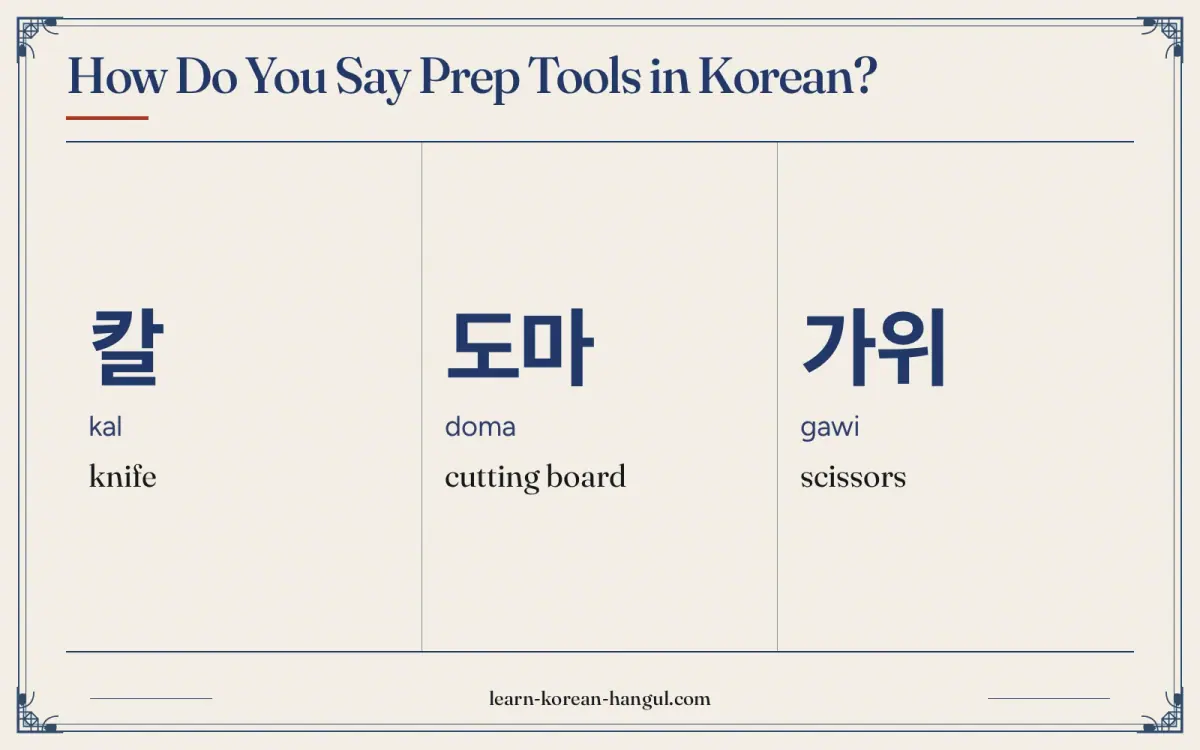
Prep tools are small, and most are native Korean words that are short and easy to say. Several use the same pattern: noun + (으)로, meaning with the tool.
| No. | Hangul | Revised Romanization | Meaning | Origin | Example sentence | Audio assetId |
|---|---|---|---|---|---|---|
| 28 | 칼 | kal | knife | native | 칼이 날카로워요. (kari nalkarowoyo; The knife is sharp.) | au-pg-vocabulary-daily-life-home-kitchen-28; example: au-pg-vocabulary-daily-life-home-kitchen-128 |
| 29 | 도마 | doma | cutting board | native | 도마 위에서 채소를 썰어요. (doma wieseo chaesoreul sseoreoyo; I cut vegetables on the cutting board.) | au-pg-vocabulary-daily-life-home-kitchen-29; example: au-pg-vocabulary-daily-life-home-kitchen-129 |
| 30 | 가위 | gawi | scissors | native | 가위로 고기를 잘라요. (gawiro gogireul jallayo; I cut meat with scissors.) | au-pg-vocabulary-daily-life-home-kitchen-30; example: au-pg-vocabulary-daily-life-home-kitchen-130 |
| 31 | 국자 | gukja | ladle | native | 국자로 국을 떠요. (gukjaro gugeul tteoyo; I scoop soup with a ladle.) | au-pg-vocabulary-daily-life-home-kitchen-31; example: au-pg-vocabulary-daily-life-home-kitchen-131 |
| 32 | 뒤집개 | dwijipgae | spatula; turner | native | 뒤집개로 전을 뒤집어요. (dwijipgaero jeoneul dwijibeoyo; I flip the pancake with a spatula.) | au-pg-vocabulary-daily-life-home-kitchen-32; example: au-pg-vocabulary-daily-life-home-kitchen-132 |
| 33 | 집게 | jipge | tongs | native | 집게로 고기를 집어요. (jipgero gogireul jibeoyo; I pick up meat with tongs.) | au-pg-vocabulary-daily-life-home-kitchen-33; example: au-pg-vocabulary-daily-life-home-kitchen-133 |
| 34 | 강판 | gangpan | grater | Sino-Korean | 강판에 무를 갈아요. (gangpane mureul garayo; I grate radish on the grater.) | au-pg-vocabulary-daily-life-home-kitchen-34; example: au-pg-vocabulary-daily-life-home-kitchen-134 |
| 35 | 밀대 | mildae | rolling pin | native | 밀대로 반죽을 밀어요. (mildaero banjugeul mireoyo; I roll the dough with a rolling pin.) | au-pg-vocabulary-daily-life-home-kitchen-35; example: au-pg-vocabulary-daily-life-home-kitchen-135 |
| 36 | 앞치마 | apchima | apron | native | 앞치마를 입어요. (apchimareul ibeoyo; I put on an apron.) | au-pg-vocabulary-daily-life-home-kitchen-36; example: au-pg-vocabulary-daily-life-home-kitchen-136 |
- Korean cooks use 가위 in the kitchen for more than paper: they cut noodles, kimchi and grilled meat with kitchen scissors. Restaurant staff often hand you a pair at the table.
- 집게 and 가위 are often served together at a barbecue restaurant. 집게 turns the meat and 가위 cuts it.
- Many tool names come from the verb they do: 뒤집개 comes from 뒤집다 (flip) and 밀대 from 밀다 (push or roll).
Sink and Cleaning
The last group has four words for the sink, the cleaning cloths and the kitchen itself.
| No. | Hangul | Revised Romanization | Meaning | Origin | Example sentence | Audio assetId |
|---|---|---|---|---|---|---|
| 37 | 싱크대 | singkeudae | sink; kitchen counter unit | mixed | 싱크대가 깨끗해요. (singkeudaega kkaekkeutaeyo; The sink is clean.) | au-pg-vocabulary-daily-life-home-kitchen-37; example: au-pg-vocabulary-daily-life-home-kitchen-137 |
| 38 | 수세미 | susemi | scrubber; dish sponge | native | 수세미로 그릇을 닦아요. (susemiro geureuseul dakkayo; I clean the bowl with a scrubber.) | au-pg-vocabulary-daily-life-home-kitchen-38; example: au-pg-vocabulary-daily-life-home-kitchen-138 |
| 39 | 행주 | haengju | dishcloth | native | 행주로 식탁을 닦아요. (haengjuro siktageul dakkayo; I wipe the table with a dishcloth.) | au-pg-vocabulary-daily-life-home-kitchen-39; example: au-pg-vocabulary-daily-life-home-kitchen-139 |
| 40 | 부엌 | bueok | kitchen | native | 부엌에서 요리해요. (bueokeseo yorihaeyo; I cook in the kitchen.) | au-pg-vocabulary-daily-life-home-kitchen-40; example: au-pg-vocabulary-daily-life-home-kitchen-140 |
- 부엌 is the native word for the kitchen, and 주방 is the Sino-Korean word used in restaurants and for a professional kitchen. At home, say 부엌.
- The final ㅋ in 부엌 is said [ㄱ], so alone it sounds like bueok. When a vowel follows, the ㅋ returns: 부엌에 is said [부어케].
- 싱크대 names the whole sink unit with its counter and cupboards, not only the basin.
How Do You Pronounce These Words?
Kitchen words are rich in the sound rules where a final consonant makes the next sound tense. The table shows five, following the Standard Pronunciation rules (표준 발음법) of the 국립국어원.
| Word | Romanization | Said | Rule |
|---|---|---|---|
| 숟가락 | sutgarak | [숟까락] | ㄱ after ㄷ becomes tense |
| 젓가락 | jeotgarak | [젇까락] | final ㅅ closes as [ㄷ], then ㄱ becomes tense |
| 뚝배기 | ttukbaegi | [뚝빼기] | ㅂ after ㄱ becomes tense |
| 밥솥 | bapsot | [밥쏟] | ㅅ after ㅂ becomes tense, and final ㅌ closes as [ㄷ] |
| 부엌 | bueok | [부억] | final ㅋ is said as [ㄱ] at the end of a word |
Revised Romanization is the official romanization system of South Korea, announced on 7 July 2000. It follows most sound changes, but it does not show tensing caused by a neighbouring sound, so it is only a learning aid. Always read the Hangul as well.
Audio and Slow Playback
Each headword and each example sentence has its own audio clip, and the 5 words in the first-words section also have a slow clip at 0.8 times the speed. Nothing plays until you press a button. Listen once, repeat aloud, and only then check the romanization.
What Mistakes Do Learners Make with Kitchen Words?
- Spelling 숟가락 with ㅅ or 젓가락 with ㄷ. The spelling is 숟가락 (ㄷ) and 젓가락 (ㅅ).
- Saying 수저 for only a spoon. 수저 is the set of spoon and chopsticks.
- Using 냄비 for every pot. Use 뚝배기 for an earthenware stew pot and 솥 for a large rice pot.
- Calling the kimchi refrigerator an ordinary 냉장고. The names differ because the two machines do different jobs.
- Reading the romanization instead of the sounds. Words such as 숟가락 are said with a tense ㄱ, but Revised Romanization does not show it.
Practice: Flashcards and Worksheet
Drill these 40 words with the vocabulary flashcard decks: each card shows the Hangul on one side and the meaning on the other, so you can test recall instead of recognition. Print a labelling sheet from the vocabulary worksheets and write the Korean word for each numbered object in the scene above. A simple plan is to learn 8 to 10 words a day: read the table, press play, say the word, cover the English, then write one sentence of your own. Come back after a day and again after a week.
Self-Test: 10 Sentences
Fill each blank with a word from this page. Say the whole sentence aloud when you have it. The answers follow the test.
- ___를 놓아요. (I set out the spoon and chopsticks.)
- ___에 반찬을 담아요. (I put side dishes on a plate.)
- ___을 씻어요. (I wash the water glass.)
- ___에 계란을 부쳐요. (I fry an egg in the frying pan.)
- ___로 만두를 쪄요. (I steam dumplings with a steamer.)
- ___에 김치를 넣어요. (I put kimchi in the kimchi refrigerator.)
- ___은 안전해요. (The induction cooktop is safe.)
- ___ 위에서 채소를 썰어요. (I cut vegetables on the cutting board.)
- ___로 고기를 집어요. (I pick up meat with tongs.)
- ___가 깨끗해요. (The sink is clean.)
Answers: 1. 수저; 2. 접시; 3. 물컵; 4. 프라이팬; 5. 찜기; 6. 김치냉장고; 7. 인덕션; 8. 도마; 9. 집게; 10. 싱크대.
A score of 8 or more suggests the words are settling in. If you scored lower, reread the groups where you missed words.
Where to Go Next
After kitchen words, many learners move on to Korean House and Furniture Vocabulary and Korean Bathroom Vocabulary. This list sits inside House and Home.
FAQ
How Do You Say Spoon and Chopsticks in Korean?
Say 수저 (sujeo) for the set of spoon and chopsticks. For only the spoon say 숟가락 (sutgarak), and for only the chopsticks say 젓가락 (jeotgarak). At a restaurant, 수저 주세요 asks for the set.
How Do You Pronounce 숟가락 (sutgarak)?
숟가락 is read sutgarak but said [숟까락]. The final ㄷ closes the first syllable, and the ㄱ that follows becomes tense. In the first syllable, the vowel ㅜ is said with rounded lips, as in English "too".
How Many Kitchen Words Should I Learn First?
Learn the 19 words in the cutlery and pots groups first, because they cover the table and stove. At 8 to 10 new words a day that takes two days; then add appliances, prep tools and the sink words, and keep reviewing for a week.
Where Can I Practise Kitchen Words with Flashcards?
Use the vocabulary flashcard decks. Start with the first 10 words of this page, then add 10 more each day. Review the older cards before you add new ones, so the earlier words do not fade.
Is the Romanization on This Page Official?
Yes, as a learning aid. It follows the Revised Romanization of Korean, the system South Korea has officially used since 7 July 2000, and the page also gives the Hangul for every word. It follows most sound changes, but it does not show tensing caused by a neighbouring sound: 숟가락 is written sutgarak but said [숟까락]. Treat the Hangul as the real spelling.
Is There a Printable Worksheet for Kitchen Words?
The vocabulary worksheets page lists the printable sheets. The sheet for this topic is a labelling task built on the same illustrated scene as this page, so you write the Korean word next to each numbered object.