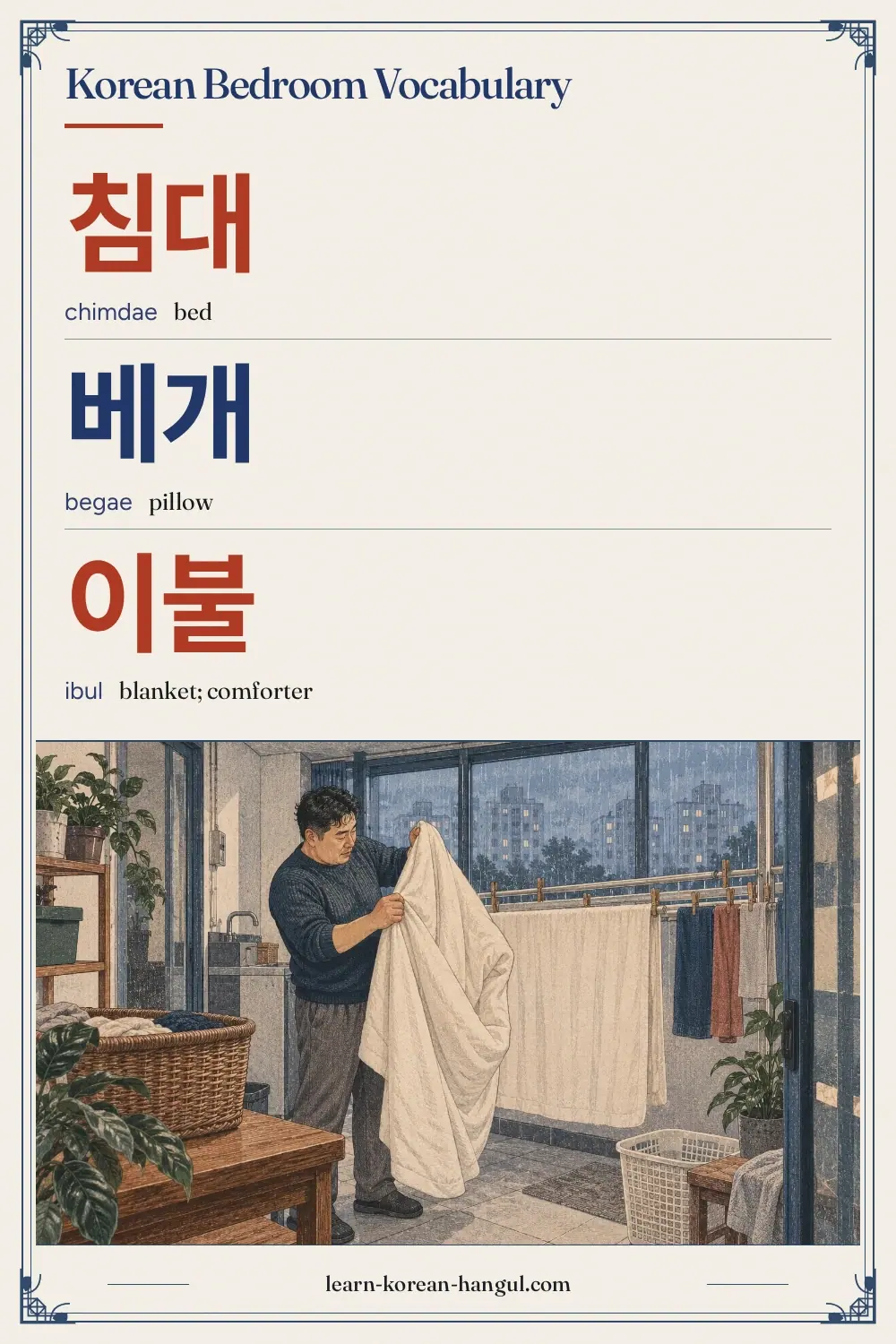
Korean Bedroom Vocabulary at a Glance
This list has 25 words in five groups of five. It covers a bed and its bedding, sleep, storage, the alarm and lights, and the floor bedding used in traditional Korean homes. It belongs to House and Home. Most words are common nouns, and a few are loanwords, so you can learn the whole list in a few short sessions.
| Group | Words | Use |
|---|---|---|
| Bed and bedding | 5 | Beds, pillows and covers |
| Sleep | 5 | Talking about sleep and rest |
| Clothes storage | 5 | Wardrobes, drawers and hangers |
| Alarm and lights | 5 | Waking up and lighting the room |
| Floor sleeping | 5 | Bedding for sleeping on a heated floor |
Bedroom vocabulary reflects a real difference in how people sleep. Some sleep in a 침대 and some on a 요, and Korean has words for both. The next section ranks the words and explains the contrast.
Which Bedroom Words Should You Learn First?
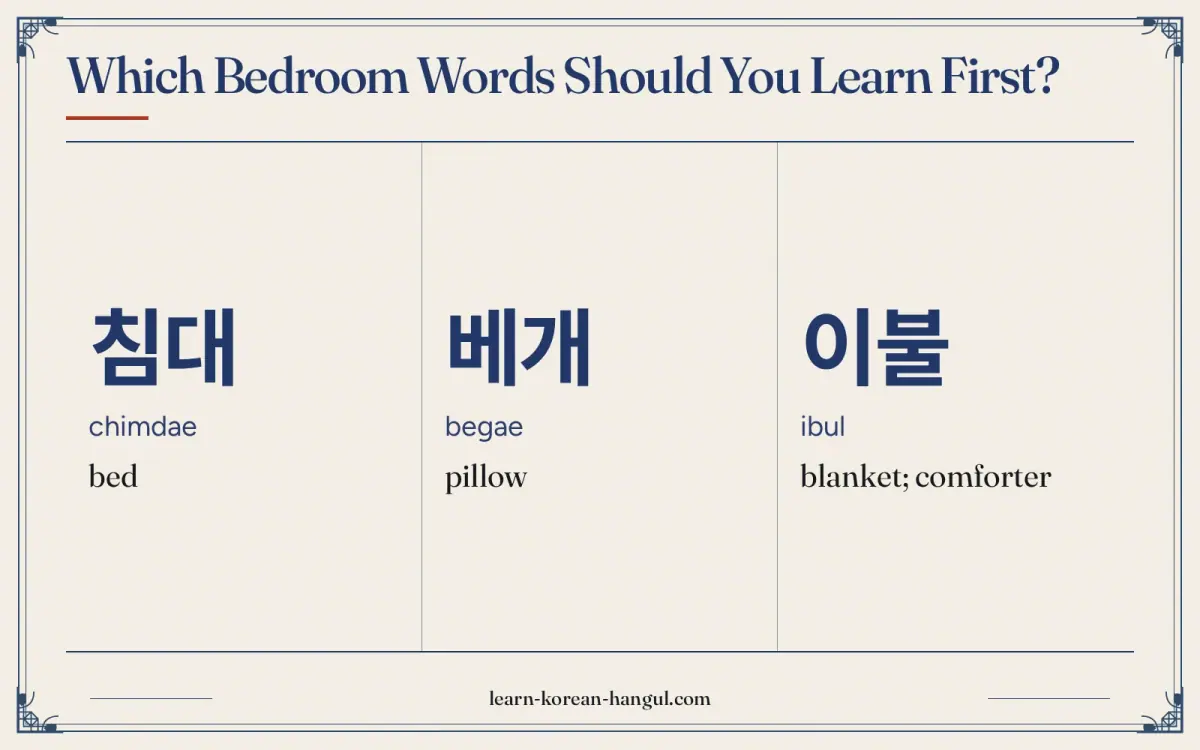
Learn 침대 (bed), 이불 (blanket), 베개 (pillow), 잠 (sleep) and 알람 (alarm) first. They cover going to bed, staying warm and waking up. The sentence 침대에서 자요 (I sleep in the bed) uses the first of them and the most common verb of the topic.
- Words to say. 침대, 이불, 베개, 잠, 알람. Use these when you describe your room or ask for bedding.
- Words to recognise. 요, 전기장판, 온수매트, 이불장. These appear in guesthouses and traditional homes.
- Phrases to hear. 안녕히 주무세요 (good night, to an elder) and 잘 자요 (sleep well). You will hear both at bedtime.
Korean has two common bedtime greetings. 안녕히 주무세요 is the honorific form for elders and people you respect, and 잘 자요 is the polite form among friends and family. The casual form 잘 자 is for close friends and children. The scene below shows a bedroom with numbered objects that match the list.
Word · 10
- 1
침대
chimdae
bed
- 2
베개
begae
pillow
- 3
이불
ibul
blanket; comforter
- 4
잠
jam
sleep
- 5
옷장
otjang
wardrobe
- 6
서랍
seorap
drawer
- 7
알람
allam
alarm
- 8
스탠드
seutaendeu
desk lamp; bedside lamp
- 9
요
yo
floor mattress
- 10
전기장판
jeongijangpan
electric heating mat
Bed and Bedding
Bed and bedding words are nouns that take the verbs 덮다 (to cover), 깔다 (to spread) and 갈다 (to change). 침대 is a bed on a frame, and 이불 is a blanket or comforter. 매트리스 is a mattress, a loanword, and 시트 is the sheet. A 베개 is a pillow. Say them with the particle 에서 for location: 침대에서 자요.
| No. | Hangul | Revised Romanization | Meaning and note | Example sentence | Audio assetId |
|---|---|---|---|---|---|
| 1 | 침대 | chimdae | bed. 자다 means to sleep. | 침대에서 자요. (I sleep in the bed.) | au-pg-vocabulary-daily-life-home-bedroom-1; example: au-pg-vocabulary-daily-life-home-bedroom-26 |
| 2 | 베개 | begae | pillow. 부드럽다 changes to 부드러워요. | 베개가 부드러워요. (The pillow is soft.) | au-pg-vocabulary-daily-life-home-bedroom-2; example: au-pg-vocabulary-daily-life-home-bedroom-27 |
| 3 | 이불 | ibul | blanket; comforter. 덮다 means to cover. | 이불을 덮어요. (I cover myself with a blanket.) | au-pg-vocabulary-daily-life-home-bedroom-3; example: au-pg-vocabulary-daily-life-home-bedroom-28 |
| 4 | 매트리스 | maeteuriseu | mattress. Loanword. | 매트리스가 딱딱해요. (The mattress is hard.) | au-pg-vocabulary-daily-life-home-bedroom-4; example: au-pg-vocabulary-daily-life-home-bedroom-29 |
| 5 | 시트 | siteu | bed sheet. 갈다 here means to replace. | 시트를 갈아요. (I change the sheets.) | au-pg-vocabulary-daily-life-home-bedroom-5; example: au-pg-vocabulary-daily-life-home-bedroom-30 |
Notice the verb pattern: 덮다 pairs with 이불, 깔다 pairs with 요 and 시트, and 갈다 pairs with anything that is replaced, such as 시트 and 이불. A learner who knows the three verbs can talk about making a bed.
Example Sentences
Three frames carry most of the examples. The first is noun + 에서 + verb, as in 침대에서 자요 (I sleep in the bed). The second is noun + 을/를 + verb, as in 이불을 덮어요 (I cover myself with a blanket). The third is noun + 이/가 + descriptive verb, as in 베개가 부드러워요 (the pillow is soft). Say each sentence aloud after the audio, then swap the noun. Remember that 을 follows a consonant (이불을) and 를 follows a vowel (시트를).
How Do You Say Sleep in Korean?
Sleep has two common nouns. 잠 (jam) is the everyday word for sleep, and 수면 is the formal word used in health talk. Korean says 잠이 와요, sleep comes, for I am sleepy. A 꿈 is a dream, and 꿈을 꾸다 means to have a dream. A 낮잠 is a nap, from 낮 (daytime) and 잠. 코골이 means snoring.
| No. | Hangul | Revised Romanization | Meaning and note | Example sentence | Audio assetId |
|---|---|---|---|---|---|
| 6 | 잠 | jam | sleep. Literally, sleep arrives. | 잠이 와요. (I am sleepy (sleep comes).) | au-pg-vocabulary-daily-life-home-bedroom-6; example: au-pg-vocabulary-daily-life-home-bedroom-31 |
| 7 | 꿈 | kkum | dream. 꾸다 pairs only with 꿈. | 꿈을 꿔요. (I have a dream.) | au-pg-vocabulary-daily-life-home-bedroom-7; example: au-pg-vocabulary-daily-life-home-bedroom-32 |
| 8 | 낮잠 | natjam | nap. Said [낟짬]. | 낮잠을 자요. (I take a nap.) | au-pg-vocabulary-daily-life-home-bedroom-8; example: au-pg-vocabulary-daily-life-home-bedroom-33 |
| 9 | 코골이 | kogori | snoring. 코 is nose; 골이 comes from 골다, to snore. | 코골이가 심해요. (The snoring is loud.) | au-pg-vocabulary-daily-life-home-bedroom-9; example: au-pg-vocabulary-daily-life-home-bedroom-34 |
| 10 | 수면 | sumyeon | sleep (formal). Used in health and science. | 수면 시간이 짧아요. (My sleeping time is short.) | au-pg-vocabulary-daily-life-home-bedroom-10; example: au-pg-vocabulary-daily-life-home-bedroom-35 |
Two phrases help with common situations. 잠이 안 와요 means I can't fall asleep (sleep does not come), and 잠을 못 자요 means I can't sleep or don't get enough sleep. The first describes lying awake, and the second the result. See parts of the day for the time words that go with bedtime.
Clothes Storage
Clothes storage words are straightforward compound nouns. 옷 means clothes, so 옷장 is a clothes cabinet and 옷걸이 is a clothes hanger. A 서랍 is a drawer, and a 화장대 is a dressing table. 잠옷 is pajamas, and its two parts, 잠 (sleep) and 옷 (clothes), appear in other words on this page.
| No. | Hangul | Revised Romanization | Meaning and note | Example sentence | Audio assetId |
|---|---|---|---|---|---|
| 11 | 옷장 | otjang | wardrobe. Said [옫짱]. | 옷장에 옷이 있어요. (There are clothes in the wardrobe.) | au-pg-vocabulary-daily-life-home-bedroom-11; example: au-pg-vocabulary-daily-life-home-bedroom-36 |
| 12 | 서랍 | seorap | drawer. 열다 means to open. | 서랍을 열어요. (I open the drawer.) | au-pg-vocabulary-daily-life-home-bedroom-12; example: au-pg-vocabulary-daily-life-home-bedroom-37 |
| 13 | 옷걸이 | otgeori | clothes hanger. 걸다 means to hang; 이 forms a noun. | 옷걸이가 필요해요. (I need a hanger.) | au-pg-vocabulary-daily-life-home-bedroom-13; example: au-pg-vocabulary-daily-life-home-bedroom-38 |
| 14 | 잠옷 | jamot | pajamas. Said [자몯]. | 잠옷을 입어요. (I wear pajamas.) | au-pg-vocabulary-daily-life-home-bedroom-14; example: au-pg-vocabulary-daily-life-home-bedroom-39 |
| 15 | 화장대 | hwajangdae | dressing table. 화장 means makeup. | 화장대 앞에 앉아요. (I sit in front of the dressing table.) | au-pg-vocabulary-daily-life-home-bedroom-15; example: au-pg-vocabulary-daily-life-home-bedroom-40 |
The word 옷 is the base of many clothing words, from 속옷 (underwear) to 겉옷 (outer clothes). The Clothing page covers these words, which you can use here to fill the wardrobe.
How Do You Say Alarm and Lights in Korean?
Clock and light words set the rhythm of a bedroom. An 알람 is an alarm on a phone or clock, and a 자명종 is an alarm clock, an older word. 조명 is lighting in general, 전등 is a ceiling or room light, and 스탠드 is a desk or bedside lamp. The verbs to use are 켜다 (switch on), 끄다 (switch off) and 맞추다 (set).
| No. | Hangul | Revised Romanization | Meaning and note | Example sentence | Audio assetId |
|---|---|---|---|---|---|
| 16 | 알람 | allam | alarm. 맞추다 means to set or adjust. | 알람을 맞춰요. (I set the alarm.) | au-pg-vocabulary-daily-life-home-bedroom-16; example: au-pg-vocabulary-daily-life-home-bedroom-41 |
| 17 | 자명종 | jamyeongjong | alarm clock. 울리다 means to ring. | 자명종이 울려요. (The alarm clock rings.) | au-pg-vocabulary-daily-life-home-bedroom-17; example: au-pg-vocabulary-daily-life-home-bedroom-42 |
| 18 | 조명 | jomyeong | lighting. 어둡다 changes to 어두워요. | 조명이 어두워요. (The lighting is dim.) | au-pg-vocabulary-daily-life-home-bedroom-18; example: au-pg-vocabulary-daily-life-home-bedroom-43 |
| 19 | 스탠드 | seutaendeu | desk lamp; bedside lamp. Loanword from stand. | 스탠드를 켜요. (I turn on the lamp.) | au-pg-vocabulary-daily-life-home-bedroom-19; example: au-pg-vocabulary-daily-life-home-bedroom-44 |
| 20 | 전등 | jeondeung | light; ceiling lamp. 끄다 changes to 꺼요. | 전등을 꺼요. (I turn off the light.) | au-pg-vocabulary-daily-life-home-bedroom-20; example: au-pg-vocabulary-daily-life-home-bedroom-45 |
Time words go naturally with the alarm. Say 일곱 시에 알람을 맞춰요 (I set the alarm for seven o'clock). Hours use native numbers and 시, so seven o'clock is 일곱 시. The parts of the day page covers morning, evening and night.
Floor Sleeping
Many Korean homes have a heated floor, and many people sleep directly on it. A 요 (yo) is a thin floor mattress, which you spread out at night and fold away in the morning. The warm floor is a 방바닥. An 이불장 is a cupboard where the bedding is stored, and winter heating mats such as 전기장판 and 온수매트 sit on the floor under the 요.
| No. | Hangul | Revised Romanization | Meaning and note | Example sentence | Audio assetId |
|---|---|---|---|---|---|
| 21 | 요 | yo | floor mattress. 깔다 means to spread. | 요를 깔아요. (I spread out the floor mattress.) | au-pg-vocabulary-daily-life-home-bedroom-21; example: au-pg-vocabulary-daily-life-home-bedroom-46 |
| 22 | 전기장판 | jeongijangpan | electric heating mat. A common winter item. | 전기장판을 켜요. (I turn on the electric mat.) | au-pg-vocabulary-daily-life-home-bedroom-22; example: au-pg-vocabulary-daily-life-home-bedroom-47 |
| 23 | 방바닥 | bangbadak | room floor. 방 is room; 바닥 is floor. | 방바닥이 따뜻해요. (The floor is warm.) | au-pg-vocabulary-daily-life-home-bedroom-23; example: au-pg-vocabulary-daily-life-home-bedroom-48 |
| 24 | 이불장 | ibuljang | bedding closet. 넣다 means to put in. | 이불장에 이불을 넣어요. (I put the blanket in the bedding closet.) | au-pg-vocabulary-daily-life-home-bedroom-24; example: au-pg-vocabulary-daily-life-home-bedroom-49 |
| 25 | 온수매트 | onsumaeteu | hot-water mat. Warms with water, not electricity. | 온수매트를 써요. (I use a hot-water mat.) | au-pg-vocabulary-daily-life-home-bedroom-25; example: au-pg-vocabulary-daily-life-home-bedroom-50 |
How Do You Pronounce These Words?
Bedroom words have tense sounds and final-consonant changes. Standard pronunciation follows the National Institute of Korean Language (국립국어원) rules, and the romanization follows the Revised Romanization of Korean, which does not mark every sound change.
| Spelling | Sounds like | What changes |
|---|---|---|
| 낮잠 | [낟짬] | The final ㅈ is said [ㄷ], and the next ㅈ becomes a tense [ㅉ]. |
| 옷장 | [옫짱] | The final ㅅ is said [ㄷ], and the next ㅈ becomes a tense [ㅉ]. |
| 잠옷 | [자몯] | The ㅁ links to the vowel; the final ㅅ is said [ㄷ]. |
| 전등 | [전등] | No change. |
| 전기장판 | [전기장판] | No change in careful speech. |
In Korean a final consonant is said in a reduced way, so ㅈ and ㅅ at the end of a syllable both sound like ㄷ. This is why 낮 and 옷 are spelled differently but sound alike. When a vowel follows, the original sound returns, as in 옷이 [오시].
Audio and Slow Playback
Each word and sentence has its own clip. The five clips below replay the hardest words slowly. Play one, repeat it aloud, then play it again and compare.
What Mistakes Do Learners Make with Bedroom Words?
Five mistakes appear often.
- Saying 안녕히 주무세요 to a friend. 안녕히 주무세요 is honorific and suits elders. For friends and family use 잘 자요, and for close friends 잘 자.
- Using 침대 for any bedding. 침대 is the raised bed itself. The covers are 이불 and the mattress is 매트리스. A 요 is floor bedding.
- Translating sleep with 자다 only. 자다 is the verb to sleep, but 잠 is the noun. 잠이 와요 and 잠을 자요 are both natural.
- Spelling 낮잠 as it sounds. The sound is [낟짬], but the spelling keeps ㅈ in 낮 (daytime). Write 낮잠, not 낟잠.
- Forgetting that 꾸다 pairs with 꿈. You do not 하다 a dream. Say 꿈을 꿔요.
Learning the bedtime greetings and the three bedding verbs solves most trouble. For the single query on its own, see bedroom in Korean. The practice section below turns the list into drills.
Practice: Flashcards and Worksheet
Study in three steps. First, run the flashcard deck in recognition mode until you recognise all 25 words. Second, switch to listening mode. Third, take the quiz. The deck holds all 25 words with audio, and your progress stays in your browser. The vocabulary flashcard decks page lists the other decks.
Practice · 55
- 01침대
Show answer
headword 1: bed
- 02베개
Show answer
headword 2: pillow
- 03이불
Show answer
headword 3: blanket; comforter
- 04매트리스
Show answer
headword 4: mattress
- 05시트
Show answer
headword 5: bed sheet
- 06잠
Show answer
headword 6: sleep
- 07꿈
Show answer
headword 7: dream
- 08낮잠
Show answer
headword 8: nap
- 09코골이
Show answer
headword 9: snoring
- 10수면
Show answer
headword 10: sleep (formal)
- 11옷장
Show answer
headword 11: wardrobe
- 12서랍
Show answer
headword 12: drawer
- 13옷걸이
Show answer
headword 13: clothes hanger
- 14잠옷
Show answer
headword 14: pajamas
- 15화장대
Show answer
headword 15: dressing table
- 16알람
Show answer
headword 16: alarm
- 17자명종
Show answer
headword 17: alarm clock
- 18조명
Show answer
headword 18: lighting
- 19스탠드
Show answer
headword 19: desk lamp; bedside lamp
- 20전등
Show answer
headword 20: light; ceiling lamp
- 21요
Show answer
headword 21: floor mattress
- 22전기장판
Show answer
headword 22: electric heating mat
- 23방바닥
Show answer
headword 23: room floor
- 24이불장
Show answer
headword 24: bedding closet
- 25온수매트
Show answer
headword 25: hot-water mat
- 26침대에서 자요.
Show answer
example sentence for headword 1
- 27베개가 부드러워요.
Show answer
example sentence for headword 2
- 28이불을 덮어요.
Show answer
example sentence for headword 3
- 29매트리스가 딱딱해요.
Show answer
example sentence for headword 4
- 30시트를 갈아요.
Show answer
example sentence for headword 5
- 31잠이 와요.
Show answer
example sentence for headword 6
- 32꿈을 꿔요.
Show answer
example sentence for headword 7
- 33낮잠을 자요.
Show answer
example sentence for headword 8
- 34코골이가 심해요.
Show answer
example sentence for headword 9
- 35수면 시간이 짧아요.
Show answer
example sentence for headword 10
- 36옷장에 옷이 있어요.
Show answer
example sentence for headword 11
- 37서랍을 열어요.
Show answer
example sentence for headword 12
- 38옷걸이가 필요해요.
Show answer
example sentence for headword 13
- 39잠옷을 입어요.
Show answer
example sentence for headword 14
- 40화장대 앞에 앉아요.
Show answer
example sentence for headword 15
- 41알람을 맞춰요.
Show answer
example sentence for headword 16
- 42자명종이 울려요.
Show answer
example sentence for headword 17
- 43조명이 어두워요.
Show answer
example sentence for headword 18
- 44스탠드를 켜요.
Show answer
example sentence for headword 19
- 45전등을 꺼요.
Show answer
example sentence for headword 20
- 46요를 깔아요.
Show answer
example sentence for headword 21
- 47전기장판을 켜요.
Show answer
example sentence for headword 22
- 48방바닥이 따뜻해요.
Show answer
example sentence for headword 23
- 49이불장에 이불을 넣어요.
Show answer
example sentence for headword 24
- 50온수매트를 써요.
Show answer
example sentence for headword 25
- 51낮잠
Show answer
slow playback of headword 8: nap
- 52옷장
Show answer
slow playback of headword 11: wardrobe
- 53잠옷
Show answer
slow playback of headword 14: pajamas
- 54전기장판
Show answer
slow playback of headword 22: electric heating mat
- 55침대
Show answer
slow playback of headword 1: bed
Practice · 5
What does 침대 (chimdae) mean?
Show answer
bed
침대 means bed. Example: 침대에서 자요. (I sleep in the bed.)
What does 이불 (ibul) mean?
Show answer
blanket; comforter
이불 means blanket; comforter. Example: 이불을 덮어요. (I cover myself with a blanket.)
What does 베개 (begae) mean?
Show answer
pillow
베개 means pillow. Example: 베개가 부드러워요. (The pillow is soft.)
What does 옷장 (otjang) mean?
Show answer
wardrobe
옷장 means wardrobe. Example: 옷장에 옷이 있어요. (There are clothes in the wardrobe.)
What does 전기장판 (jeongijangpan) mean?
Show answer
electric heating mat
전기장판 means electric heating mat. Example: 전기장판을 켜요. (I turn on the electric mat.)
Korean Bedroom Vocabulary Worksheet (PDF)
A printable worksheet for these words (word list, matching, writing practice, fill-in-the-blank exercises and answer key) is available in A4 and US Letter from the download card on this page. For practice, describe your own bedroom in five sentences, one for each group. Writing a short description is the best way to use the words.
Where to Go Next
After this page, continue with Korean Bathroom Vocabulary or Korean Household Appliances Vocabulary. For time words, see parts of the day. To move up a level, return to House and Home.
Frequently Asked Questions
How Do You Say Bedroom in Korean?
Bedroom is 침실 (chimsil), and the main bedroom of a family home is 안방 (anbang). In daily speech people often just say 방 (room). A bed is 침대 (chimdae). The single-word page on bedroom in Korean gives more detail on these words.
How Do You Pronounce 침대 (chimdae)?
Say chim-dae in two beats. The first syllable ends in m, with the lips closed. The second syllable starts with a soft d, between d and t, and ends in an open ae vowel, like the e in bed. It means bed. Press the audio button to hear it.
How Many Bedroom Words Should I Learn First?
Five first: 침대, 이불, 베개, 잠 and 알람. At five new words a day the whole list of 25 takes five days plus review. Learn the bedtime greetings at the same time, since you will hear them often.
Where Can I Practise Bedroom Words with Flashcards?
Use the vocabulary flashcard decks. The deck for this page holds all 25 words with Hangul, romanization and audio, with recognition and listening modes. Your progress stays in your browser. Return daily and review the cards you missed.
Is the Romanization on This Page Official?
It follows the Revised Romanization of Korean, which South Korea adopted on 7 July 2000 and whose rules the National Institute of Korean Language (국립국어원) publishes. It is a learning aid and does not mark every sound change, so rely on the Hangul and the audio.
Is There a Printable Worksheet for Bedroom Words?
A printable worksheet for these words (word list, matching, writing practice, fill-in-the-blank exercises and answer key) is available in A4 and US Letter from the download card on this page. For practice, copy the tables on this page by hand or use the flashcard deck, which carries the same 25 words.