Korean House and Furniture Vocabulary at a Glance
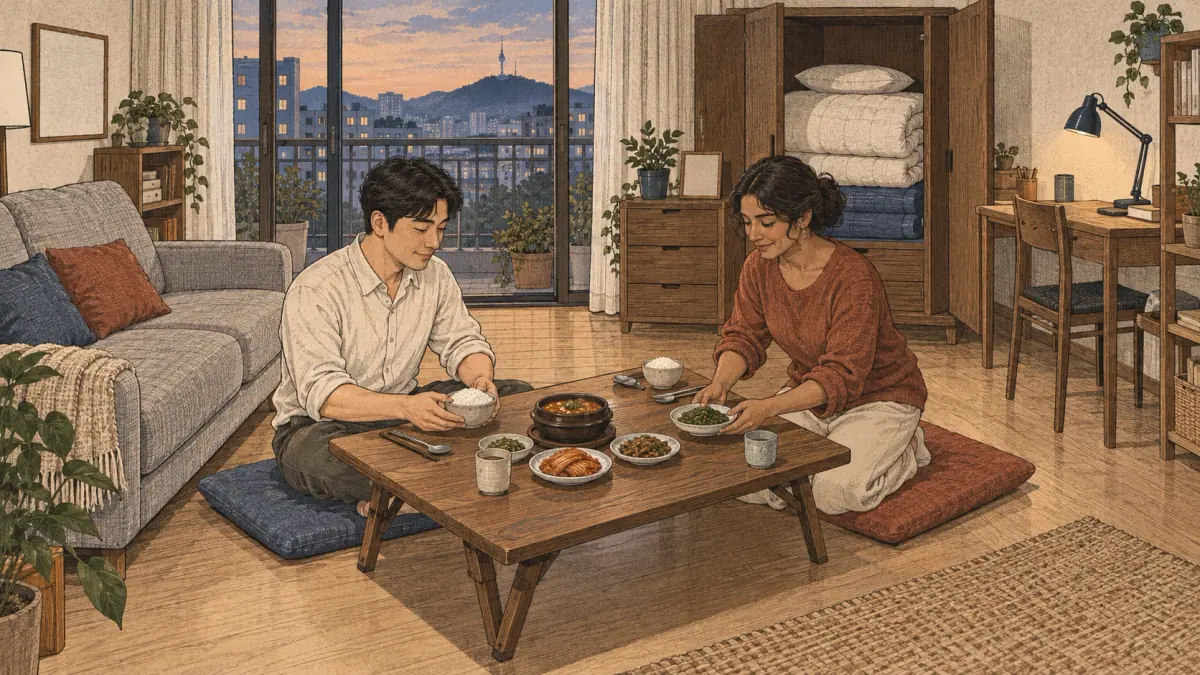
Korean furniture words show how the language mixes sources. Some are Sino-Korean (의자, 책상, 선반), some are loanwords from English (소파, 커튼, 에어컨) and a few are native Korean (서랍, 이불, 거울). A traditional Korean home also uses the floor: people sit on cushions, sleep on a thin mattress and eat at a low table, so the list includes words many English guides skip, such as 방석, 요 and 밥상.
The list holds 40 words. By origin, the list has 5 native Korean, 18 Sino-Korean (built from Chinese-derived syllables), 13 loanwords and 4 mixed. Knowing the origin helps you guess how a new word will behave. The groups are:
| Group | Words | Examples |
|---|---|---|
| Seating and tables | 8 | 의자, 책상, 탁자, 식탁 |
| Storage | 9 | 서랍, 선반, 장, 옷장 |
| Bedding and sleeping | 9 | 침대, 이불, 요, 베개 |
| Lighting and windows | 7 | 전등, 조명, 램프, 스탠드 |
| Appliances in the room | 7 | 텔레비전, 에어컨, 선풍기, 히터 |
The origin column marks each word as native, Sino-Korean or a loanword, so you can see the pattern. Loanwords are quick to learn, because you can guess them from English, but their Korean spelling follows Korean sounds: 소파 is so-pa, not sofa. The floor-living words are the ones to learn carefully, since they have no exact English twin. This list sits inside House and Home, where you can find the related topics.
Which Furniture Words Should You Learn First?
Start with five words that cover a whole room: 의자, 책상, 침대, 이불 and 방석. Press play, then the slow button, and say each word aloud.
의자 (uija) means chair. The first syllable is the vowel ㅢ with no consonant before it, so it keeps its full sound: ui-ja. Example: 의자에 앉아요. (I sit on the chair.)
책상 (chaeksang) means desk. It joins 책 (book) and 상 (table). Say it as [책쌍]: the ㅅ after the final ㄱ becomes tense, and the romanization still reads chaeksang. Example: 책상 위에 책이 있어요. (There is a book on the desk.)
침대 (chimdae) means bed. This is a bed with a frame. Because many Korean homes still use floor bedding, you will often ask the type: 침대예요, 아니면 바닥이에요? (A bed, or the floor?). Example: 침대가 커요. (The bed is big.)
이불 (ibul) means floor bedding or blanket. It is a thick quilted cover or floor bedding. In a Korean home 이불 is used on the floor, and it can mean the whole set of covers. Compare 요, the thin mattress under you. Example: 이불을 덮어요. (I cover myself with a blanket.)
방석 (bangseok) means floor cushion. It is a floor cushion for sitting on, found in homes and restaurants with floor seating. It is flat and thin, not a pillow. Say 방석에 앉으세요 (Please sit on the cushion). Example: 방석에 앉아요. (I sit on a floor cushion.)
Seating and Tables
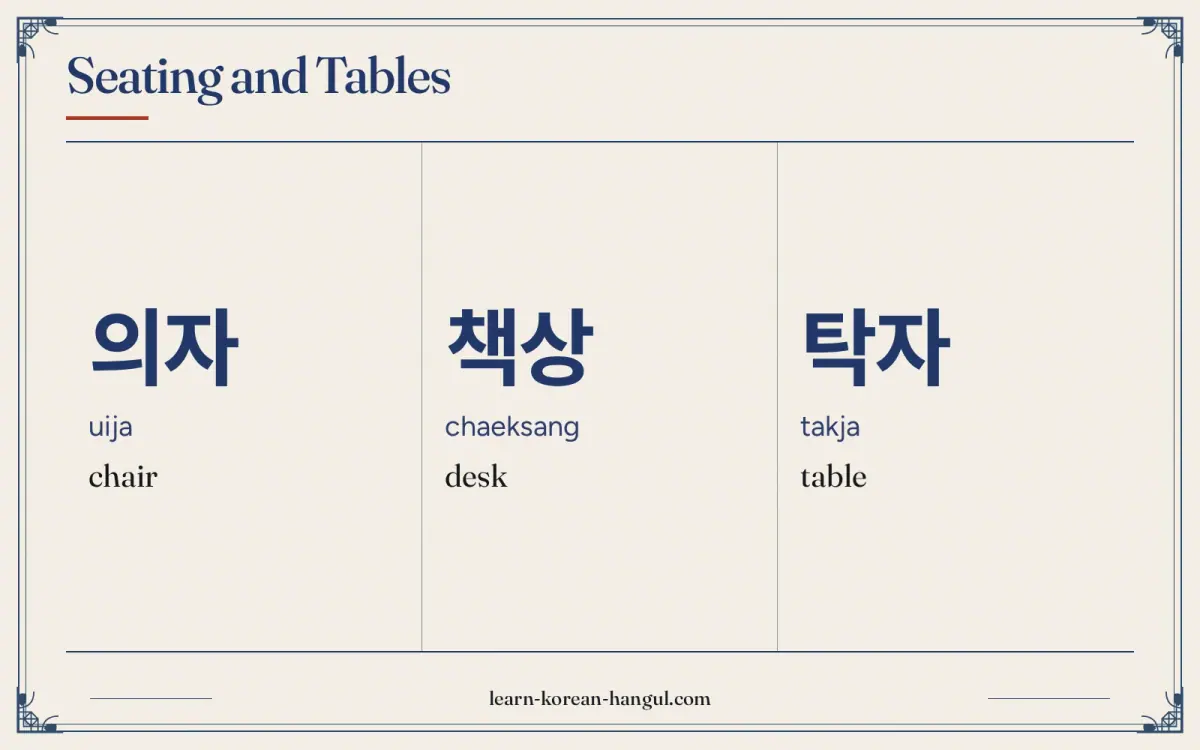
Seating and tables include modern pieces and the traditional low table. Learn all eight and you can describe where people sit and eat.
| No. | Hangul | Revised Romanization | Meaning | Origin | Example sentence | Audio assetId |
|---|---|---|---|---|---|---|
| 1 | 의자 | uija | chair | Sino-Korean | 의자에 앉아요. (uijae anjayo; I sit on the chair.) | au-pg-vocabulary-daily-life-home-furniture-1; example: au-pg-vocabulary-daily-life-home-furniture-101 |
| 2 | 책상 | chaeksang | desk | Sino-Korean | 책상 위에 책이 있어요. (chaeksang wie chaegi isseoyo; There is a book on the desk.) | au-pg-vocabulary-daily-life-home-furniture-2; example: au-pg-vocabulary-daily-life-home-furniture-102 |
| 3 | 탁자 | takja | table | Sino-Korean | 탁자에 컵을 놓아요. (takjae keobeul noayo; I put a cup on the table.) | au-pg-vocabulary-daily-life-home-furniture-3; example: au-pg-vocabulary-daily-life-home-furniture-103 |
| 4 | 식탁 | siktak | dining table | Sino-Korean | 식탁에서 밥을 먹어요. (siktageseo babeul meogeoyo; I eat at the dining table.) | au-pg-vocabulary-daily-life-home-furniture-4; example: au-pg-vocabulary-daily-life-home-furniture-104 |
| 5 | 소파 | sopa | sofa | loanword | 소파에서 텔레비전을 봐요. (sopaeseo tellebijeoneul bwayo; I watch television on the sofa.) | au-pg-vocabulary-daily-life-home-furniture-5; example: au-pg-vocabulary-daily-life-home-furniture-105 |
| 6 | 밥상 | bapsang | low meal table | mixed | 밥상을 차려요. (bapsangeul charyeoyo; I set out the meal table.) | au-pg-vocabulary-daily-life-home-furniture-6; example: au-pg-vocabulary-daily-life-home-furniture-106 |
| 7 | 방석 | bangseok | floor cushion | Sino-Korean | 방석에 앉아요. (bangseoge anjayo; I sit on a floor cushion.) | au-pg-vocabulary-daily-life-home-furniture-7; example: au-pg-vocabulary-daily-life-home-furniture-107 |
| 8 | 쿠션 | kusyeon | cushion | loanword | 쿠션이 부드러워요. (kusyeoni budeureowoyo; The cushion is soft.) | au-pg-vocabulary-daily-life-home-furniture-8; example: au-pg-vocabulary-daily-life-home-furniture-108 |
- 탁자 is a general table, 식탁 is a table for eating and 책상 is a table for study or work. The loanword 테이블 is also common in shops and cafes.
- 밥상 is the low table that is carried in and set up for a meal in a traditional home. 상 on its own means a table or a tray, and 밥상을 차리다 means to prepare a meal.
- 방석 and 쿠션 differ: a 방석 is flat and used for sitting on the floor, while a 쿠션 is a soft cushion on a sofa.
Example Sentences
Furniture is the easiest way to practice position words. The frame is place + 에 + object + 이/가 있어요. For example: 책상 위에 책이 있어요 (There is a book on the desk), 침대 옆에 서랍장이 있어요 (There is a chest of drawers next to the bed), 소파 앞에 탁자가 있어요 (There is a table in front of the sofa), 의자 아래에 가방이 있어요 (There is a bag under the chair) and 창문 옆에 커튼이 있어요 (There is a curtain next to the window). The words 위, 아래, 옆 and 앞 are explained in direction and position words.
How Do You Say Storage in Korean?
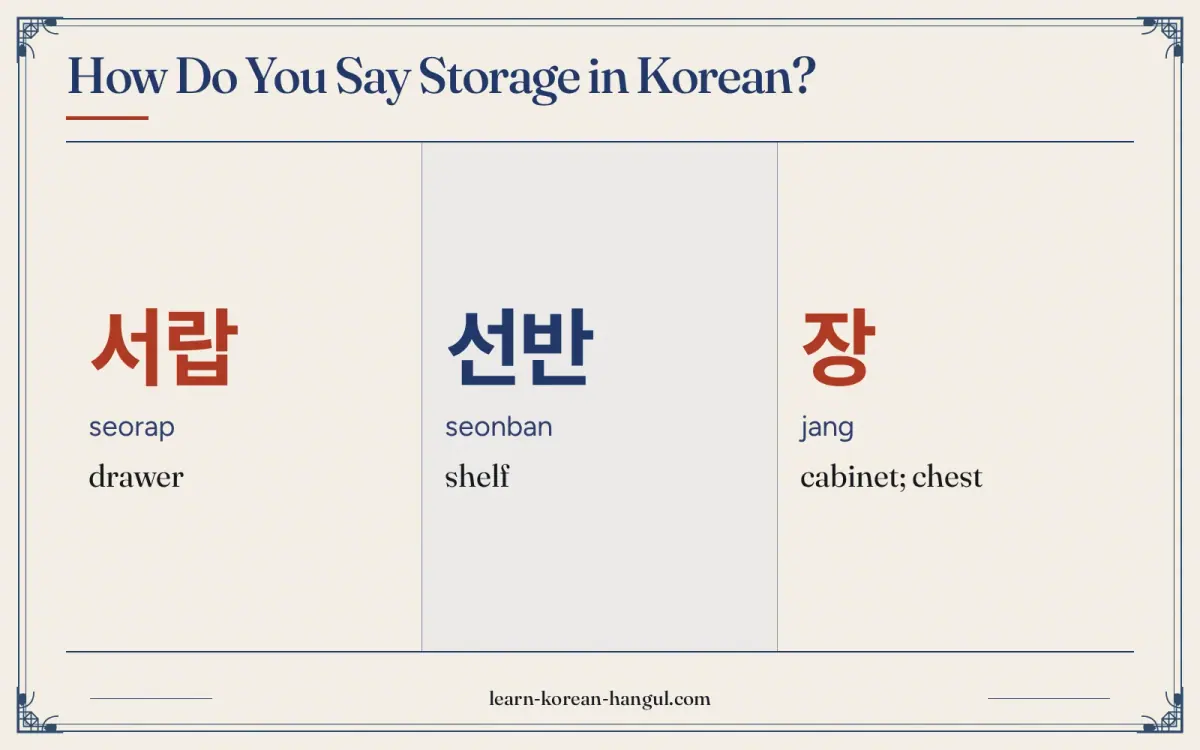
Storage words depend on size and use. Three words cause the most confusion: 서랍 (drawer), 선반 (shelf) and 장 (cabinet or chest).
| No. | Hangul | Revised Romanization | Meaning | Origin | Example sentence | Audio assetId |
|---|---|---|---|---|---|---|
| 9 | 서랍 | seorap | drawer | native | 서랍을 열어요. (seorabeul yeoreoyo; I open the drawer.) | au-pg-vocabulary-daily-life-home-furniture-9; example: au-pg-vocabulary-daily-life-home-furniture-109 |
| 10 | 선반 | seonban | shelf | Sino-Korean | 선반에 책을 놓아요. (seonbane chaegeul noayo; I put books on the shelf.) | au-pg-vocabulary-daily-life-home-furniture-10; example: au-pg-vocabulary-daily-life-home-furniture-110 |
| 11 | 장 | jang | cabinet; chest | Sino-Korean | 장 안에 이불이 있어요. (jang ane iburi isseoyo; There is bedding in the chest.) | au-pg-vocabulary-daily-life-home-furniture-11; example: au-pg-vocabulary-daily-life-home-furniture-111 |
| 12 | 옷장 | otjang | wardrobe | mixed | 옷장에 옷을 걸어요. (otjange oseul georeoyo; I hang clothes in the wardrobe.) | au-pg-vocabulary-daily-life-home-furniture-12; example: au-pg-vocabulary-daily-life-home-furniture-112 |
| 13 | 책장 | chaekjang | bookcase | Sino-Korean | 책장이 방에 있어요. (chaekjangi bange isseoyo; The bookcase is in the room.) | au-pg-vocabulary-daily-life-home-furniture-13; example: au-pg-vocabulary-daily-life-home-furniture-113 |
| 14 | 서랍장 | seorapjang | chest of drawers | mixed | 서랍장이 침대 옆에 있어요. (seorapjangi chimdae yeope isseoyo; The chest of drawers is next to the bed.) | au-pg-vocabulary-daily-life-home-furniture-14; example: au-pg-vocabulary-daily-life-home-furniture-114 |
| 15 | 신발장 | sinbaljang | shoe cabinet | mixed | 신발장이 현관에 있어요. (sinbaljangi hyeongwane isseoyo; The shoe cabinet is in the entryway.) | au-pg-vocabulary-daily-life-home-furniture-15; example: au-pg-vocabulary-daily-life-home-furniture-115 |
| 16 | 화장대 | hwajangdae | dressing table | Sino-Korean | 화장대 앞에 앉아요. (hwajangdae ape anjayo; I sit in front of the dressing table.) | au-pg-vocabulary-daily-life-home-furniture-16; example: au-pg-vocabulary-daily-life-home-furniture-116 |
| 17 | 거울 | geoul | mirror | native | 거울을 봐요. (geoureul bwayo; I look in the mirror.) | au-pg-vocabulary-daily-life-home-furniture-17; example: au-pg-vocabulary-daily-life-home-furniture-117 |
- 서랍 is a drawer inside a piece of furniture, 선반 is an open shelf fixed to a wall or a frame, and 장 is a larger cabinet or chest. Many furniture names end in 장: 옷장, 책장, 서랍장, 신발장.
- 신발장 is a shoe cabinet, found at the 현관, the entryway where Koreans take off their shoes before stepping up into the home.
- 화장대 is a dressing table with a mirror, used for makeup. The word 거울 on its own means any mirror.
Bedding and Sleeping
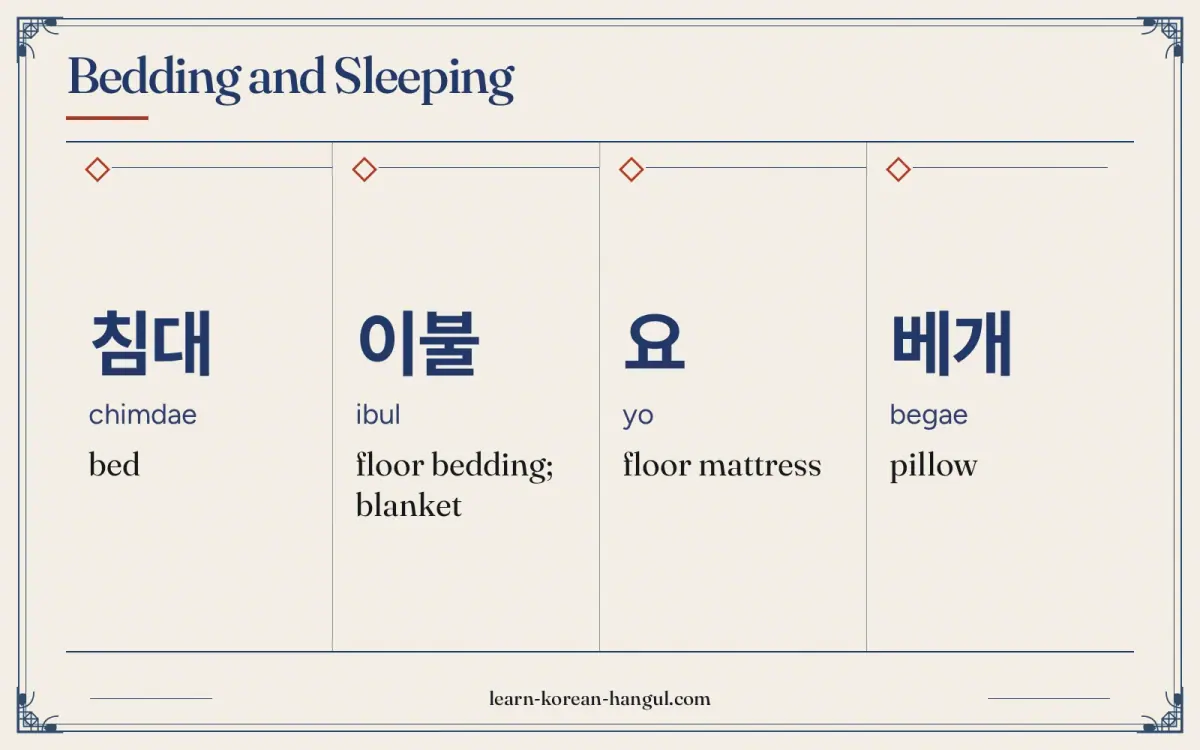
Bedding words show the most difference from English. Koreans use beds, but many also sleep on a floor mattress, and the floor itself can be heated.
| No. | Hangul | Revised Romanization | Meaning | Origin | Example sentence | Audio assetId |
|---|---|---|---|---|---|---|
| 18 | 침대 | chimdae | bed | Sino-Korean | 침대가 커요. (chimdaega keoyo; The bed is big.) | au-pg-vocabulary-daily-life-home-furniture-18; example: au-pg-vocabulary-daily-life-home-furniture-118 |
| 19 | 이불 | ibul | floor bedding; blanket | native | 이불을 덮어요. (ibureul deopeoyo; I cover myself with a blanket.) | au-pg-vocabulary-daily-life-home-furniture-19; example: au-pg-vocabulary-daily-life-home-furniture-119 |
| 20 | 요 | yo | floor mattress | Sino-Korean | 요를 깔아요. (yoreul kkarayo; I lay out the floor mattress.) | au-pg-vocabulary-daily-life-home-furniture-20; example: au-pg-vocabulary-daily-life-home-furniture-120 |
| 21 | 베개 | begae | pillow | native | 베개가 높아요. (begaega nopayo; The pillow is high.) | au-pg-vocabulary-daily-life-home-furniture-21; example: au-pg-vocabulary-daily-life-home-furniture-121 |
| 22 | 매트리스 | maeteuriseu | mattress | loanword | 매트리스가 딱딱해요. (maeteuriseuga ttakttakaeyo; The mattress is hard.) | au-pg-vocabulary-daily-life-home-furniture-22; example: au-pg-vocabulary-daily-life-home-furniture-122 |
| 23 | 시트 | siteu | bed sheet | loanword | 시트를 갈아요. (siteureul garayo; I change the sheet.) | au-pg-vocabulary-daily-life-home-furniture-23; example: au-pg-vocabulary-daily-life-home-furniture-123 |
| 24 | 침구 | chimgu | bedding | Sino-Korean | 침구를 세탁해요. (chimgureul setakaeyo; I wash the bedding.) | au-pg-vocabulary-daily-life-home-furniture-24; example: au-pg-vocabulary-daily-life-home-furniture-124 |
| 25 | 온돌 | ondol | underfloor heating | Sino-Korean | 온돌 바닥은 따뜻해요. (ondol badageun ttatteutaeyo; An ondol floor is warm.) | au-pg-vocabulary-daily-life-home-furniture-25; example: au-pg-vocabulary-daily-life-home-furniture-125 |
| 26 | 바닥 | badak | floor | native | 바닥에 앉아요. (badage anjayo; I sit on the floor.) | au-pg-vocabulary-daily-life-home-furniture-26; example: au-pg-vocabulary-daily-life-home-furniture-126 |
- 요 is a one-syllable word: the thin mattress laid on the floor, with 이불 on top. Together they are called 이부자리, the bedding set.
- 온돌 is the traditional floor-heating system that warms the room from below. Modern homes use pipes with hot water from a 보일러, but the idea is still called 온돌.
- 침구 is the shop word for a bedding set. A store sign 침구류 means bedding goods.
How Do You Say Lighting and Windows in Korean?
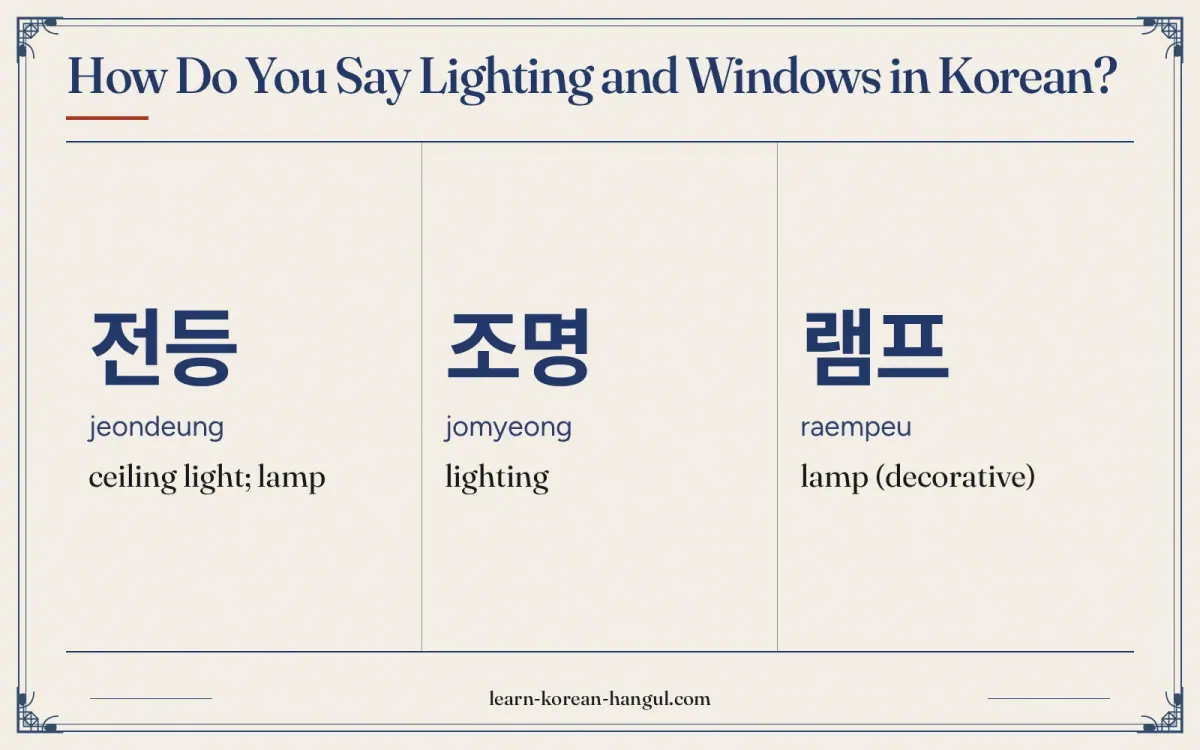
This group covers the lights you switch on and the windows you cover. Most of the words are loanwords or short Sino-Korean nouns.
| No. | Hangul | Revised Romanization | Meaning | Origin | Example sentence | Audio assetId |
|---|---|---|---|---|---|---|
| 27 | 전등 | jeondeung | ceiling light; lamp | Sino-Korean | 전등을 켜요. (jeondeungeul kyeoyo; I turn on the light.) | au-pg-vocabulary-daily-life-home-furniture-27; example: au-pg-vocabulary-daily-life-home-furniture-127 |
| 28 | 조명 | jomyeong | lighting | Sino-Korean | 조명이 밝아요. (jomyeongi balgayo; The lighting is bright.) | au-pg-vocabulary-daily-life-home-furniture-28; example: au-pg-vocabulary-daily-life-home-furniture-128 |
| 29 | 램프 | raempeu | lamp (decorative) | loanword | 책상 위에 램프가 있어요. (chaeksang wie raempeuga isseoyo; There is a lamp on the desk.) | au-pg-vocabulary-daily-life-home-furniture-29; example: au-pg-vocabulary-daily-life-home-furniture-129 |
| 30 | 스탠드 | seutaendeu | desk lamp; floor lamp | loanword | 스탠드를 꺼요. (seutaendeureul kkeoyo; I turn off the lamp.) | au-pg-vocabulary-daily-life-home-furniture-30; example: au-pg-vocabulary-daily-life-home-furniture-130 |
| 31 | 커튼 | keoteun | curtain | loanword | 커튼을 닫아요. (keoteuneul dadayo; I close the curtain.) | au-pg-vocabulary-daily-life-home-furniture-31; example: au-pg-vocabulary-daily-life-home-furniture-131 |
| 32 | 창문 | changmun | window | Sino-Korean | 창문을 열어요. (changmuneul yeoreoyo; I open the window.) | au-pg-vocabulary-daily-life-home-furniture-32; example: au-pg-vocabulary-daily-life-home-furniture-132 |
| 33 | 블라인드 | beullaindeu | blinds | loanword | 블라인드를 올려요. (beullaindeureul ollyeoyo; I raise the blinds.) | au-pg-vocabulary-daily-life-home-furniture-33; example: au-pg-vocabulary-daily-life-home-furniture-133 |
- 전등 is the general word for an electric light. 램프 usually points to a decorative lamp, and 스탠드 is a lamp that stands on a desk or the floor.
- The verbs go with the light: 켜다 (turn on) and 끄다 (turn off). The same pair works for TV, air conditioners and computers.
- 창문 is the window pane and frame. When you mean the glass, use 유리.
Appliances in the Room
Appliances in a Korean room are mostly loanwords, with a few Sino-Korean nouns. Heating and cooling words matter because the seasons are strong.
| No. | Hangul | Revised Romanization | Meaning | Origin | Example sentence | Audio assetId |
|---|---|---|---|---|---|---|
| 34 | 텔레비전 | tellebijeon | television | loanword | 텔레비전을 봐요. (tellebijeoneul bwayo; I watch television.) | au-pg-vocabulary-daily-life-home-furniture-34; example: au-pg-vocabulary-daily-life-home-furniture-134 |
| 35 | 에어컨 | eeokeon | air conditioner | loanword | 에어컨을 켜요. (eeokeoneul kyeoyo; I turn on the air conditioner.) | au-pg-vocabulary-daily-life-home-furniture-35; example: au-pg-vocabulary-daily-life-home-furniture-135 |
| 36 | 선풍기 | seonpunggi | electric fan | Sino-Korean | 선풍기가 돌아가요. (seonpunggiga doragayo; The fan is spinning.) | au-pg-vocabulary-daily-life-home-furniture-36; example: au-pg-vocabulary-daily-life-home-furniture-136 |
| 37 | 히터 | hiteo | heater | loanword | 히터를 틀어요. (hiteoreul teureoyo; I turn on the heater.) | au-pg-vocabulary-daily-life-home-furniture-37; example: au-pg-vocabulary-daily-life-home-furniture-137 |
| 38 | 가습기 | gaseupgi | humidifier | Sino-Korean | 가습기를 사용해요. (gaseupgireul sayonghaeyo; I use a humidifier.) | au-pg-vocabulary-daily-life-home-furniture-38; example: au-pg-vocabulary-daily-life-home-furniture-138 |
| 39 | 컴퓨터 | keompyuteo | computer | loanword | 컴퓨터는 책상 위에 있어요. (keompyuteoneun chaeksang wie isseoyo; The computer is on the desk.) | au-pg-vocabulary-daily-life-home-furniture-39; example: au-pg-vocabulary-daily-life-home-furniture-139 |
| 40 | 보일러 | boilleo | boiler | loanword | 보일러를 켜요. (boilleoreul kyeoyo; I turn on the boiler.) | au-pg-vocabulary-daily-life-home-furniture-40; example: au-pg-vocabulary-daily-life-home-furniture-140 |
- 텔레비전 is the full form, and 티비 (TV) is common in speech. 에어컨 is a short form of the English phrase air conditioner.
- 보일러 heats the floor in many homes. In winter, people say 보일러를 틀어요 to switch the heating on.
- 선풍기 is a fan. Some people also use the loanword 팬, but 선풍기 is the everyday choice.
How Do You Pronounce These Words?
Five of these words show common Korean sound rules. The table gives the Revised Romanization, the way the word is said and the rule, following the Standard Pronunciation rules (표준 발음법) of the 국립국어원.
| Word | Romanization | Said | Rule |
|---|---|---|---|
| 의자 | uija | [의자] | ㅢ in a first syllable with no consonant before it keeps its sound |
| 책상 | chaeksang | [책쌍] | ㅅ after ㄱ becomes tense |
| 밥상 | bapsang | [밥쌍] | ㅅ after ㅂ becomes tense |
| 옷장 | otjang | [옫짱] | final ㅅ closes as [ㄷ], then ㅈ becomes tense |
| 서랍장 | seorapjang | [서랍짱] | ㅈ after ㅂ becomes tense |
Revised Romanization is the official romanization system of South Korea, announced on 7 July 2000. It follows most sound changes, but it does not show tensing caused by a neighbouring sound, so it is only a learning aid. Always read the Hangul as well.
Audio and Slow Playback
Each headword and each example sentence has its own audio clip, and the 5 words in the first-words section also have a slow clip at 0.8 times the speed. Nothing plays until you press a button. Listen once, repeat aloud, and only then check the romanization.
What Mistakes Do Learners Make with Furniture Words?
- Using 이/가 instead of 에 for the place. Say 책상 위에 책이 있어요, not 책상 위가 책이 있어요.
- Mixing 서랍, 선반 and 장. A 서랍 slides out, a 선반 is open, and a 장 is a bigger cabinet.
- Treating 이불 as only a blanket. In a Korean home 이불 is also the main bedding, and 요 is the mattress under it.
- Using 침대 for any bed. If you sleep on the floor, say 바닥에서 자요 (I sleep on the floor).
- Saying the loanwords like English. Say 소파 as so-pa and 커튼 as keo-teun, with Korean vowels, not as English sofa and curtain.
Practice: Flashcards and Worksheet
Drill these 40 words with the vocabulary flashcard decks: each card shows the Hangul on one side and the meaning on the other, so you can test recall instead of recognition. Print a labelling sheet from the vocabulary worksheets and write the Korean word for each numbered object in the scene above. A simple plan is to learn 8 to 10 words a day: read the table, press play, say the word, cover the English, then write one sentence of your own. Come back after a day and again after a week.
Self-Test: 10 Sentences
Fill each blank with a word from this page. Say the whole sentence aloud when you have it. The answers follow the test.
- ___에 앉아요. (I sit on the chair.)
- ___에서 텔레비전을 봐요. (I watch television on the sofa.)
- ___을 열어요. (I open the drawer.)
- ___이 방에 있어요. (The bookcase is in the room.)
- ___을 봐요. (I look in the mirror.)
- ___가 높아요. (The pillow is high.)
- ___ 바닥은 따뜻해요. (An ondol floor is warm.)
- 책상 위에 ___가 있어요. (There is a lamp on the desk.)
- ___를 올려요. (I raise the blinds.)
- ___를 틀어요. (I turn on the heater.)
Answers: 1. 의자; 2. 소파; 3. 서랍; 4. 책장; 5. 거울; 6. 베개; 7. 온돌; 8. 램프; 9. 블라인드; 10. 히터.
A score of 8 or more suggests the words are settling in. If you scored lower, reread the groups where you missed words.
Where to Go Next
After furniture, many learners move on to Korean Kitchen Vocabulary and then Korean Bathroom Vocabulary. This list sits inside House and Home.
FAQ
How Do You Say Chair in Korean?
Say 의자 (uija). Put the place before it with 에: 의자에 앉아요 means I sit on the chair. The first syllable keeps its full ㅢ sound: say [의자], not [이자].
How Do You Pronounce 책상 (chaeksang)?
책상 is read chaeksang and said [책쌍]. The final ㄱ closes the first syllable, and the ㅅ that follows becomes tense. The vowel ㅐ is like the e in English "bed".
How Many Furniture Words Should I Learn First?
Learn the 17 words in the first two groups (seating and storage) first, because they cover the most common rooms. At 8 to 10 new words a day that takes two days; add bedding, lighting and appliances over the next three days, and keep reviewing for a week.
Where Can I Practise Furniture Words with Flashcards?
Use the vocabulary flashcard decks. Start with the first 10 words of this page, then add 10 more each day. Review the older cards before you add new ones, so the earlier words do not fade.
Is the Romanization on This Page Official?
Yes, as a learning aid. It follows the Revised Romanization of Korean, the system South Korea has officially used since 7 July 2000, and the page also gives the Hangul for every word. It follows most sound changes, but it does not show tensing caused by a neighbouring sound: 책상 is written chaeksang but said [책쌍]. Treat the Hangul as the real spelling.
Is There a Printable Worksheet for Furniture Words?
The vocabulary worksheets page lists the printable sheets. The sheet for this topic is a labelling task built on the same illustrated scene as this page, so you write the Korean word next to each numbered object.