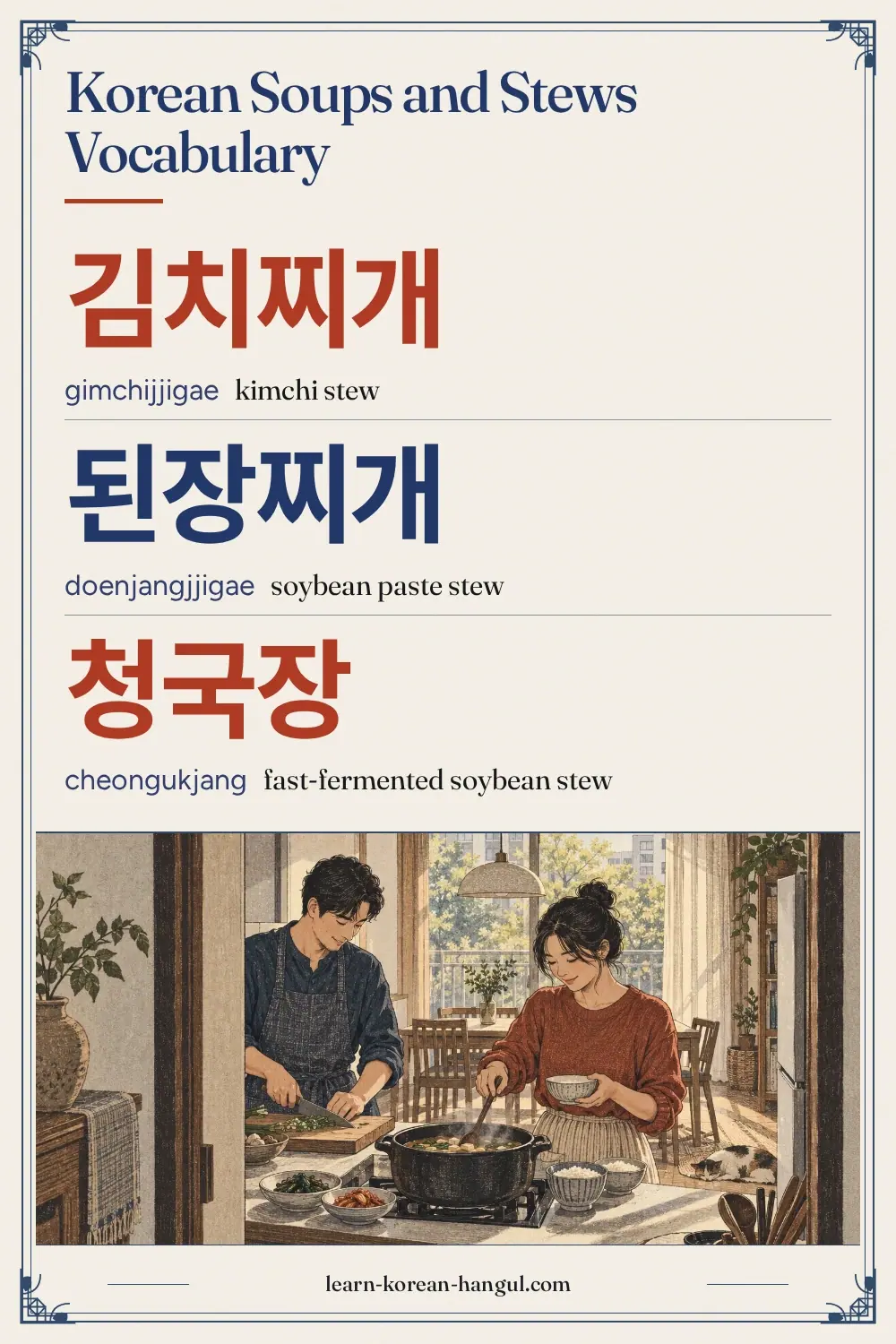
Korean Soups and Stews Vocabulary at a Glance
This list has 25 words in five groups of five. The first four groups are stews sorted by their base: kimchi, fermented soybean paste, seafood and tofu. The last group covers 부대찌개 and the tools that go with it. The page is part of Korean Dishes and works with the page on soups, which lists the lighter dishes.
| Group | Words | Use |
|---|---|---|
| Kimchi stew family | 5 | Naming stews made from kimchi |
| Soybean stews | 5 | Naming stews and pastes made from fermented soybeans |
| Seafood stews | 5 | Naming stews made from fish and shellfish |
| Tofu stews | 5 | Naming stews built around tofu and soy |
| Army stew and fusion | 5 | Naming 부대찌개 and the items that go in the pot |
Learners often mix up 찌개, 국 and 탕, so the page includes a short comparison after the soybean group. If you learn only one rule, learn this: when the dish name ends in 찌개, the pot comes to the table bubbling and everyone eats from it with their own spoon.
Which Stew Names Should You Learn First?
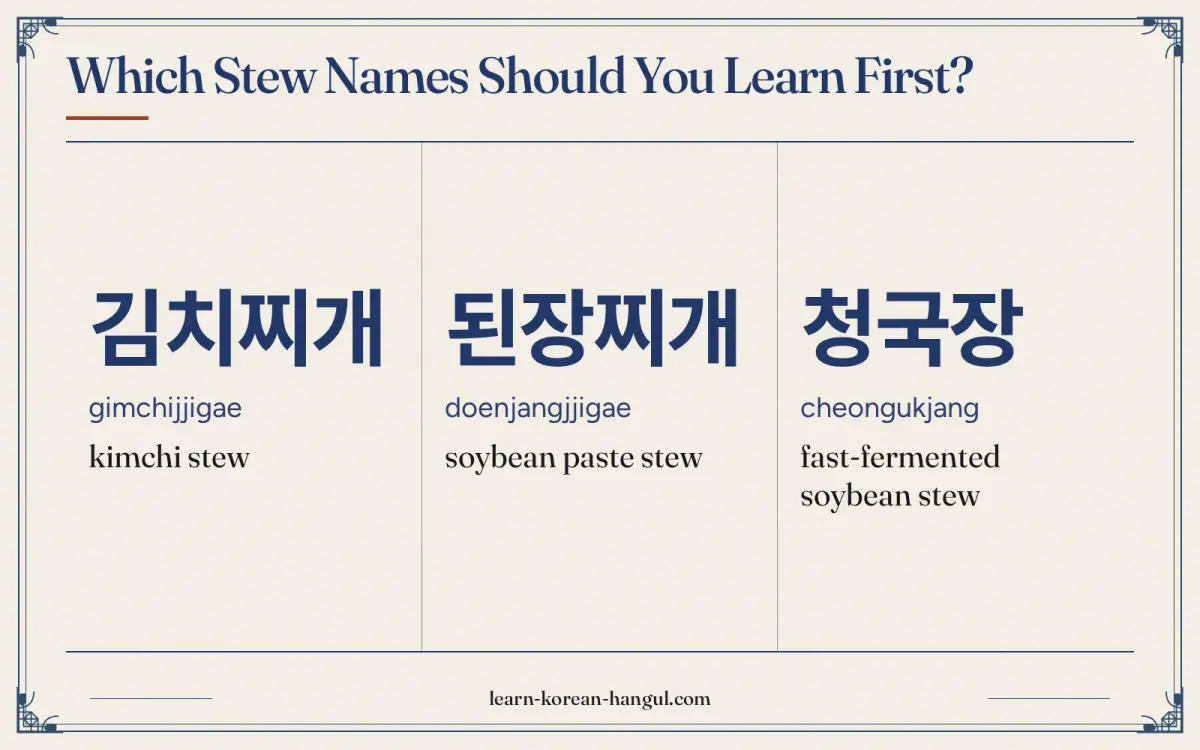
Learn 찌개 (stew), 김치찌개 (kimchi stew), 된장찌개 (soybean paste stew), 순두부찌개 (soft tofu stew) and 부대찌개 (army stew) first. These four stews are on most Korean stew menus. With 찌개 as the base word, you can read the rest of the list, because every other stew name is built the same way.
- Words to say. 김치찌개, 된장찌개, 순두부찌개. These are the orders you will use most.
- Words to recognise. 청국장, 동태찌개, 비지찌개, 해물찌개. They appear on set menus and in specialist restaurants.
- Words for the table. 뚝배기, 사리, 인분. They help you order extras and read a bill.
A stew usually arrives with rice and small side dishes. The rice is eaten with a spoonful of stew at a time, and the pot stays in the middle of the table.
Word · 8
- 1
김치찌개
gimchijjigae
kimchi stew
- 2
된장찌개
doenjangjjigae
soybean paste stew
- 3
청국장
cheongukjang
fast-fermented soybean stew
- 4
동태찌개
dongtaejjigae
frozen pollock stew
- 5
순두부찌개
sundubujjigae
soft tofu stew
- 6
부대찌개
budaejjigae
army stew
- 7
사리
sari
extra noodles; add-on
- 8
뚝배기
ttukbaegi
earthenware pot
Kimchi Stew Family
Kimchi stew is the stew most visitors meet first. It is made from sour, well-fermented kimchi simmered with pork or tuna, tofu and onion. Because the base is kimchi, the stew tastes sour, salty and spicy at once. The word 찌개 itself means a stew, so every dish in this group is the base word with an ingredient in front of it.
| No. | Hangul | Revised Romanization | Meaning and note | Example sentence | Audio assetId |
|---|---|---|---|---|---|
| 1 | 찌개 | jjigae | stew. A thick, salty stew cooked in a small pot and shared at the table. | 찌개를 끓여요. (I boil a stew.) | au-pg-vocabulary-food-korean-dishes-jjigae-1; example: au-pg-vocabulary-food-korean-dishes-jjigae-26 |
| 2 | 김치찌개 | gimchijjigae | kimchi stew. The best-known stew; made with sour kimchi and pork or tuna. | 김치찌개 주세요. (Kimchi stew, please.) | au-pg-vocabulary-food-korean-dishes-jjigae-2; example: au-pg-vocabulary-food-korean-dishes-jjigae-27 |
| 3 | 참치김치찌개 | chamchigimchijjigae | tuna kimchi stew. A milder version made with canned tuna instead of pork. | 참치김치찌개가 맛있어요. (The tuna kimchi stew is tasty.) | au-pg-vocabulary-food-korean-dishes-jjigae-3; example: au-pg-vocabulary-food-korean-dishes-jjigae-28 |
| 4 | 묵은지찌개 | mugeunjijjigae | aged kimchi stew. Said [무근지찌개]. Made from kimchi aged a year or more; the taste is deep and sour. | 묵은지찌개를 좋아해요. (I like aged kimchi stew.) | au-pg-vocabulary-food-korean-dishes-jjigae-4; example: au-pg-vocabulary-food-korean-dishes-jjigae-29 |
| 5 | 김치찜 | gimchijjim | braised kimchi. Whole kimchi braised with pork until soft; has little liquid. | 김치찜을 먹어요. (I eat braised kimchi.) | au-pg-vocabulary-food-korean-dishes-jjigae-5; example: au-pg-vocabulary-food-korean-dishes-jjigae-30 |
Example Sentences
Three frames cover most of the examples. The first is noun + 주세요 (please give me noun), the polite way to order, as in 김치찌개 주세요. The second is noun + 이/가 + adjective, as in 고추장찌개가 매워요 (the chilli paste stew is spicy). The third is noun + 을/를 + verb, as in 두부를 넣어요 (I add tofu). The verb 끓이다 (to boil) becomes 끓여요 in the polite present. Play each clip, then say the sentence aloud.
The pattern is ingredient + 찌개, and it holds across the whole list. 김치 + 찌개 gives 김치찌개, and 참치 (tuna) + 김치찌개 gives 참치김치찌개. Note that 김치찜 ends in 찜, which means steamed or braised, because it has little liquid and is a drier dish.
How Do You Say Soybean Stews in Korean?
Fermented soybean paste, called 된장 (doenjang), is a base of Korean home cooking. Doenjang is made from fermented soybeans and salt, and it gives stews a savoury, earthy taste. The adjective 구수하다 describes that taste: nutty, earthy and comforting. The strongest relative is 청국장, a stew from soybeans fermented for only a few days.
| No. | Hangul | Revised Romanization | Meaning and note | Example sentence | Audio assetId |
|---|---|---|---|---|---|
| 6 | 된장찌개 | doenjangjjigae | soybean paste stew. Made with doenjang, tofu, zucchini and onion; the standard home stew. | 된장찌개는 구수해요. (The soybean paste stew is savoury.) | au-pg-vocabulary-food-korean-dishes-jjigae-6; example: au-pg-vocabulary-food-korean-dishes-jjigae-31 |
| 7 | 된장 | doenjang | fermented soybean paste. The paste itself; also the base of 된장국. | 된장은 콩으로 만들어요. (Soybean paste is made from beans.) | au-pg-vocabulary-food-korean-dishes-jjigae-7; example: au-pg-vocabulary-food-korean-dishes-jjigae-32 |
| 8 | 청국장 | cheongukjang | fast-fermented soybean stew. Said [청국짱]. A strong-smelling stew from quickly fermented soybeans. | 청국장은 냄새가 강해요. (Fast-fermented soybean stew has a strong smell.) | au-pg-vocabulary-food-korean-dishes-jjigae-8; example: au-pg-vocabulary-food-korean-dishes-jjigae-33 |
| 9 | 강된장 | gangdoenjang | thick soybean paste sauce. A thick, almost dry paste with vegetables; eaten with rice and leaves. | 강된장에 밥을 비벼요. (I mix rice with the thick soybean paste.) | au-pg-vocabulary-food-korean-dishes-jjigae-9; example: au-pg-vocabulary-food-korean-dishes-jjigae-34 |
| 10 | 고추장찌개 | gochujangjjigae | chilli paste stew. A spicy stew with gochujang, potatoes and zucchini. | 고추장찌개가 매워요. (The chilli paste stew is spicy.) | au-pg-vocabulary-food-korean-dishes-jjigae-10; example: au-pg-vocabulary-food-korean-dishes-jjigae-35 |
The two words 된장 (the paste) and 된장찌개 (the stew) are close. You say 된장 for the ingredient you buy and 된장찌개 for the dish you order. 고추장 (red chilli paste) is the other paste. 고추장찌개 uses it, so it tastes spicy, not earthy.
What Is the Difference between 찌개, 국 and 탕?
Three words are often translated as soup, and they are not the same dish. Use this table to pick the right one when you order or read a menu.
| Word | Texture and strength | How it is served | Example |
|---|---|---|---|
| 찌개 (jjigae) | thick, salty, strong | one small pot, often shared | 김치찌개 |
| 국 (guk) | lighter, more broth | one bowl per person | 미역국 |
| 탕 (tang) | hot, often meaty, rich | a large bowl, often for one or a few | 갈비탕 |
So 된장찌개 is a stew, but 된장국 is a thinner soup made from the same paste. Also, 탕 is used for some dishes that look like stews, such as 매운탕, so the label is a guide and not a strict rule. The soups page lists the 국 and 탕 dishes in detail.
Seafood Stews
Seafood stews have a lighter broth than kimchi or soybean stews. The broth tastes of the sea and is usually seasoned with chilli flakes and radish. The adjective for the taste is 시원하다, which means refreshing and clean here. Korean uses it for broths that feel good after a long day.
| No. | Hangul | Revised Romanization | Meaning and note | Example sentence | Audio assetId |
|---|---|---|---|---|---|
| 11 | 동태찌개 | dongtaejjigae | frozen pollock stew. Pollock, radish and tofu in a spicy clear broth. | 동태찌개가 시원해요. (The pollock stew is refreshing.) | au-pg-vocabulary-food-korean-dishes-jjigae-11; example: au-pg-vocabulary-food-korean-dishes-jjigae-36 |
| 12 | 해물찌개 | haemuljjigae | seafood stew. Squid, shrimp and clams in a red broth; usually ordered for two. | 해물찌개 이 인분 주세요. (Two portions of seafood stew, please.) | au-pg-vocabulary-food-korean-dishes-jjigae-12; example: au-pg-vocabulary-food-korean-dishes-jjigae-37 |
| 13 | 꽃게찌개 | kkotgejjigae | blue crab stew. Said [꼳께찌개]. Blue crab simmered in a spicy or soybean-based broth. | 꽃게찌개를 먹어요. (I eat blue crab stew.) | au-pg-vocabulary-food-korean-dishes-jjigae-13; example: au-pg-vocabulary-food-korean-dishes-jjigae-38 |
| 14 | 생선찌개 | saengseonjjigae | fish stew. A general name for stew from any fish; the fish varies by restaurant. | 생선찌개를 끓여요. (I boil a fish stew.) | au-pg-vocabulary-food-korean-dishes-jjigae-14; example: au-pg-vocabulary-food-korean-dishes-jjigae-39 |
| 15 | 매운탕 | maeuntang | spicy fish soup. A hot, red fish soup; the name means spicy soup. | 매운탕은 얼큰해요. (The spicy fish soup is hot and spicy.) | au-pg-vocabulary-food-korean-dishes-jjigae-15; example: au-pg-vocabulary-food-korean-dishes-jjigae-40 |
One word here, 매운탕, ends in 탕 and not 찌개. It is a spicy fish soup that sits on the border of stew and soup. In practice, people order it in the same restaurants as the seafood stews, so it is listed here. If the dish is served bubbling in the middle of the table and shared, think of it as a stew.
How Do You Say Tofu Stews in Korean?
Tofu stews are gentle and filling. 두부 (dubu) is firm tofu, and 순두부 (sundubu) is soft tofu that has not yet been pressed, so it breaks into soft curds. The soft kind gives the famous 순두부찌개 its silky texture. A raw egg is often cracked into the hot pot at the table, and it cooks in the broth while you eat.
| No. | Hangul | Revised Romanization | Meaning and note | Example sentence | Audio assetId |
|---|---|---|---|---|---|
| 16 | 순두부찌개 | sundubujjigae | soft tofu stew. Soft tofu in a spicy red broth with seafood or pork; cracked egg on top. | 순두부찌개 하나 주세요. (One soft tofu stew, please.) | au-pg-vocabulary-food-korean-dishes-jjigae-16; example: au-pg-vocabulary-food-korean-dishes-jjigae-41 |
| 17 | 순두부 | sundubu | soft tofu. Unpressed tofu curds; also eaten plain with soy sauce. | 순두부는 부드러워요. (Soft tofu is smooth.) | au-pg-vocabulary-food-korean-dishes-jjigae-17; example: au-pg-vocabulary-food-korean-dishes-jjigae-42 |
| 18 | 두부 | dubu | tofu. Firm tofu; the general word for tofu. | 두부를 넣어요. (I add tofu.) | au-pg-vocabulary-food-korean-dishes-jjigae-18; example: au-pg-vocabulary-food-korean-dishes-jjigae-43 |
| 19 | 두부찌개 | dubujjigae | tofu stew. A simple stew with sliced tofu and a light seasoning. | 두부찌개를 좋아해요. (I like tofu stew.) | au-pg-vocabulary-food-korean-dishes-jjigae-19; example: au-pg-vocabulary-food-korean-dishes-jjigae-44 |
| 20 | 비지찌개 | bijijjigae | ground soybean stew. Made from the pulp left after tofu is made; thick and grainy. | 비지찌개를 먹어요. (I eat ground soybean stew.) | au-pg-vocabulary-food-korean-dishes-jjigae-20; example: au-pg-vocabulary-food-korean-dishes-jjigae-45 |
비지찌개 uses 비지, the pulp left over when tofu is made, so it is thick and grainy, with a mild nutty taste. If you want a stew that is not very spicy, tofu stews are a good starting point, and you can change the heat when you order.
How Do You Order a Stew and Ask for Less Heat?
Stews are ordered by portion. The counter is 인분 (inbun), used with Sino-Korean numbers: 일 인분 is one portion and 이 인분 is two. Some restaurants set a minimum of two portions for a pot, so check the menu. Rice is usually served with the stew, and an extra bowl of rice is 공깃밥, often written 공기밥 on menus.
For heat, use these three requests. They all end in the polite 주세요 or 해 주세요.
| You want | You say | Meaning |
|---|---|---|
| not spicy | 안 맵게 해 주세요 | please make it not spicy |
| regular heat | 보통으로 주세요 | the regular level, please |
| spicy | 맵게 해 주세요 | please make it spicy |
The word 맵다 (to be spicy) changes to 매워요 in the polite present, which is why you hear 매워요 so often. Say 안 매워요 to report that a dish is not spicy.
Army Stew and Fusion
부대찌개 is a modern stew with ham, sausages, kimchi, noodles and cheese. The first part, 부대, means an army unit or base. A common account says the dish grew from using leftover and imported processed meats in the years after the Korean War, which is why the name carries the word for the military. Treat that story as a local explanation, not a settled fact.
| No. | Hangul | Revised Romanization | Meaning and note | Example sentence | Audio assetId |
|---|---|---|---|---|---|
| 21 | 부대찌개 | budaejjigae | army stew. Spicy stew with ham, sausage, kimchi and instant noodles. | 부대찌개에 라면을 넣어요. (I put instant noodles in the army stew.) | au-pg-vocabulary-food-korean-dishes-jjigae-21; example: au-pg-vocabulary-food-korean-dishes-jjigae-46 |
| 22 | 햄 | haem | ham. A loanword from English; the pink processed meat in the stew. | 햄을 넣어요. (I add ham.) | au-pg-vocabulary-food-korean-dishes-jjigae-22; example: au-pg-vocabulary-food-korean-dishes-jjigae-47 |
| 23 | 스팸 | seupaem | canned ham (Spam). The canned brand; a common ingredient in 부대찌개. | 스팸을 구워요. (I fry Spam.) | au-pg-vocabulary-food-korean-dishes-jjigae-23; example: au-pg-vocabulary-food-korean-dishes-jjigae-48 |
| 24 | 사리 | sari | extra noodles; add-on. A serving of noodles added to a stew. | 라면 사리 추가해 주세요. (Please add extra ramyeon noodles.) | au-pg-vocabulary-food-korean-dishes-jjigae-24; example: au-pg-vocabulary-food-korean-dishes-jjigae-49 |
| 25 | 뚝배기 | ttukbaegi | earthenware pot. Said [뚝빼기]. A heavy clay pot that keeps the stew hot at the table. | 뚝배기에 끓여요. (I boil it in an earthenware pot.) | au-pg-vocabulary-food-korean-dishes-jjigae-25; example: au-pg-vocabulary-food-korean-dishes-jjigae-50 |
The last two words are for the table, not the pot. 사리 means an extra serving of noodles added to a stew, and 뚝배기 is the heavy earthenware bowl that keeps the stew boiling. Asking for 라면 사리 (extra ramyeon noodles) is the usual way to extend the meal.
How Do You Pronounce These Words?
Stew names combine several consonant changes. Standard pronunciation follows the National Institute of Korean Language (국립국어원) rules, and the romanization on this page follows the Revised Romanization of Korean, which does not mark every sound change.
| Spelling | Sounds like | What changes |
|---|---|---|
| 청국장 | [청국짱] | After a final ㄱ, the ㅈ of 장 is said as a tense [ㅉ]. |
| 꽃게찌개 | [꼳께찌개] | The final ㅊ of 꽃 is said as [ㄷ], and the ㄱ after it is tense [ㄲ]. |
| 뚝배기 | [뚝빼기] | After the final ㄱ, the ㅂ of 배 is said tight as [ㅃ]. |
| 묵은지찌개 | [무근지찌개] | The final ㄱ of 묵 moves to the vowel of 은 and links. |
| 끓여요 | [끄려요] | The ㅎ in the final ㅀ is silent before a vowel, so the sound is [끄려요]. |
| 순두부찌개 | [순두부찌개] | No change; keep the doubled ㅉ tight in 찌개. |
The tense sounds in 뚝배기 and 청국장 are the ones learners most often miss. Say the second tense sound with a tight throat and no puff of air. The word 찌개 itself always starts with a tense [ㅉ], and the romanization jjigae shows that with a double j.
Audio and Slow Playback
Every word and every example sentence has its own clip. The five clips below replay the trickiest words slowly. Play one, repeat it aloud, then play it again and compare.
What Mistakes Do Learners Make with Stew Names?
These five mistakes are the ones that most often cause a wrong order.
- Calling every hot dish soup. A 찌개 is a stew. If you ask for soup, a server may bring a 국 and not the bubbling pot you expected.
- Writing jjigae with one j. The Revised Romanization is jjigae, with the doubled j for the tense sound. Menus sometimes write jigae, but the double form matches the Hangul.
- Forgetting that stews are for sharing. A pot can be too large for one person. Check whether the menu says 1인분 or 2인분.
- Mixing up 된장 and 고추장. 된장 is soybean paste and 고추장 is chilli paste. The stews taste very different.
- Saying 부대 for the stew. 부대 on its own means army unit. Say 부대찌개 for the dish.
If you learn the ingredient + 찌개 rule and the three heat requests, you can order with confidence in nearly every stew restaurant.
Practice: Flashcards and Worksheet
Study in three steps. First, run the flashcard deck in recognition mode until you recognise each of the 25 words. Second, switch to listening mode. Third, take the quiz. Your progress stays in your browser, and the vocabulary flashcard decks page lists the other decks.
Practice · 55
- 01찌개
Show answer
headword 1: stew
- 02김치찌개
Show answer
headword 2: kimchi stew
- 03참치김치찌개
Show answer
headword 3: tuna kimchi stew
- 04묵은지찌개
Show answer
headword 4: aged kimchi stew
- 05김치찜
Show answer
headword 5: braised kimchi
- 06된장찌개
Show answer
headword 6: soybean paste stew
- 07된장
Show answer
headword 7: fermented soybean paste
- 08청국장
Show answer
headword 8: fast-fermented soybean stew
- 09강된장
Show answer
headword 9: thick soybean paste sauce
- 10고추장찌개
Show answer
headword 10: chilli paste stew
- 11동태찌개
Show answer
headword 11: frozen pollock stew
- 12해물찌개
Show answer
headword 12: seafood stew
- 13꽃게찌개
Show answer
headword 13: blue crab stew
- 14생선찌개
Show answer
headword 14: fish stew
- 15매운탕
Show answer
headword 15: spicy fish soup
- 16순두부찌개
Show answer
headword 16: soft tofu stew
- 17순두부
Show answer
headword 17: soft tofu
- 18두부
Show answer
headword 18: tofu
- 19두부찌개
Show answer
headword 19: tofu stew
- 20비지찌개
Show answer
headword 20: ground soybean stew
- 21부대찌개
Show answer
headword 21: army stew
- 22햄
Show answer
headword 22: ham
- 23스팸
Show answer
headword 23: canned ham (Spam)
- 24사리
Show answer
headword 24: extra noodles; add-on
- 25뚝배기
Show answer
headword 25: earthenware pot
- 26찌개를 끓여요.
Show answer
example sentence for 찌개
- 27김치찌개 주세요.
Show answer
example sentence for 김치찌개
- 28참치김치찌개가 맛있어요.
Show answer
example sentence for 참치김치찌개
- 29묵은지찌개를 좋아해요.
Show answer
example sentence for 묵은지찌개
- 30김치찜을 먹어요.
Show answer
example sentence for 김치찜
- 31된장찌개는 구수해요.
Show answer
example sentence for 된장찌개
- 32된장은 콩으로 만들어요.
Show answer
example sentence for 된장
- 33청국장은 냄새가 강해요.
Show answer
example sentence for 청국장
- 34강된장에 밥을 비벼요.
Show answer
example sentence for 강된장
- 35고추장찌개가 매워요.
Show answer
example sentence for 고추장찌개
- 36동태찌개가 시원해요.
Show answer
example sentence for 동태찌개
- 37해물찌개 이 인분 주세요.
Show answer
example sentence for 해물찌개
- 38꽃게찌개를 먹어요.
Show answer
example sentence for 꽃게찌개
- 39생선찌개를 끓여요.
Show answer
example sentence for 생선찌개
- 40매운탕은 얼큰해요.
Show answer
example sentence for 매운탕
- 41순두부찌개 하나 주세요.
Show answer
example sentence for 순두부찌개
- 42순두부는 부드러워요.
Show answer
example sentence for 순두부
- 43두부를 넣어요.
Show answer
example sentence for 두부
- 44두부찌개를 좋아해요.
Show answer
example sentence for 두부찌개
- 45비지찌개를 먹어요.
Show answer
example sentence for 비지찌개
- 46부대찌개에 라면을 넣어요.
Show answer
example sentence for 부대찌개
- 47햄을 넣어요.
Show answer
example sentence for 햄
- 48스팸을 구워요.
Show answer
example sentence for 스팸
- 49라면 사리 추가해 주세요.
Show answer
example sentence for 사리
- 50뚝배기에 끓여요.
Show answer
example sentence for 뚝배기
- 51꽃게찌개
Show answer
slow playback: 꽃게찌개
- 52청국장
Show answer
slow playback: 청국장
- 53뚝배기
Show answer
slow playback: 뚝배기
- 54묵은지찌개
Show answer
slow playback: 묵은지찌개
- 55끓여요
Show answer
slow playback: 끓여요
Practice · 5
What does 김치찌개 (gimchijjigae) mean?
Show answer
kimchi stew
김치찌개 means kimchi stew. Example: 김치찌개 주세요. (Kimchi stew, please.)
What does 된장찌개 (doenjangjjigae) mean?
Show answer
soybean paste stew
된장찌개 means soybean paste stew. Example: 된장찌개는 구수해요. (The soybean paste stew is savoury.)
What does 순두부찌개 (sundubujjigae) mean?
Show answer
soft tofu stew
순두부찌개 means soft tofu stew. Example: 순두부찌개 하나 주세요. (One soft tofu stew, please.)
What does 부대찌개 (budaejjigae) mean?
Show answer
army stew
부대찌개 means army stew. Example: 부대찌개에 라면을 넣어요. (I put instant noodles in the army stew.)
What does 뚝배기 (ttukbaegi) mean?
Show answer
earthenware pot
뚝배기 means earthenware pot. Example: 뚝배기에 끓여요. (I boil it in an earthenware pot.)
Korean Soups and Stews Vocabulary Worksheet (PDF)
A printable worksheet for these words (word list, matching, writing practice, fill-in-the-blank exercises and answer key) is available in A4 and US Letter from the download card on this page. For practice, copy the 25 words by hand and underline the 찌개 ending in each stew name.
Where to Go Next
Korean soups and stews vocabulary continues on the soup page, because 국 and 탕 sit next to 찌개 on the same table. After this page, continue with Korean Soups (Guk and Tang) Vocabulary, which lists the lighter dishes, or Korean Side Dishes (Banchan) Vocabulary for the small plates that come with a stew. To move up a level, return to Korean Dishes.
Frequently Asked Questions
How Do You Say Stew in Korean?
A stew is 찌개 (jjigae). Add the main ingredient in front to name the dish, as in 김치찌개 (kimchi stew) or 두부찌개 (tofu stew). To order, say the name and 주세요, as in 김치찌개 주세요 (kimchi stew, please).
What Is the Difference between Jjigae and Guk?
A 찌개 is a thicker, saltier stew cooked in a small pot and often shared. A 국 is a lighter soup served in a bowl for each person. The same paste can make both: 된장찌개 is the stew and 된장국 is the soup.
How Do You Pronounce 청국장 (cheongukjang)?
Say cheong-guk-jang, but make the last sound tense: [청국짱]. After the final ㄱ in 국, the ㅈ is said tight, with no puff of air. Press the slow audio button on this page to compare. The same tense [ㅉ] after ㄱ appears in 낙지 [낙찌].
Where Can I Practise Stew Words with Flashcards?
Use the vocabulary flashcard decks. The deck for this page holds all 25 words with Hangul, romanization and audio, in recognition and listening modes. Your progress stays in your browser, so you can return daily and review the cards you missed.
Is the Romanization on This Page Official?
It follows the Revised Romanization of Korean, which South Korea adopted on 7 July 2000 and whose rules the National Institute of Korean Language (국립국어원) publishes. It is a learning aid and does not mark every sound change, so rely on the Hangul and the audio.
Is There a Printable Worksheet for Stew Words?
A printable worksheet for these words (word list, matching, writing practice, fill-in-the-blank exercises and answer key) is available in A4 and US Letter from the download card on this page. For practice, copy the tables on this page by hand or use the flashcard deck, which carries the same 25 words.